1996 CADILLAC DEVILLE tire
[x] Cancel search: tirePage 2 of 354

Downloaded from www.Manualslib.com manuals search engine #== -*-
The 1996 Cadillac DeVille/DeVille Concours Owner’s Manual
c
c
c
c
Seats and Restraint Systems ............................................................. 1-1
FeaturesandControls .................................................................. 2-1
Comfort Controls and Audio Systems ..................................................... 3-1
YourDrivingandtheRoad .............................................................. 4-1
This section tells you how to use your seats and safety belts properly. It also explains the “SIR” system.
This section explains how to start and operate your Cadillac.
This section tells you how to adjust the ventilation and comfort controls and how to operate your
audio system.
Here you’ll find helpful information and tips about the road\
and how to drive under different conditions.
This section tells
you what to do if you have a problem while driving, such as a flat tire or overheat\
ed
engine, etc.
Here the manual tells you how to keep your Cadillac running p\
roperly and looking good.
This section tells you how to contact Cadillac for assistance \
and how
to get service and owner publications.
It also gives you information on “Reporting Safety Defects” o\
n page
7- 10.
Here’s an alphabetical listing of almost every subject in this manual. You can use it to quickly find
something you want to read.
ProblemsontheRoad .................................................................. 5-1
ServiceandAppearanceCare ............................................................ 6-1
Customer Assistance Information ........................................................ 7-1
Index ........................................................................\
........ 8-1
c
c
i
Page 10 of 354

Downloaded from www.Manualslib.com manuals search engine c
c
P
L-
C
t
For .the 1948 model, Cadillac introduced the legendary
tail fin which once more set the trend in automotive
styling for nearly two decades.
This was closely
followed with the two door hardtop Coupe DeVille and the industry's first modern overhead valve, high
compression V8 engine on the 1949 model.
Engineering innovations, conveniences and styling
dominated the
'50s and '60s. Cruise control, automatic
climate control, tilt and telescoping steering wheels,
twilight sentinel and four door hard tops all debuted in
these
years. In 1957 the Eldorado Brougham featured advances such as air suspension, memory seat,
automatic electric door locks, transistor radio, a brushed
stainless steel roof and low profile tires.
1957 Eldorado Brougham
The Eldorado, introduced in 1953, was redesigned for
1967 as the first front wheel drive personal
luxury car.
The 472 cu. in.
V8 engine used in all Cadillacs in 1968
and 1969 was enlarged to
500 cu. in. for all 1970
through 1976 Eldorados. The Track Master
computerized skid control braking system option
debuted on 1970 Eldorados.
A driver and passenger Air Cushion Restraint
system (air bag) was available on all 1974, 1975 and
1976 Cadillacs.
Analog Electronic Fuel Injection was available, on 1975 Cadillacs and standard on
the new international
size 1976 Seville. In 1978, the Trip Computer option
incorporated the first on-board microprocessor.
ix
Page 17 of 354
Downloaded from www.Manualslib.com manuals search engine i
0
0
0
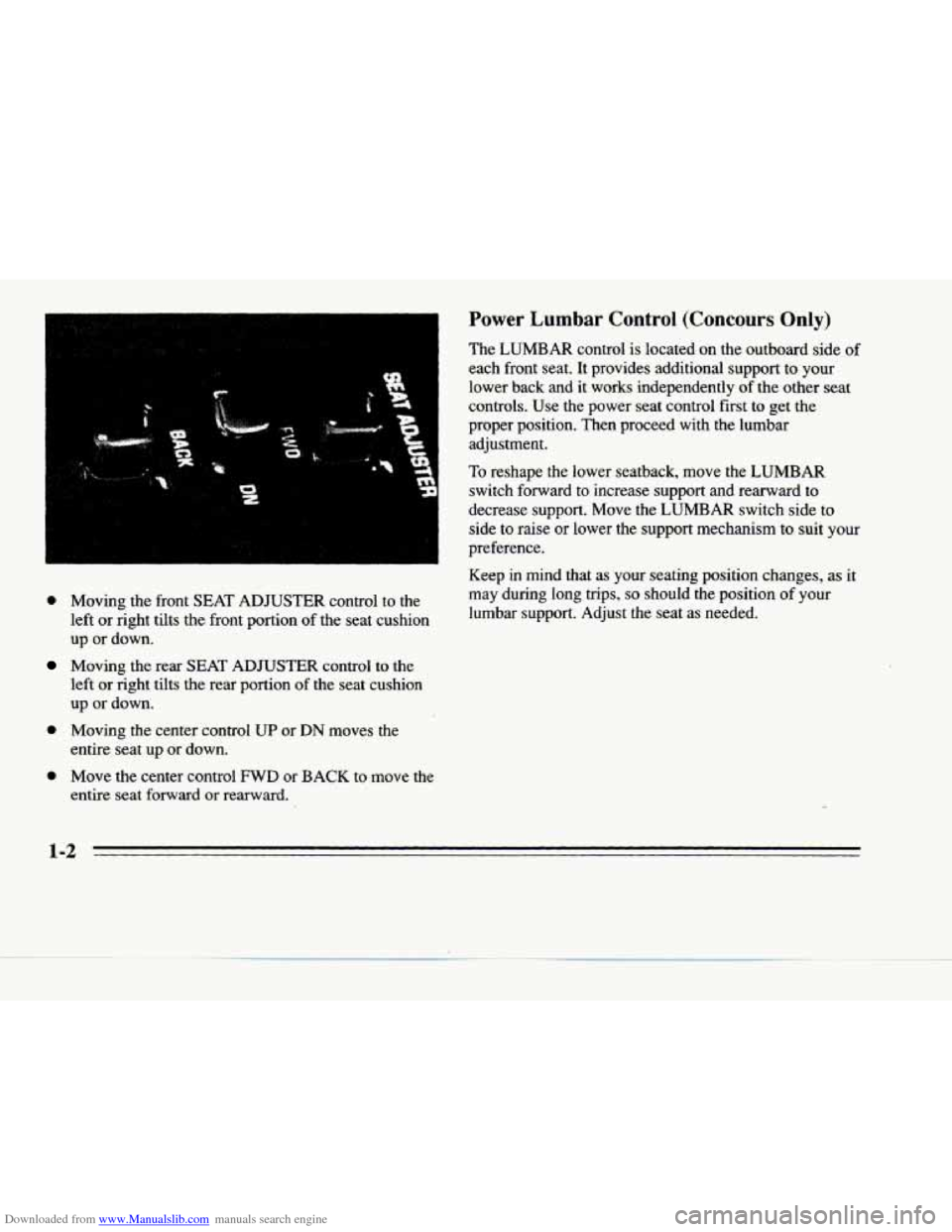
Moving the front SEAT ADJUSTER control to the
left
or right tilts the front portion of the seat cushion
up or down.
Moving
the rear SEAT ADJUSTER control to the
left or right tilts the rear portion
of the seat cushion
up or down.
Moving the center control
UP or DN moves the
entire seat up
or down.
Move the center control
FWD or BACK to move the
entire seat forward or rearward.
Power Lumbar Control (Concours Only)
The LUMBAR control is located on the outboard side of
each front seat. It provides additional support to your
lower back and it works independently of the other seat
controls. Use the power seat control first to get the
proper position. Then proceed with the lumbar
adjustment.
To reshape the lower seatback, move the LUMBAR
switch forward to increase support and rearward to
decrease support. Move the
LUMBAR switch side to
side to raise
or lower the support mechanism to suit your
preference.
Keep in mind that
as your seating position changes, as it
may during long trips,
so should the position of your
lumbar support. Adjust the seat as needed.
-.
13
Page 99 of 354

Downloaded from www.Manualslib.com manuals search engine Cruise Control
With cruise control, you can maintain a speed of about
25 mph (40 b/h) or more without keeping your foot on
the accelerator. This can help on long trips. Cruise
control does not work at speeds below about
25 mph
(40 km/h).
Cruise control shuts off when you apply your brakes.
A CAUTION:
e
e Cruise control can be dangerous where you
can’t drive safely at a steady speed.
So,
don’t use your cruise control on winding
roads
or in heavy traffic.
Cruise control can be dangerous on
slippery
roads. On such roads, fast changes
in tire traction can cause needless wheel
spinning, and
you could lose control. Don’t
use cruise control on slippery roads.
If your vehicle is in cruise control when the traction
control system begins
to limit wheel spin, the cruise
control will automatically disengage. (See “Traction Control System” in
the Index.) When road conditions
allow you to safely use it again, you may turn the cruise
control back on.
2-36
P
P
Page 142 of 354

Downloaded from www.Manualslib.com manuals search engine P-
,+
c
c
FUEL LEVEL VERY LOW - 11: This message serves
as a warning that the fuel level in the tank is critically
low. Stop for fuel immediately.
MONITORED SYSTEMS OK - I: This message only
appears in the “recall” mode by pressing the
RESET
button. It lets you know that no other messages are
stored or currently active.
PASS KEY NOT PROGRAMMED - 31: This
warning message displays when the PASS-Key pellet information has not been programmed into your vehicle.
See your Cadillac dealership for service.
PCM FAULT - 110: The circuit in the Powertrain
Control Module
(PCM) has shorted or is loose when this
message appears. Have your Cadillac serviced by your
dealership at once.
REDUCED ENGINE POWER - 41: This message
informs
the driver that due to wheel slippage your
vehicle
is reducing engine power to compensate for the
loss of traction. Accelerating too fast causing the tires to
spin
is an example of when this message would display.
REMOVE KEY - 70: This message will appear when
the Personalized Automotive Security System
(PASS-Key
11) is unable to read the pellet on the
ignition key or
an improper key pellet has been inserted.
Wait for the DIC to display STARTING DISABLED
DUE TO THEFT SYSTEM REMOVE IGNITION
KEY. The instrument panel cluster will then
run a timer
and change the messages to WAIT
3 MINUTES, WAIT
2 MINUTES,. WAIT 1 MINUTE and then START CAR.
When the REMOVE
KEY message is displayed, remove
the ignition key. Check the ignition key for damage. If it
is damaged,
it may need to be replaced. If you see no
damage, clean the pellet contacts with a soft cloth
or
napkin before inserting the key back into the ignition.
Have your vehicle serviced if the message still appears.
SERVICE A/C SYSTEM A/C COMPRESSOR
OFF
- 14: This message appears when the electronic
sensors that control the A/C and heating systems are no
longer working. Have the climate control system serviced
if you notice a drop in heating and A/C efficiency.
SERVICE AIR BAG - 83: There is a problem with the
Supplemental Inflatable Restraint (air bag) system when
this message appears. Let only a qualified technician work on your vehicle. See your Cadillac dealership for
service
at once.
2-79
Page 186 of 354

Downloaded from www.Manualslib.com manuals search engine 1
c
c
Control of a Vehicle
You have three systems that make your vehicle go where
you want it to
go. They are the brakes, the steering and
the accelerator. All three systems have to do their work at the places where the tires meet the road.
Braking
Braking action involves perception time and reaction
time.
First, you have to decide to push on the brake pedal.
That’s
perception time. Then you have to bring up your
foot and do it. That’s
reaction time.
Average reaction time is about 3/4 of a second. But
that’s only an average. It might be less with one driver
and as long as two or three seconds
or more with
another. Age, physical condition, alertness, coordination
and eyesight all play a part.
So do alcohol, drugs and
frustration. But even in
3/4 of a second, a vehicle
moving at
60 mph (100 km/h) travels 66 feet (20 m).
That could be a lot of distance in an emergency, so
keeping enough space between your vehicle and others
is important.
And,
of course, actual stopping distances vary greatly
with the surface of the road (whether it’s pavement
or
gravel); the condition of the road (wet, dry, icy); tire
tread; and the condition
of your brakes.
Sometimes, as when you’re driving on snow or ice, it’s
easy to ask more
of those control systems than the tires
md road can provide. That means you can lose control
your vehicle.
4-5
Page 188 of 354

Downloaded from www.Manualslib.com manuals search engine r
F 4
I"
i
?-
I
r
Here's how anti-lock works. Let's say the road is wet.
You're driving safely. Suddenly
an animal jumps out in
front of you.
You slam on the brakes. Here's what happens with
ABS.
A computer senses that wheels are slowing down. If one
of the wheels is about
to stop rolling, the computer will
separately work the brakes at each front wheel and at the
rear wheels. The anti-lock system can change the brake pressure faster
than any driver could. The computer is programmed to
make the
most of available tire and road conditions.
You can steer around the obstacle while braking hard.
As you brake, your computer keeps receiving updates on
wheel speed and controls braking pressure accordingly.
4-7
Page 191 of 354

Downloaded from www.Manualslib.com manuals search engine Braking in Emergencies
Use your anti-lock braking system when you need to.
With anti-lock, you can steer
and brake at the same
time.
In many emergencies, steering can help you more
than even the very best braking.
Steering
Power Steering
If you lose power steering assist because the engine
stops or
the system is not functioning, you can steer but
it will take much more effort.
MAGNASTEER TM (Concours Only)
Your vehicle may be equipped with GM MAGNASTEER,
a system that continuously adjusts the effort you feel when
steering at
all vehicle speeds. It provides ease when
parking yet a fm, solid feel at highway speeds.
Speed Sensitive Steering (SSS)
(DeVille Only)
This system varies the amount of steering effort
proportionate to your vehicle speed. Steering is easier at
a lower speed for maneuvering and parking ease. As
your vehicle speed increases, the steering effort also
increases.
At highway speeds, the amount of steering
effort is increased
to provide manual-like steering for
maximum control and stability.
Steering Tips
Driving on Curves
It’s important to take curves at a reasonable speed.
A lot of the “driver lost control” accidents mentioned on
the news happen on curves. Here’s why:
Experienced driver or beginner, each
of us is subject to
the same laws
of physics when driving on curves. The
traction
of the tires against the road surface makes it
possible for the vehicle
to change its path when you turn
the front wheels. If there’s no traction, inertia will keep
the vehicle going
in the same direction. If you’ve ever
tried to steer
a vehicle on wet ice, you’ll understand this.
4-10