Page 183 of 340
A C U-ION:
Heater and radiator hoses, and other engine
parts, can be very hot. Don’t touch them.
If you
do, you can be burned.
Don’t run the engine if there
is a leak. If you run
the engine,
it could lose all coolant. That could
cause an engine fire, and you could be burned.
Get any leak fixed before you drive the vehicle.
NOTICE:
Engine damage from running your engine
without coolant isn’t covered by your warranty.
If there seems to be no leak, with the engine on, check to
see if the electric engine fan is running. If the engine is
overheating, the fan should
be running. If it isn’t, your
vehicle needs service.
How to Add Coolant to the Coolant
Recovery Tank
If you haven’t found a problem yet, but the coolant
level isn’t at ADD, add a
50/50 mixture of clean water
(preferably distilled) and DEX-COOL (orange-colored,
silicate-free) antifreeze at
the coolant recovery tank. (See
“Engine Coolant” in the Index for more information.)
Adding only plain water to your cooling system
can be dangerous. Plain
water, or some other
liquid like alcohol, can boil before the proper
coolant mix will. Your vehicle’s coolant warning
system
is set for the proper coolant mix. With
plain
water or the wrong mix, your engine could
get too hot but you wouldn’t get the overheat
warning. Your engine could catch fire and you or
others could be burned. Use
a 50/50 mix of clean
water and DEX-COOL
TM antifreeze.
5-17
ProCarManuals.com
Page 189 of 340
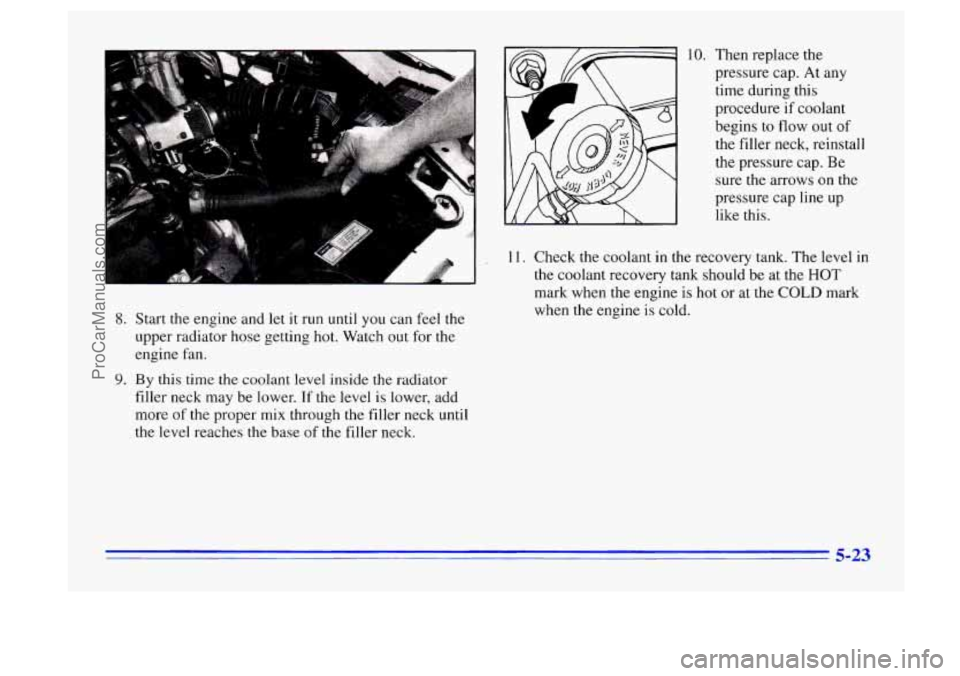
8. Start the engine and let it run until you can feel the
upper radiator hose getting hot. Watch out for the
engine fan.
9. By this time the coolant level inside the radiator
filler neck may be lower.
If the level is lower, add
more
of the proper mix through the filler neck until
the level reaches the base of the filler neck. 10.
Then replace the
pressure cap. At any
time during this
procedure
if coolant
begins to
flow out of
the filler neck, reinstall
the pressure cap. Be
sure the arrows on
the
pressure cap line up
like this.
11. Check the coolant
in the recovery tank. The level in
the coolant recovery tank should be at the HOT
mark when the engine is hot or at the COLD mark
when
the engine is cold.
5-23
ProCarManuals.com
Page 209 of 340

If your vehicle is certified to meet California Emission
Standards (indicated on the underhood tune-up label), it
is designed
to operate on fuels that meet California
specifications. If such fuels are not available
in states
adopting California emissions standards, your vehicle
will operate satisfactorily on fuels meeting federal
specifications, but emission control system performance
may be affected.
The malfunction indicator lamp on
your instrument panel may turn on and/or your vehicle
may fail
a smog-check test. If this occurs, return to your
authorized Buick dealer for diagnosis to determine the
cause of failure. In the event it is determined that the
cause of the condition is the type
of fuels used, repairs
may not be covered by your warranty.
In Canada, some gasolines contain an octane enhancing
additive called MMT.
If such fuels are used, your
emission control system performance may be affected.
The malfunction indicator lamp on your instrument
panel may also turn on. If this occurs, return to your
authorized Buick dealer for service.
To provide cleaner air, all gasolines are now required to
contain additives that will help prevent deposits from
forming
in your engine and fuel system, allowing your
emission control system to function properly. Therefore,
you should not have to add anything to the fuel. In
addition, gasolines containing oxygenates, such
as ethers
and ethanol, and reformulated gasolines may be
available
in your area to help clean the air. General
Motors recommends that you use these gasolines
if they
comply with the specifications described earlier.
I NOTICE:
Your vehicle was not designed for fuel that
contains methanol. Don’t use it. It can corrode
metal parts in your fuel system and also damage
plastic and rubber parts. That damage wouldn’t
be covered under your warranty.
6-3
ProCarManuals.com
Page 216 of 340

Things that burn can get on hot engine parts and
start a fire. These include liquids like gasoline,
oil, coolant, brake fluid, windshield washer and
other fluids, and plastic or rubber. You or others
could be burned. Be careful not
to drop or spill
Underhood Lamp
Your underhood lamp is designed to come on whenever
you raise the hood.
Engine Oil
It's a good idea to check your engine oil every time you
get fuel. In order
to get an accurate reading, the oil must
be warm and the vehicle must be on level ground.
things that will burn onto a hot engine. Turn off the engine and give the oil a few minutes to
drain back into the oil pan. If you don't, the oil dipstick
Before closing the hood, be sure all the filler caps
are on properly.
Then lift the hood
to relieve pressure on the hood prop.
Remove the hood prop from the slot in the hood and
return the prop
to its retainer. Then just let the hood
down and close
it firmly. might
not show the actual level.
Checking Engine Oil
Pull out the dipstick and clean it with a paper towel or
cloth, then push it back in all the way. Remove it again,
keeping the tip down, and check the level.
6-10
ProCarManuals.com
Page 221 of 340
A CAUTION:
I
Operating the engine with the air cleaner off can
cause you or others to be burned. The
air cleaner
not only cleans the
air, it stops flame if the engine
backfires.
If it isn’t there, and the engine
backfires,
you could be burned. Don’t drive with
it off, and be careful working on the engine with
the air cleaner
off.
I
NOTICE:
If the air cleaner is off, a backfire can cause a
damaging engine fire. And, dirt can easily get
into your engine, which will damage it. Always
have the air cleaner in place when you’re driving.
To check or replace the air filter
1. Use a screwdriver to loosen the hose clamp, then lift
the rubber duct.
6-15
ProCarManuals.com
Page 223 of 340

Automatic Transaxle Fluid
A good time to check your automatic transaxle fluid
level
is when the engine oil is changed.
Change both the fluid and filter every
50,000 miles
(83 000 km) if the vehicle is mainly driven under one or
more of these conditions:
In heavy city traffic where the outside temperature
regularly reaches
90” F (32°C) or higher.
In hilly or mountainous terrain.
When doing frequent trailer towing.
Uses such as found in taxi, police or delivery service.
If you do
not use your vehicle under any of these
conditions, the fluid and filter do not require changing.
See “Scheduled Maintenance Services” in the Index.
How to Check
Because this operation can be a little difficult, you may
choose to have this done at your Buick dealership’s
Service Department.
If you do
it yourself, be sure to follow all the instructions
here, or you could get a false reading
on the dipstick.
~~
NOTICE:
Too much or too little fluid can damage your
transaxle.
Too much can mean that some of the
fluid could come out and fall on hot engine parts
or exhaust system parts, starting
a fire. Be sure to
get an accurate reading if you check your
transaxle fluid.
6-17
ProCarManuals.com
Page 224 of 340
Wait at least 30 minutes before checking the transaxle
fluid level if
you have been driving:
When outside temperatures are above 90 OF (32 O C).
0 At high speed for quite a while.
In heavy traffic -- especially in hot weather.
0 While pulling a trailer.
To get the right reading, the fluid should be at normal
operating temperature, which is
180°F to 200°F (82°C
Get the vehicle warmed up by driving about
15 miles
(24 km) when outside temperatures are above 50°F
(10°C). If it's colder than 50°F (lO"C), you may
have
to drive longer.
to 93°C).
Checking the Fluid Level
Park your vehicle on a level place. Keep the
engine running.
0 With the parking brake applied, place the shift lever
in PARK
(P).
With your foot on the brake pedal, move the shift
lever through each gear range, pausing for about
three seconds
in each range. Then, position the shift
lever in PARK (P).
0 Let the engine run at idle for three to five minutes.
Then, without shutting off the engine, follow these steps:
ProCarManuals.com
Page 229 of 340
What to Use
Use a mixture of one-half clean water (preferably
distilled) and one-half
DEX-COOL TM (orange-colored,
silicate-free) antifreeze that meets
GM Specification
6277M, which won’t damage aluminum parts. Use
GM Engine Coolant Supplement (sealer) (GM Part
No. 3634621) with any complete coolant change. If you
use this mixture, you don’t need to add anything else.
lain water to your cooling system
can be dangerous. Plain water, or some other
liquid like alcohol, can boil before the proper
coolant mix will. Your vehicle’s coolant warning
system is set for the proper coolant mix. With
plain water or the wrong mix, your engine could
get too hot but you wouldn’t get the overheat
warning.
Your engine could catch fire and you or
others could be burned. Use
a 50/50 mix of clean
water and
DEX-COOL TM (orange-colored,
silicate-free) antifreeze.
I NOTICE:
If you use an improper coolant mix, your
engine could overheat and be badly damaged.
The repair cost wouldn’t be covered by your
warranty. Too much water in the mix can freeze
and crack the engine, radiator, heater core and
other parts.
If you have to add coolant more than four times a year,
have your dealer check your cooling system.
NOTICE:
If you use the proper coolant, you don’t have to
add extra inhibitors or additives which claim to
improve the system. These can be harmful.
6-23
ProCarManuals.com