1996 BUICK CENTURY light
[x] Cancel search: lightPage 86 of 340

As you signal a turn or a lane change, if the arrows don’t
flash but just stay on,
a signal bulb may be burned out
and other drivers won’t
see your turn signal.
If a bulb is burned out, replace it to help avoid an
accident. If the arrows don’t go on at all when you
signal a turn, check for burned-out bulbs and check the
fuse
(see “Fuses and Circuit Breakers’’ in the Index).
Turn Signal Reminder
If your turn signal is left on for more than 3/4 of a mile
(1.2 km), a chime will sound. To turn off the chime,
move the turn signal lever
to the OFF position.
Headlamp High/Low Beam Changer Windshield Wipers
a _:::a::_
To change
the headlamps
from low beam
to high or
high
to low, pull the turn
signal lever all the way
toward you. Then release
it. When the high beams
are on, this light
on the
instrument panel also
will be on. You
control the windshield wipers by turning the band
marked WIPER.
For a single wiping cycle, turn the band to MIST.
GoTd
it there until the wipers start, then let go. The wipers will
stop after
one cycle. If you want more cycles, hold the
band on MIST longer.
You can set the wiper speed for a long or short delay
between wipes. This can be very useful in light rain or
snow. Turn the band to choose the delay time. The
closer to
LO, the shorter the delay.
2-2s
ProCarManuals.com
Page 91 of 340

Passing Another Vehicle While Using Cruise Control
Use the accelerator pedal to increase your speed. When
you take your foot off the pedal, your vehicle will slow
down
to the cruise control speed you set earlier.
Using Cruise Control on Hills
How well your cruise control will work on hills depends
upon your speed, load and the steepness
of the hills.
When going up steep hills, you may have to step
on the
accelerator pedal to maintain your speed. When going
downhill, you may have to brake or shift
to a lower gear
to keep your speed down. Of course, applying the brake
takes you out
of cruise control. Many drivers find this to
be
too much trouble and don’t use cruise control on
steep hills.
Ending Cruise Control
There are two ways to turn off the cruise control:
Step lightly on the brake pedal; or
Move the cruise switch to OFF.
Erasing Cruise Speed Memory
When you turn off the cruise control or the ignition,
your cruise control set speed memory is erased.
Lamps
..
li
LtOWtS
0 Headlamps
0 Parking Lamps
0 Sidemarker Lamps
Taillamps
0 License Plate Lamps
0 Instrument Panel Lights
To turn on the headlamps, press the switch with the
lamp symbol.
Press
the switch marked P to turn on the parking lamps.
Press
OFF to turn off all lamps.
2-33
ProCarManuals.com
Page 92 of 340

Headlamps on Warning
If you open the door while leaving the lamps on, you
will hear a warning chime.
Daytime Running Lamps (Option)
Daytime Running Lamps (DRL) can make it easier for
others to see the front of your vehicle during the day.
DRL can be helpful in many different driving
conditions, but they can be especially helpful in the
short periods after dawn and before sunset.
A light sensor in the instrument panel cluster makes the
DRL work, so be sure it isn’t covered.
The DRL system will make your low-beam headlamps
come on at reduced brightness when:
the ignition is on,
the headlamp switch is off, and
the parking brake is released.
When the
DRL are on, only your low-beam headlamps
will be
on. The taillamps, sidemarker and other lamps
won’t be on. Your instrument panel won’t be lit up either.
When it’s dark enough outside, your headlamps will
come on to full brightness. The other lamps that come
on with your headlamps will also come on. When
it’s bright enough outside, the regular lamps will
go off, and your low-beam headlamps will come
on at a
reduced brightness.
To idle your vehicle with the DRL off, set the parking
brake while the ignition is in the
OFF or LOCK
position. Then start the vehicle. The DRL will stay off
until you release the parking brake.
As with any vehicle, you should turn on the regular
headlamp system when
you need it.
Interior Lamps
Instrument Panel Brightness Control
., . I. .
1.r
LOW
You can brighten or dim the
instrument panel lights by
rotating the control up or
down.
To turn on the
interior courtesy lamps,
rotate the control all the way
up to HI.
2-34
ProCarManuals.com
Page 95 of 340

Mirrors
Inside Daymight Rearview M ror
When you are sitting in a comfortable driving position,
adjust the mirror
so you can see clearly behind your
vehicle. The dayhight adjustment allows you to reduce
glare from lights behind you.
To reduce glare pull the
lever toward
you to the night position.
Manual Remote Control Mirror
Both the driver and passenger side outside mirrors
should
be adjusted so that you just see the side of your
vehicle and the area behind your vehicle when you are
sitting
in a comfortable driving position.
Use the remote control knob on the driver's door to
adjust the driver's outside mirror. Adjust the passenger's
outside mirror by hand.
2-37
ProCarManuals.com
Page 99 of 340
a
. . , .- ....... ..,.,
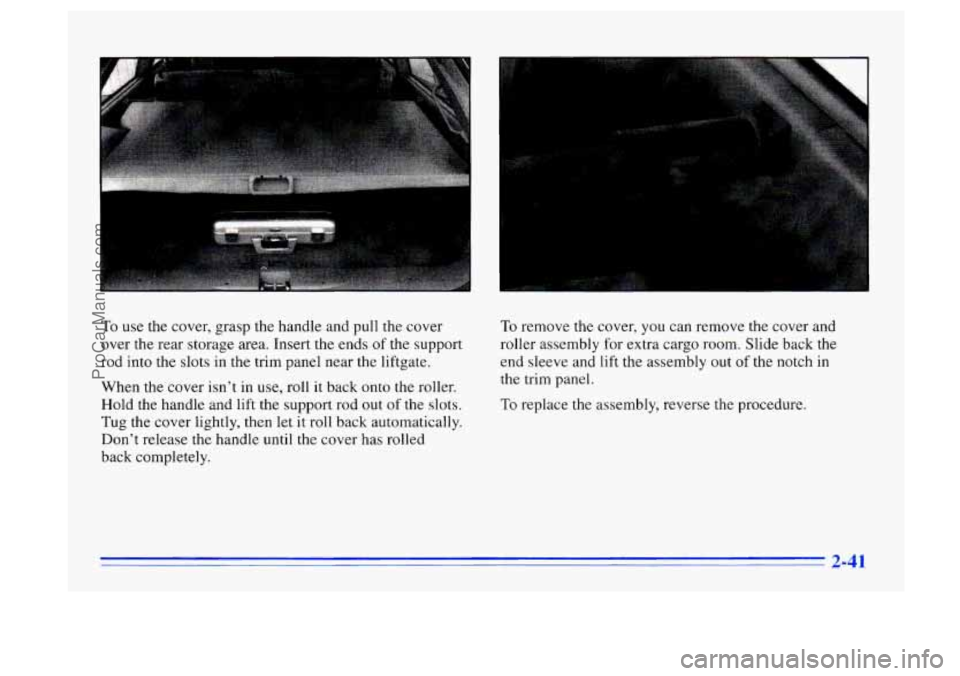
To use the cover, grasp the handle and pull the cover
over the rear storage area. Insert the ends of the support
rod into the slots in the trim panel near the liftgate.
When the cover isn’t in use, roll
it back onto the roller.
Hold the handle and lift the support rod out of the slots.
Tug the cover lightly, then let it roll back automatically.
Don’t release the handle
until the cover has rolled
back completely.
To remove the cover, you can remove the cover and
roller assembly for extra cargo room. Slide back the
end sleeve and lift the assembly out of the notch in
the trim panel.
To replace the assembly, reverse the procedure.
ProCarManuals.com
Page 100 of 340

Luggage Carrier (Option)
If you have the optional luggage carrier, you can load
things on top
of a wagon, or on the deck lid of your
vehicle. The luggage carrier has slats attached to the
roof, side rails and adjustable crossrails. The crossrails
can be adjusted by loosening the screws. After moving
the crossrails, be sure to tighten the screws securely.
Don’t exceed the maximum vehicle capacity when
loading your Buick. For more information on vehicle
capacity and loading,
see “Loading Your Vehicle”
in the Index.
To prevent damage or loss
of cargo as you’re driving,
check now and then to make sure the luggage carrier and
cargo are still securely fastened.
NOTICE:
Loading cargo that weighs more than 50 lbs.
(23 kg) for the deck lid or 200 lbs. (90kg) for the
roof on the luggage carrier may damage your
vehicle. When you carry large things, never let
them hang over the rear or the sides of your
vehicle. Load your cargo
so that it rests on the
slats and does not scratch or damage the vehicle.
Put the cargo against the rear rail of the deck lid
carrier and fasten it securely. On the wagon, put
the cargo against the side rails of the roof carrier
and fasten it securely.
Ashtrays and Lighter
Reach under the front edge of the ashtray compartment
to open it.
To remove the ashtray for cleaning, reach
under the ashtray and push up from behind
it.
To clean the rear ashtrays, fully open the ashtray.
Press down on the snuffer
as you pull the ashtray
down and out.
2-42
ProCarManuals.com
Page 101 of 340
1 NOTICE:
Don’t put papers and other things that burn into
ashtrays. If you do, cigarettes
or other smoking
materials could set them on fire, causing damage.
To use the lighter, push it in all the way and let go.
When it’s ready, it will pop back by itself.
NOTICE:
Don’t hold a cigarette lighter in with your hand
while it is heating.
If you do, it won’t be able to
back
away from the heating element when it’s
ready. That can make it overheat, damaging the
lighter and the heating element.
Sun Visors
To block out glare, you can swmg down the visors. You
can also move them from side
to side.
Lighted Visor Vanity Mirror (Option)
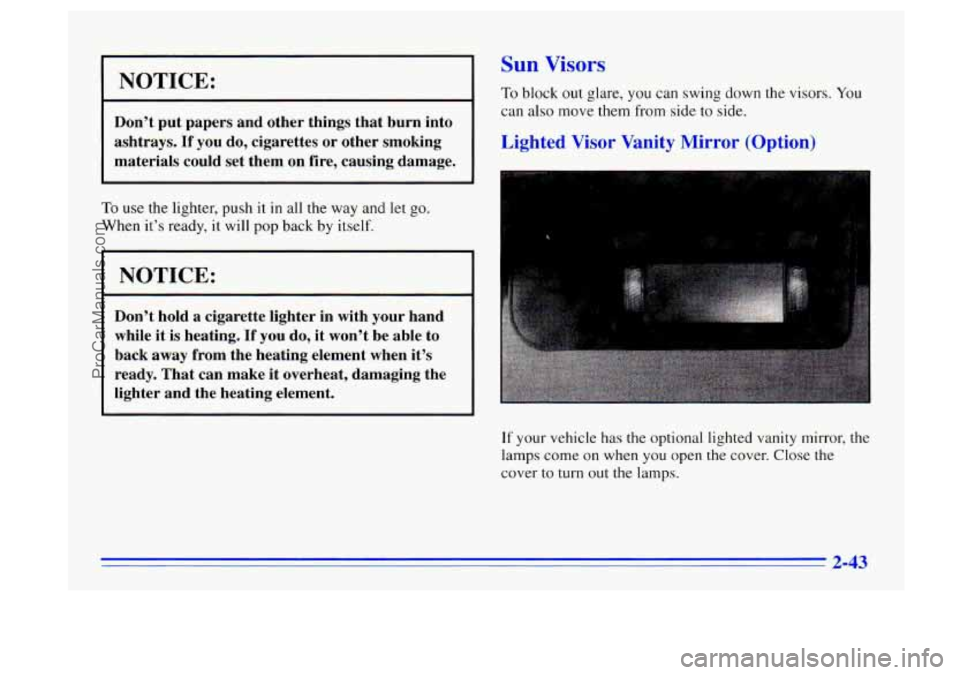
If your vehicle has the optional lighted vanity mirror, the
lamps come
on when you open the cover. Close the
cover to turn out the lamps.
2-43
ProCarManuals.com
Page 106 of 340

Speedometer and Odometer
Your speedometer lets you see your speed in both miles
per hour (mph) and kilometers per hour (kmh). Your
odometer shows how far your vehicle has been driven,
in either miles (used in the United States) or kilometers
(used in Canada).
Your Buick has a “tamper-resistant odometer.” If
you
can see very noticeable bright silver lines between the
numbers, someone has probably tried to turn it back.
The numbers may not be true.
You may wonder what happens if a vehicle has to have
a new odometer installed. If possible, the new one has
to be set
to the same reading as the old one. If it can’t
be, then it’s set at zero, and a label on the driver’s door
must show the old reading and when the new one
was installed.
Trip Odometer
The trip odometer can tell you how many miles you
have driven since
you last set it to zero. To reset it, push
the button
on the instrument cluster.
Warning Lights, Gages and Indicators
This part describes the warning lights and gages that may
be
on your vehicle. The pictures will help you locate them.
Warning lights and gages can signal that something is
wrong before it becomes serious enough to cause an
expensive repair or replacement. Paying attention
to
your warning lights and gages could also save you or
others from injury.
Warning lights come on when there may be or is a
problem with one of your vehicle’s hnctions.
As you will
see in the details
on the next few pages, some warning
lights come on briefly when you
start the engine just to let
you know they’re working. If you are familiar with this
section, you should not be alarmed when this happens.
Gages can indicate when there may be or is a problem
with one
of your vehicle’s functions. Often gages and
warning lights work together to
let you know when
there’s a problem with your vehicle.
When one of the warning lights comes on and stays on
when
you are driving, or when one of the gages shows
there may be a problem, check the section that tells you
what to do about it. Please follow this manual’s advice.
Waiting to do repairs can be costly
-- and even
dangerous.
So please get to know your warning lights
and gages. They’re a big help.
2-48
ProCarManuals.com