Page 183 of 340
A C U-ION:
Heater and radiator hoses, and other engine
parts, can be very hot. Don’t touch them.
If you
do, you can be burned.
Don’t run the engine if there
is a leak. If you run
the engine,
it could lose all coolant. That could
cause an engine fire, and you could be burned.
Get any leak fixed before you drive the vehicle.
NOTICE:
Engine damage from running your engine
without coolant isn’t covered by your warranty.
If there seems to be no leak, with the engine on, check to
see if the electric engine fan is running. If the engine is
overheating, the fan should
be running. If it isn’t, your
vehicle needs service.
How to Add Coolant to the Coolant
Recovery Tank
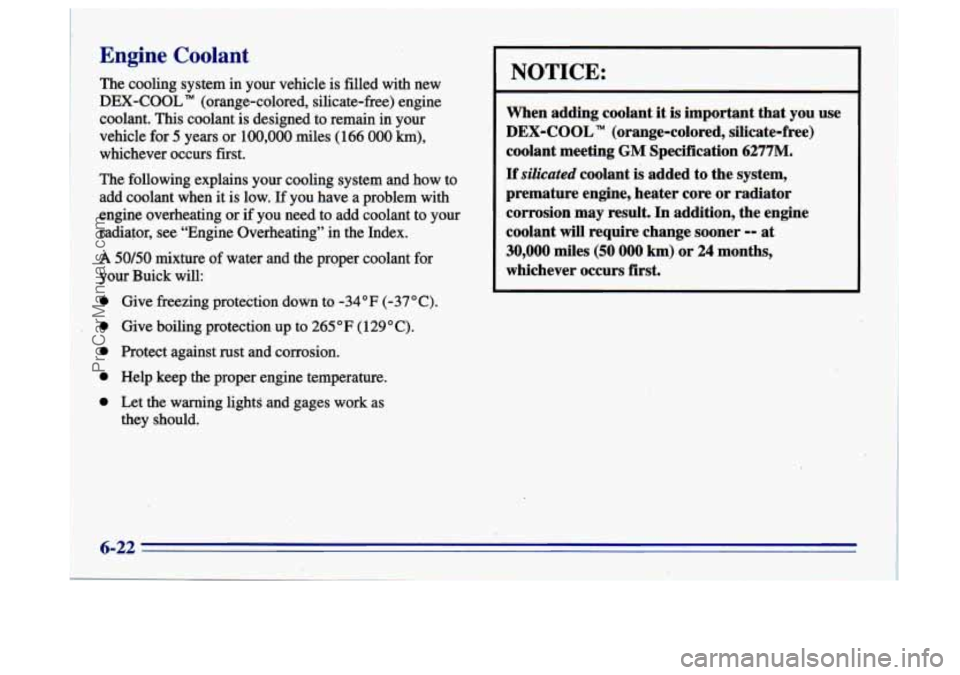
If you haven’t found a problem yet, but the coolant
level isn’t at ADD, add a
50/50 mixture of clean water
(preferably distilled) and DEX-COOL (orange-colored,
silicate-free) antifreeze at
the coolant recovery tank. (See
“Engine Coolant” in the Index for more information.)
Adding only plain water to your cooling system
can be dangerous. Plain
water, or some other
liquid like alcohol, can boil before the proper
coolant mix will. Your vehicle’s coolant warning
system
is set for the proper coolant mix. With
plain
water or the wrong mix, your engine could
get too hot but you wouldn’t get the overheat
warning. Your engine could catch fire and you or
others could be burned. Use
a 50/50 mix of clean
water and DEX-COOL
TM antifreeze.
5-17
ProCarManuals.com
Page 184 of 340
I I
NOTICE:
In cold weather, water can freeze and crack the
engine, radiator, heater core and other
parts.
Use the recommended coolant and the proper
coolant
mix.
. .. .
i.
You can be burned if you spill coolant on hot
engine parts. Coolant contains ethylene glycol
and
it will burn if the engine parts are hot
enough. Don’t spill coolant on a hot engine.
1
When the coolant in the coolant recovery tank is at the
FULL HOT mark, start your vehicle.
If the overheat warning continues, there’s one more
thing
you can try. You can add the proper coolant mix
directly to the raqiator, but be sure the cooling system is:
cool before you do it.
I
5-18
ProCarManuals.com
Page 228 of 340
Engine Coolant
@ Protect ag- rust and corrosion.
@ Help.keep the proper engine temperature.
Let the whg lightd md gages work as
they shouicl.
NOTICE:
When adding coolant it is important that you use
DEX-COOL TM (orange-colored, silicate-free)
coolant meeting
GM Specification 6277M.
If silicated coolant is added to the system,
premature engine, heater core or radiator
corrosion may result. In addition, the engiue
coolant will
require change sooner -- at
30,000 miles (50 000 km) or 24 months,
whichever occurs first.
ProCarManuals.com
Page 229 of 340
What to Use
Use a mixture of one-half clean water (preferably
distilled) and one-half
DEX-COOL TM (orange-colored,
silicate-free) antifreeze that meets
GM Specification
6277M, which won’t damage aluminum parts. Use
GM Engine Coolant Supplement (sealer) (GM Part
No. 3634621) with any complete coolant change. If you
use this mixture, you don’t need to add anything else.
lain water to your cooling system
can be dangerous. Plain water, or some other
liquid like alcohol, can boil before the proper
coolant mix will. Your vehicle’s coolant warning
system is set for the proper coolant mix. With
plain water or the wrong mix, your engine could
get too hot but you wouldn’t get the overheat
warning.
Your engine could catch fire and you or
others could be burned. Use
a 50/50 mix of clean
water and
DEX-COOL TM (orange-colored,
silicate-free) antifreeze.
I NOTICE:
If you use an improper coolant mix, your
engine could overheat and be badly damaged.
The repair cost wouldn’t be covered by your
warranty. Too much water in the mix can freeze
and crack the engine, radiator, heater core and
other parts.
If you have to add coolant more than four times a year,
have your dealer check your cooling system.
NOTICE:
If you use the proper coolant, you don’t have to
add extra inhibitors or additives which claim to
improve the system. These can be harmful.
6-23
ProCarManuals.com
Page 264 of 340
Fuse I qe Chart Fuse Circuitry
I----
ECM INJ/COIL UNLOCK FANiALT
GAUGES
STOP HAZ CTSY WDo
FRONT VIEW OF FUSE BLOCK
Fuse
ECM INJ/COIL
Circuitry
Powertrain Control Module Fuel Injectors UNLOCK Auto
Door Locks (Remove
this
fuse to disable the automatic
door unlock.)
FAN/ALT Electric Fan, Starter
and Generator, Seq. Fuel
Inj
(V6), Cruise Control,
Anti-Lock Brakes
TURN B/U Back-up Lamps
AIR BAG Supplemental Inflatable
Restraint (Air Bag System)
TAIL
HTR A/C
GAGES Taillamps,
Parking, Sidemarker,
License Plate, Stopflurn Signal
Heater/Air Conditioner
Blower Controls
IA? Cluster, Warning Indicators,
Torque Converter Clutch,
Audible Warning System, Trunk
Release, Brake Warning
Indicator, Rear Defog Switch,
Remote Keyless
Entry,
Headlamps, Air Bag System
6-58
ProCarManuals.com
Page 265 of 340
Fuse Circuitry
STOP HA2 Stoplamps, Hazard Flashers
CTSY Interior, Underhood, Courtesy,
UP, Trunk Lamps, Door Locks,
Horn Relay, Passive Restraint
System, Deck Lid Release,
Power Antenna Remote Keyless
Entry, Vanity Mirror
WDO* Power Windows
INST LPS Illumination for:
I/P, Radio, Pod
Lamps, Ashtray, Console Lamp,
Heater and A/C Control, Defog
Switch, Headlamp Switch,
Power Antenna
Fuse Circuitry
RADIO Radio
PWR ACC* Seats, Door Locks, Rear Defog,
Power Seat Recliner, Rear
Window Wiper, Trunk Release
WPR
CIG LTR Windshield
Wiperwasher
Cigarette Lighter
*Circuit Breaker
6-59
ProCarManuals.com
Page 266 of 340

Replacement Bulbs
'OUTSIDE LAMPS BULB INSIDE LAMPS BULB
'.Back-up
Lamps . , . . . . . . . . . . . . . . . .. . . . . . . . 1156
Front ParkingEurn Signal Lamps
. . . . . . . . 2357NA Courtesy' Lamps
194 Dome Lamp
. . . . . . . . . . . . . . . . . . . . . . . . . . . 561
,License Plate Lamp . . . . . . . . , . . . . . . . . . . . . . .
Halogen Headlamps Glove
Box Lamp . . . . .<. . . . . . . . . . . . . . . . . . . 194
' Sidemarker Lamps (Front) . . . . , , . . . . . . . 194NA Heater and A/C Control . . . . .. . . . . . . . . . . . . . . T-1 .o
Ashtray ................................. 194
.. I I.
Lamps (Rear) . . . . . . . . . . , . . . . . . . . . . . . . . . 194
Stop/TaiVTurn Signai Lamps
. . . . . . . . . . . . . . . 2397
Underhood Lamp
. . . . . . . . . . . . . . . . . . . . . . . . . 089
Taillamps (between stop and back-up lamps) . . . 194
High-Beam Indicator . . . . . . . . . . . , . . . . . . . . . . 194
High-Level Stoplamp
. . . . . . . . . . . . . . . . , . . . 1156
Indicator Lights Rear Window Defogger Switch
. . . . . . . . . . . 2102
Lighted Rearview Mirrors
, . . . . . . . . . . . . . 212-2
Cluster (Illumination)
. . . . . . . . . . . . . . . . . . . . 161
Turn Signal Indicators . . . . . . . ; . . . . . . . . . . . . 194
6-60
ProCarManuals.com
Page 310 of 340
Part C: Periodic Maintenance
Inspections
Listed below are inspections and services which should
be performed
at least twice a year (for instance, each
spring and fall). You should
let your GM dealer’s
service department or other qualified service center do
these jobs. Make sure an.y necessary repairs are
completed at once.
Proper procedures to perform these services may be
found in a Buick Service Manual. See “Service and
Owner Publications” in the Index.
Steering, Suspension and Front- Wheel-Drive
Axle Boot and Seal Inspection
Inspect the front and rear suspension and steering
system for damaged, loose or missing parts, signs of
wear or lack of lubrication. Inspect the power steering
lines and hoses for proper hook-up, binding, leaks,
cracks, chafing, etc. Clean and then inspect the drive
axle boot seals for damage, tears or leakage. Replace
seals if necessary.
Exhaust System Inspection
Inspect the complete exhaust system. Inspect the body near
the exhaust system.
Look for broken, damaged, missing or out-of-position parts as well
as open seams, holes, loose
connections or other conditions which could cause a
heat
build-up in the floor pan or could let exhaust fumes into
the vehicle. See “Engine Exhaust” in the Index.
Radiator and Heater Hose Inspection
Inspect the hoses and have them replaced if they are
cracked, swollen or deteriorated. Inspect all pipes,
fittings and clamps; replace as needed.
Throttle Linkage Inspection
Inspect the throttle linkage for interference or binding,
and for damage or missing parts. Replace parts
as
needed. Replace any cables that have high effort or
excessive wear.
Do not lubricate accelerator and cruise
control cables.
Brake System Inspection
Inspect the complete system. Inspect brake lines and
hoses for proper hook-up, binding, leaks, cracks,
chafing, etc. Inspect disc brake pads for wear and rotors
for surface condition. Also inspect drum brake linings
for wear and cracks. Inspect other brake parts, including
drums, wheel cylinders, calipers, parking brake, etc.
Check parking brake adjustment. You may need to have
your brakes inspected more often if your driving habits
or conditions result in frequent braking.
7-40
ProCarManuals.com