1996 BMW 318i Hand
[x] Cancel search: HandPage 39 of 759

Tires,
checking
inflation
pressure
Brake
pad/rotor
wear,
checking
Correct
tire
pressuresare
important
to
handling
and
stability,
Al¡
E36
cars
are
fitted
withdisc
brakes
at
al¡
four
wheels
.
See
fuel
economy,
and
tire
wear
.
Tire
pressures
change
with
temper-
Fig
.
24
.
Although
thebrakesare
equipped
with
a
brake
pad
ature
.
Pressures
should
be
checked
often
during
seasonal
tem-
warning
system,
the
system
only
monitors
one
wheel
per
axle
.
perature
changes
.
Correct
inflation
pressures
canbe
found
on
It
is
recommended
that
pad
thickness
should
be
checked
the
driver's
door
pillar
and
in
the
owner's
manual
.
Note
that
tire
whenever
the
wheels
are
off
or
brakework
is
beggg
done
.
pressuresshould
be
higher
when
thecar
is
more
heavily
loaded
.
WARNING
-
Do
not
inflate
any
tire
to
a
higher
pressure
than
the
tiress
maximum
ínflation
pressure
listed
on
the
side-
wall
.
Use
cara
when
addlng
air
to
warm
tires
.
Warm
tire
pressures
can
increase
as
much
as4
psi
(0.3
bar)
over
their
cold
pressures
.
Tires,
rotating
BMW
does
not
recommend
tire
rotation
.
Due
to
the
cars
sus-
pension
design,
the
fronttires
begin
to
wear
first
at
the
outer
shoulder
and
the
rear
tires
begin
to
wear
first
at
themiddle
of
the
tread
or
inner
shoulder
.
Rotating
the
tires
may
adversely
af-
fect
roadhandling
and
tire
grip
.
NOTE-
The
main
purpose
of
tire
rotation
isto
promote
even
wear
and
maximum
tire
life
.
Tire
life
may
be
decreased
slightly
if
the
tires
are
not
rotated
.
Wheels,
aligning
Routine
maintenance
of
the
brake
system
includes
maintain-
ing
the
brake
fluid
in
the
reservoir,
checking
brakepads
for
wear,
checking
hand
brake
functíon,
and
inspecting
the
system
for
fluid
leaks
or
other
damage
.
Check
that
brake
hoses
are
correctly
routed
to
avoidchafing
or
kinkíng
.
Inspect
unions
and
brake
calipers
for
signs
of
fluid
leaks
.
Inspect
rigid
fines
for
corrosion,
dents,
or
other
damage
.
Inspect
flexible
hoses
for
cracking
.
Replace
faulty
hoses
or
lines
as
described
in
340Brakes
.
WARNING
-
Incorrect
installation
or
overtightening
hoses,
fines,
and
unions
may
cause
chafing
or
leakage
.
This
can
lead
to
partíal
or
completebrake
system
failure
.
MAINTENANCE
PROGRAM
020-
1
7
B323
Fig
.
24
.
Disc
brake
pad
wear
can
checked
through
opening
in
caliper
.
The
brake
caliper
should
be
unbolted
from
the
suspension
strut
to
properly
inspect
the
brake
pads
and
the
rotors
.
See
Fig
.
25
.
Brake
caliper
removal
and
installation
procedures
are
given
in
340
Brakes
.
BMW
recommends
checking
the
front
and
rear
alignment
once
a
year
and
whenever
new
tires
are
installed
.
See320
Steering
and
Wheel
Alignment
for
a
more
detailed
discus-
sion
of
alignment
requirements
and
specifications
.
Brake
Pad
Lining
Minimum
Thickness
(Dimension
A)
Brake
system,
inspecting
"
Front
and
reardisc
brake
pads
....
3
.0
mm
(0
.12
in)
Brake
fluid,
replacing
BMW
strictly
recommends
replacing
the
brake
fluid
every
two
years
.
This
will
help
protect
against
corrosion
and
the
ef-
fects
of
moisture
in
the
(luid
.
See340
Brakes
for
brake
fluid
flushing
procedures
.
Parking
brake,
checking
The
parking
brakesystem
is
independent
of
the
main
braking
system
and
may
requireperiodic
adjustment
dependingon
use
.
Adjust
the
parking
brake
if
the
brake
lever
can
be
pulled
up
more
than
8
clicks
.
Check
that
the
cable
moves
freely
.
A
de-
scription
of
the
parking
brake
and
parking
brake
adjustment
can
be
found
in
340Brakes
.
UNDER-CARMAINTENANCE
Page 42 of 759

020-20
MAINTENANCE
PROGRAM
Seat
Belts
Washing
Chassis
Dirt
and
other
abrasive
particles
will
damage
seat
belt
web-
Periodic
washing
of
the
underside
of
the
car,
especially
in
bing
.
If¡t
is
necessary
to
clean
seat
belts,
use
a
mild
soap
solu-
winter,
will
help
prevent
accumulation
of
road
salt
and
rust
.
The
tion
.
Bleach
and
other
strong
cleaning
agents
may
weaken
the
besttime
to
wash
the
underside
is
just
after
the
car
has
been
belt
webbing
and
should
be
avoided
.
driven
in
wet
conditions
.
Spray
the
chassis
with
a
powerful
jet
of
water
.
Commercial
or
self-service
car
washes
may
not
be
best
WARNING-
for
this,
as
they
may
recycle
the
salt-contaminated
water
.
Do
not
clean
the
seat
belt
webbing
using
dry
clean-
ing
or
other
chemicals
.
Allow
wet
belts
to
dry
before
allowing
them
to
retract
.
Speeial
Cleaning
The
condition
of
the
belt
webbing
and
the
function
of
the
re-
tractor
mechanisms
should
be
inspected
.
See720
Seat
Belts
for
seat
belt
inspection
information
.
Exterior
Washing
The
longer
dirt
isleft
on
the
paint,
the
greater
the
risk
of
dam-
aging
the
glossy
finish,
either
by
scratching
or
by
the
chemical
effect
dirt
particles
may
have
on
the
paintedsurface
.
Do
not
wash
the
car
in
direct
sunlight
.
If
the
engine
hood
is
warm,
allow
it
to
cool
.
Beads
of
water
not
only
leavespots
when
dried
rapidly
by
the
sun
or
heat
from
the
engine,
but
also
can
act
as
small
magnifyingglasses
and
burn
spots
into
the
finish
.
Wash
thecar
with
a
mixture
of
lukewarmwater
and
a
car
wash
product
.
Rinse
using
plenty
of
clear
water
.
Wipe
the
body
dry
witha
soft
cloth
towel
or
chamois
to
prevent
water-spotting
.
Waxing
For
a
long-lasting,protective,
and
glossy
finish,
apply
a
hard
wax
after
thecar
has
been
washed
and
dried
.
Use
carnauba
or
synthetic
based
products
.
Waxing
is
not
needed
after
every
washing
.
You
can
tell
when
waxing
is
required
by
looking
at
the
finísh
when
it
is
wet
.
If
the
water
coats
the
paint
in
smooth
sheets
instead
of
forming
beads
that
rol¡
off,
a
new
coat
of
wax
is
needed
.
Wax
shouldnot
be
applied
to
black
trim
pieces,
rub-
ber,or
other
plastic
parts
.
Polishing
Use
paintpolish
only
if
the
finish
assumes
a
dull
lock
after
long
service
.
Polish
can
beused
to
remove
tar
spots
and
tar-
nish,
but
afterwards
a
coat
of
wax
should
be
applied
to
protect
the
clean
finish
.
Do
not
use
abrasive
polish
or
cleaners
on
alu-
minum
trimor
accessories
.
BODYAND
INTERIOR
MAINTENANCE
Cylinder
Head
and
Valvetrain
The
aluminum
cylinder
head
uses
chain-driven
double
overhead
camshafts
and
four
valves
per
cylinder
.
See
Fig
.
1
.
Tha
rvfinriar
hand
nmnlnve
n
ernceflnier
rineinn
fnr
nronter
Tar
spots
canbe
removed
with
a
bugand
tar
remover
.
Never
use
gasoline,
kerosene,
nail
polish
remover,
or
other
unsuitable
solvents
.
Insect
spots
also
respond
to
tar
remover
.
A
bit
of
bak-
ing
soda
dissolved
in
the
wash
water
will
facilitate
their
removal
.
This
method
can
also
beused
to
remove
spotting
from
tree
sap
.
Interior
Care
Dirt
spots
can
usually
be
removed
with
lukewarm
soapy
wa-
ter
or
a
dry
foam
cleaner
.
Use
spot
remover
for
grease
and
o¡I
spots
.
Do
not
pour
the
(quid
directly
on
the
carpetor
fabric,
but
dampen
a
clean
cloth
and
rub
carefully,starting
at
the
edge
of
the
spot
and
working
inward
.
Do
not
use
gasoline,
naptha,
or
other
flammable
substances
.
Leather
Upholstery
and
Trim
Leather
upholstery
and
trim
should
be
periodically
cleaned
using
a
slightly
damp
cotton
or
wool
cloth
.
The
idea
is
to
get
rid
of
the
dirtin
the
creases
and
pores
that
can
cause
brittleness
and
premature
aging
.
On
heavily
soiled
areas,
usea
mild
deter-
gent
(such
as
Woolite®)
or
other
specially
formulated
leather
r
cleaners
.
Use
two
tablespoons
to
one
quart
of
cold
water
.
Dry
the
trim
and
upholstery
completely
using
a
soft
cloth
.
Regular
use
of
agood
quality
leather
conditioner
will
reduce
drying
and
crackingof
the
leather
.
1
.
Camshafts
2
.
Rocker
arms
3
.
Hydraulic
valve
adjusters
(HVA)
4
.
Valve
and
conical
valve
spring
Page 55 of 759

If
a
battery
cableconnection
hasno
visible
faults,
but
is
still
suspect,
measure
the
voltage
drop
across
the
connection
.
A
large
drop
indicates
excessive
resistance,
meaning
the
con-
nection
is
corroded,
dirty,
or
damaged
.
Clean
or
repair
the
connection
and
retest
.
NOTE-
For
instructions
on
conducting
a
voltage
drop
test,
and
other
general
electrical
troubleshooting
information,
see600
Electrical
System-General
.
Wiring
and
Harness
Connections
The
electronic
fuel
injection
and
ignition
systems
operate
at
low
voltage
and
current
values,
making
them
sensitive
to
small
increases
in
resistance
.
The
electrical
system
is
routine-
ly
subjected
to
corrosion,
vibration
and
wear,
so
faults
or
cor-
rosion
in
the
wiring
harness
and
connectors
are
common
causes
of
driveability
problems
.
Visually
inspect
all
wiring,
connectors,
switches
and
fuses
in
the
system
.
Loose
or
damaged
connectors
can
cause
inter-
mittent
problems,
especially
the
smallterminals
in
the
ECM
connectors
.
Disconnect
the
wiring
harness
connectors
to
check
for
corrosion
;
and
use
electrical
cleaning
spray
to
re-
move
contaminants
.
Often,
simply
disconnecting
and
recon-
necting
a
dirty
connector
several
times
will
clean
the
terminals
and
help
to
reestablish
good
electrical
contact
.
If
a
wiring
harnessconnectorhasno
visible
faults,
but
is
still
suspect,
measure
the
voltage
drop
across
the
connector
.
A
large
drop
indicates
excessive
resistance,
meaning
the
con-
nector
is
corroded,
dirty
or
damaged
.
Clean
or
repair
the
con-
nector
and
retest
.
Ground
Connections
For
any
electrical
circuit
to
work,
it
must
make
acomplete
path,
beginning
at
the
positive
(+)
battery
terminal
and
ending
at
the
negative
(-)
terminal
.
The
negative
(-)
battery
cable
is
attached
to
the
car's
chassis
.
Therefore,
any
wireor
metal
part
attached
to
the
chassis
provides
a
good
ground
path
back
to
the
negative
(-)
battery
terminal
.
Poorground
connections
are
amajor
source
of
driveabílity
problems
.
If
any
of
themainground
connections
for
the
igni-
tion
system
or
the
fuelinjection
system
are
faulty,
the
in-
creased
resistance
in
that
circuit
will
cause
problems
.
Visually
inspect
al¡
ground
wires
and
connections
for
breaks,
looseness
or
corrosion
.
Be
careful
because
wires
sometimes
break
internally
or
in
areas
not
easily
visible
.
The
main
grounds
for
the
DME
system
are
shown
in
Fig
.
11,Fig
.
12,
and
Fig
.
13
.
Also
check
the
main
fuel
pump
ground
in
the
center
console,
below
the
emergency
brake
handle
.
If
a
ground
connection
has
no
visiblefaults,
but
is
still
suspect,
measure
the
voltage
drop
acrossthe
connection
.
A
large
drop
indicates
high
resistance,
meaning
the
connection
is
corroded,
dirty
or
damaged
.
Clean
or
repair
the
connection
and
retest
.
ENGINE-GENERAL
100-
1
3
UU,~uyi
Fig
.
11
.
Mainground
(arrow)
for
engine
management
system
.
Grounds
are
in
right
rear
of
engine
compartment
.
Fig
.
12
.
Mainground
for
ignition
coils
on
MS
41
.1
engine
manage-
ment
system
(arrow)
.
DRIVEABILITY
TROLIBLESHOOTING
Page 59 of 759

110
Engine
Removal
and
Installation
GENERAL
.
.
.
.
.......
.
.
.
..........
.
...
110-1
Engine,
removing
and
installing
(4-cylinder
engines)
.
..
.....
..
...........
110-1
ENGINE
REMOVAL
AND
INSTALLATION
110-1
Engine,
removing
and
installing
(6-cylinder
engines)
..
...
...
..
.....
..
....
110-4
GENERAL
Some
special
tools
are
required
for
removal
and
installation
of
the
engine
.
Be
sure
to
have
the
necessary
equipment
on
hand
before
starting
thejob
.
CAUTION-
"
Engine
removal
requires
disconnecting
the
bat-
tery
.
This
may
erase
any
system
fault
code(s)
that
havebeen
stored
in
control
unit
memories
.
Check
forfault
codes
prior
to
disconnecting
the
battery
cables
.
"
If
the
Check
Engine
lightis
illuminated
with
the
engine
running,
see
100
Engine-General
for
On-Board
Diagnostics
(08D)
fault
code
infor-
mation
.
"
If
any
other
system
faults
have
been
detected,
as
indicated
by
an
illuminated
ANTI
LOCK,
SRS
or
AST
warning
light,
see
the
appropriate
repair
group
inthis
manual
or
an
authorized
BMW
dealer
for
more
information
on
fault
codes
.
ENGINE
REMOVALAND
INSTALLATION
Engine,
removing
and
installing
(4-cylinder
engines)
Cover
al¡
painted
surfaces
before
beginning
theremoval
procedure
.
Asan
aid
to
installation,
label
al¡
components,
wires,
and
hoses
before
removing
them
.
Do
not
reuse
gas-
kets,
O-rings
or
seals
during
reassembly
.
WARNING
-
Due
to
risk
of
personal
injury,
be
sure
the
engine
is
cold
before
beginning
the
removalprocedure
.
1.
Disconnect
negative
(-)
cable
from
battery
in
luggage
compartment
.
0011969
CAUTION-
Prior
to
disconnecting
the
battery,
read
the
battery
disconnection
cautions
given
at
the
front
of
this
manual
on
page
viii
.
ENGINE
REMOVAL
AND
INSTALLATION
110-1
2
.
Remove
transmission
from
car
.
See230
Manual
Transmission
or
240
Automatic
Transmission
.
3
.
Remove
enginehood
or
place
hood
in
service
positíon
.
See
410
Fenders,
Engine
Hood
.
NOTE-
tt
is
notnecessary
to
remove
the
engine
hood,
but
it
is
helpful
and
will
make
engine
removal
and
installation
easier
.
4
.
Remove
splash
guard
under
engine,
if
applicable
.
5
.
Unbolt
ignition
coil
assembly
from
bracket
on
strut
tow-er
.
Disconnect
wiring
to
ignition
cofs,
then
place
coil
assembly
on
engine
.
6
.
Disconnect
al¡
cables
and
harness
connectors
at
throt-
tle
housing
.
7
.
Unbolt
andremove
complete
air
cleaner
housing
with
mass
air
flow
sensor,
disconnecting
and
labeling
con-
nectors,
ducting
and
hoses
asnecessary
.
See
Fig
.
1
.
Fig
.
1
.
Intake
air
duct
hose
clamp
(A),
mass
air
flow
sensor
connec-
tor
(B),
and
air
cleanerto
air
flow
sensor
clips
(C)
on
M44
en-
gine
.
ENGINE
REMOVAL
AND
INSTALLATION
Page 60 of 759

110-2
ENGINE
REMOVAL
AND
INSTALLATION
8
.
Drain
engine
coolant
andremove
coolant
hoses
at-
10
.
Remove
radiator
cooling
fan
and
radiator
as
described
tached
to
cylinder
head
.
in
170
Radiator
and
Cooling
System
.
"
Drain
radiator
and
engine
block
.
See
170
Radiator
and
Cooling
System
.
NOTE-
"
Disconnect
hoses
from
thermostat
housing
at
front
of
Some
late
4-cylinder
modelsuse
an
electric
prímary
cylinder
head
.
cooling
fan
.
"
Disconnect
heater
hoses
at
rear
of
engine
.
See
Fig
.
2
.
CAUTION-
NOTE-
On
cars
with
viscous-type
cooling
fans,
the
radia-
"
The
block
drain
plug
is
located
on
the
exhaust
side
to-
tor
fan
has
left
hand
threads
.
wards
rear
of
engine
.
"
Remove
small
plastic
lock
clíp
to
pull
radiator
drain
11
.
Remove
upper
intake
manifold,
unfasten
cable
duct
plug
out
completely
.
from
lower
intake
manifold,
crankcase
vent
valve
hose
(M44
engine
only)
0012687
Fig
.
2
.
Coolant
hoses
at
heater
valve
and
heatercore
to
be
discon-
nected
(arrows)
.
9
.
Remove
air
shroud
from
top
of
radiator
.
See
Fig
.
3
.
ENGINE
REMOVAL
AND
INSTALLATION
12
.
Disconnect
fuel
supply
and
fuel
return
lines,
main
en-
gine
electrical
connectors,
and
lower
intake
manifold
as
described
in
113
Cylinder
HeadRemoval
and
Instal-
lation
.
See
Fig
.
4
.
0012504
Fig
.
4
.
Crankcase
ventvalve
(A)
on
top
of
lower
intake
manifoldof
M44
engine
.
Fueldelivery
and
retum
lines
shown
at
B
.
Engine
harness
and
sensor
connectors
shown
at
C
.
WARNING
-
"
Fuel
may
be
expelled
under
pressure
.
Do
not
smoke
orworknear
heaters
or
other
fire
haz-
ards
.
Keep
a
fire
extinguisher
handy
.
Before
dis-
connecting
fuel
hoses,
wrap
a
cloth
around
fuel
hoses
to
absorb
any
leaking
fuel
.
Plug
all
open
fuel
lines
.
"
Always
unscrew
the
fuel
tank
cap
to
release
pres-
sure
in
the
tank
before
working
on
the
tank
or
lines
.
CAUTION-
0013137
I
Stuff
clean
rags
into
the
open
intake
ports
topre-
Fig
.
3
.
Front
air
shroud
mounting
screws
(arrows)
.
vent
any
parts
from
falling
into
the
engine
intake
.
13
.
Disconnect
vacuum
hose
from
brake
booster
on
bulk-
head
.
Cover
bothhole
in
booster
and
plug
hose
end
.
Page 63 of 759

11
.
Draín
engine
coolant
and
Rmove
coolant
hoses
at-
tached
to
cylinder
head
.
"
Drain
engine
block
byremoving
block
drain
.
"
Disconnect
hoses
from
thermostat
housing
in
front
of
cylinder
head
.
"
Disconnect
heater
hoses
at
rear
of
engine
.
See
Fig
.
9
.
"
Drain
radiator
by
removingthreaded
plastic
plug
from
lower
left
comer
.
NOTE-
"
The
block
drain
plug
is
located
oh
the
exhaust
side
to-
wards
rear
ofengine
.
"
Remove
small
plastic
lock
clipto
pulíradiator
draín
plug
out
completely
.
NOTE-
CAUTION-
Radiatorfan
has
left
hand
threads
.
ENGINE
REMOVAL
AND
INSTALLATION
110-
5
Fig
.
9
.
Coolant
hoses
at
heater
valve
and
heater
core
to
be
discon-
nected
(arrows)
.
12
.
Remove
radiator
cooling
fan
and
radiator
as
described
in
170
Radiator
and
Cooling
System
.
13
.
Label
and
disconnectcoolant
hoses,
cables,
and
har-
ness
connectors
from
throttle
housing
.
See
Fig
.
10
.
14
.
Working
atrearof
intake
manifold,
label
and
then
re-
move
fuel
supply
and
fuel
retum
lines
.
Disconnect
fuel
lines
from
support
bracket
on
manifold
.
See
Fig
.
11
.
uu12ivu
Fig
.
10
.
Throttle
housing
assemblyon
M52
engine
.
Disconnect
hos-
es,
cables
and
harness
connectors
at
and
around
housing
.
0012699
Fig
.
11
.
Special
fuelline
fitting
at
fuel
rail
on
M52/S52US
engine
.
Use
BMW
special
tool
16
1
050
to
releaselocking
fittings
at
ends
offuel
lines
.
WARNING
-
"
Fuel
may
be
expelled
under
pressure
.
Do
not
smoke
or
work
near
heaters
or
other
fire
haz-ards
.
Keep
a
fire
extinguísher
handy
.
Before
dis-
connecting
fuel
hoses,
wrapa
cloth
around
fuel
hoses
to
absorb
any
leaking
fuel
.
Plug
all
oyen
fuel
fines
.
"
Always
unscrew
the
fuel
tank
cap
to
release
pres-
sure
ín
the
tank
before
working
on
the
tank
or
lines
.
OnM52
and
S52US
engines,
special
fittings
are
used
to
retain
the
fuel
lines
to
the
fuel
rail
.
Use
BMW
special
16
.
Remove
intake
manifold
from
engine
byremoving
sev-
tool
no
.
161050
to
compress
the
locking
clip
insidethe
en
mounting
nuts
from
above
andtwo
mounting
bracket
end
of
the
fuel
line
fittings
to
release
the
fine
.
boits
from
below
.
See
Fig
.
12
.
15
.
Unbolt
power
steering
fluid
reservoir
from
its
mounting
CAllTION-
bracket
.
Use
stiff
wire
to
hang
reservoir
to
one
side
.
Do
Stuff
clean
rags
into
the
open
intake
ports
to
pre-
not
disconnect
fluid
fines
.
vent
any
parts
from
falling
into
the
engine
intake
.
ENGINE
REMOVAL
AND
INSTALLATION
Page 74 of 759
113-8
CYLINDER
HEAD
REMOVAL
AND
INSTALLATION
IW?
-
L
'/~f
W
~
4r
"
-
"
;,s
1
12
.
On
M44
engine
:
Place
sensor
wheel
on
intake
cam-
shaft
sprocket
so
that
arrowon
sensor
wheel
points
up
.
13
.
Instan
and
hand-tighten
sprocket
mounting
bolts
.
CAUTION-
Different
hydraulic
chaintensioners
were
used
during
manufacture,
depending
onengine
type
.
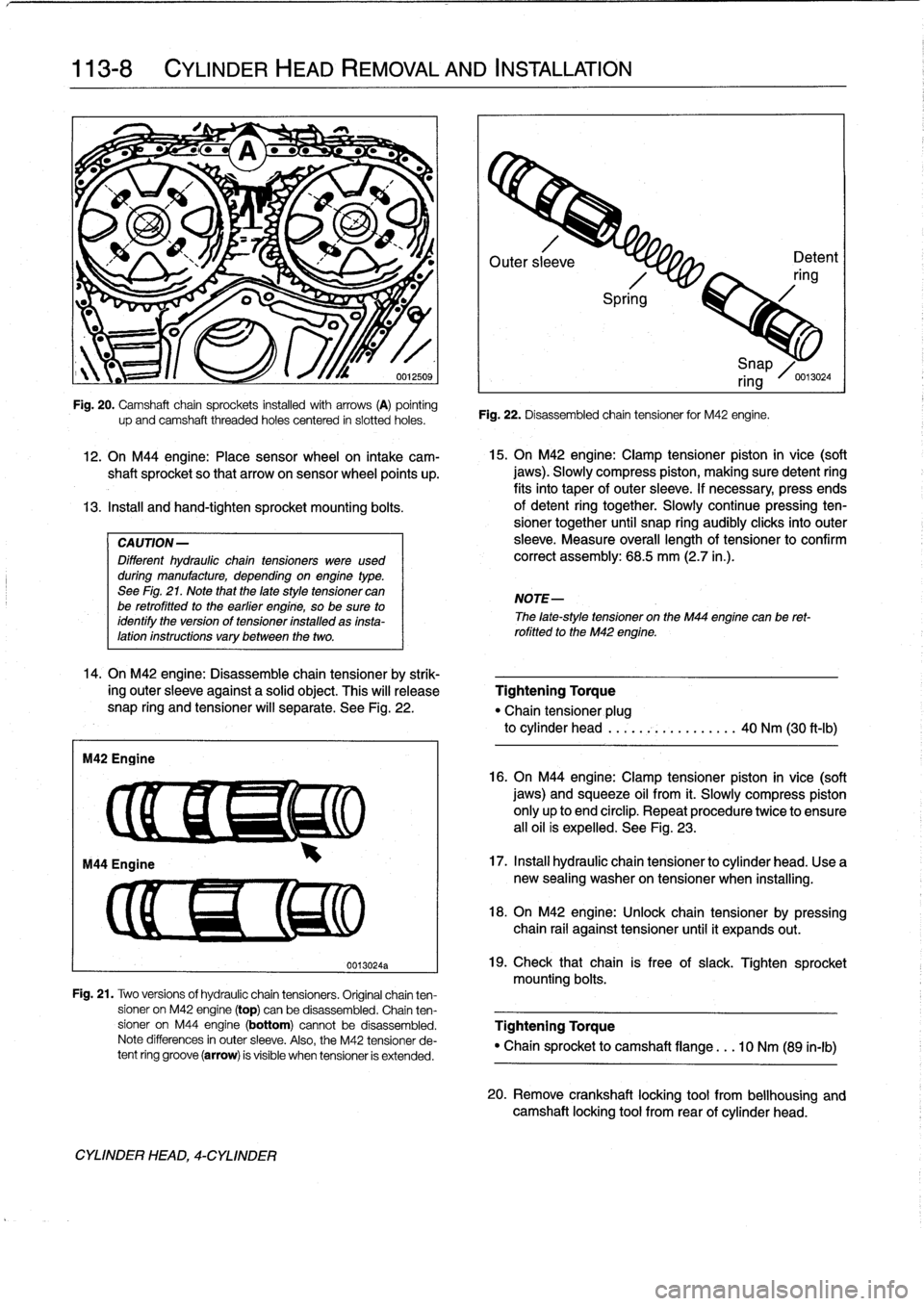
See
Fig
.
21
.
Note
that
the
late
style
tensioner
can
be
retrofitted
to
the
earlier
engine,
so
be
sure
to
identify
the
version
of
tensioner
installed
as
insta-lation
instructions
vary
between
the
two
.
14
.
On
M42
engine
:
Disassemble
chain
tensioner
by
strik-
ing
outer
sleeve
against
a
solid
object
.
This
will
release
snap
ring
and
tensioner
will
separate
.
See
Fig
.
22
.
M42
Engine
up
and
camshaft
threaded
holes
centered
in
siotted
holes
.
CYLINDER
HEAD,
4-CYLINDER
0013024a
Outer
sl
eve
Detent
ring
Spri
g
Fig
.
22
.
Disassembled
chain
tensioner
for
M42
engine
.
15
.
On
M42
engine
:
Clamp
tensioner
piston
in
vice
(soft
jaws)
.
Slowly
compress
piston,
making
sure
detent
ring
fits
into
taper
of
outer
sleeve
.
If
necessary,
press
ends
of
detent
ring
together
.
Slowly
continuepressing
ten-
sioner
together
until
snap
ring
audibly
clicksinto
outer
sleeve
.
Measure
overall
lengthof
tensioner
to
confirm
correct
assembly
:
68
.5
mm
(2.7
in
.)
.
NOTE-
i
Snap
ring
/0
.13024
The
late-style
tensioner
on
the
M44
engíne
canbe
ret-
rofitted
to
the
M42
engine
.
Tightening
Torque
"Chain
tensioner
plug
to
cylinder
head
.....
.-~
..........
40
Nm
(30
ft-Ib)
16
.
On
M44
engíne
:
Clamp
tensioner
píston
in
vice
(soft
jaws)
and
squeeze
oil
from
it
.
Slowly
compress
piston
only
up
to
end
circlip
.
Repeat
procedure
twice
to
ensure
all
oil
is
expelled
.
See
Fig
.
23
.
17
.
Instan
hydraulic
chain
tensioner
to
cylinder
head
.
Use
a
new
sealing
washer
on
tensioner
when
installing
.
18
.
On
M42
engine
:
Unlock
chain
tensioner
by
pressing
chain
rail
against
tensioner
until
it
expands
out
.
19
.
Check
that
chain
is
free
of
slack
.
Tighten
sprocket
mounting
bolts
.
Fig
.
21
.
Two
versions
of
hydraulic
chain
tensioners
.
Original
chainten-
sioner
on
M42
engine
(top)
can
be
disassembled
.
Chain
ten
sioner
on
M44
engine
(bottom)
cannotbe
disassembled
.
Tightening
Torque
Note
differences
in
outer
sleeve
.
Also,
the
M42
tensioner
de-
"
Chain
sprocket
to
camshaft
flange
.
..
10
Nm
(89
in-lb)
tent
ring
groove
(arrow)
is
visible
when
tensioner
is
extended
.
20
.
Remove
crankshaft
locking
tool
from
bellhousing
and
camshaft
locking
tool
from
rear
of
cylinder
head
.
Page 75 of 759

Fig
.
23
.
When
reinstalling
chain
tensioner
on
M44
engine,
old
oil
in
tensioner
piston
mustbe
expelled
bycompressing
piston
in
vise
.
When
compressing
piston,
only
compress
up
to
end
cir-
clip
(arrow)
.
21
.
Turn
engine
overby
hand
in
direction
of
rotation
at
least
two
fui¡
rotations
.
Reinstall
camshaft
and
crankshaft
locking
tools
to
check
engíne
timing
.
Remove
locking
tools
if
no
faults
are
found
.
22
.
Insta¡¡
upper
timingchain
cover
.
"
Install
gaskets
and
instan
cover
using
two
mounting
Tightening
Torque
bolts
.
Using
a
screwdriver,
lever
down
on
front
cover
"
Cylinder
head
cover
until
cover
gasket
surface
is
flush
with
cylinder
head
to
cylinder
head
(M6
screws)
.......
10
Nm
(89
in-lb)
gasket
surface
.
See
Fig
.
24
.
Tighten
two
bolis
.
"
Insta¡¡
and
tighten
remainder
of
bolis
.
23
.
Install
cylinder
head
cover
.
CYLINDER
HEAD
REMOVAL
AND
INSTALLATION
113-
9
0012507
Fig
.
24
.
Install
upper
timing
case
cover
with
two
bolis,
then
press
down
on
cover
so
that
top
surface
is
flush
withcylinder
head
(arrow)
.
Hold
cover
in
position
and
tighten
bolis
.
"
Clean
old
gasket
glue
from
sealing
surfaces
.
Usea
small
amount
of
3-Bond
®
1209
adhesive
or
equivalent
at
corners
of
half-moon
cut-outs
at
back
of
cylinder
head
.
See
Fig
.
25
.
NOTE-
OnM44
engines,
reptace
sea¡
for
oil
supply
tube
.
See
Fig
.
17
.)
Fig
.
25
.
Rear
of
cylinder
head
cover
showing
area
where
sealant
(ar-
rows)
should
be
applied
.
Inset
shows
cylinder
head
cover
mounting
bolt
and
insulator
assembly
:
M6
screw
(1),
rubber
damper
(2),
washer
(3)
.
24
.
Installation
of
remaining
parts
is
reverseofremoval,
noting
the
following
:
"
Make
sure
al¡
sealing
surfaces
are
clean
and
free
of
old
gasket
material
.
Install
new
intake
manifold
gasket
.
"
On
M44
engine
:
Replace
seals
above
and
below
crankcase
ventvalve
.
"
When
installing
lower
intake
manifold,
make
sure
hol-
low
locating
bushings
are
on
two
lower
studs
.
"
Reinstall
harness
connectors
for
oil
pressure
switch
and
coolant
temperature
sensor
before
installing
in-
take
manifold
.
Tighten
manifold
nuts
in
stages
.
"
Refill
cooling
system
as
described
in
170
Radiator
and
Cooling
System
.
"
Change
engine
oil
and
filter
as
described
in
020
Main-
tenance
Program
.
"
If
necessary,
adjust
accelerator
cable
.
"
Run
engine
at
approx
.
3,500
rpm
for
about
20
seconds
to
allow
hydraulic
chain
tensioner
to
fill
with
oil
.
"
Reconnect
battery
last
.
CYLINDER
HEAD,-CYLINDER