1995 PONTIAC GRAND-AM coolant temperature
[x] Cancel search: coolant temperaturePage 117 of 354

If the anti-lock brake system warning light stays on
longer than normal after you’ve started your engine, turn
the ignition off. Or, if the light comes on
and stays on
when you’re driving, stop as soon as possible and turn
the ignition
off. Then start the engine again to reset the
system. If the light still stays on, or comes on again
while you’re driving, your Pontiac needs service.
If the
light
is on but not flashing and the regular brake system
warning light isn’t on, you still have brakes, but you
don’t have anti-lock brakes.
. Engine Coolant Temperature Warning
Light
This light tells you that your
engine coolant has
overheated or your radiator
cooling fan is not working.
If you have been operating your vehicle under normal
driving conditions, you should pull off the road, stop
your vehicle and turn the engine
off as soon as possible.
HOT COOLANT CAN BURN YOU BADLY!
In “Problems on the Road”, this manual shows what to
do. See “Engine Overheating” in the Index.
2-62
ProCarManuals.com
Page 118 of 354

Engine Coolant Temperature Gage
loo b
280
-E- -
r-r .J
This gage shows the engine coolant temperature. If the
gage pointer moves into the red area, your engine
is too
hot!
That reading means the same thing as the warning light.
It means that your engine coolant has overheated.
If you have been operating your vehicle under normal
driving conditions, you should pull
off the road, stop
your vehicle and
turn off the engine as soon as possible.
HOT COOLANT CAN BURN YOU BADLY!
In “Problems on the Road”, this manual shows what to
do. See “Engine Overheating’, in the Index.
Low Coolant Warning Light
LOW
COOLANT
If this light comes on and
stays on, the vehicle should
be promptly pulled off the
road
and the coolant level
checked. See “Engine
Coolant” in the Index.
If
there are visible signs of
steam see “Engine
Overheating” in the:Index
before opening the hood.
2-63
ProCarManuals.com
Page 125 of 354

VENT Use when outside temperatures are mild,
and little heating or cooling is needed. Air flow is
through the instrument panel outlets. Set the center
control knob to the temperature desired.
HEATER: This setting brings heated air through
the heater ducts, and some through the windshield
defroster vents.
If you have the optional engine coolant heater (engine
block heater) and use it during cold weather,
0°F
(- 18 “C) or lower, your heating system will more quickly
provide heat because the engine coolant is already
warmed. See “Engine Coolant Heater” in the Index.
9 BLEND: This setting divides air flow equally
between the heater ducts and the windshield defroster
vents.
DEFROST This setting directs air through the
windshield defroster vents located on top of the
instrument panel.
Defogging Windows
To defog the windshield, turn all three control knobs to
the
far right.
Air Conditioning System (Option)
The air conditioner and heater work best if you keep
your windows closed while using them. Your vehicle
also has the flow-through ventilation system described
later in this section.
Air Conditioning
Your system has three air conditioner settings. Before using
your
air conditioner on very hot days, open the windows
long enough to let hot inside
air escape. This reduces the
amount
of work your air conditioner’s compressor will have
to do, which should help fuel economy.
MAX: Use for maximum cooling. This setting
recirculates much of the air inside your vehicle
so it
maximizes your air conditioner’s performance and your
vehicle’s fuel economy.
A/C: Use for normal cooling on hot days. This setting
cools outside air and directs it through the instrument
panel outlets.
BI-LEVEL: Use on cool, but sunny days. This
setting brings in the outside air, but directs it in two
ways. The cool air is directed to the upper portion
of
your body through the instrument panel outlets, but
slightly warmer air is directed through the heater ducts
and defroster vents. At times this temperature difference
may be more apparent than others.
ProCarManuals.com
Page 126 of 354
Ventilation
Use when outside temperatures are mild, and little
heating or cooling is needed.
Turn the right knob to
VENT. Air
flow is directed through the instrument panel
outlets. Set the center knob to the temperature desired.
Heating
Turning the right control knob to HEATER and the
center control knob clockwise will send heated air
through the heater ducts toward your feet and the
floor,
and some through the defroster vents.
VENT and HEATER are economical positions because
the air conditioner compressor doesn’t run in these two
settings. This reduces engine load, resulting in improved
fuel economy. If either setting fails to keep you
comfortable, or causes your windows to fog up, turn the
right control
knob to one of the air conditioning
positions, or to DEFROST.
If you have the optional engine coolant heater (engine
block heater) and use it during cold weather,
0°F
(- 18 O C) or lower, your heating system will more quickly
provide heat because the engine coolant ‘is already
warmed. See “Engine Coolant Heater” the Index.
BLEND: This setting divides airflow equally between
the heater ducts and the windshield defroster vents.
Defrosting
The DEFROST setting directs air through ‘the defroster
vents located on top of the instrument panel.
Defogging Windows with Air Conditioning
System
To defog the windshield, turn all three control knobs to
the far right.
To defog the side windows, turn the right control knob
to BI-LEVEL and the fan control
knob to HIGH. Aim
the side vents toward the side windows. For increased
air flow to the side vents, close the center vents.
22
ProCarManuals.com
Page 193 of 354
NOTICE:
Towing a vehicle over rough surfaces could
damage a vehicle. Damage can occur from vehicle
to ground or vehicle to wheel-lift equipment. To
help avoid damage, install a towing dolly and
raise the vehicle until adequate clearance is
obtained between the ground and/or wheel-lift
equipment.
Do not attach winch cables or J-hooks to
suspension components when using car carrier
equipment.
Always use T-hooks inserted in the
T-hook Slots.
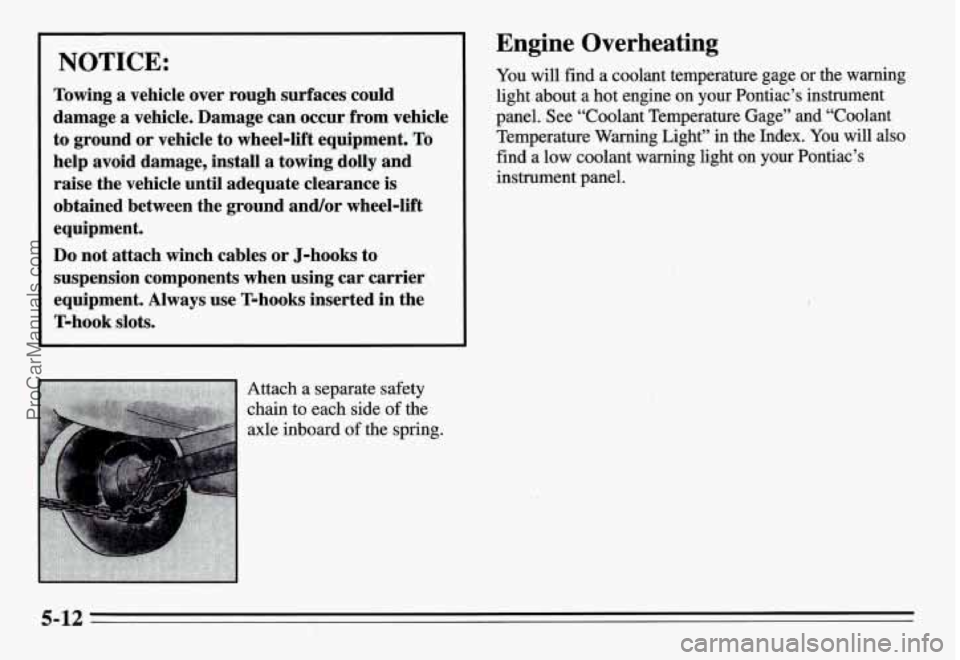
Attach a separate safety
chain to each side of the
axle inboard
of the spring.
Engine Overheating
You will find a coolant temperature gage or the warning
light about
a hot engine on your Pontiac’s instrument
panel. See “Coolant Temperature Gage” and “Coolant
Temperature Warning Light” in the Index. You will also
find a low coolant warning light on your Pontiac’s
instrument panel.
5-12
ProCarManuals.com
Page 227 of 354
When to Change Engine Oil
See if any one of these is true for you:
Most trips are less than 5 to 10 miles (8 to 16 km).
This is particularly important when outside
temperatures are below freezing.
Most trips include extensive idling (such as frequent
driving in stop and go traffic).
0 Most trips are through dusty areas.
0 You frequently tow a trailer or use a carrier on top of
your car.
If any one of these is true for your vehicle, then you
need to change your oil and filter every
3,000 miles
(5 000 km) or 3 months -- whichever comes first.
If none of them is true, change the oil and filter every
7,500 miles (12 500 km) or 12 months -- whichever
comes first.
Engine Coolant Heater
An engine coolant heater can be a big help if you have
to park outside in very cold weather,
0 OF (- 18 O C) or
colder.
If your vehicle has this option, see “Engine
Coolant Heater” in the Index.
What to Do with Used Oil
Did you know that used engine oil contains certain
elements that may be unhealthy for your skin and could
even cause cancer? Don’t let used oil stay on your skin
for
very long. Clean your skin and nails with soap and
water, or a good hand cleaner. Wash or properly throw
away clothing or rags containing used engine oil. (See
the manufacturer’s warnings about the use and disposal
of oil products.)
Used oil can be a real threat to the environment. If you
change your own oil, be sure to drain all free-flowing oil
from the filter before disposal. Don’t ever dispose of oil
by putting it in the trash, pouring it on the ground, into
sewers, or into streams or bodies of water. Instead,
recycle it by taking it
to a place that collects used oil. If
you have a problem properly disposing
of your used oil,
ask your dealer, a service station or a local recycling
center for help.
6-16
ProCarManuals.com
Page 233 of 354
Hydraulic Clutch Refer to the Maintenance Schedule to determine how often you should check the fluid level in your clutch
The hydraulic clutch linkage in your vehicle is master cylinder reservoir and for the proper fluid. See
self-adjusting. The clutch master cylinder reservoir is “Owner Checks and Services” and “Recommended
filled with hydraulic clutch fluid. Fluids and Lubricants” in the Index.
It isn’t a good idea to “top off’ your clutch fluid. Adding
fluid won’t correct a leak. How to Check
A fluid loss in this system could indicate a problem.
Have the system inspected and repaired.
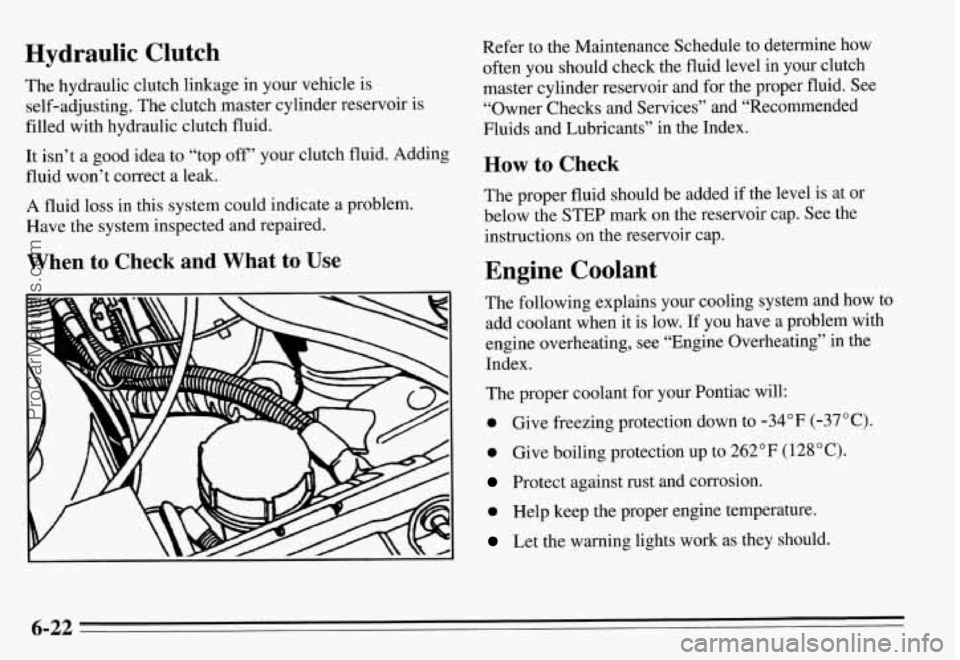
When to Check and What to Use
The proper fluid should be added if the level is at or
below the STEP mark on the reservoir cap. See the
instructions on the reservoir cap.
Engine Coolant
The following explains your cooling system and how to
add coolant when it is low. If you have a problem with
engine overheating, see “Engine Overheating” in the
Index.
The proper coolant for your Pontiac will:
0 Give freezing protection down to -34°F (-37°C).
0 Give boiling protection up to 262 OF ( 128 O C).
Protect against rust and corrosion.
0 Help keep the proper engine temperature.
Let the warning lights work as they should.
6-22
ProCarManuals.com
Page 236 of 354
II WASH
FLUID
LOW
COOLANT
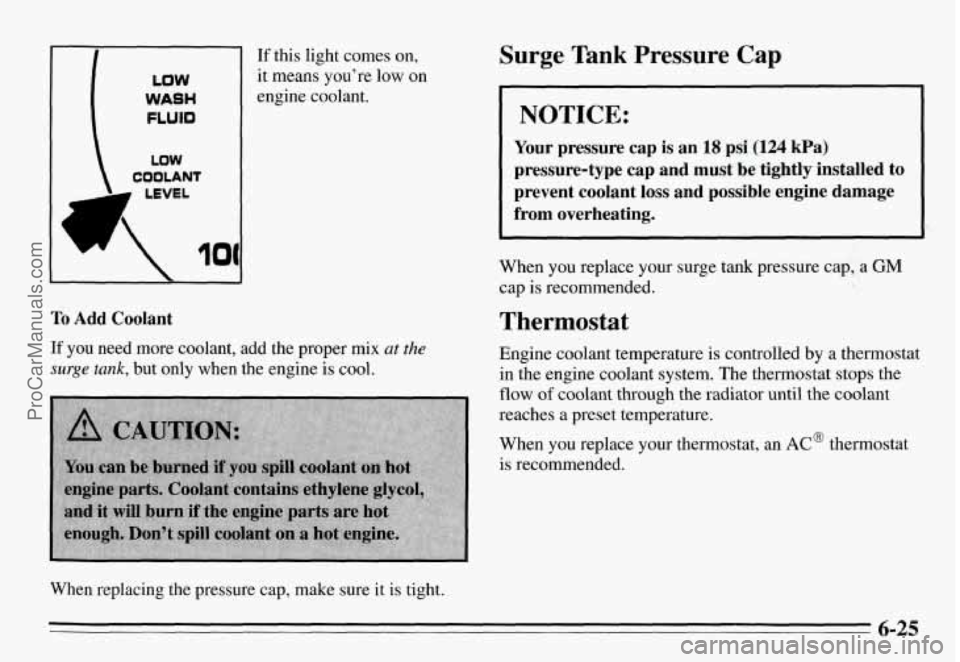
To Add Coolant
If this light comes on,
it means you’re low on
engine coolant.
If you need more coolant, add the proper mix at the
surge tank, but only when the engine is cool.
When replacing the pressure cap, make sure it is tight.
Surge Tank Pressure Cap
NOTICE:
Your pressure cap is an 18 psi (124 kPa)
pressure-type cap and must be tightly installed to
prevent coolant
loss and possible engine damage
from overheating.
When you replace your surge tank pressure cap, a GM
cap is recommended.
Thermostat
Engine coolant temperature is controlled by a thermostat
in the engine coolant system. The thermostat stops the
flow of coolant through the radiator until the coolant
reaches a preset temperature.
When you replace your thermostat, an AC@ thermostat
is recommended.
6-25
ProCarManuals.com