1995 JEEP YJ transmission
[x] Cancel search: transmissionPage 1750 of 2158
(1) Remove park/neutral position switch and dis-
connect transmission shift lever.
(2) Remove oil pan and valve body.
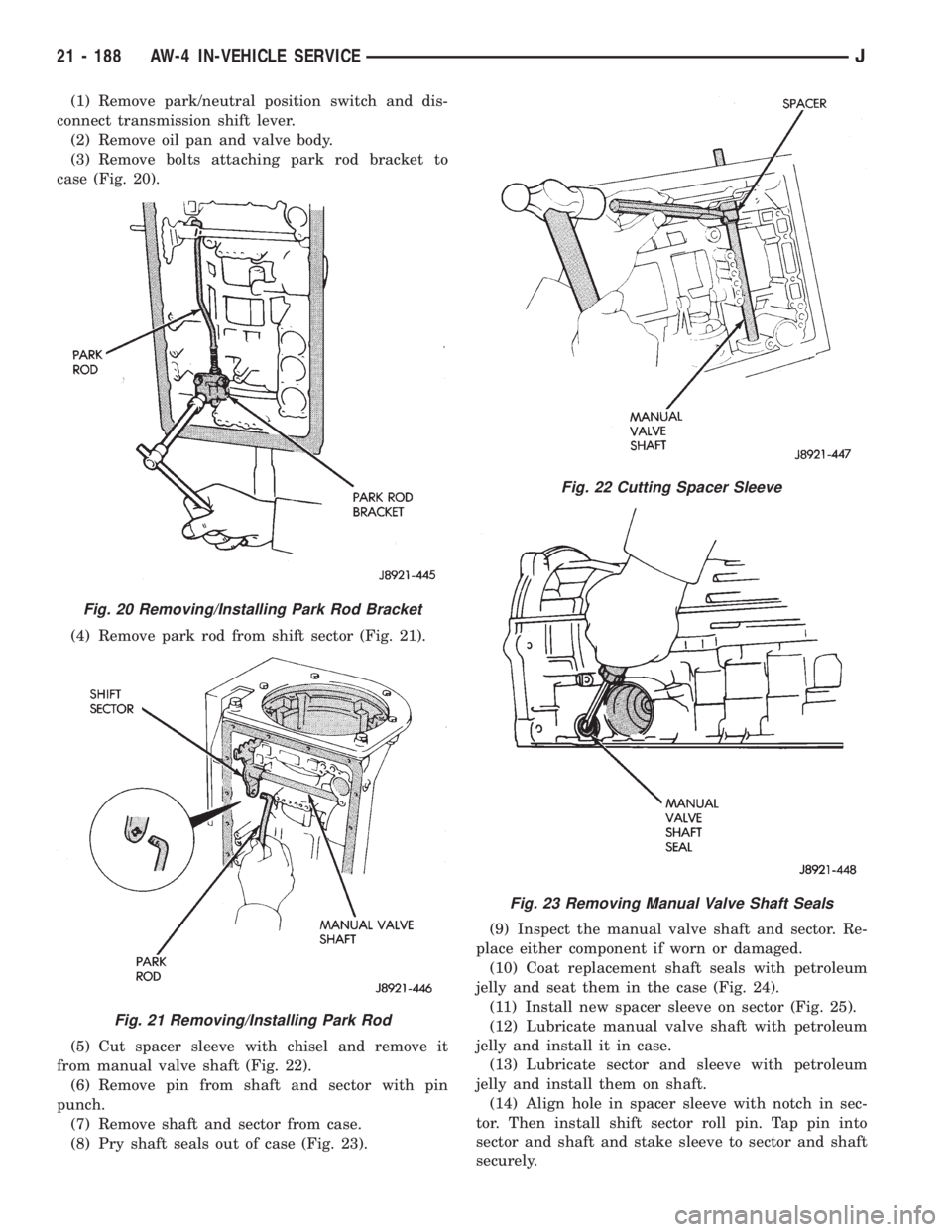
(3) Remove bolts attaching park rod bracket to
case (Fig. 20).
(4) Remove park rod from shift sector (Fig. 21).
(5) Cut spacer sleeve with chisel and remove it
from manual valve shaft (Fig. 22).
(6) Remove pin from shaft and sector with pin
punch.
(7) Remove shaft and sector from case.
(8) Pry shaft seals out of case (Fig. 23).(9) Inspect the manual valve shaft and sector. Re-
place either component if worn or damaged.
(10) Coat replacement shaft seals with petroleum
jelly and seat them in the case (Fig. 24).
(11) Install new spacer sleeve on sector (Fig. 25).
(12) Lubricate manual valve shaft with petroleum
jelly and install it in case.
(13) Lubricate sector and sleeve with petroleum
jelly and install them on shaft.
(14) Align hole in spacer sleeve with notch in sec-
tor. Then install shift sector roll pin. Tap pin into
sector and shaft and stake sleeve to sector and shaft
securely.
Fig. 20 Removing/Installing Park Rod Bracket
Fig. 21 Removing/Installing Park Rod
Fig. 22 Cutting Spacer Sleeve
Fig. 23 Removing Manual Valve Shaft Seals
21 - 188 AW-4 IN-VEHICLE SERVICEJ
Page 1752 of 2158
(4) Inspect pistons, springs and piston bores. Re-
place worn damaged pistons. Replace broken, col-
lapsed or distorted springs. Replace case if piston
bores are damaged.
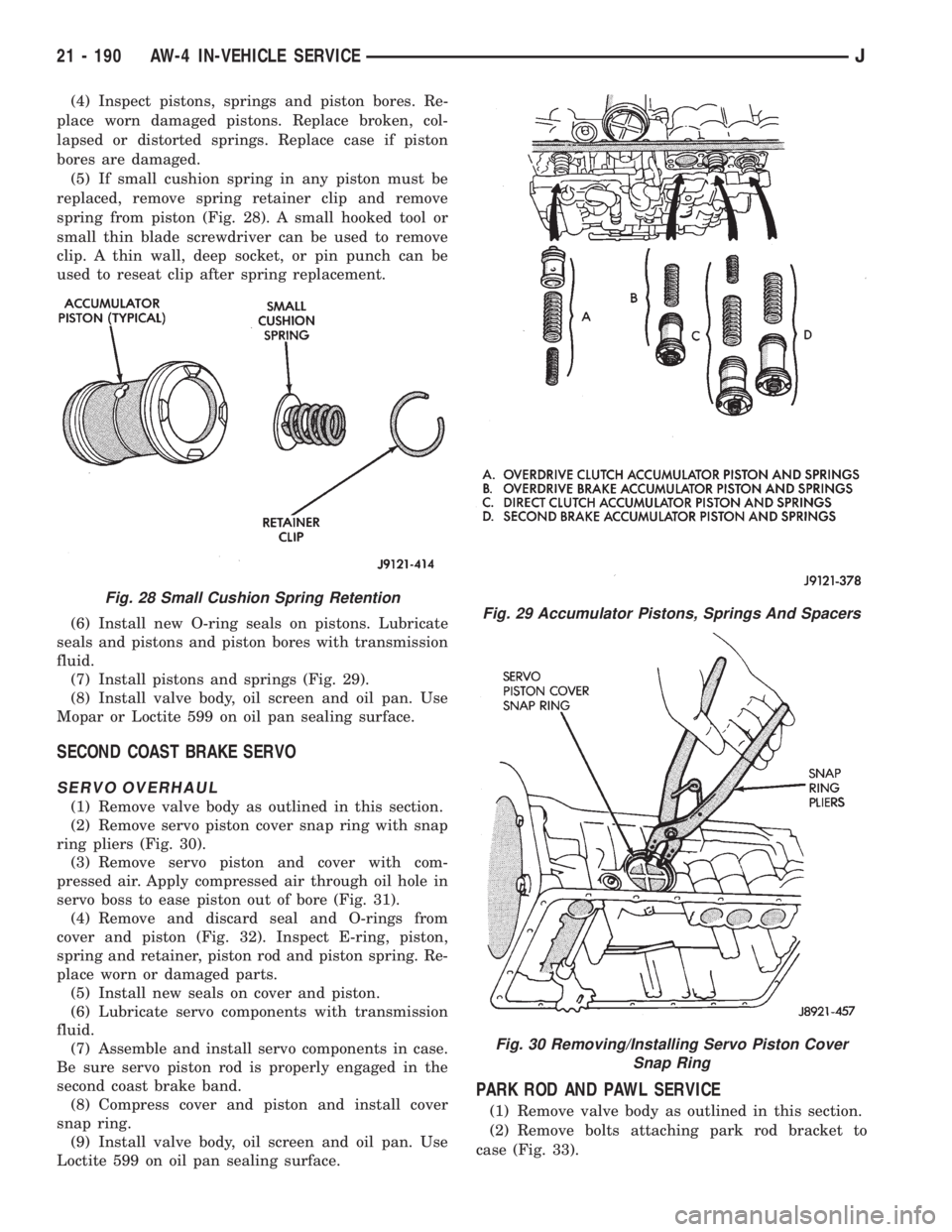
(5) If small cushion spring in any piston must be
replaced, remove spring retainer clip and remove
spring from piston (Fig. 28). A small hooked tool or
small thin blade screwdriver can be used to remove
clip. A thin wall, deep socket, or pin punch can be
used to reseat clip after spring replacement.
(6) Install new O-ring seals on pistons. Lubricate
seals and pistons and piston bores with transmission
fluid.
(7) Install pistons and springs (Fig. 29).
(8) Install valve body, oil screen and oil pan. Use
Mopar or Loctite 599 on oil pan sealing surface.
SECOND COAST BRAKE SERVO
SERVO OVERHAUL
(1) Remove valve body as outlined in this section.
(2) Remove servo piston cover snap ring with snap
ring pliers (Fig. 30).
(3) Remove servo piston and cover with com-
pressed air. Apply compressed air through oil hole in
servo boss to ease piston out of bore (Fig. 31).
(4) Remove and discard seal and O-rings from
cover and piston (Fig. 32). Inspect E-ring, piston,
spring and retainer, piston rod and piston spring. Re-
place worn or damaged parts.
(5) Install new seals on cover and piston.
(6) Lubricate servo components with transmission
fluid.
(7) Assemble and install servo components in case.
Be sure servo piston rod is properly engaged in the
second coast brake band.
(8) Compress cover and piston and install cover
snap ring.
(9) Install valve body, oil screen and oil pan. Use
Loctite 599 on oil pan sealing surface.
PARK ROD AND PAWL SERVICE
(1) Remove valve body as outlined in this section.
(2) Remove bolts attaching park rod bracket to
case (Fig. 33).
Fig. 29 Accumulator Pistons, Springs And Spacers
Fig. 30 Removing/Installing Servo Piston Cover
Snap Ring
Fig. 28 Small Cushion Spring Retention
21 - 190 AW-4 IN-VEHICLE SERVICEJ
Page 1753 of 2158
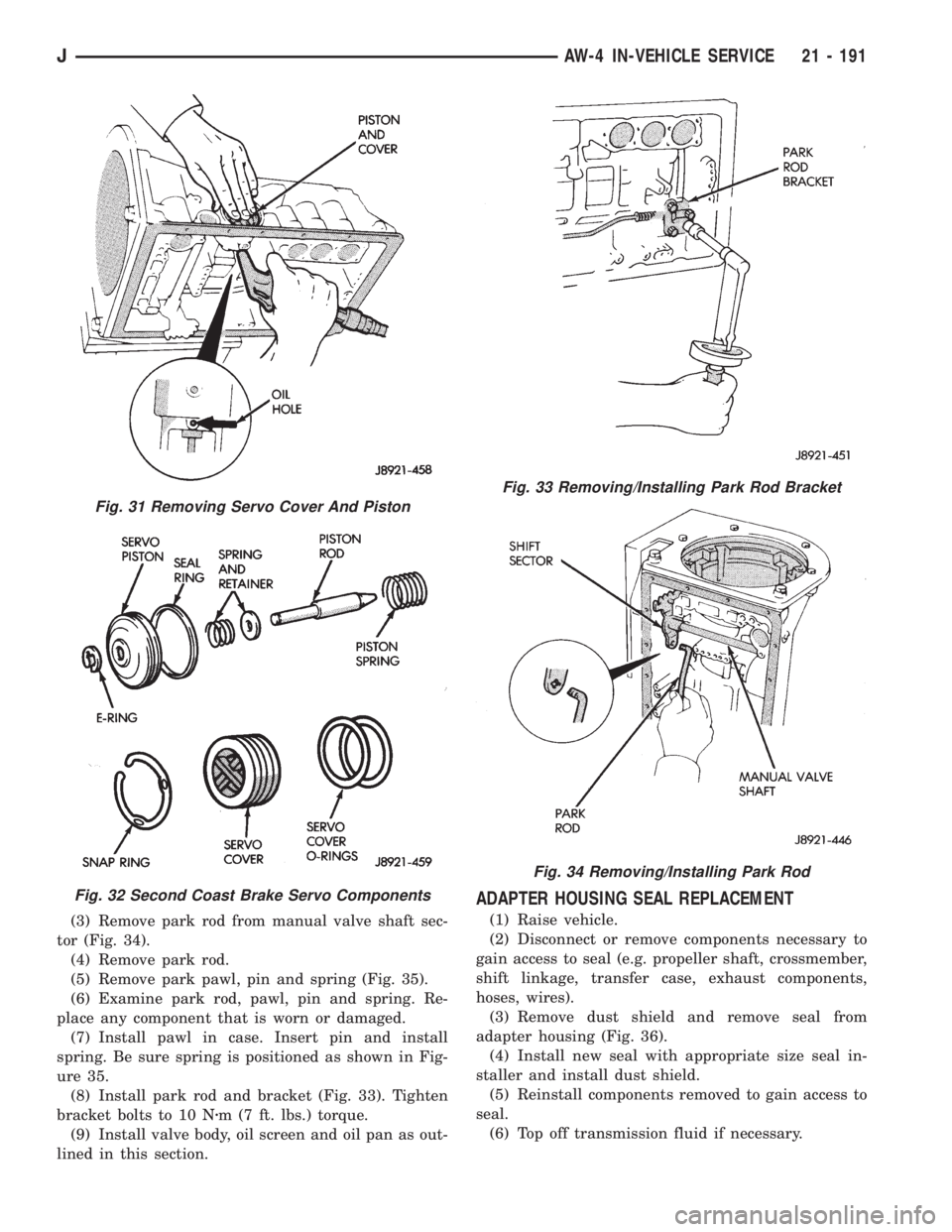
(3) Remove park rod from manual valve shaft sec-
tor (Fig. 34).
(4) Remove park rod.
(5) Remove park pawl, pin and spring (Fig. 35).
(6) Examine park rod, pawl, pin and spring. Re-
place any component that is worn or damaged.
(7) Install pawl in case. Insert pin and install
spring. Be sure spring is positioned as shown in Fig-
ure 35.
(8) Install park rod and bracket (Fig. 33). Tighten
bracket bolts to 10 Nzm (7 ft. lbs.) torque.
(9) Install valve body, oil screen and oil pan as out-
lined in this section.
ADAPTER HOUSING SEAL REPLACEMENT
(1) Raise vehicle.
(2) Disconnect or remove components necessary to
gain access to seal (e.g. propeller shaft, crossmember,
shift linkage, transfer case, exhaust components,
hoses, wires).
(3) Remove dust shield and remove seal from
adapter housing (Fig. 36).
(4) Install new seal with appropriate size seal in-
staller and install dust shield.
(5) Reinstall components removed to gain access to
seal.
(6) Top off transmission fluid if necessary.
Fig. 31 Removing Servo Cover And Piston
Fig. 32 Second Coast Brake Servo Components
Fig. 33 Removing/Installing Park Rod Bracket
Fig. 34 Removing/Installing Park Rod
JAW-4 IN-VEHICLE SERVICE 21 - 191
Page 1754 of 2158
SPEED SENSOR
SPEED SENSOR TESTING
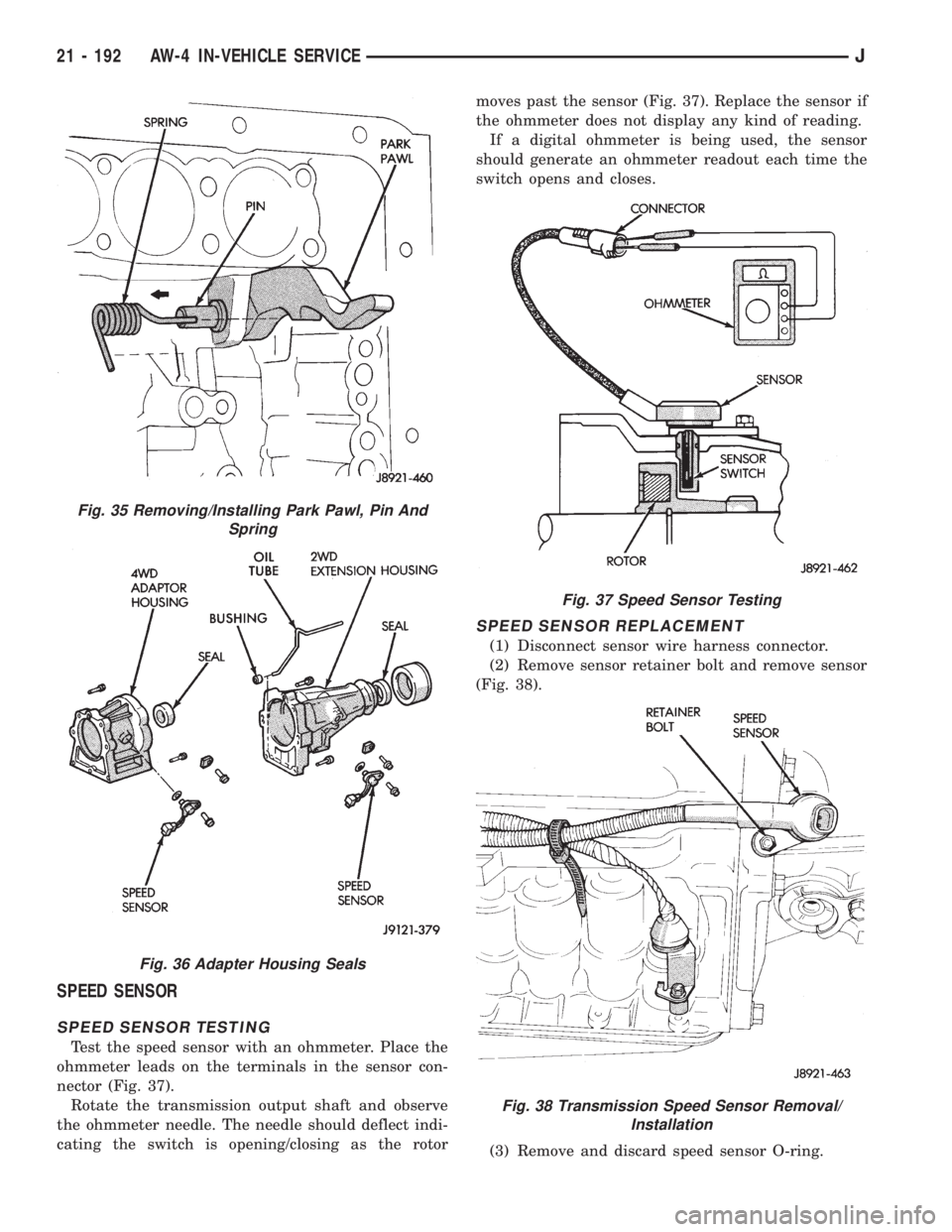
Test the speed sensor with an ohmmeter. Place the
ohmmeter leads on the terminals in the sensor con-
nector (Fig. 37).
Rotate the transmission output shaft and observe
the ohmmeter needle. The needle should deflect indi-
cating the switch is opening/closing as the rotormoves past the sensor (Fig. 37). Replace the sensor if
the ohmmeter does not display any kind of reading.
If a digital ohmmeter is being used, the sensor
should generate an ohmmeter readout each time the
switch opens and closes.
SPEED SENSOR REPLACEMENT
(1) Disconnect sensor wire harness connector.
(2) Remove sensor retainer bolt and remove sensor
(Fig. 38).
(3) Remove and discard speed sensor O-ring.
Fig. 35 Removing/Installing Park Pawl, Pin And
Spring
Fig. 36 Adapter Housing Seals
Fig. 37 Speed Sensor Testing
Fig. 38 Transmission Speed Sensor Removal/
Installation
21 - 192 AW-4 IN-VEHICLE SERVICEJ
Page 1755 of 2158
(4) Install new O-ring on speed sensor and install
sensor in transmission case.
(5) Install sensor bracket and retainer bolt.
Tighten bolt to 7.4 Nzm (65 in. lbs.) torque.
(6) Connect sensor wire harness connector.
SPEED SENSOR ROTORÐSPEEDOMETER DRIVE
GEAR
ROTORÐDRIVE GEAR REMOVAL
(1) Raise vehicle.
(2) Remove components necessary to gain access to
rotor and drive gear such as propeller shaft, transfer
case, crossmember, and shift linkage.
(3) Disconnect speedometer cable and/or speed sen-
sor.
(4) Remove adaptor housing.
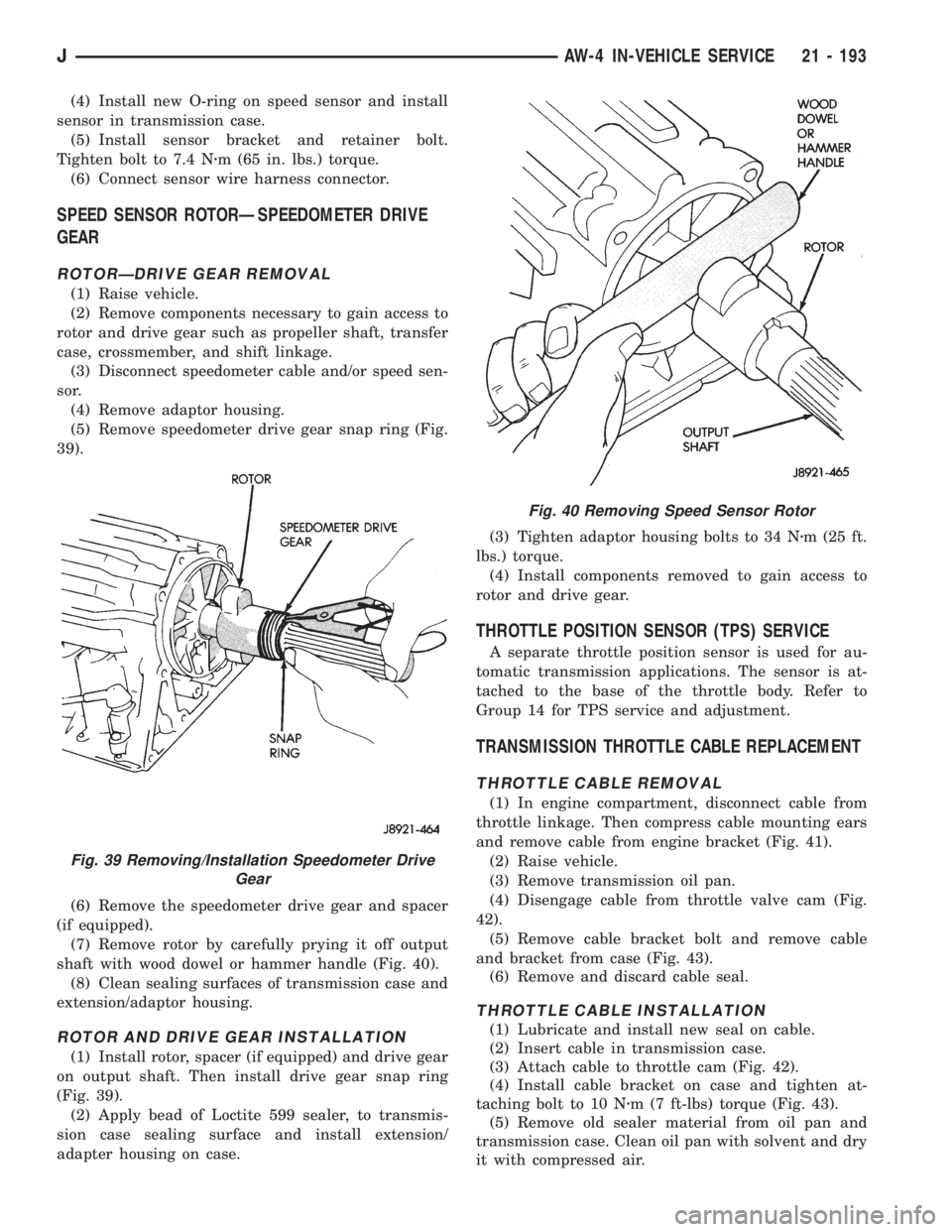
(5) Remove speedometer drive gear snap ring (Fig.
39).
(6) Remove the speedometer drive gear and spacer
(if equipped).
(7) Remove rotor by carefully prying it off output
shaft with wood dowel or hammer handle (Fig. 40).
(8) Clean sealing surfaces of transmission case and
extension/adaptor housing.
ROTOR AND DRIVE GEAR INSTALLATION
(1) Install rotor, spacer (if equipped) and drive gear
on output shaft. Then install drive gear snap ring
(Fig. 39).
(2) Apply bead of Loctite 599 sealer, to transmis-
sion case sealing surface and install extension/
adapter housing on case.(3) Tighten adaptor housing bolts to 34 Nzm (25 ft.
lbs.) torque.
(4) Install components removed to gain access to
rotor and drive gear.
THROTTLE POSITION SENSOR (TPS) SERVICE
A separate throttle position sensor is used for au-
tomatic transmission applications. The sensor is at-
tached to the base of the throttle body. Refer to
Group 14 for TPS service and adjustment.
TRANSMISSION THROTTLE CABLE REPLACEMENT
THROTTLE CABLE REMOVAL
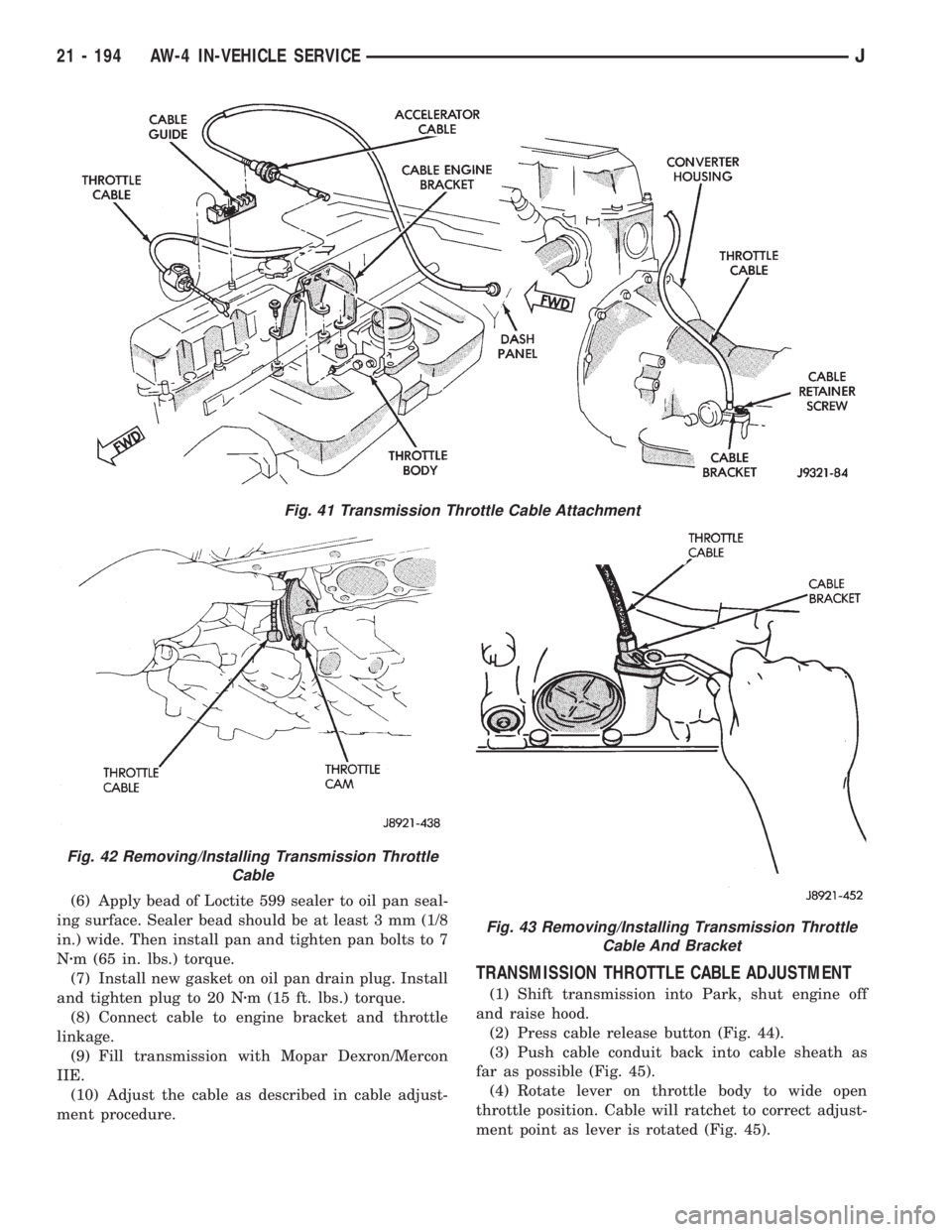
(1) In engine compartment, disconnect cable from
throttle linkage. Then compress cable mounting ears
and remove cable from engine bracket (Fig. 41).
(2) Raise vehicle.
(3) Remove transmission oil pan.
(4) Disengage cable from throttle valve cam (Fig.
42).
(5) Remove cable bracket bolt and remove cable
and bracket from case (Fig. 43).
(6) Remove and discard cable seal.
THROTTLE CABLE INSTALLATION
(1) Lubricate and install new seal on cable.
(2) Insert cable in transmission case.
(3) Attach cable to throttle cam (Fig. 42).
(4) Install cable bracket on case and tighten at-
taching bolt to 10 Nzm (7 ft-lbs) torque (Fig. 43).
(5) Remove old sealer material from oil pan and
transmission case. Clean oil pan with solvent and dry
it with compressed air.
Fig. 40 Removing Speed Sensor Rotor
Fig. 39 Removing/Installation Speedometer Drive
Gear
JAW-4 IN-VEHICLE SERVICE 21 - 193
Page 1756 of 2158
(6) Apply bead of Loctite 599 sealer to oil pan seal-
ing surface. Sealer bead should be at least 3 mm (1/8
in.) wide. Then install pan and tighten pan bolts to 7
Nzm (65 in. lbs.) torque.
(7) Install new gasket on oil pan drain plug. Install
and tighten plug to 20 Nzm (15 ft. lbs.) torque.
(8) Connect cable to engine bracket and throttle
linkage.
(9) Fill transmission with Mopar Dexron/Mercon
IIE.
(10) Adjust the cable as described in cable adjust-
ment procedure.
TRANSMISSION THROTTLE CABLE ADJUSTMENT
(1) Shift transmission into Park, shut engine off
and raise hood.
(2) Press cable release button (Fig. 44).
(3) Push cable conduit back into cable sheath as
far as possible (Fig. 45).
(4) Rotate lever on throttle body to wide open
throttle position. Cable will ratchet to correct adjust-
ment point as lever is rotated (Fig. 45).
Fig. 43 Removing/Installing Transmission Throttle
Cable And Bracket
Fig. 41 Transmission Throttle Cable Attachment
Fig. 42 Removing/Installing Transmission Throttle
Cable
21 - 194 AW-4 IN-VEHICLE SERVICEJ
Page 1757 of 2158
SHIFT CABLE ADJUSTMENT
(1) Shift transmission into Park.
(2) Raise vehicle.
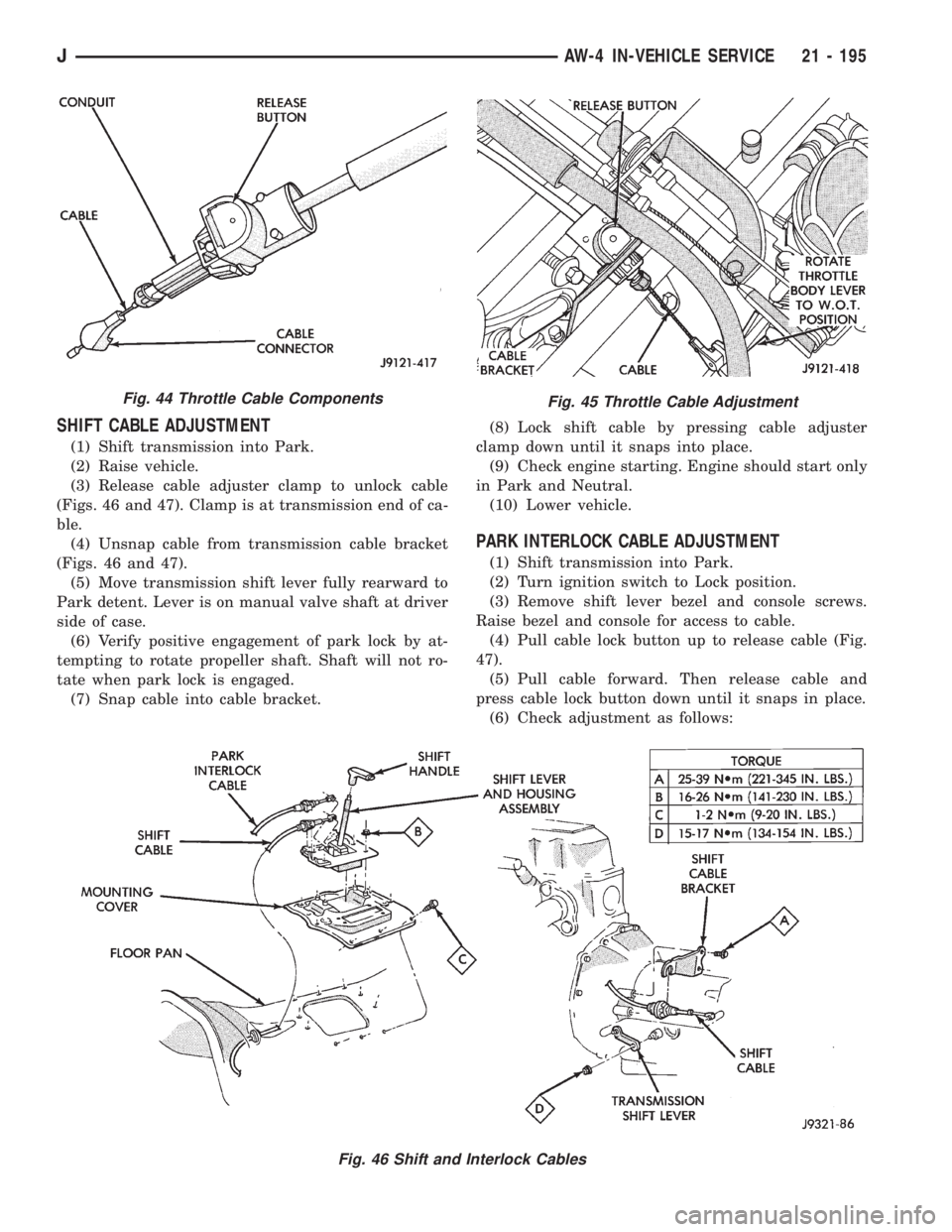
(3) Release cable adjuster clamp to unlock cable
(Figs. 46 and 47). Clamp is at transmission end of ca-
ble.
(4) Unsnap cable from transmission cable bracket
(Figs. 46 and 47).
(5) Move transmission shift lever fully rearward to
Park detent. Lever is on manual valve shaft at driver
side of case.
(6) Verify positive engagement of park lock by at-
tempting to rotate propeller shaft. Shaft will not ro-
tate when park lock is engaged.
(7) Snap cable into cable bracket.(8) Lock shift cable by pressing cable adjuster
clamp down until it snaps into place.
(9) Check engine starting. Engine should start only
in Park and Neutral.
(10) Lower vehicle.
PARK INTERLOCK CABLE ADJUSTMENT
(1) Shift transmission into Park.
(2) Turn ignition switch to Lock position.
(3) Remove shift lever bezel and console screws.
Raise bezel and console for access to cable.
(4) Pull cable lock button up to release cable (Fig.
47).
(5) Pull cable forward. Then release cable and
press cable lock button down until it snaps in place.
(6) Check adjustment as follows:
Fig. 45 Throttle Cable Adjustment
Fig. 46 Shift and Interlock Cables
Fig. 44 Throttle Cable Components
JAW-4 IN-VEHICLE SERVICE 21 - 195
Page 1758 of 2158
(a) Check movement of release shift handle but-
ton (floor shift) or release lever (column shift). You
should not be able to press button inward or move
column lever.
(b) Turn ignition switch to On position.
(c) Press floor shift lever release button or move
column lever. Then shift into Neutral. If cable ad-
justment is correct, ignition switch can not be
turned to Lock position. Perform same check with
transmission in D range.
(7) Move shift lever back to Park and check igni-
tion switch operation. You should be able to turn
switch to Lock position and shift lever release button/
lever should not move.
TRANSMISSION COOLER SERVICE
Main Cooler
The transmission main cooler is located in the ra-
diator. The main cooler can be flushed when neces-
sary, however, the cooler is not a repairable
component. If the cooler is damaged, plugged, or
leaking, the radiator will have to be replaced.
Auxiliary Cooler
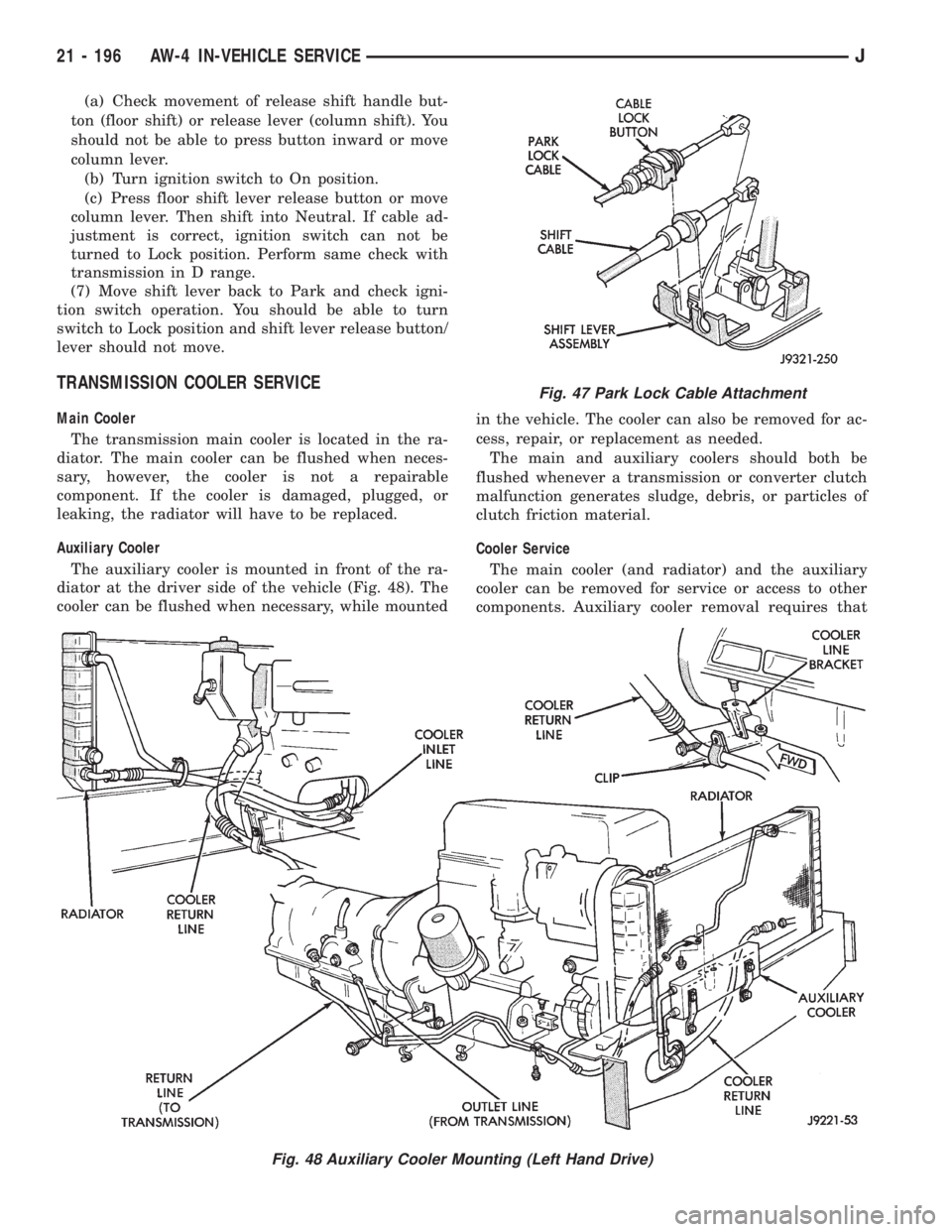
The auxiliary cooler is mounted in front of the ra-
diator at the driver side of the vehicle (Fig. 48). The
cooler can be flushed when necessary, while mountedin the vehicle. The cooler can also be removed for ac-
cess, repair, or replacement as needed.
The main and auxiliary coolers should both be
flushed whenever a transmission or converter clutch
malfunction generates sludge, debris, or particles of
clutch friction material.
Cooler Service
The main cooler (and radiator) and the auxiliary
cooler can be removed for service or access to other
components. Auxiliary cooler removal requires that
Fig. 47 Park Lock Cable Attachment
Fig. 48 Auxiliary Cooler Mounting (Left Hand Drive)
21 - 196 AW-4 IN-VEHICLE SERVICEJ