1995 HONDA ODYSSEY tailgate
[x] Cancel search: tailgatePage 5 of 240
Your Occupant Protection System
Your Honda is equipped with seat belts and other features that worktogether to protect you and your
passenger during a crash.
Seat belts are the most important
part of your occupant protection system. When worn properly, seat
belts can reduce the chance of serious injury or death in a crash.
For added protection during a severe
frontal collision, your Odyssey has a Supplemental Restraint System (SRS) with airbags for the driver and
a front seat passenger. Two indicator lights are also part of
your safety system. One reminds youto make sure you and your passen-
gers wear seat belts. The otheralerts you to a possible problem with
your supplemental restraint system (see page 16).
The seats, head restraints, and door locks also play a role in occupantsafety. For example, reclining the
seat-back can decrease the effec-
tiveness of your seat belt. Head
restraints can help protect your neck and head, especially during rear-end
impacts. Door locks help keep your doors from being accidentally
opened during a crash. To get the maximum protection from
your occupant protection system, check the following before you drive
away:
Everyone in the car is wearing aseat belt properly (see page 7). Infants and small children are
properly secured in child safety seats (see page 20). All doors and the tailgate are
closed and locked (see page 19). Seat-backs are upright and head
restraints are properly adjusted
(see pages 18 and 56).
There are no loose items that could be thrown around and hurtsomeone during a crash or sudden
stop (see page 19).
By following these guidelines, you
can reduce injuries to yourself and
your passengers in many crash situations. Remember, however, that
no safety system can prevent all
injuries or deaths that can occur in severe crashes.
Driver and Passenger SafetyProCarManuals.comMain Menu Table of Contents s t
Page 27 of 240
Child Safety
Using Child Restraints with
Tethers
U.S. Models
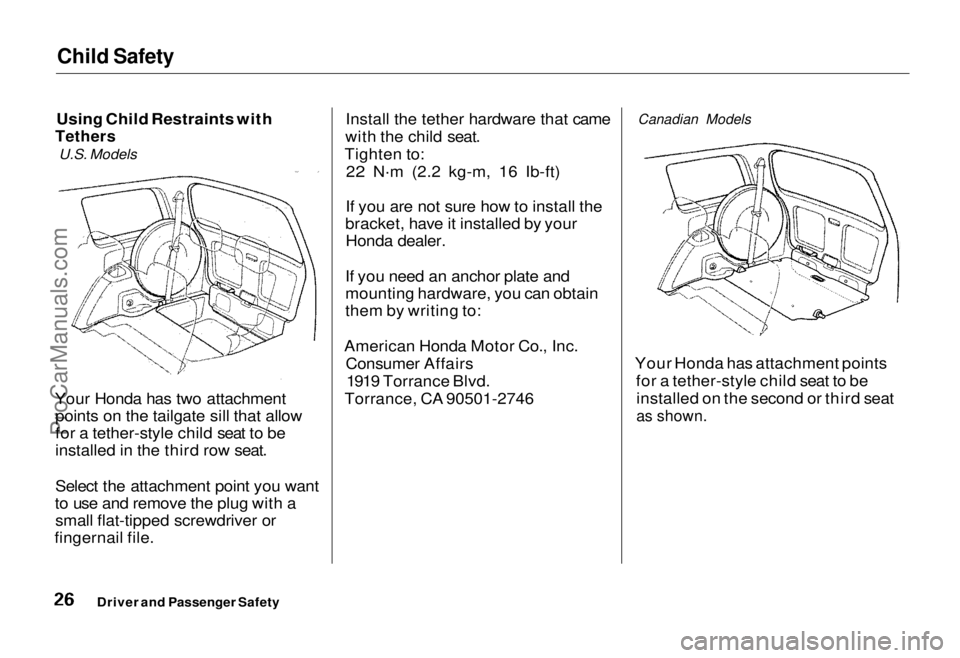
Your Honda has two attachment points on the tailgate sill that allow
for a tether-style child seat to be
installed in the third row seat.
Select the attachment point you want
to use and remove the plug with a small flat-tipped screwdriver or
fingernail file. Install the tether hardware that came
with the child seat.
Tighten to:
22 N .
m (2.2 kg-m, 16 Ib-ft)
If you are not sure how to install the
bracket, have it installed by your Honda dealer.
If you need an anchor plate and
mounting hardware, you can obtain
them by writing to:
American Honda Motor Co., Inc. Consumer Affairs1919 Torrance Blvd.
Torrance, CA 90501-2746
Canadian Models
Your Honda has attachment points for a tether-style child seat to beinstalled on the second or third seat
as shown.
Driver and Passenger Safety
ProCarManuals.comMain Menu Table of Contents s t
Page 28 of 240
Child Safety
Second Seat Installation:
There are three attachment points available for the seven-passenger
model, and two attachment points
available for the six-passenger model.
To install a child seat in the second seat, fold the third seat into the floor
recess (see page 62). You will find a
U-shaped slit
in the carpeting at each
attachment point. Select the attach-
ment point you want to use, and pull
up the carpeting at the slit.
Third Seat Installation:
There are two attachment points onthe tailgate sill. Select the attach-
ment point you want use, and
remove the plug with a small flat-
tipped screwdriver or a fingernail file.
Install the tether hardware that came
with the child seat.
Tighten to:
22 N .
m (2.2 kg-m, 16 Ib-ft)
If you are not sure how to install the
bracket, have it installed by your Honda dealer. Storing a Child Seat
When you are not using an infant seat or other child restraint, either
remove it or make sure it is properly secured so it cannot be thrown
around the car during a crash.
Driver and Passenger Safety
ProCarManuals.comMain Menu Table of Contents s t
Page 30 of 240
Carbon Monoxide Hazard
Your car's exhaust contains carbon monoxide gas. You should have no
problem with carbon monoxide
entering the car in normal driving if
you maintain your car properly. Have the exhaust system inspected
for leaks whenever:
The car is raised for an oil change.
You notice a change in the soundof the exhaust.
The car was in an accident that may have damaged the underside.
Carbon monoxide gas is toxic.Breathing it can cause
unconsciousness and can even
kill you.
Avoid any enclosed areas or activities that expose you to
carbon monoxide. High levels of carbon monoxide can
collect rapidly in enclosed areas,
such as a garage. Do not run the
engine with the garage door closed.
Even with the door open, run the
engine only long enough to move thecar out of the garage.
With the tailgate open, air flow can pull exhaust gas into your car's
interior and create a hazardous
condition. If you must drive with the
tailgate open, open all the windowsand set the heating and cooling
system as follows. If you must sit in your parked car,
even in an unconfined area, with the
engine running, adjust the heating
and cooling system as follows: 1. Push the button.
2. Select the mode.
3. Turn the fan on high speed.
4. Set the temperature control to a
comfortable setting.
Driver and Passenger SafetyProCarManuals.comMain Menu Table of Contents s t
Page 33 of 240
Instruments and Controls
This section gives information about the controls and displays thatcontribute to the daily operation of
your Honda. All the essential controls are within easy reach.
Control Locations............................ 34
Indicator Lights................................ 35
Gauges............................................. 39
Speedometer............................... 39
Trip Meter................................... 39
Odometer..................................... 39
Temperature Gauge................... 40
Fuel Gauge.................................. 40
Maintenance Required
Indicator................................... 40
Controls Near the Steering Wheel...................................... 41
Headlights...................................
42
Daytime Running
Lights............ 42
Instrument Panel Brightness.... 43
Turn Signals................................. 43
Windshield Wipers...................... 44
Windshield Washers................... 44 Rear Window Wiper and Washer...................................... 45
Hazard Warning.......................... 45
Rear Window Defogger.............. 45
Steering Wheel Adjustment....... 46
Steering Wheel Controls ................ 48 Cruise Control.............................. 48
Horn............................................. 51
Keys and Locks................................ 51
Keys............................................... 51
Ignition Switch............................. 52
Power Door Locks....................... 53Remote Transmitter.................... 54
Childproof Door Locks............... 54
Tailgate......................................... 55 Glove Box..................................... 55
Seats................................................. 56
Passenger Seating...................... 56
Seat Adjustments........................ 56
Driver's Seat Power HeightAdjustment.............................. 57
Head Restraints.......................... 58
Third Seat Access....................... 58 Removing the Second Seats
in the Six-Passenger Model.... 59
Folding the Second Seats in the Seven-Passenger
Model................................... 60
Reclining the Second Seat.......... 61
Folding the Third Seat in All Models...........................
62
Power Windows.............................. .
64
Sunroof............................................. 65
Mirrors............................................. 66
Adjusting the Power Mirrors.....
67
Parking Brake.................................
68
Digital Clock..................................... 68
Beverage Holder.............................. 69 Dashboard Compartment............... 70
Center Poket.................................... 71
Coin Box........................................... 71
Vanity Mirror................................... 71
Cigarette Lighter............................. 72
Ashtrays........................................... 72
Interior Lights.................................. 73
Ceiling Lights.............................. 73
Spotlights..................................... 73
Tailgate Light............................... 74 Courtesy Lights........................... 74
Instruments and ControlsProCarManuals.comMain Menu s t
Page 37 of 240
Indicator Lights
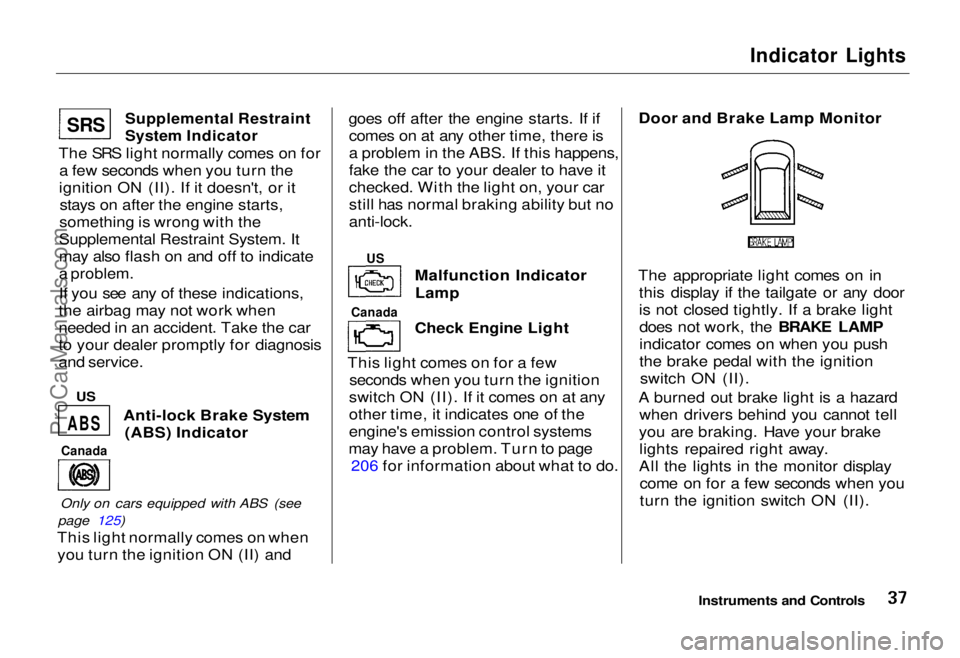
Supplemental Restraint
System Indicator
The SRS light normally comes on for a few seconds when you turn the
ignition ON (II). If it doesn't, or it stays on after the engine starts,
something is wrong with the
Supplemental Restraint System. It
may also flash on and off to indicate
a problem.
If you see any of these indications,
the airbag may not work when
needed in an accident. Take the car
to your dealer promptly for diagnosis
and service.
Anti-lock Brake System(ABS) Indicator
Only on cars equipped with ABS (see
page 125)
This light normally comes on when you turn the ignition ON (II) and goes off after the engine starts. If if
comes on at any other time, there is
a problem in the ABS. If this happens,
fake the car to your dealer to have it
checked. With the light on, your car
still has normal braking ability but no
anti-lock.
Malfunction IndicatorLamp
Check Engine Light
This light comes on for a few seconds when you turn the ignition
switch ON (II). If it comes on at any
other time, it indicates one of the
engine's emission control systems
may have a problem. Turn to page 206 for information about what to do. Door and Brake Lamp Monitor
The appropriate light comes on in this display if the tailgate or any door
is not closed tightly. If a brake lightdoes not work, the BRAKE LAMP
indicator comes on when you push
the brake pedal with the ignition switch ON (II).
A burned out brake light is a hazard when drivers behind you cannot tell
you are braking. Have your brake lights repaired right away.
All the lights in the monitor display come on for a few seconds when you
turn the ignition switch ON (II).
Instruments and Controls
Canada
ABS
Canada
US
SR
S
US
ProCarManuals.comMain Menu Table of Contents s t
Page 51 of 240
Steering Wheel Controls, Keys and Locks
Horn
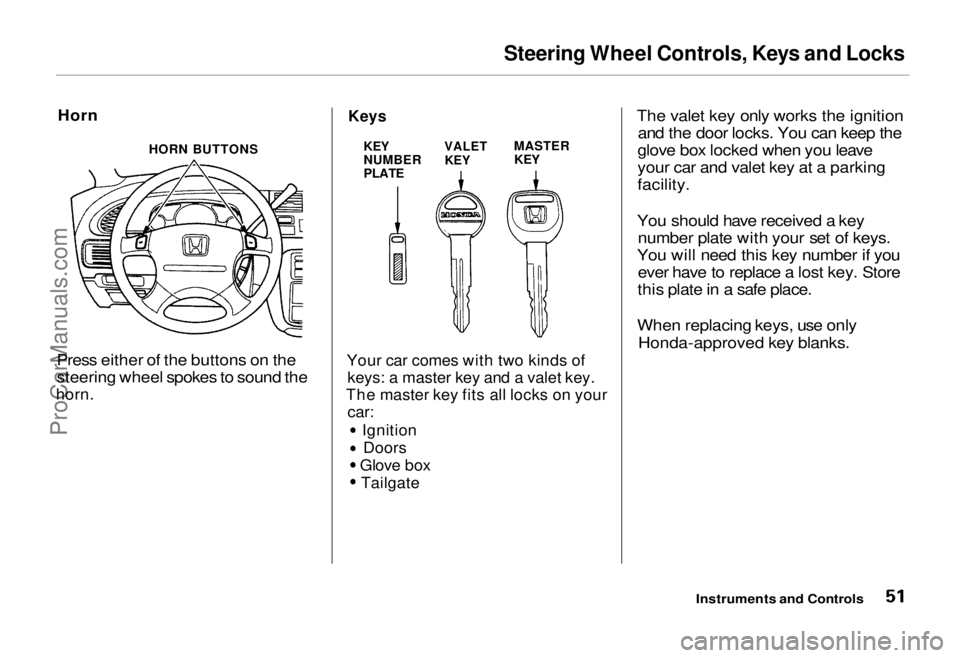
Press either of the buttons on the
steering wheel spokes to sound the
horn.
Keys
Your car comes with two kinds of
keys: a master key and a valet key.
The master key fits all locks on your
car:
IgnitionDoors
Glove box Tailgate
The valet key only works the ignition
and the door locks. You can keep the
glove box locked when you leave
your car and valet key at a parking
facility.
You should have received a key number plate with your set of keys.
You will need this key number if you ever have to replace a lost key. Store
this plate in a safe place.
When replacing keys, use only Honda-approved key blanks.
Instruments and Controls
HORN BUTTONS
KEY
NUMBER
PLATE
VALET
KEY
MASTER
KEYProCarManuals.comMain Menu Table of Contents s t
Page 53 of 240
Keys and Locks
Power Door Locks
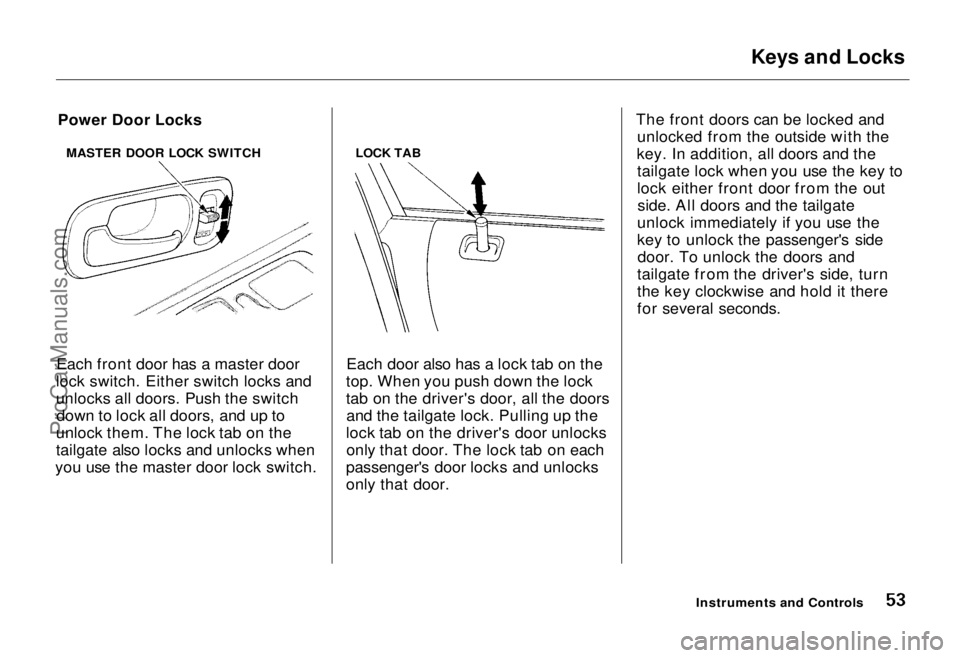
Each front door has a master door
lock switch. Either switch locks and
unlocks all doors. Push the switch down to lock all doors, and up to
unlock them. The lock tab on the
tailgate also locks and unlocks when
you use the master door lock switch. LOCK TAB
Each door also has a lock tab on the
top. When you push down the lock
tab on the driver's door, all the doors and the tailgate lock. Pulling up the
lock tab on the driver's door unlocks only that door. The lock tab on each
passenger's door locks and unlocks
only that door. The front doors can be locked and
unlocked from the outside with the
key. In addition, all doors and the tailgate lock when you use the key to
lock either front door from the outside. All doors and the tailgate
unlock immediately if you use the
key to unlock the passenger's side door. To unlock the doors and
tailgate from the driver's side, turn
the key clockwise and hold it there
for several seconds.
Instruments and Controls
MASTER DOOR LOCK SWITCHProCarManuals.comMain Menu Table of Contents s t