1995 HONDA ODYSSEY wheel
[x] Cancel search: wheelPage 127 of 240
Driving in Bad Weather
Visibility — Being able to see clearly in all directions and being
visible to other drivers are important in all weather conditions. This is
more difficult in bad weather. To be
seen more clearly during daylight
hours, turn on your headlights.
Inspect your windshield wipers and
washers frequently. Keep the wind- shield washer reservoir full of the
proper fluid. Have the windshield
wiper blades replaced if they start to streak the windshield or leave parts
unwiped. Use the defrosters and air conditioning to keep the windows
from fogging up on the inside (see page 82). Traction — Check your tires
frequently for wear and properpressure. Both are important in
preventing "hydroplaning" (loss of
traction on a wet surface). In the
winter, mount snow tires on all four
wheels for the best handling.
Watch road conditions carefully, they can change from moment to
moment. Wet leaves can be as slip-
pery as ice. "Clear" roads can have
patches of ice. Driving conditions
can be very hazardous when theoutside temperature is near freezing.
The road surface can become covered with areas of water puddles
mixed with areas of ice, so your
traction can change without warning.
Be careful when downshifting. If
traction is low, you can lock up the drive wheels for a moment and cause
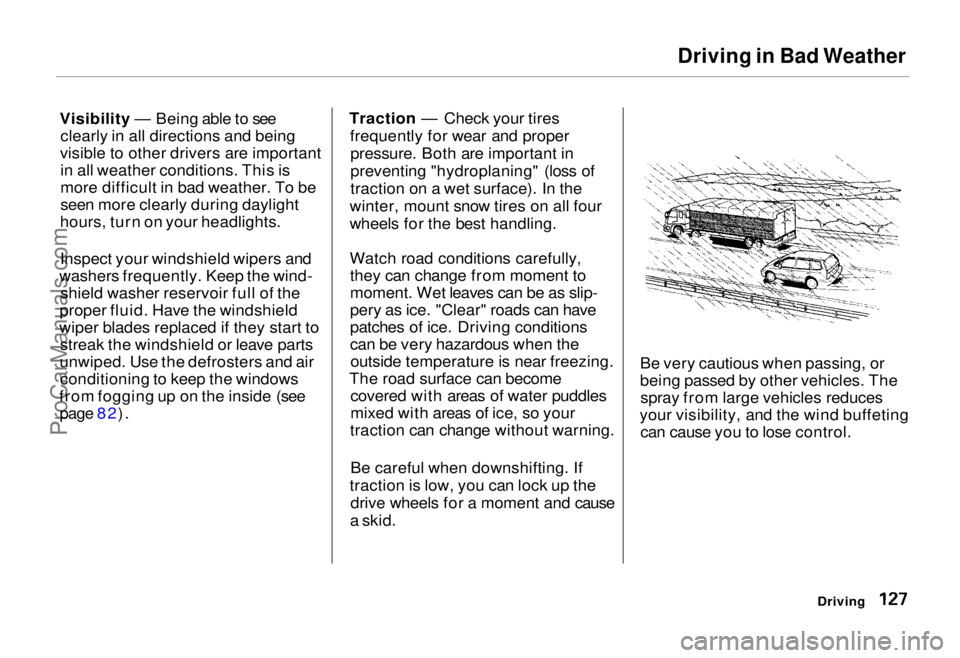
a skid. Be very cautious when passing, or
being passed by other vehicles. The
spray from large vehicles reduces
your visibility, and the wind buffeting can cause you to lose control.
DrivingProCarManuals.comMain Menu Table of Contents s t
Page 133 of 240

Towing a Trailer
If you have to stop while going uphill, do not hold the car in place by
pressing on the accelerator. This can cause the automatic transmission to
overheat. Use the parking brake or
footbrake.
When parking your car and trailer, especially on a hill, be sure to follow
all the normal precautions. Turn
your front wheels into the curb, set the parking brake firmly, and put thetransmission in Park. In addition,
place wheel chocks at each of the
trailer's tires. Backing up with a trailer is difficult
and takes practice. Drive slowly,
make small movements with the
steering wheel, and have someone
stand outside to guide you. Grip the
steering wheel on the bottom (rather
than the usual position near the top). Move your hand to the left to get the
trailer to move to the left, and right
to move the trailer right.
DrivingProCarManuals.comMain Menu Table of Contents s t
Page 134 of 240
Maintenance
This section explains why it is important to keep your car well
maintained and to follow basic
maintenance safety precautions.
This section also includes Maintenance Schedules for normal
driving and severe driving conditions,
a Maintenance Record, and
instructions for simple maintenance
tasks you may want to take care of
yourself.
If you have the skills and tools
required to perform more complex
maintenance tasks on your Honda,
you may want to purchase the Service Manual. See page 233 for
information on how to obtain a copy, or see your Honda dealer.
Maintenance Safety....................... 136
Maintenance Schedule.................. 138
Maintenance Record..................... 142
Periodic Checks............................. 144
Fluid Locations............................... 145
Engine Oil....................................... 146
Checking Engine Oil................. 146
Adding......................................... 146
Recommended Oil..................... 147
Additives..................................... 148
Oil and Filter Changes.............. 148
Cooling System.............................. 150
Checking the Engine Coolant
Level........................................ 150
Adding Engine Coolant............. 151
Replacing Engine Coolant........ 152
Windshield Washers..................... 154
Automatic Transmission Fluid..... 155
Brake Fluid..................................... 156
Brake System............................. 156
Anti-lock Brake System............ 157
Power Steering............................... 157
Air Cleaner..................................... 158
Spark Plugs..................................... 160
Replacement............................... 160
Specification............................... 161
Battery............................................ 162
Windshield Wipers........................ 165
Air Conditioning............................. 168 Drive Belts...................................... 169
Tires................................................ 169 Inflation....................................... 170
Inspection................................... 171
Maintenance............................... 171
Tire Rotation.............................. 172 Replacing Tires and Wheels .... 172
Wheels and Tires....................... 173
Winter Driving........................... 173 Snow Tires.............................. 174
Tire Chains............................. 174
Lights.............................................. 175 Headlight Aiming...................... 175
Replacing Bulbs......................... 177
Storing Your Car............................ 182
MaintenanceProCarManuals.comMain Menu s t
Page 156 of 240
Brake Fluid, Power Steering
Anti-lock Brake System
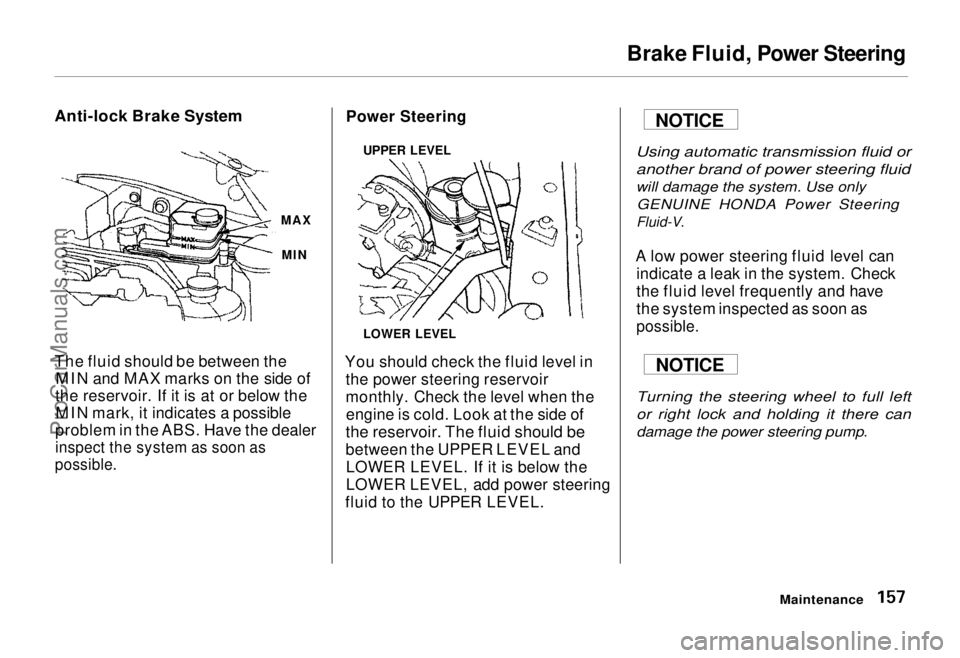
The fluid should be between the MIN and MAX marks on the side of
the reservoir. If it is at or below the MIN mark, it indicates a possible
problem in the ABS. Have the dealer
inspect the system as soon as
possible.
Power Steering
You should check the fluid level in the power steering reservoir
monthly. Check the level when theengine is cold. Look at the side of
the reservoir. The fluid should be
between the UPPER LEVEL and LOWER LEVEL. If it is below the
LOWER LEVEL, add power steering
fluid to the UPPER LEVEL. A low power steering fluid level can
indicate a leak in the system. Check
the fluid level frequently and have
the system inspected as soon as
possible.
Maintenance
NOTICETurning the steering wheel to full left
or right lock and holding it there can
damage the power steering pump.
NOTICE
UPPER LEVE
L
MAX MIN
LOWER LEVEL
Using automatic transmission fluid or
another brand of power steering fluid
will damage the system. Use only
GENUINE HONDA Power Steering
Fluid-V.
ProCarManuals.comMain Menu Table of Contents s t
Page 170 of 240
Tires
You should get your own tire pressure gauge and use it whenever
you check your tire pressures. This
will make it easier for you to tell if a pressure loss is due to a tire problemand not due to a variation between
gauges.
Tubeless tires have some ability to self-seal if they are punctured.
However, because leakage is often
very slow, you should look closely for punctures if a tire starts losing
pressure.
Inspection
Every time you check inflation, you
should also examine the tires for
damage, foreign objects, and wear. You should look for:
Bumps or bulges in the tread orside of the tire. Replace the tire if
you find either of these conditions.
Cuts, splits, or cracks in the side
of the tire. Replace the tire if you
can see fabric or tread.
Excessive tread wear.
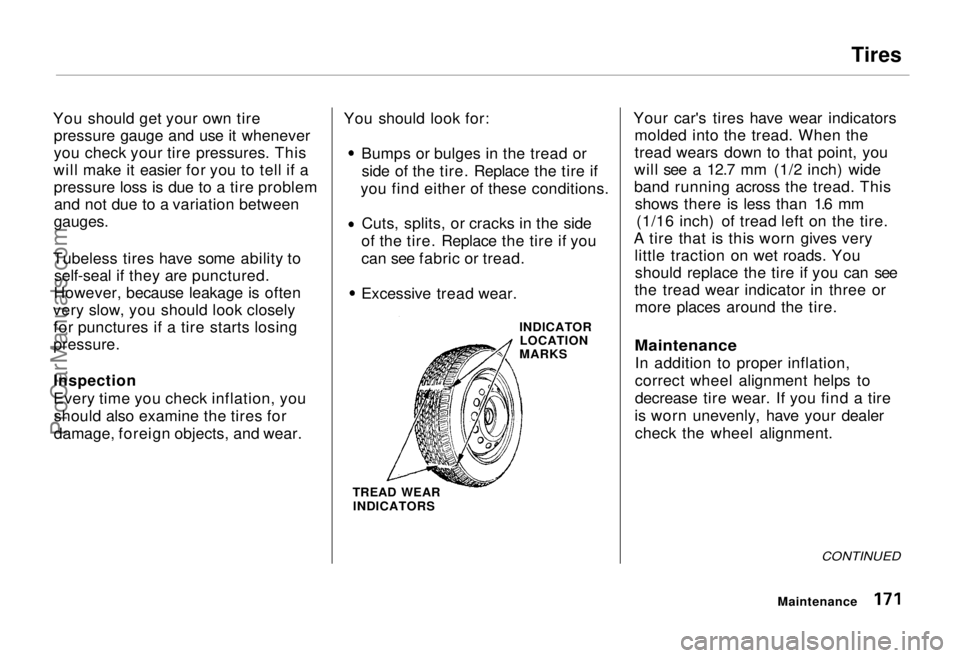
INDICATORLOCATION
MARKS
TREAD WEAR INDICATORS Your car's tires have wear indicators
molded into the tread. When the
tread wears down to that point, you
will see a 12.7 mm (1/2 inch) wide
band running across the tread. This shows there is less than 1.6 mm (1/16 inch) of tread left on the tire.
A tire that is this worn gives very little traction on wet roads. Youshould replace the tire if you can see
the tread wear indicator in three or more places around the tire.
Maintenance
In addition to proper inflation,
correct wheel alignment helps to
decrease tire wear. If you find a tire
is worn unevenly, have your dealer check the wheel alignment.
CONTINUED
MaintenanceProCarManuals.comMain Menu Table of Contents s t
Page 171 of 240
Tires
The tires were properly balanced by the factory. They may need to be
rebalanced at some time before theyare worn out. Have your dealer
check the tires if you feel a consis-
tent vibration while driving. A tire should always be rebalanced if it is
removed from the wheel for repair.
Make sure the installer balances the
wheels when you have new tires
installed. This increases riding comfort and tire life. Your car's
original tires were dynamic or "spin"
balanced at the factory. For best results, have the installer perform adynamic balance.
(US:
EX)
Improper wheel weights can damage
your car's aluminum wheels. Use only
genuine Honda wheel weights for
balancing.
Tire Rotation
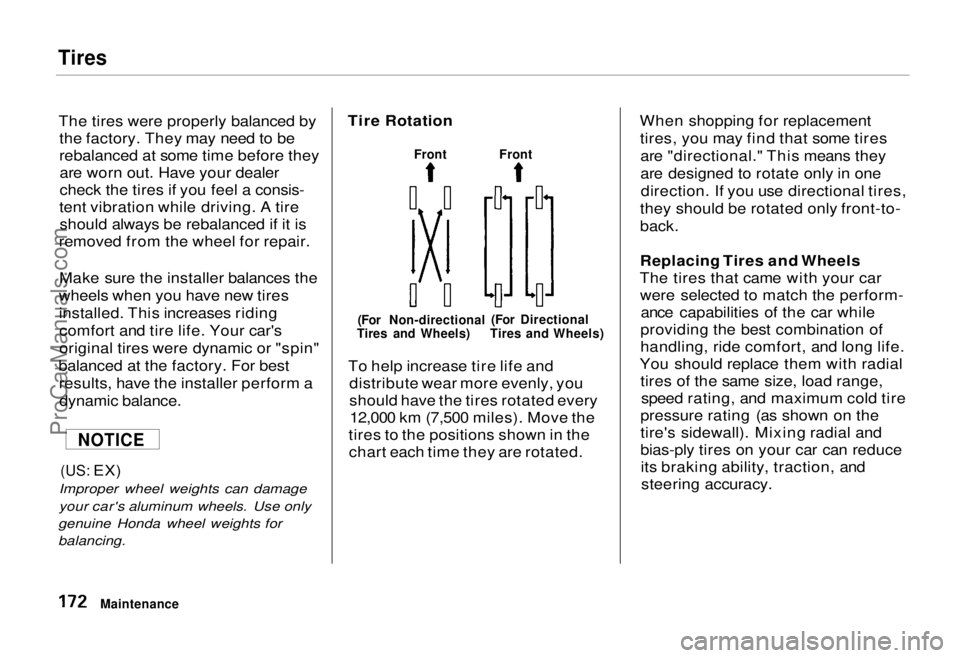
To help increase tire life and distribute wear more evenly, you
should have the tires rotated every12,000 km (7,500 miles). Move the
tires to the positions shown in the chart each time they are rotated. When shopping for replacement
tires, you may find that some tiresare "directional." This means they
are designed to rotate only in onedirection. If you use directional tires,
they should be rotated only front-to-
back.
Replacing Tires and Wheels
The tires that came with your car were selected to match the perform- ance capabilities of the car while
providing the best combination of
handling, ride comfort, and long life.
You should replace them with radial tires of the same size, load range,speed rating, and maximum cold tire
pressure rating (as shown on the
tire's sidewall). Mixing radial and
bias-ply tires on your car can reduce its braking ability, traction, andsteering accuracy.
Maintenance
NOTICE
Front
Front
(For Non-directional
Tires and Wheels) (For Directional
Tires and Wheels)ProCarManuals.comMain Menu Table of Contents s t
Page 172 of 240
Tires
It is best to replace all four tires at
the same time. If that is not possible
or necessary, then replace the two
front tires or the two rear tires as a
pair. Replacing just one tire can seriously affect your car's handling.
The ABS works by comparing the speed of the wheels. When replacing
tires, use the same size originally supplied with the car. Tire size and
construction can affect wheel speed
and may cause the system to work in-
consistently. If you ever need to replace a wheel,
make sure the wheel's specifications
match those of the original wheel
that came on your car. Replacement
wheels are available at your Honda
dealer.
Wheels and Tires Wheel:15 x 6JJ
Tire:
P205/65R15 92S
See Tire Information on page 221 for
additional information about tire and
wheel size designations. See page 222 for information about DOT Tire
Quality Grading.
Winter Driving
Tires that are marked "M + S" or
"All Season" on the sidewall have an
all-weather tread design. Theyshould be suitable for most winter
driving conditions. Tires without
these markings are designed for optimum traction in dry conditions.
They may not provide adequate performance in winter driving.
For the best performance in snowyor icy conditions, you should install
snow tires or tire chains. They may
be required by local laws under
certain conditions.
CONTINUED
Maintenance
installing improper tires on your
car can affect handling and
stability. This can cause a crash in which you can be seriously
hurt or killed.
Always use the size and type of
tires recommended in this owner's manual.
ProCarManuals.comMain Menu Table of Contents s t
Page 173 of 240
Tires
Snow Tires
If you mount snow tires on your
Honda, make sure they are radial
tires of the same size and load range as the original tires. Mount snow
tires on all four wheels to balance
your car's handling in all weather conditions. Keep in mind the traction
provided by snow tires on dry roads
may not be as high as your car's original equipment tires. You should
drive cautiously even when the roads
are clear. Check with the tire dealer
for maximum speed recommenda- tions.
Tire Chains
Mount snow chains on your car
when warranted by driving condi- tions or required by local laws. Makesure the chains are the correct size
for your tires. Install them only on the front tires. If metal chains are
used, they must be SAE class "S".Cable type traction devices can also
be used. When installing chains, follow the
manufacturer's instructions and
mount them as tightly as you can.
Drive slowly with chains installed. If
you hear the chains contacting the body or chassis, stop and tightenthem. If they still make contact, slow
down until it stops. Remove the
chains as soon as you begin drivingon cleared roads.
Chains of the wrong size or that are
improperly installed can damage your
car's brake lines, suspension, body, and wheels. Stop driving if you hear the
chains hitting any part of the car.
Maintenance
NOTICEProCarManuals.comMain Menu Table of Contents s t