Page 193 of 488
If you decide you can go down a hill safely, then try to keep your vehicle
headed straight down, and use a low gear. This way, engine drag can help
your brakes and they won’t have to do all
the work. Descend slowly,
keeping your vehicle under control at all times.
A CAUTION:
Heavy braking when going down a hill can cause your brakes to
overheat and fade. This could cause
loss of control and a serious
accident. Apply the brakes lightly when descending
a hill and
use a low gear to keep vehicle speed under control.
Q: Are there some things I should not do when driving down a hill?
A: Yes! These are important because if you ignore them you could lose
control and have a serious accident.
When driving downhill, avoid turns that take you across the incline of
the hill. A hill that’s not too steep to drive down may be too steep to
drive across.
You could roll over if you don’t drive straight down.
Never go downhill with the transmission in NEUTRAL (N) , or with
the clutch pedal depressed in a manual shift
. This is called
“free-wheeling.” Your brakes will have to do all the work and could
overheat and fade.
Q: Am I likely to stall when going downhill?
A: It’s much more likely to happen going uphill. But if it happens going
downhill, here’s what
to do.
0 Stop your vehicle by applying the regular brakes. Apply the parking
brake.
Shift to PARK (P) (or to Neutral with the manual transmission) and,
while still braking, restart the engine.
down.
Shift back to a low gear, release the parking brake, and drive straight
If the engine won’t start, get out and get help.
4- 19
ProCarManuals.com
Page 209 of 488
Power Take-Off (PTO)
NOTICE:
If you have a PTO that will exceed 35 horsepower installed on
your vehicle, it could damage the transfer case or transmission.
When having
a PTO installed on your vehicle, make sure that it
will not exceed 35 horsepower.
Before using a power take-off, refer to the manufacturer’s or installer’s
instructions.
NOTICE:
Using a PTO while operating in one place before the vehicle has
reached normal operating temperature can damage the transfer
case or transmission.
If you will be using the PTO while
operating in one place, drive and warm up the vehicle before
using the PTO.
To engage a power take-off
1. Set the parking brake.
2. Shift the transmission into NEUTRAL (N).
3. Hold the clutch pedal down and engage the power take-off.
I NOTICE:
Using a PTO for more than four hours without driving your
vehicle can damage the transfer case or transmission.
If using a
PTO for more than four hours without dr$ving your vehicle,
drive your vehicle for
a while to allow the transfer case and
transmission to cool.
If you are going to drive the vehicle, shift the transmission into the gear
you want. Then shift the transfer case into the range you want (if you
have four-wheel drive), apply the regular brakes and release the
parking brake.
4. Release the clutch (and the regular brakes) as you normally would.
When you release the clutch, the power take-off will start.
4-35
ProCarManuals.com
Page 210 of 488
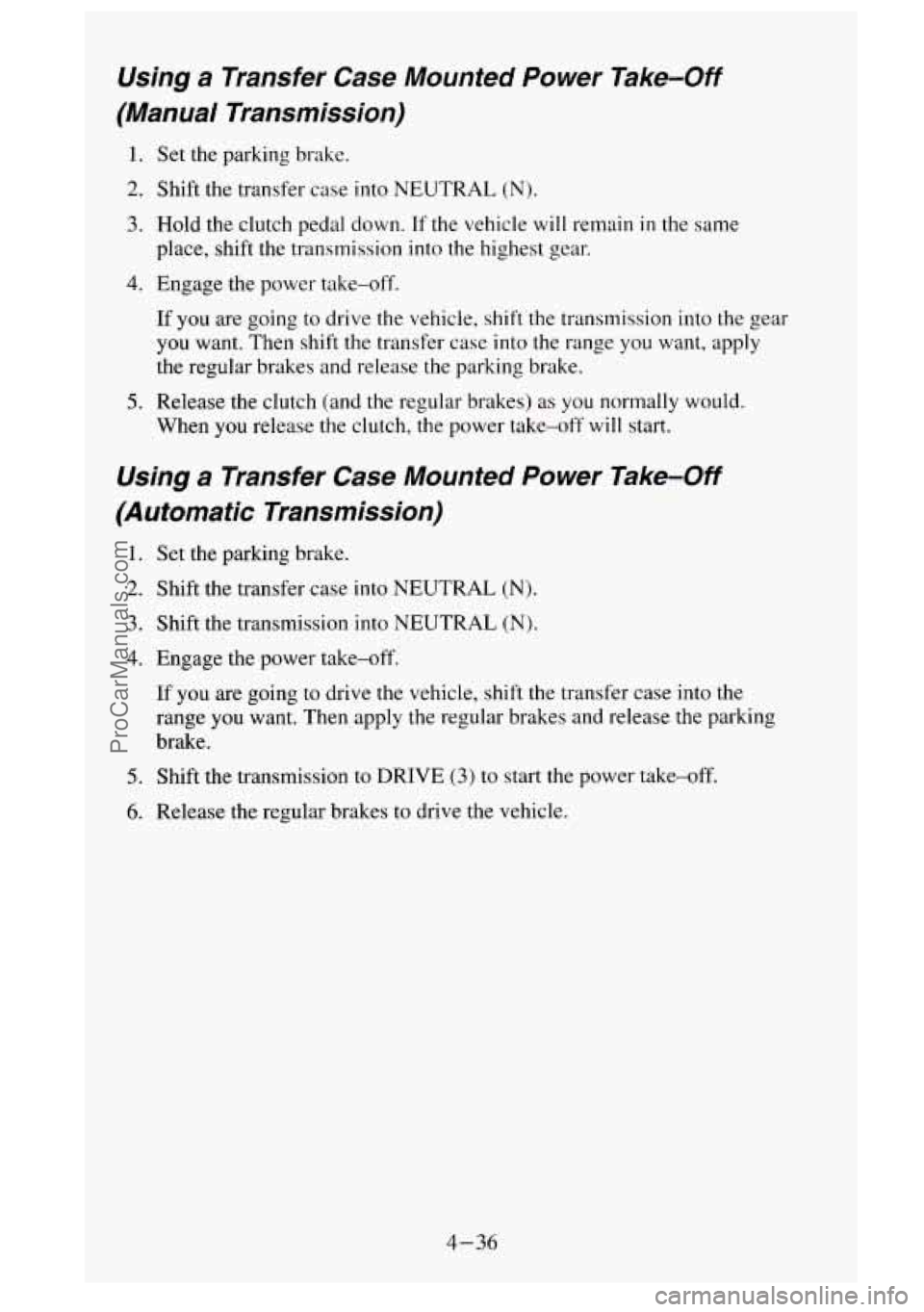
Using a Transfer Case Mounted Power Take-Off
(Manual Transmission)
1. Set the parking brake.
2. Shift the transfer case into NEUTRAL (N).
3. Hold the clutch pedal down. If the vehicle will remain in the same
place, shift the transmission into the highest gear.
4. Engage the power take-off.
If you are going to drive the vehicle, shift the trans~nission into the gear
you want, Then shift the transfer case into the range you want, apply
the regular brakes and release the parking brake.
5. Release the clutch (and the regular brakes) as you normally would.
When
you release the clutch, the power take-off will start.
Using a Transfer Case Mounted Power Take-Off
(Automatic Transmission)
1.
2.
3.
4.
5.
6.
Set the parking brake.
Shift the transfer case into NEUTRAL
(N).
Shift the transmission into NEUTRAL (N).
Engage the power take-off.
If
you are going to drive the vehicle, shift the transfer case into the
range
you want. Then apply the regular brakes and release the parking
brake.
Shift the transmission to DRIVE
(3) to start the power take-off.
Release
the regular brakes to drive the vehicle.
4-36
ProCarManuals.com
Page 249 of 488
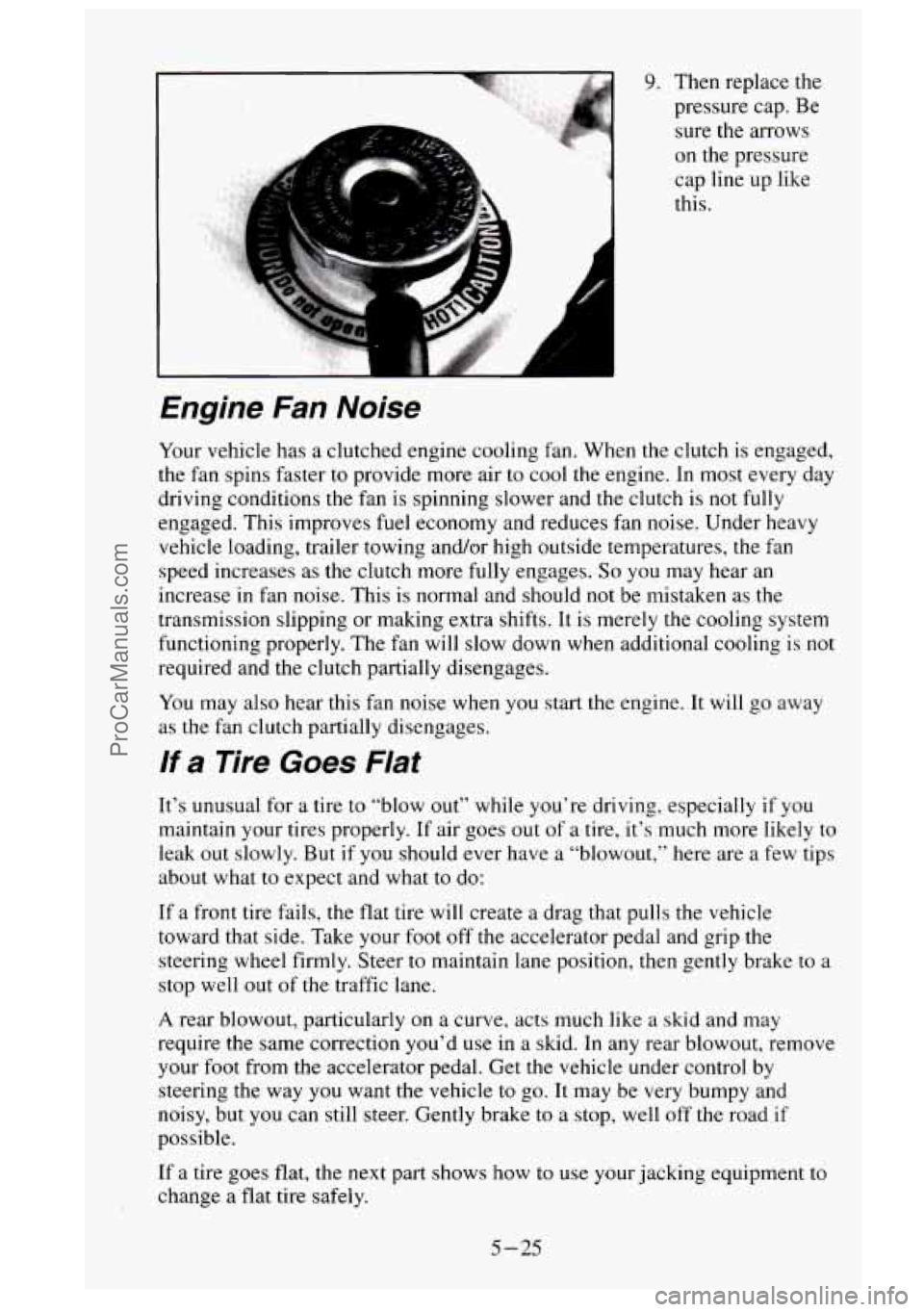
Engine Fan Noise
Your vehicle has a clutched engine cooling fan. When the clutch is engaged,
the fan spins faster
to provide more air to cool the engine. In most every day
driving conditions the fan is spinning slower and the clutch is
not fully
engaged. This improves fuel economy and reduces fan noise. Under heavy
vehicle loading, trailer towing and/or high outside temperatures, the fan
speed increases as the clutch more fully engages.
So you may hear an
increase
in fan noise. This is normal and should not be mistaken as the
transmission slipping or making extra shifts.
It is merely the cooling system
functioning properly. The fan will slow down when additional cooling is not
required and the clutch partially disengages.
You may also hear this fan noise when you start the engine. It will go away
as the
fan clutch partially disengages.
If a Tire Goes Flat
It’s unusual for a tire to “blow out” while you’re driving, especially if you
maintain your tires properly. If air goes out
of a tire, it’s much more likely to
leak out slowly. But if you should ever have a “blowout,” here are a few tips
about what to expect and what to do:
If a front tire fails, the flat tire will create a drag that pulls the vehicle
toward that side. Take your foot
off the accelerator pedal and grip the
steering wheel firmly, Steer
to maintain lane position, then gently brake to a
stop well out of
the traffic lane.
A rear blowout, particularly on a curve, acts much like a skid and may
require the same correction you’d use in a skid. In any rear blowout, remove
your
foot from the accelerator pedal. Get the vehicle under control by
steering the way
you want the vehicle to go. It may be very bumpy and
noisy, but you can still steer. Gently brake to a stop, well
off the road if
possible.
If a tire goes flat, the next part shows how to use your jacking equipment to
change a flat tire safely.
5-25
ProCarManuals.com
Page 281 of 488
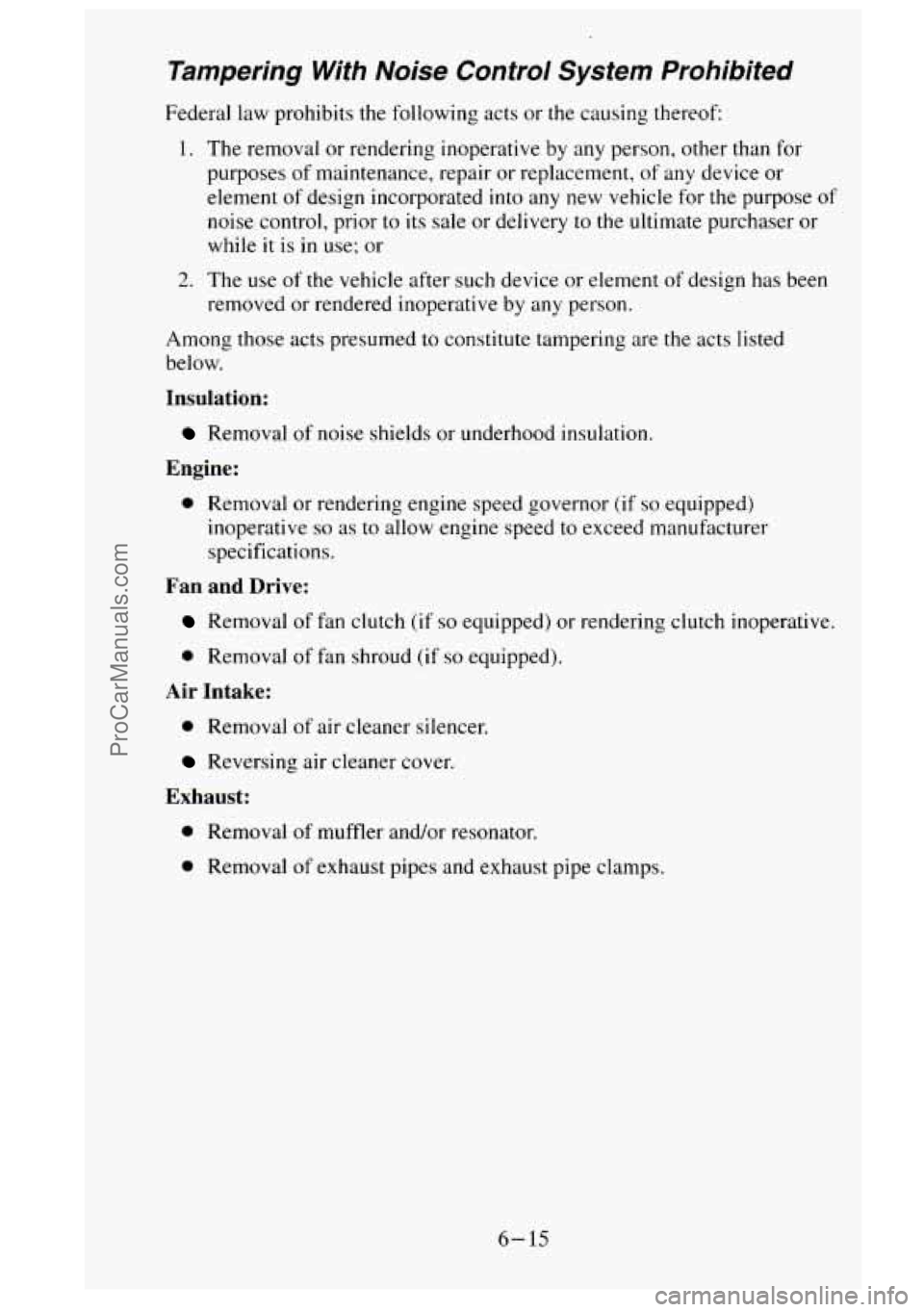
Tampering With Noise Control System Prohibited
Federal law prohibits the following acts or the causing thereof
1. The removal or rendering inoperative by any person, other than for
purposes of maintenance, repair or replacement,
of any device or
element
of design incorporated into any new vehicle for the purpose of
noise control, prior to its sale or delivery to the ultimate purchaser or
while
it is in use; or
2. The use of the vehicle after such device or element of design has been
removed or rendered inoperative by any person.
Among those acts presumed
to constitute tampering are the acts listed
below.
Insulation:
Removal of noise shields or underhood insulation.
Engine:
0 Removal or rendering engine speed governor (if so equipped)
inoperative
so as to allow engine speed to exceed manufacturer
specifications.
Fan and Drive:
Removal of fan clutch (if so equipped) or rendering clutch inoperative.
0 Removal of fan shroud (if so equipped).
Air Intake:
0 Removal of air cleaner silencer.
Reversing air cleaner cover.
Exhaust:
0 Removal of muffler and/or resonator.
0 Removal of exhaust pipes and exhaust pipe clamps.
6- 15
ProCarManuals.com
Page 297 of 488
Then, follow these steps:
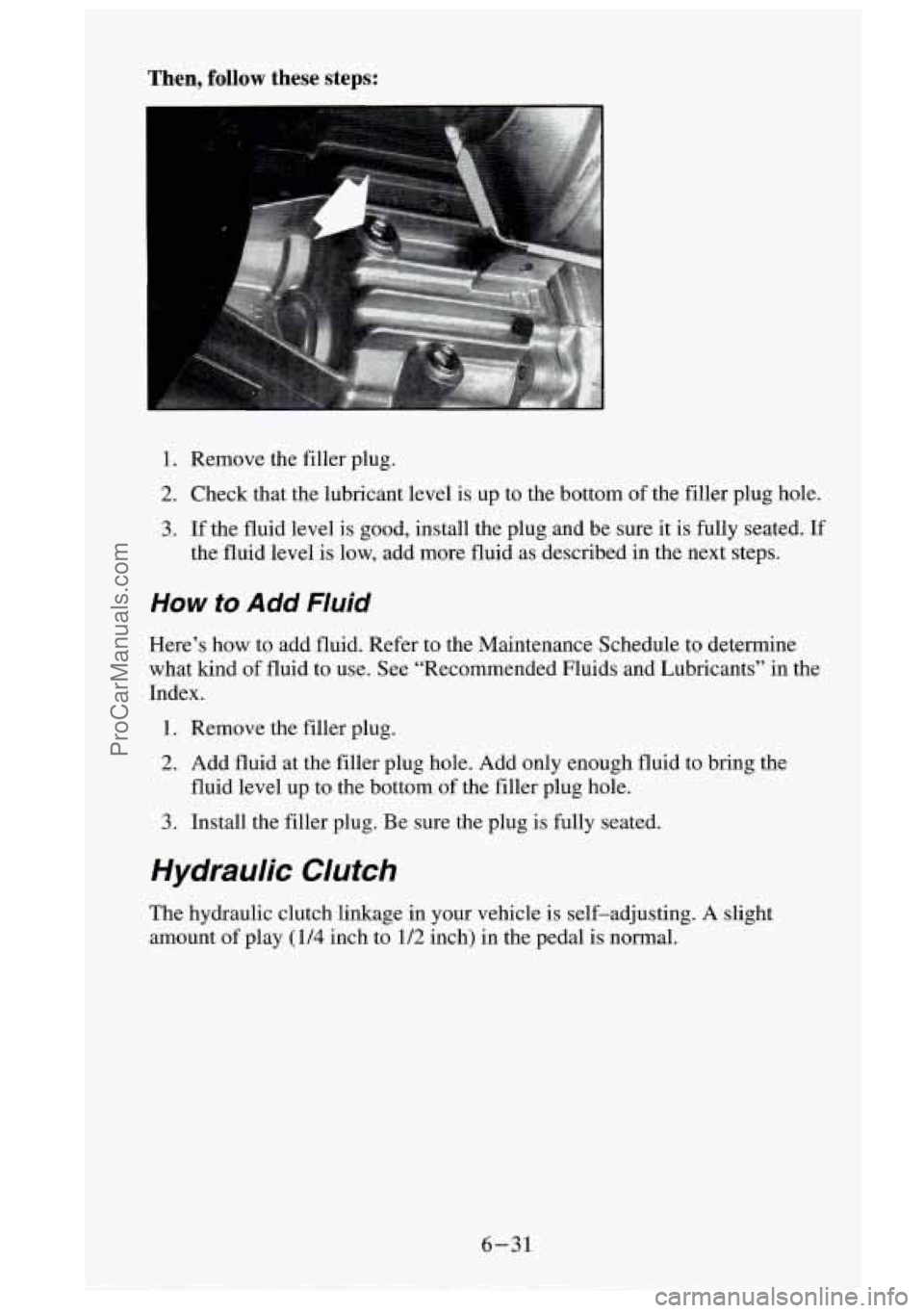
1. Remove the filler plug.
2. Check that the lubricant level is up to the bottom of the filler plug hole.
3. If the fluid level is good, install the plug and be sure it is fully seated. If
the fluid level is low, add more fluid as described in the next steps.
How to Add Fluid
Here’s how to add fluid. Refer to the Maintenance Schedule to determine
what kind of fluid to use. See “Recommended Fluids and Lubricants” in \
the
Index.
1. Remove the filler plug.
2. Add fluid at the filler plug hole. Add only enough fluid to bring the
fluid level up to the bottom of the filler plug hole.
3. Install the filler plug. Be sure the plug is fully seated.
Hydraulic Clutch
The hydraulic clutch linkage in your vehicle is self-adjusting. A slight
amount
of play (1/4 inch to 1/2 inch) in the pedal is normal.
6-31
ProCarManuals.com
Page 298 of 488
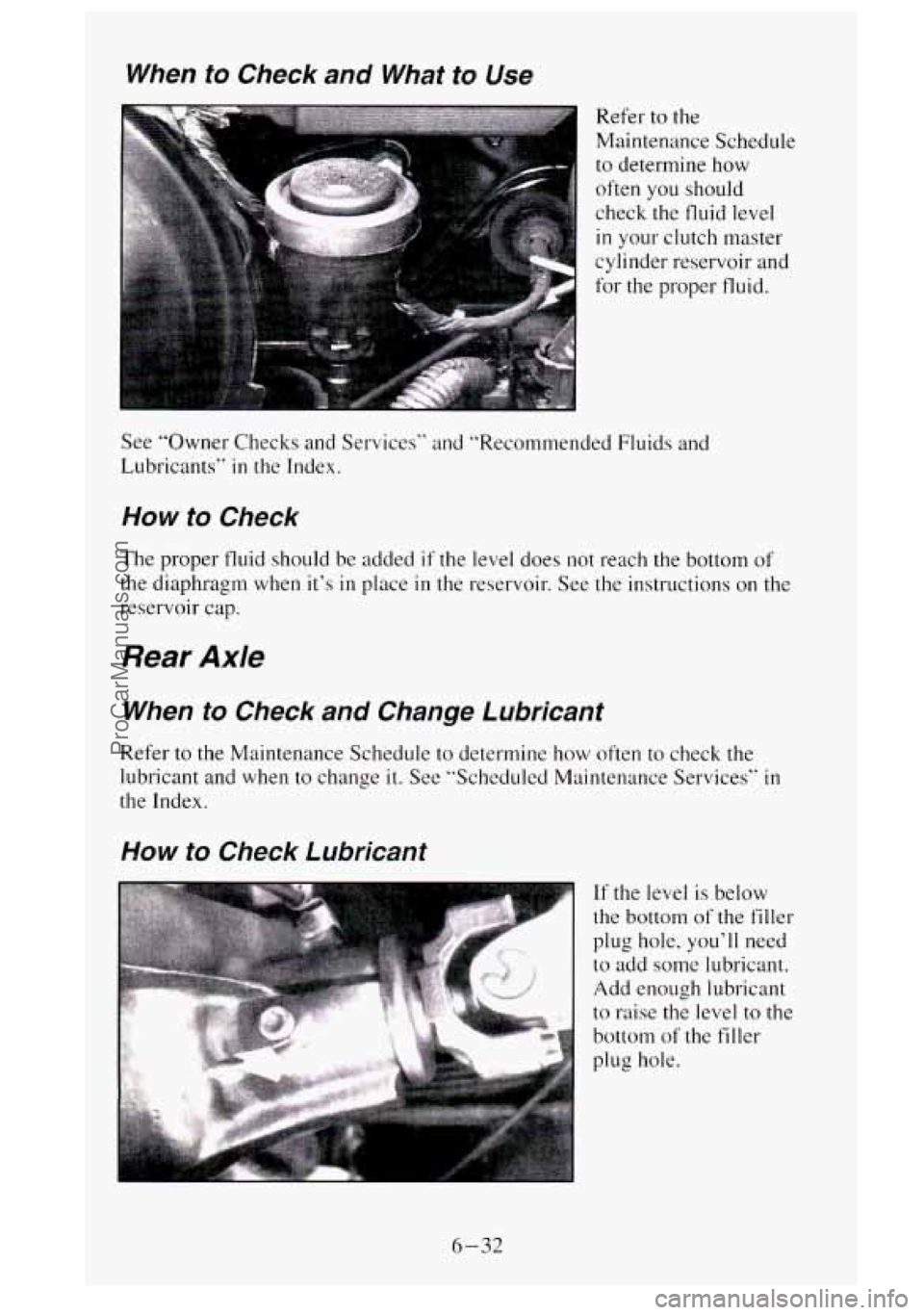
When to Check and What to Use
Refer to the
Maintenance Schedule
to determine how
often
you should
check the
fluid level
in your clutch master
cylinder reservoir and
d for the proper fluid.
See “Owner Checks and Services” and “Recommended Fluids and
Lubricants”
in the Index.
How to Check
The proper fluid should be added if the level does not reach the bottom of
the diaphragm when it’s in place in the reservoir. See the instructions on the
reservoir cap.
Rear Axle
When to Check and Change Lubricant
Refer to the Maintenance Schedule to determine how often to check the
lubricant and when to change
it. See ”Scheduled Maintenance Services’‘ in
the Index.
How to Check Lubricant
If the level is below
the bottom of the filler
plug hole, you’ll need
to add some lubricant.
Add enough lubricant
to raise the level to the
bottom of the filler
plug hole.
6-32
ProCarManuals.com
Page 361 of 488
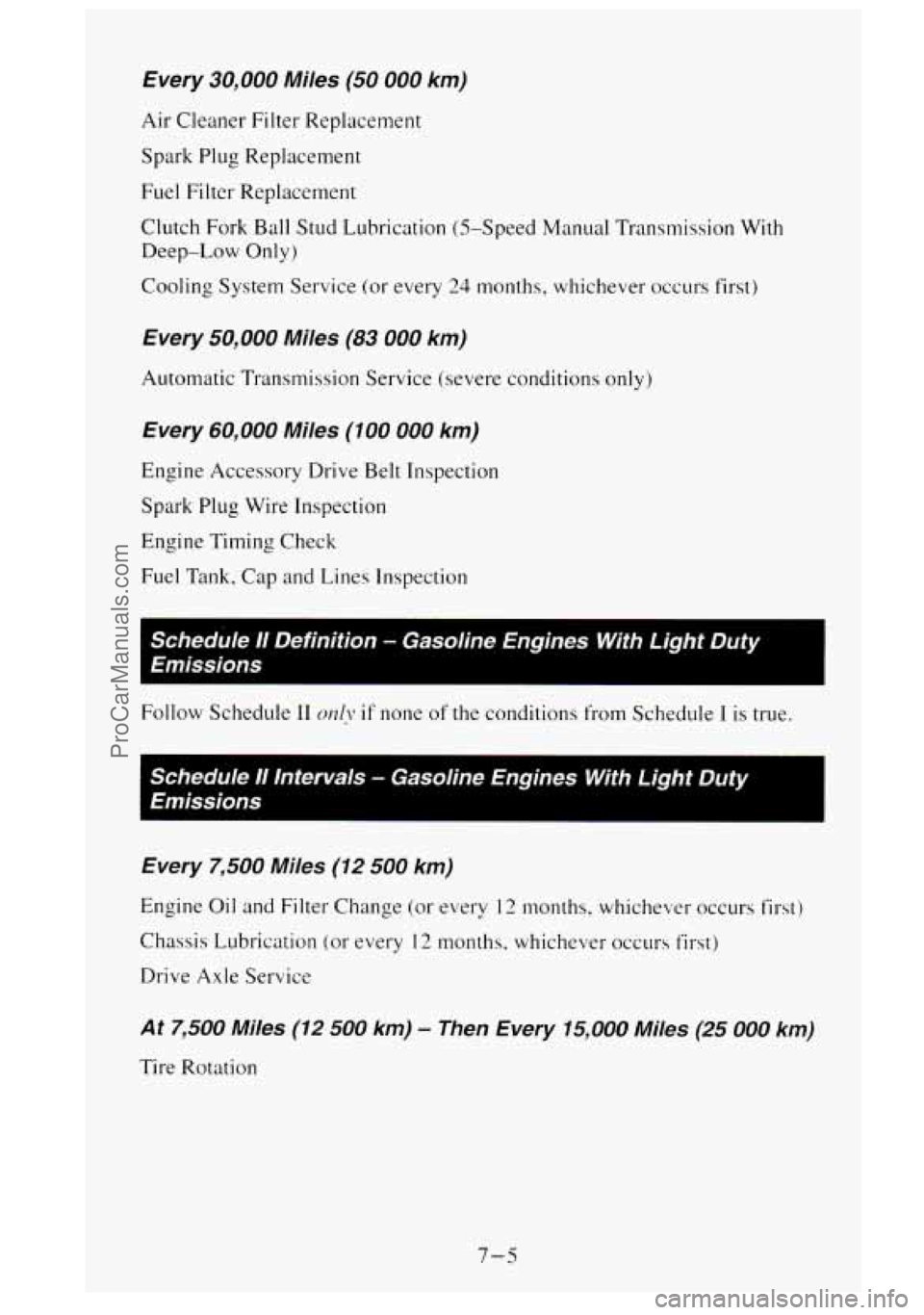
Every 30,000 Miles (50 000 km)
Air Cleaner Filter Replacement
Spark Plug Replacement
Fuel Filter Replacement
Clutch
Fork Ball Stud Lubrication (5-Speed Manual Transmission With
Deep-Low Only)
Cooling System Service (or every
24 months, whichever occurs first)
Every 50,000 Miles (83 000 km)
Automatic Transmission Service (severe conditions only)
Every 60,000 Miles (100 000 km)
Engine Accessory Drive Belt Inspection
Spark Plug Wire Inspection
Engine Timing Check
Fuel Tank, Cap and Lines Inspection
Schedule 11 Definition - Gasoline Engines With Light Duty
Emissions
Follow Schedule I1 only if none of the conditions from Schedule I is true.
Schedule I1 Intervals - Gasoline Engines With Light Duty
Emissions
Every
7,500 Miles (12 500 km)
Engine Oil and Filter Change (or every 12 months, whichever occurs first)
Chassis Lubrication (or every
12 months, whichever occurs first)
Drive Axle Service
At 7,500 Miles (12 500 km) - Then Every 15,000 Miles (25 000 km)
Tire Rotation
7-5
ProCarManuals.com