Page 183 of 354
Towing Your Vehicle
I
I
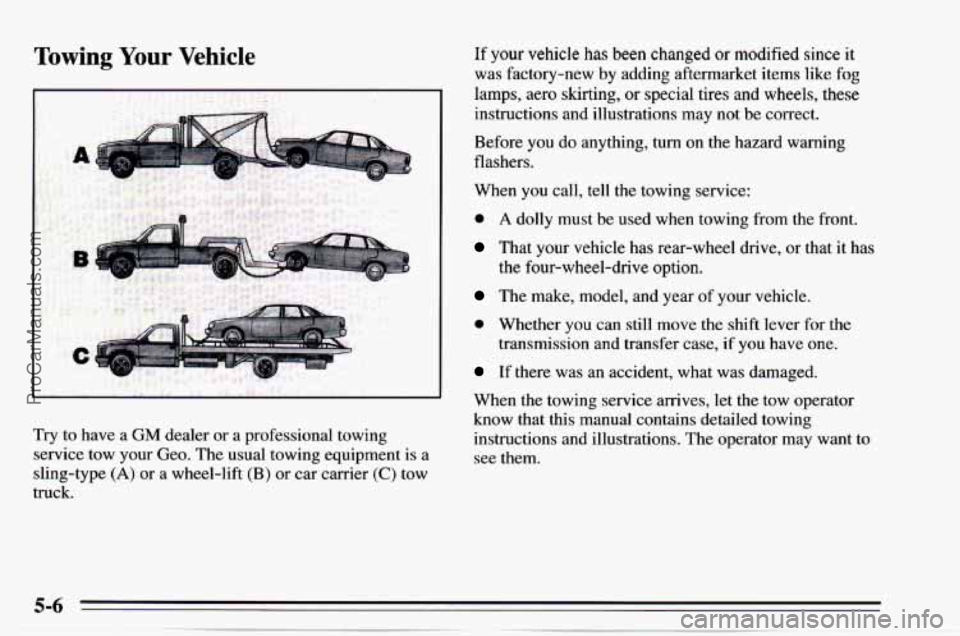
Try to have a GM dealer or a professional towing
service tow your Geo. The usual towing equipment is
a
sling-type (A) or a wheel-lift (B) or car carrier (C) tow
truck.
If your vehicle has been changed or modified since it
was factory-new by adding aftermarket items
like fog
lamps, aero skirting, or special tires and wheels, these
instructions and illustrations may not be correct.
Before you do anything, turn on the hazard warning
flashers.
When
you call, tell the towing service:
0 A dolly must be used when towing from the front.
That your vehicle has rear-wheel drive, or that it has
The make, model, and year of your vehicle.
0 Whether you can still move the shift lever for the
transmission and transfer case, if you have
one.
the four-wheel-drive option.
If there was an accident, what was damaged.
When the towing service arrives, let the tow operator
know that this manual contains detailed towing
instructions and illustrations. The operator may want
to
see them.
ProCarManuals.com
Page 184 of 354
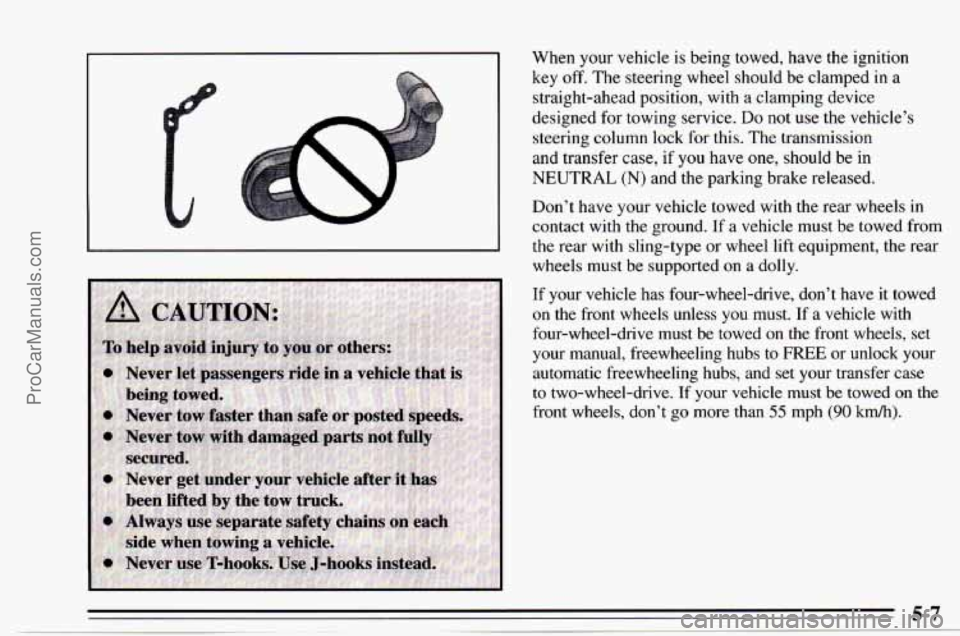
When your vehicle is being towed, have the ignition
key
off. The steering wheel should be clamped in a
straight-ahead position, with a clamping device
designed for towing service.
Do not use the vehicle’s
steering column lock
for this. The transmission
and transfer
case, if you have one, should be in
NEUTRAL (N) and the parking brake released.
Don’t have your vehicle towed with the rear wheels in
contact with the ground. If a vehicle must be towed from
the rear with sling-type or wheel lift equipment, the rear
wheels must be supported on a dolly.
If your vehicle has four-wheel-drive, don’t have it towed on
the front wheels unless you must. If a vehicle with
four-wheel-drive must be towed
on the front wheels, set
your manual, freewheeling hubs to FREE or unlock your
automatic freewheeling hubs, and set your transfer case
to two-wheel-drive. If
your vehicle must be towed on the
front wheels, don’t
go more than 55 mph (90 km/h).
5-7
ProCarManuals.com
Page 235 of 354
Rear Axle Four- Wheel Drive
When to Check and Change Lubricant
Refer to the
Maintenance Schedule to determine how
often to check the lubricant and when to change it. See
“Periodic Maintenance Inspections” and “Scheduled
Maintenance Services” in the Index.
How to Check Lubricant
If the level is below the bottom of the filler plug hole,
you’ll need to add some lubricant. Add enough lubricant
to raise the level to the bottom
of the filler plug hole.
What to Use
Refer to the Maintenance Schedule to determine what
kind
of lubricant to use. See “Recommended Fluids and
Lubricants” in the Index. Most
lubricant checks in this section also apply to
four-wheel-drive vehicles. However, they have
two
additional systems that need lubrication.
Transfer Case
When to Check and Change Lubricant
Refer to the Maintenance Schedule to determine how
often to check the lubricant and when
to change it. See
“Scheduled Maintenance Services” in the Index.
How to Check Lubricant
If the level is below the bottom of the filler plug hole,
you’ll need to add some lubricant. Add enough lubricant
to raise the level
to the bottom of the filler plug hole.
What to Use
Refer to the Maintenance Schedule to determine what
kind
of lubricant to use. See “Recommended Fluids and
Lubricants” in the Index.
ProCarManuals.com
Page 259 of 354
Used Replacement Wheels Tire Chains
NOTICE:
Use tire chains only where legal and only when
you must. Use only
SAE Class “S” type chains
that are the proper size for your tires. Install
them on the tires of the drive axle (four-wheel
drive vehicles can use chains on both axles).
Tighten them as tightly as possible with the ends
securely fastened. Drive slowly and follow the
chain manufacturer’s instructions.
If you can
hear the chains contacting your vehicle, stop and
retighten them.
If the contact continues, slow
down until it stops. Driving too fast or spinning
the wheels with chains
on will damage your
vehicle.
6-48
ProCarManuals.com
Page 277 of 354
Capacities (Approximate) Continued
Front Differential .................... 1.1 qt. (1 .O L)
Fuel Tank .......................... 11.1 gal. (42 L)
Manual Transmission
Four-wheel Drive
................. 1.6 qt. (1.5 L)**
Two-Wheel Drive ................. 1.8 qt. (1.7 L)**
Rear Differential .................... 2.3 qt. (2.2 L)
Transfer Case ....................... 1.8 qt. (1.7 L)
* When changing the oil filter, additional oil may be needed.
Recheck the oil level after filling. See “Engine Oil” in the
Index.
** Recheck fluid level after filling. See “Automatic
Transmission Fluid” or “Manual Transmission Fluid” in the
Index.
Wheel Nuts
Wheel Nut Torque ................. 60 lb- ft (80 Nom)
Vehicle Dimensions
Wheelbase ....................... 86.6” (2 200 mm)
Tread Front
......................... 54.9” (1 395 mm)
Rear
.......................... 55.1” (1 400 mm)
Length
......................... 142.5” (3 620 mm)
Width
........................... 64.2” (1 630 mm)
Height
........................... 65.0” (1 65 1 mm)
Air Conditioning Refrigerants
Not all air conditioning refrigerants are the same. If the air
conditioning system
in your vehicle needs refrigerant, be
sure the proper refrigerant is used. If you’re not sure, ask
your Chevrolet/Geo dealer.
For additional information, see
your “Warranty and Owner Assistance Information” booklet.
ProCarManuals.com
Page 328 of 354
Parking Brake and Automatic Ikansmission PARK Underbody Flushing \
(P) Mechanism Check At least every spring, use plain water to flush any
corrosive materials from
the underbody. Take care to
clean thoroughly any areas where mud and other debris
can collect.
.-
Park on a fairly steep hill, with the vehicle facing
downhill. Keeping your foot
on the regular brake, set the
parking brake.
0 To check the parking brake: With the engine running
and transmission
in NEUTRAL (N), slowly remove
foot pressure from the regular brake pedal.
Do this
until the vehicle is held by the parking brake only.
0 To check the PARK (P) mechanism's holding ability:
Shift to
PARK (P). Then release all brakes. If your
vehicle is four-wheel drive, be sure the transfer case
is not in NEUTRAL (N).
ProCarManuals.com
Page 330 of 354
Throttle Linkage Inspection
Inspect the throttle linkage for interference or binding,
and for damaged or missing parts. Replace parts as
needed. Accelerator and cruise control cables should
not
be lubricated.
Rear Axle (All) and Front Axle
(Four-Wheel Drive) Service
Check the gear lubricant level and add if needed. See
“Rear Axle” and “Four-Wheel Drive”
in the Index. A
fluid loss may indicate a problem. Check the system(s),
and repair the system(s) if needed. Refer
to “Scheduled
Maintenance Services,” earlier
in this section, to
determine when to change the lubricant.
Brake System Inspection
Inspect the complete system. Inspect brake lines and
hoses for proper hookup, binding, leaks, cracks, chafing,
etc. Inspect disc brake pads for wear and rotors for
surface condition. Also inspect drum brake linings for
wear and cracks. Inspect other brake parts, including
drums, wheel cylinders, calipers, parking brake, etc.
Check parking brake adjustment.
You may need to have
your brakes inspected more often if your driving habits
or conditions result in frequent braking.
Clutch System Service
Check clutch pedal free travel and adjust as necessary.
See “Clutch Adjustment’’ in
the Index.
7-53
ProCarManuals.com
Page 332 of 354

USAGE
Manual
Transmission
Shift Linkage
Automatic
Transmission
Shift Linkage
Clutch Linkage
Pivot Points
Floor Shift
Linkage
Chassis
Lubrication
Rear Axle (All)
and Front Axle
(Four-wheel
Drive)
FLUIDLUBRICANT
Chassis lubricant (GM Part
No. 1052497 or equivalent) or
lubricant meeting requirements
of
NLGI Grade 2, Category LB or
Engine oil.
GC-LB.
Lithium base grease.
Engine oil.
Chassis lubricant (GM Part
No. 1052497 or equivalent) or
lubricant meeting requirements
of
NLGI Grade 2, Category LB or
~~~~
GC-LB.
SAE 75W-90 GL-5 Hypoid Gear
Lubricant.
USAGE
Windshield
Washer Solvent
Transfer Case (Four- Wheel
Drive)
Hood Latch
Assembly
a. Pivots and Spring
Anchor
b. Release Pawl
Hood and Door Hinges
Weatherstrip
Conditioning
FLUIDLUBRICANT
GM Optikleen@ Washer Solvent
(GM Part
No. 1051515) or
equivalent.
SAE 75W-90 GL-4 Gear
Lubricant.
a. Engine oil.
b. Chassis lubricant (GM Part
No. 1052497 or equivalent) or
lubricant meeting requirements
of NLGI Grade 2, Category LB
or GC-LB.
Engine oil or Lubriplate Lubricant (GM Part No. 1050109).
Dielectric Silicone Grease-(GM
Part
No. 12345579 or equivalent).
See “Replacement Parts” in the Index for recommended
replacement filters, valves and spark plugs.
ProCarManuals.com

 Mechanism Check At least every spring, use plain water to flush any
corrosive materials from
the underbody. Take")