1995 CHEVROLET TAHOE brake
[x] Cancel search: brakePage 257 of 486
Downloaded from www.Manualslib.com manuals search engine h
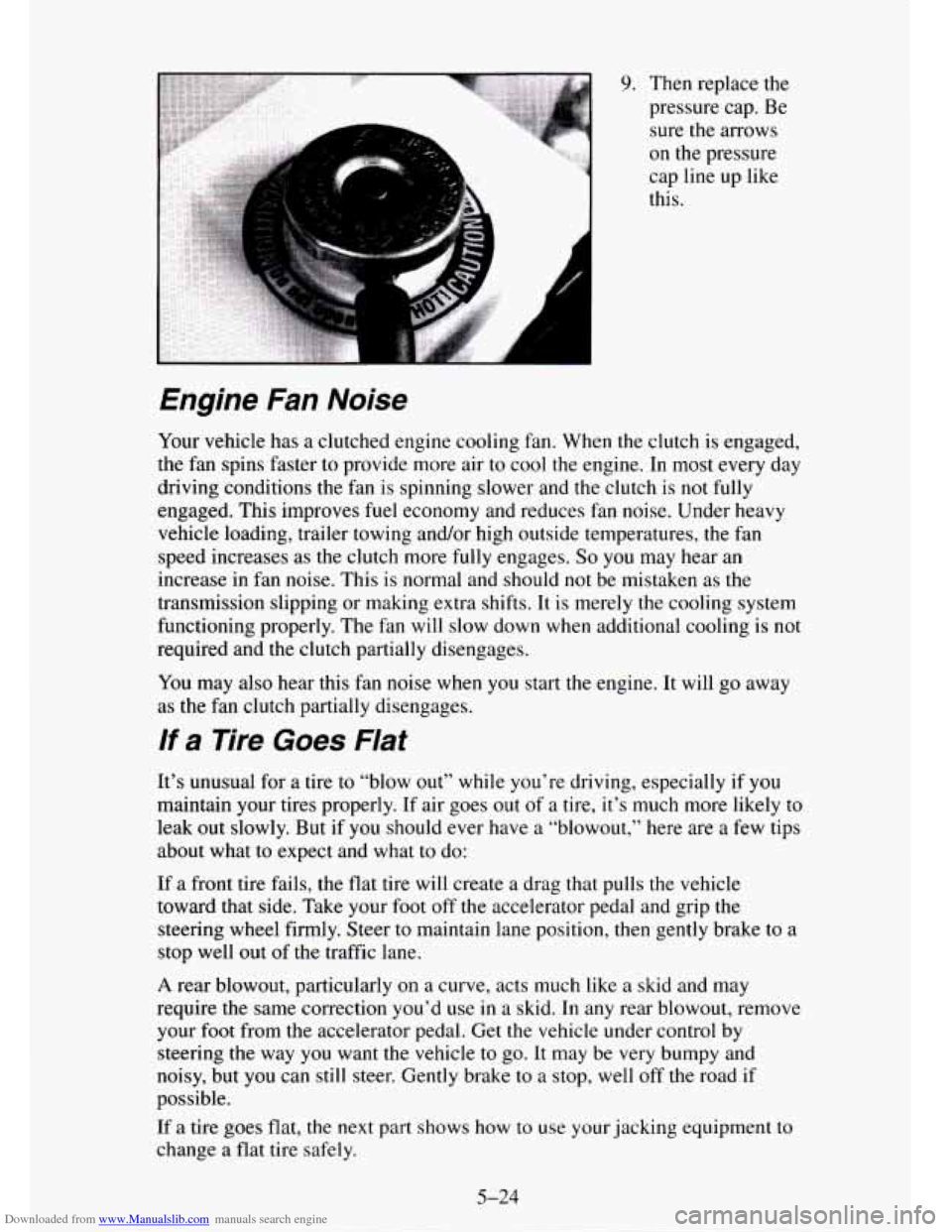
9. Then replace the
pressure cap. Be
sure the arrows
on the pressure
cap line up like
this.
Engine Fan Noise
Your vehicle has a clutched engine cooling fan. When the clutch is engaged,
the fan spins faster to provide more air to cool the engine. In most every day
driving conditions the fan
is spinning slower and the clutch is not fully
engaged. This improves fuel economy and reduces fan noise. Under heavy
vehicle loading, trailer towing and/or high outside temperatures,
the fan
speed increases as the clutch more
fully engages. So you may hear an
increase in fan noise. This is normal and should not be mistaken as the
transmission slipping
or making extra shifts. It is merely the cooling system
functioning properly. The fan will slow down when additional cooling is not
required and the clutch partially disengages.
You may also hear this fan noise when you start the engine. It will go away
as the fan clutch partially disengages.
If a Tire Goes Flat
It’s unusual for a tire to “blow out” while you’re driving, especially if you
maintain your tires properly. If air goes out of a tire, it’s much more likely to
leak out slowly. But if you should ever have a “blowout,” here are a few tips
about what
to expect and what to do:
If a front tire fails, the flat tire will create a drag that pulls the vehicle
toward that side. Take your foot off the accelerator pedal and grip the
steering wheel firmly. Steer
to maintain lane position, then gently brake to a
stop well out of the traffic lane.
A rear blowout, particularly on a curve, acts much like a skid and may
require the same correction you’d
use in a skid. In any rear blowout, remove
your foot from
the accelerator pedal. Get the vehicle under control by
steering the way
you want the vehicle to go. It may be very bumpy and
noisy, but you can still steer. Gently brake to a stop, well
off the road if
possible.
If a tire goes flat, the next part shows how to use your jacking equipment to
change a flat tire safely.
5-24
Page 284 of 486
Downloaded from www.Manualslib.com manuals search engine Hesitation or “flat” performance at high speed or during hard acceleration
may be an indication of premature fuel filter plugging due
to dirty or
contaminated fuel. The filter element may need to be changed
if this
happens. See your dealer for assistance.
To drain water:
I. Stop and park the vehicle in a safe place. Turn off the engine and apply
the parking brake.
2. Remove the fuel tank cap.
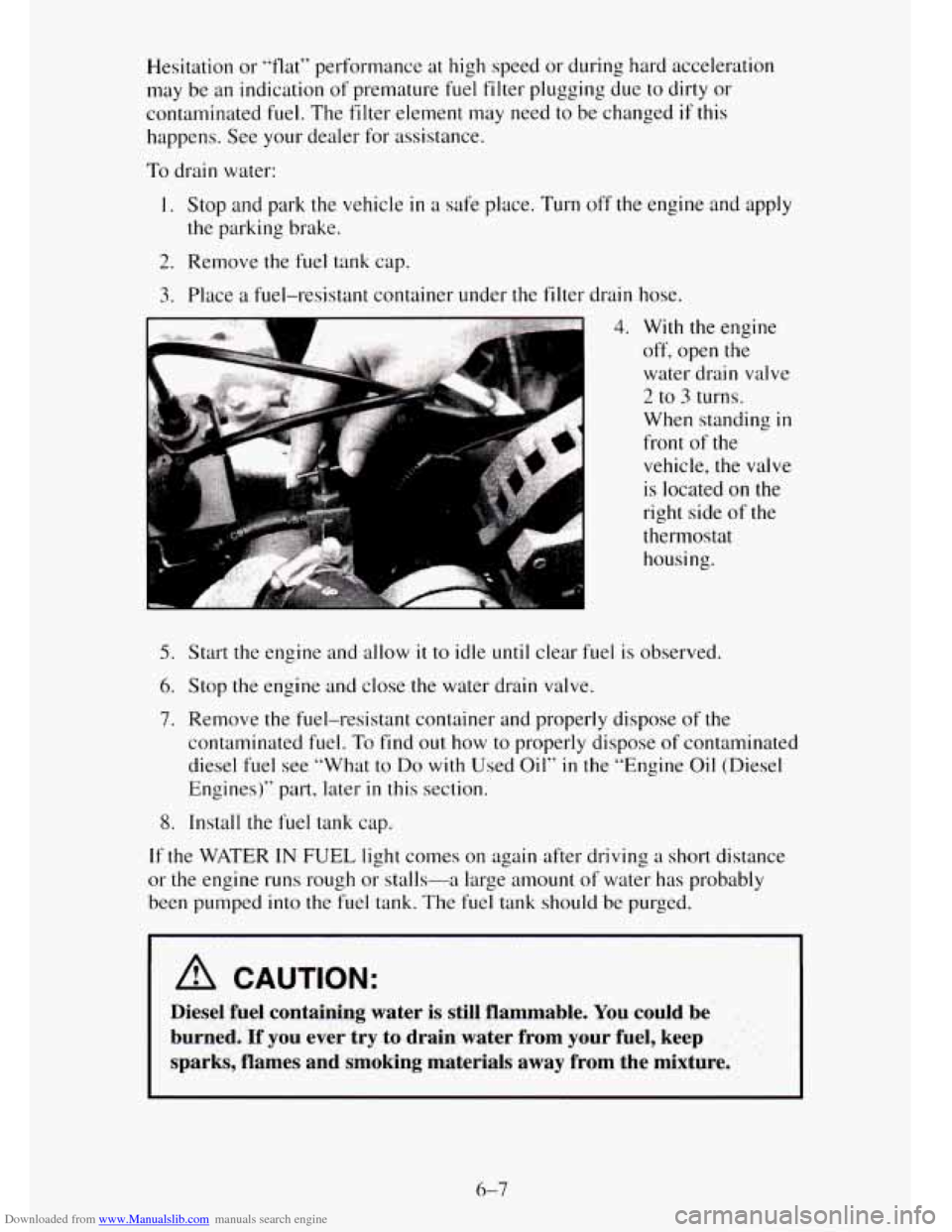
3. Place a fuel-resistant container under the filter drain hose.
4. With the engine
off? open the
water drain valve
2 to 3 turns.
When standing
in
front of the
vehicle, the valve is located
on the
right side of the
thermostat housing.
5. Start the engine and allow it to idle until clear fuel is observed.
6. Stop the engine and close the water drain valve.
7. Remove the fuel-resistant container and properly dispose of the
contaminated fuel.
To find out how to properly dispose of contaminated
diesel fuel see “What to Do
with Used Oil” in the “Engine Oil (Diesel
Engines)” part, later
in this section.
8. Install the fuel tank cap.
If the WATER IN FUEL light comes on again after driving a short distance
or the engine runs rough or stalls-a large amount of water has probably
been pumped
into the fuel tank. The fuel tank should be purged.
6% CAUTION:
Diesel he1 containing water is still flammable. You could be
burned. If you ever try to drain water from
your fuel, keep
sparks, flames and smoking materials away
from the mixture.
6-7
Page 286 of 486
Downloaded from www.Manualslib.com manuals search engine 3. Close the air bleed valve.
4. Turn the ignition key to START for 10 to 15 seconds at a time until
your engine starts.
Fuel Filter Replacement (Diesel Engines)
If you want to change the fuel filter yourself, here's how to do it:
First, drain any water from the filter following the procedure for draining
water listed previously.
Your vehicle's engine should be off until the end of the following procedure.
r.
1. Apply the parking brake.
2. Take off the fuel tank cap. This releases vacuum in the tank.
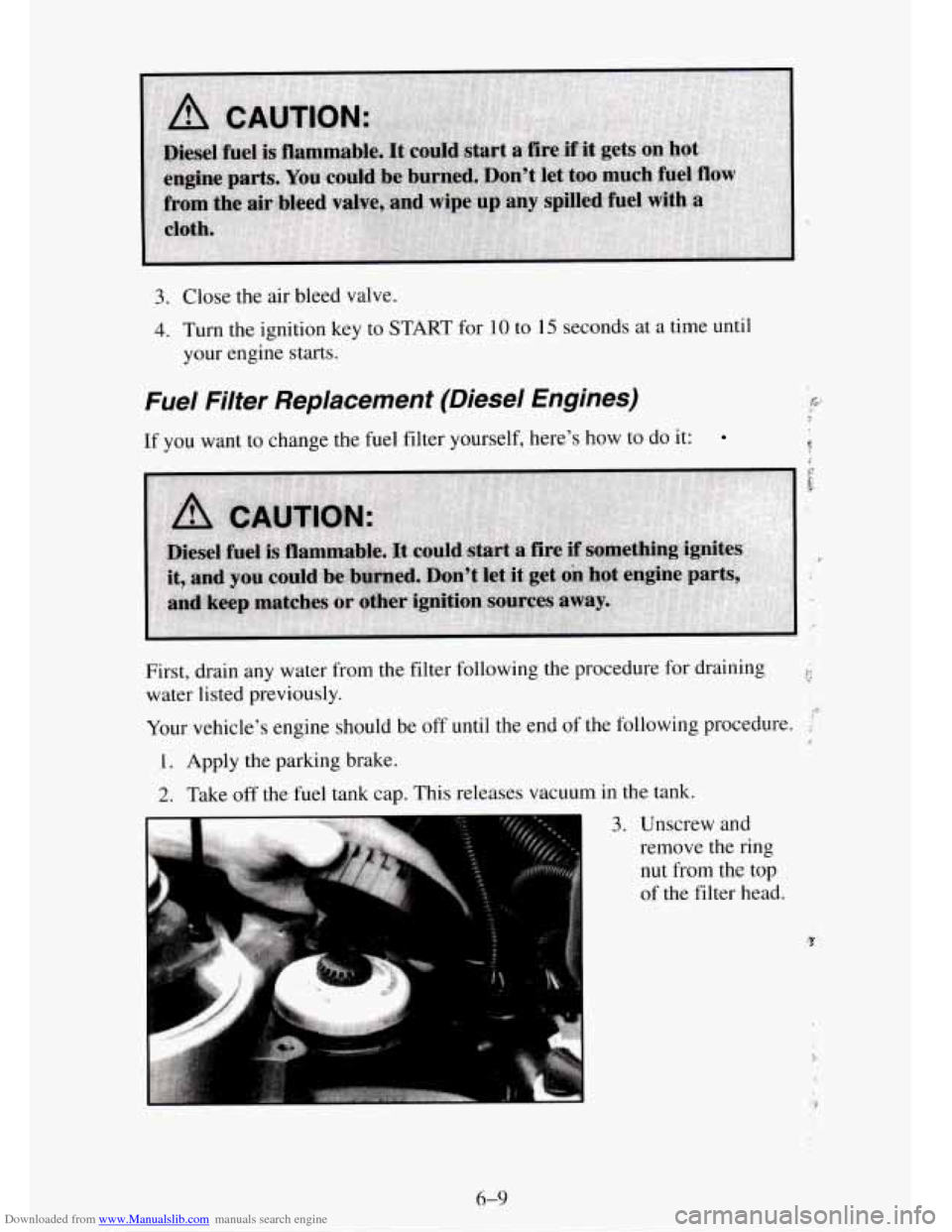
3. Unscrew and
remove the ring
nut from the top
of the filter head.
6-9
Page 304 of 486
Downloaded from www.Manualslib.com manuals search engine Wait at least 30 minutes before checking the transmission fluid level if you
have been driving:
0 When outside temperatures are above 90°F (32°C j,
At high speed for quite a while.
In heavy traffic - especially in hot weather.
0 While pulling a trailer.
To get the right reading, the fluid should be at normal operating
temperature, which
is 180°F to 200°F (82°C to 93°C).
To check transmission fluid hot: Get the vehicle warmed up by driving
about
15 miles (24 km) when outside temperatures are above 50°F (1 0°C).
If it's colder than 50°F (10"C), drive
the vehicle in DRIVE (D) until the
engine temperature gage moves and then remains steady for ten minutes.
Then follow the
hot check procedures.
To check transmission fluid cold: A cold check is made after the vehicle
has been sitting for eight hours
or more with the engine off and is used only
as
a reference. Let the engine run at idle for five minutes if outside
temperatures are 50°F (10°C) or more. If it's colder than 50°F (IO'C), you
may have to idle
the engine longer. Should the fluid level be low during a
cold check,
you must perform a hot check before adding fluid. This will
give you
a more accurate reading of the fluid level.
lo check the fluid hot or cold
0 Park your vehicle on a level place. Keep the engine running.
With the parking brake applied, place the shift lever in PARK (P).
With your foot on the brake pedal, move the shift lever through each
gear range, pausing
for about three seconds in each range. Then,
position
the shift lever in PARK (P).
Let the engine run at idle for three minutes or more.
6-27
Page 316 of 486
Downloaded from www.Manualslib.com manuals search engine Power Steering Fluid
How To Check Power Steering Fluid
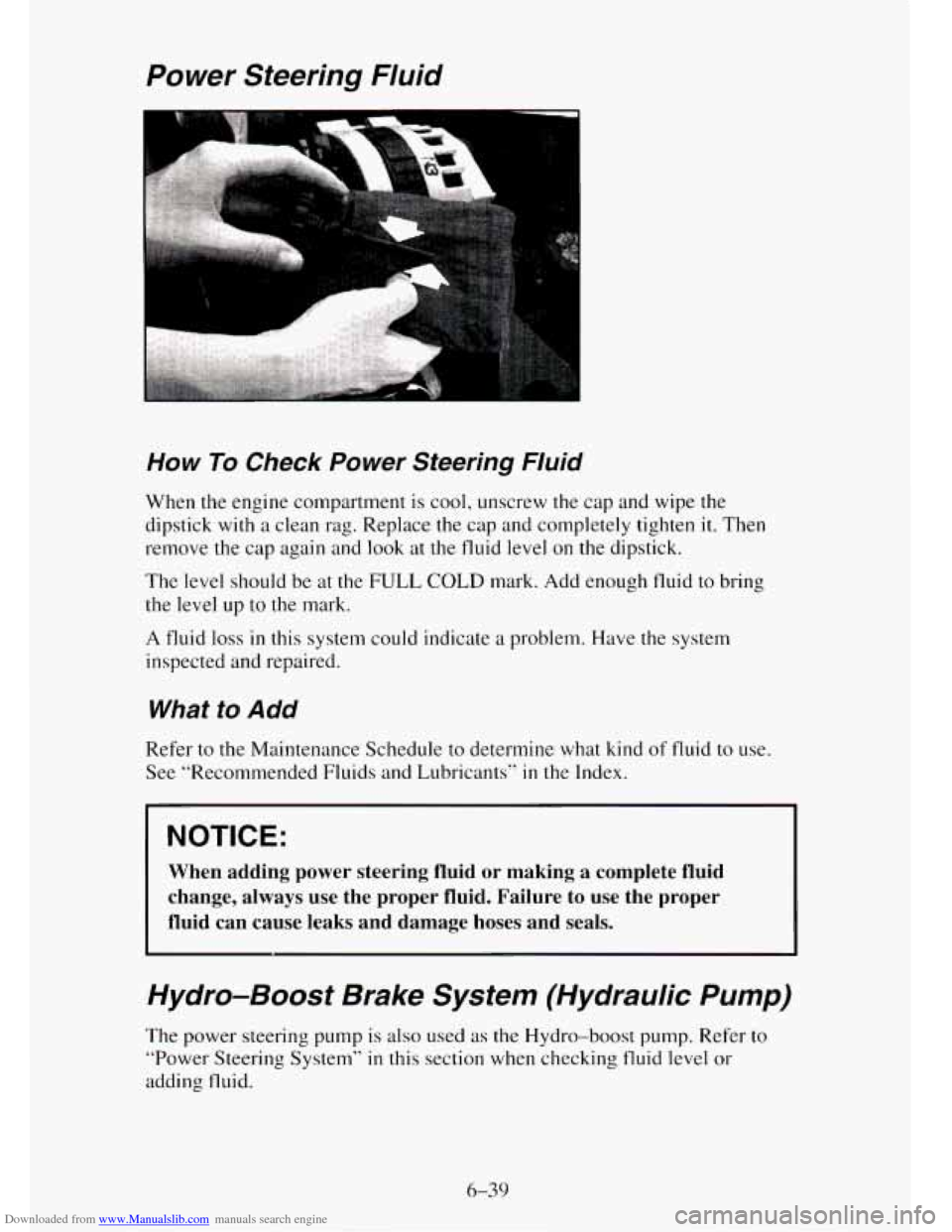
When the engine compartment is cool, unscrew the cap and wipe the
dipstick
with a clean rag. Replace the cap and completely tighten it. Then
remove the cap again
and look at the fluid level on the dipstick.
The level should be at the FULL COLD mark. Add enough fluid to bring
the level up
to the mark.
A fluid
loss in this system could indicate a problem. Have the system
inspected and repaired.
What to Add
Refer to the Maintenance Schedule to determine what kind of fluid to use.
See “Recommended Fluids and Lubricants”
in the Index.
I
I NOTICE:
When adding power steering fluid or making a complete fluid
change, always use the proper fluid. Failure to use the proper\
fluid can cause leaks and damage hoses and seals.
Hydro-Boost Brake System (Hydraulic Pump)
The power steering pump is also used as the Hydro-boost pump. Refer to
“Power Steering System” in this section when checking fluid level or
adding fluid.
6-39
Page 318 of 486
Downloaded from www.Manualslib.com manuals search engine Brakes
Brake Master Cylinder
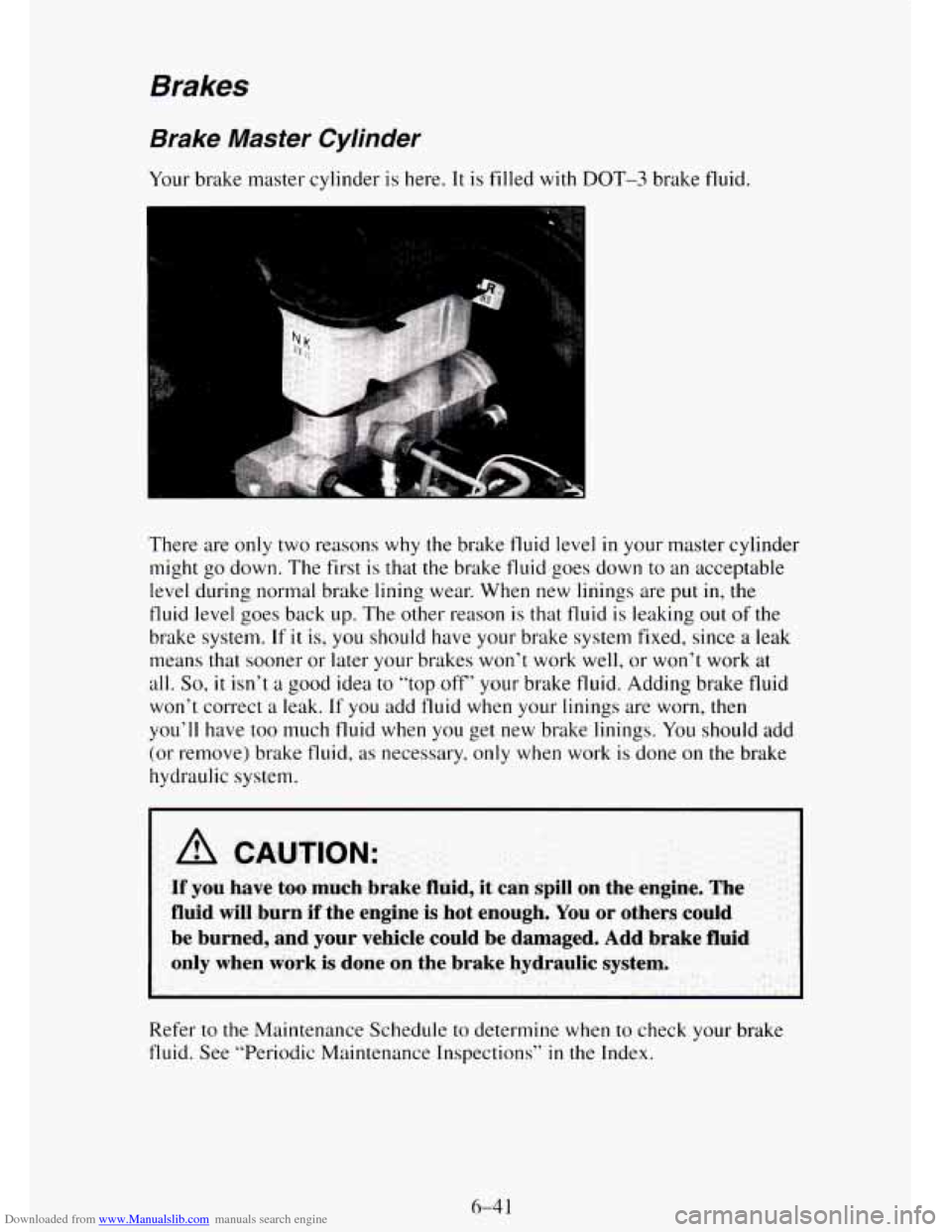
Your brake master cylinder is here. It is filled with DOT-3 brake fluid.
I L m
There are only two reasons why the brake fluid level in your master cylinder
might
go down. The first is that the brake fluid goes down to an acceptable
level during normal brake lining wear. When new linings are put
in, the
fluid level goes back up. The other reason is that fluid is leaking out of the
brake system.
If it is, you should have your brake system fixed, since a leak
means that sooner or later your brakes won’t
work well, or won’t work at
all.
So, it isn’t a good idea to “top off” your brake fluid. Adding brake fluid
won’t correct a leak.
If you add fluid when your linings are worn, then
you’ll have
too much fluid when you get new brake linings. You should add
(or remove) brake fluid, as necessary, only when work is done on
the brake
hydraulic system.
I
Refer to the Maintenance Schedule to determine when to check your brake
fluid. See “Periodic Maintenance Inspections’’
in the Index.
Page 319 of 486
Downloaded from www.Manualslib.com manuals search engine To Check Brake Fluid
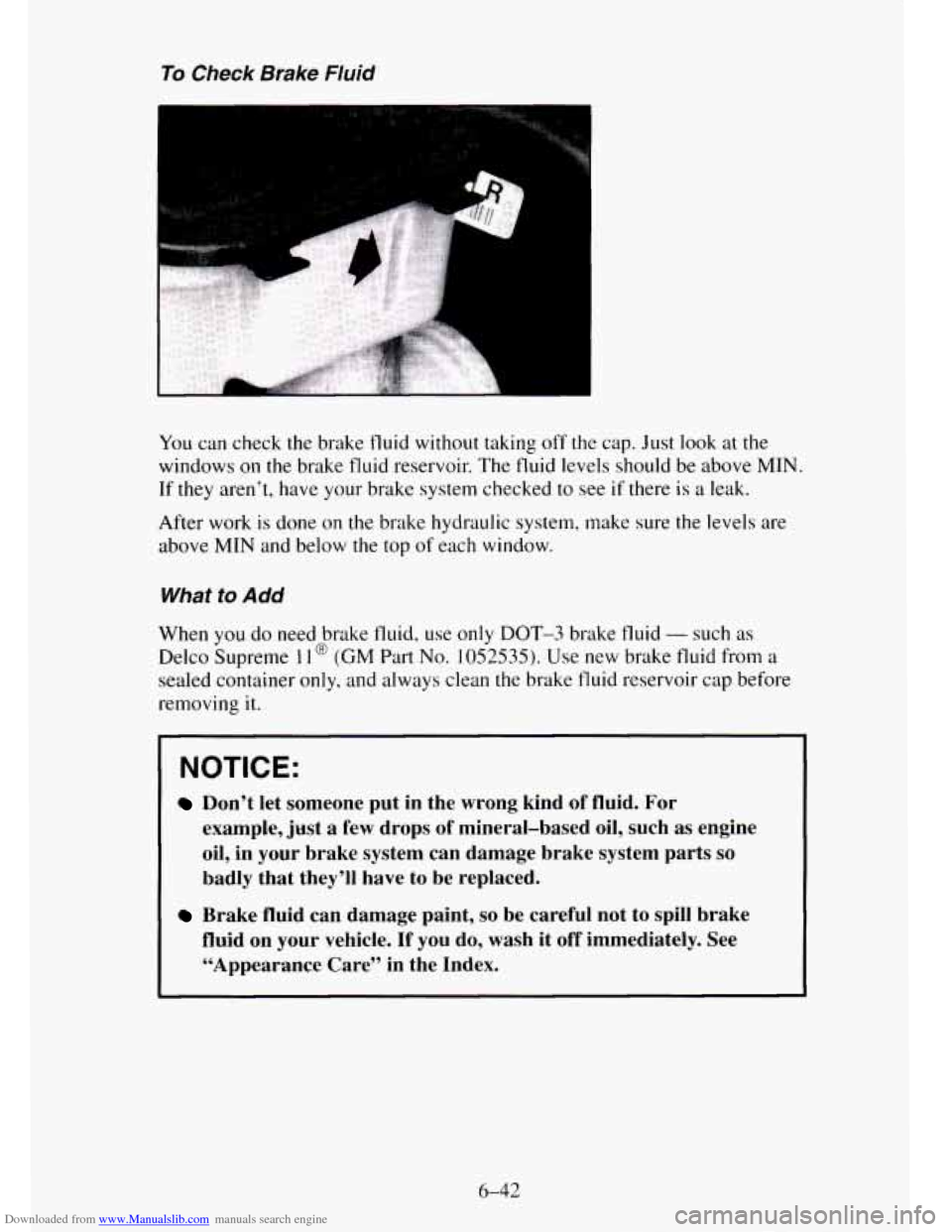
You can check the brake fluid without taking off the cap. Just look at the
windows
on the brake fluid reservoir. The fluid levels should be above MIN.
If
they aren’t, have your brake system checked to see if there is a leak.
After work
is done on the brake hydraulic system, make sure the levels are
above
MIN and below the top of each window.
What to Add
When you do need brake fluid, use only DOT-3 brake fluid - such as
Delco Supreme 1 1 @ (GM Part No. 1052535). Use new brake fluid from a
sealed container only, and always clean the brake fluid reservoir cap before
removing it.
NOTICE:
Don’t let someone put in the wrong kind of fluid. For
example, just a few drops of mineral-based oil, such
as engine
oil, in your brake system can damage brake system parts so
badly that they’ll have to be replaced.
Brake fluid can damage paint, so be careful not to spill brake
fluid on your vehicle. If you do, wash it off immediately. See
“Appearance Care” in the Index.
6-42
Page 320 of 486
Downloaded from www.Manualslib.com manuals search engine Brake Wear
Your vehicle has front disc brakes and rear drum brakes.
Disc brake pads
have built-in wear indicators that make a high-pitched
warning sound when the brake pads are worn and new pads are needed. The
sound may come and
go or be heard all the time your vehicle is moving
(except when you are pushing on the brake pedal firmly).
I NOTICE:
Continuing to drive with worn-out brake pads could result in
costly brake repair.
Some driving conditions or climates may cause a brake squeal when the
brakes are first applied or lightly applied. This does not mean something is
wrong with your brakes.
Your rear drum brakes don’t have wear indicators, but
if you ever hear a
rear brake rubbing noise, have the rear brake linings inspected. Also, the
rear brake drums should be removed and inspected each time the tires are
removed for rotation or changing. When
you have the front brakes replaced,
have
the rear brakes inspected, too.
Brake linings should always be replaced as complete axle sets.
Brake Pedal Travel
See your dealer if the brake pedal does not return to normal height, or if
there
is a rapid increase in pedal travel. This could be a sign of brake
trouble.
Brake Adjustment
Every time you make a brake stop, your disc brakes adjust for wear.
If your brake pedal goes down farther than normal, your rear drum brakes
may need adjustment. Adjust them by backing up and firmly applying the
brakes a few times.
6-43