Page 323 of 486
Downloaded from www.Manualslib.com manuals search engine Contact your dealer to learn how to prepare your vehicle for longer storage
periods.
Bulb Replacement
Before you replace any bulbs, be sure that all the lamps are off and the
engine isn’t running.
Sealed Beam Headlamps
1. Remove the four
screws
from the
headlamp
retainer.
2. Pull the headlamp
out and remove
the retainer.
3. Unplug and remove the headlamp.
4. Plug in the new headlamp and put it in place.
5. Install the retainer to the headlamp and tighten the screws.
6-46
Page 333 of 486
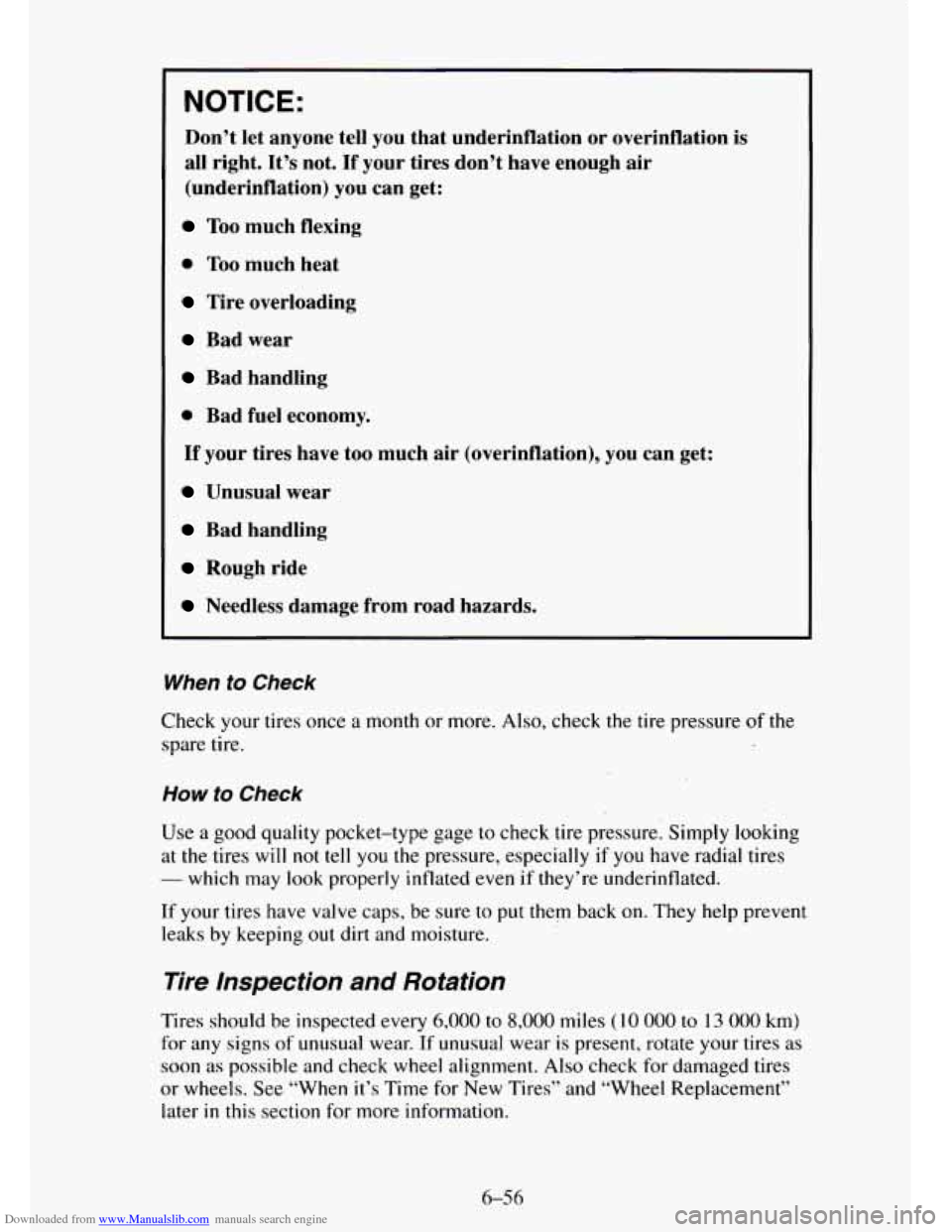
Downloaded from www.Manualslib.com manuals search engine NOTICE:
Don’t let anyone tell you that underinflation or overinflation is
all right. It’s not.
If your tires don’t have enough air
(underinflation) you can get:
Too much flexing
0 Too much heat
Tire overloading
Bad wear
Bad handling
0 Bad fuel economy.
If your tires have too much air (overinflation), you can get:
Unusual wear
Bad handling
Rough ride
Needless damage from road hazards.
When to Check
Check your tires once a month or more. Also, check the tire pressure of the
spare tire.
How to Check
Use a good quality pocket-type gage to check tire pressure. Simply looking
at the tires will not tell you the pressure, especially if you have radial tires
- which may look properly inflated even if they’re underinflated.
If your tires have valve caps, be sure
to put them back on. They help prevent
leaks by keeping
out dirt and moisture.
Tire Inspection and Rotation
Tires should be inspected every 6,000 to 8,000 miles (10 000 to 13 000 km)
for any signs
of unusual wear. If unusual wear is present, rotate your tires as
soon as possible and check wheel alignment. Also check for damaged tires
or wheels. See “When it’s Time for New Tires’’ and “Wheel Replacement”
later
in this section for more information.
6-56
Page 337 of 486
Downloaded from www.Manualslib.com manuals search engine Warning: The temperature grade for this tire is established for a tire that is
properly inflated and
not overloaded. Excessive speed, underinflation, or
excessive loading, either separately or
in combination, can cause heat
buildup and possible tire failure.
These grades are molded on the sidewalls of passenger car tires.
While
the tires available as standard or optional equipment on General
Motors vehicles may vary with respect to these grades, all such tires meet
General Motors performance standards and have been approved for
use on
General Motors vehicles.
All passenger type (P Metric) tires must conform
to Federal safety requirements in addition to these grades.
Wheel Alignment and Tire Balance
The wheels on your vehicle were aligned and balanced carefully at the
factory
to give you the longest tire life and best overall performance.
In most cases, you will not need
to have your wheels aligned again.
However,
if you notice unusual tire wear or your vehicle pulling one way or
the other, the alignment may need
to be reset. If you notice your vehicle
vibrating when driving
on a smooth road, your wheels may need to be
rebalanced.
Wheel Replacement
Replace any wheel that is bent, cracked, or badly rusted or corroded. If
wheel nuts keep coming loose, the wheel, wheel bolts, and wheel nuts
should be replaced. If the wheel leaks air, replace it (except some aluminum
wheels, which can sometimes be repaired). See your GM dealer if any of
these conditions exist.
Your dealer will know the kind
of wheel you need.
Each new wheel should have the same load carrying capacity, diameter,
width, offset, and be mounted the same way as
the one it replaces.
If you need to replace any of your wheels, wheel bolts, or wheel nuts,
replace them only with new GM original equipment parts. This way, you
will be
sure to have the right wheel, wheel bolts, and wheel nuts for your
vehicle.
Page 338 of 486
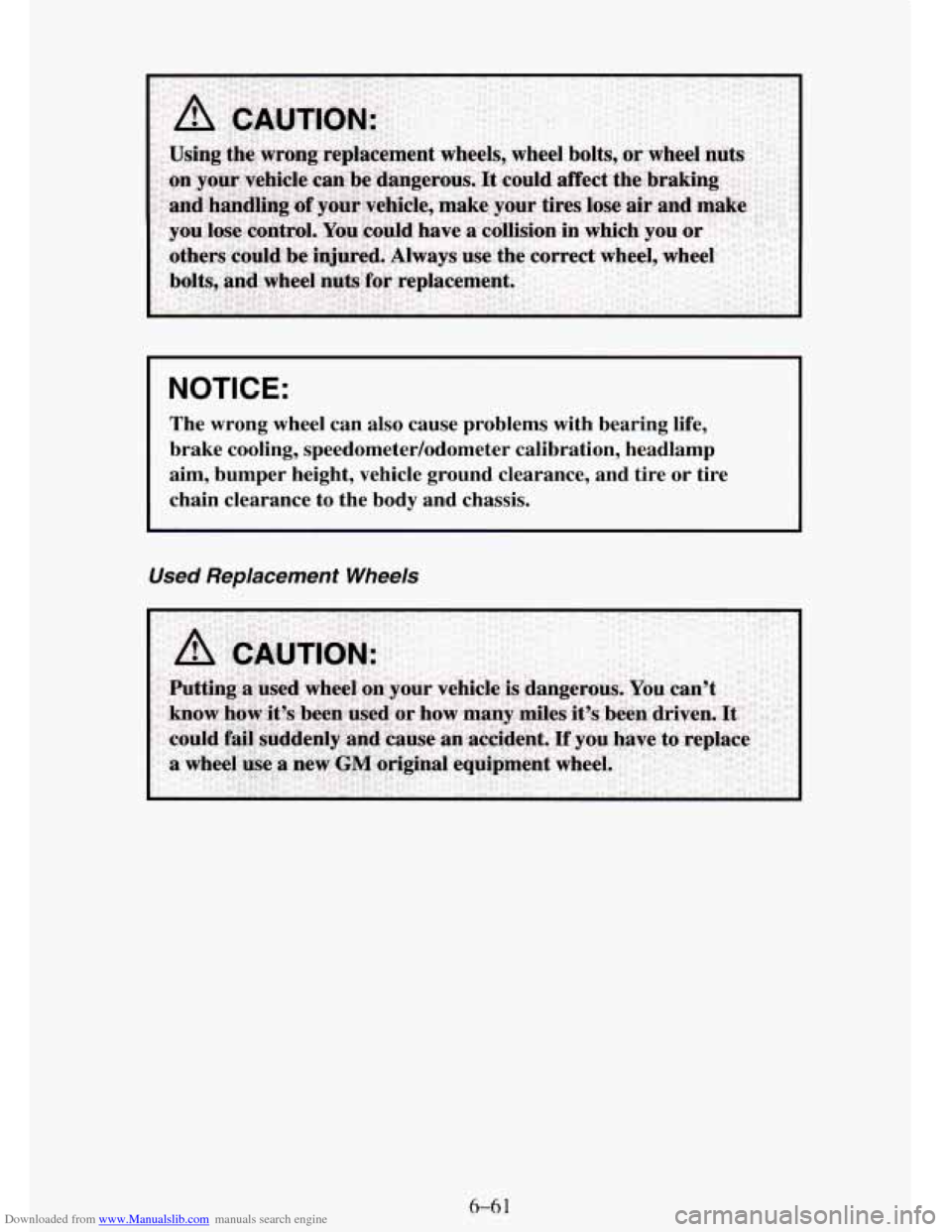
Downloaded from www.Manualslib.com manuals search engine I NOTICE:
The wrong wheel can also cause problems with bearing life,
brake cooling, speedometer/odometer calibration, headlamp
aim, bumper height, vehicle ground clearance, and tire
or tire
chain clearance
to the body and chassis.
Used Replacement Wheels
Page 346 of 486
Downloaded from www.Manualslib.com manuals search engine Protecting Exterior Bright Metal Parts
Bright metal parts should be cleaned regularly to keep their luster. Washing
with water
is all that is usually needed. However, you may use GM Chrome
Polish
on chrome or stainless steel trim, if necessary.
Use special care with aluminum trim.
To avoid damaging protective trim,
never use auto or chrome polish, steam or caustic soap
to clean aluminum.
A coating of wax, rubbed to high polish, is recommended for all bright
metal parts.
Aluminum Wheels (If So Equipped)
Your aluminum wheels have a protective coating similar to the painted
surface
of your vehicle. Don’t use strong soaps, chemicals, chrome polish,
abrasive cleaners or abrasive cleaning brushes on them because
you could
damage this coating. After rinsing thoroughly,
a wax may be applied.
NOTICE:
If you have aluminum wheels, don’t use an automatic car wash
that has hard silicon carbide cleaning brushes. These brushes
can take the protective coating
off your aluminum wheels.
Tires
To clean your tires, use a stiff brush with a tire cleaner.
When applying
a tire dressing always take care to wipe off any overspray or
splash from painted surfaces. Petroleum-based products may damage the
paint
finish.
Sheet Metal Damage
If your vehicle is damaged and requires sheet metal repair or replacement,
make sure the body repair shop applies anti-corrosion material to
the parts
repaired or replaced
to restore corrosion protection.
Foreign Material
Calcium chloride and other salts, ice melting agents, road oil and tar, tree
sap, bird droppings, chemicals from industrial chimneys, and other foreign
matter can damage your vehicle’s finish if they remain
on painted surfaces.
Use cleaners that are marked safe
for painted surfaces to remove foreign
matter.
6-69
Page 349 of 486
Downloaded from www.Manualslib.com manuals search engine Vehicle Identification Number (VIN)
This is the legal identifier for your vehicle. It appears on a plate in the front
corner
of the instrument panel, on the driver’s side. You can see it if you
look through the windshield from outside your vehicle. The VIN also
appears
on the Vehicle Certification and Service Parts labels and the
certificates of title and registration.
Engine Identification
The eighth character in your VIN is the engine code. This code will help
you identify your engine, specifications, and replacement parts.
6-72
Page 353 of 486
Downloaded from www.Manualslib.com manuals search engine Fuse Block
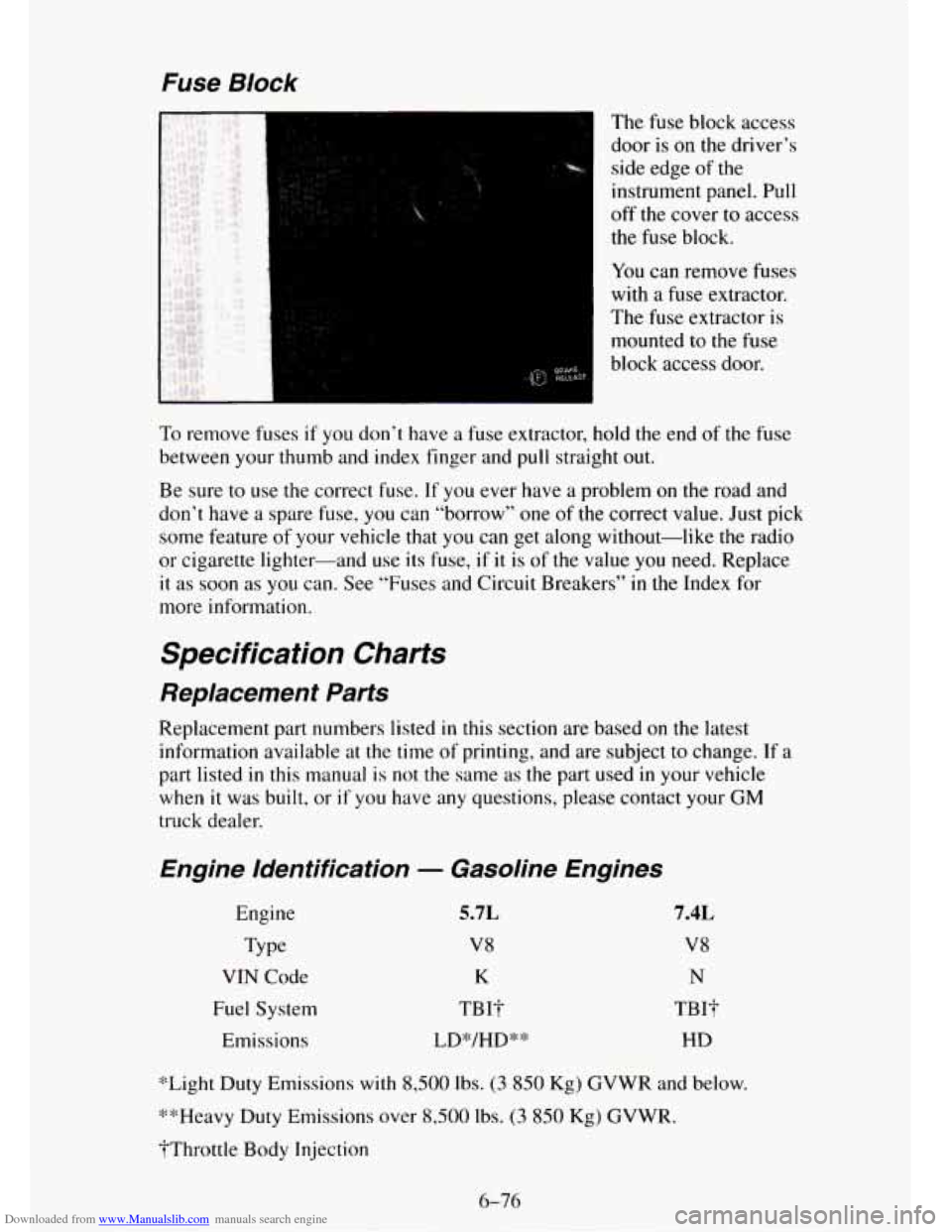
The fuse block access
door is on the driver’s
side edge
of the
instrument panel. Pull
off the cover to access
the fuse block.
You can remove fuses
with a fuse extractor.
The
fuse extractor is
mounted to the fuse
block access door.
To remove fuses if you don’t have a fuse extractor, hold the end of the fuse
between your thumb and index finger and pull straight
out.
Be sure to use the correct fuse. If you ever have a problem on the road and
don’t
have a spare fuse, you can “borrow” one of the correct value. Just pick
some feature of your vehicle that you can get along without-like the radio
or cigarette lighter-and use its fuse,
if it is of the value you need. Replace
it as soon as you can. See “Fuses and Circuit Breakers” in the Index for
more information.
Specification Charts
Replacement Parts
Replacement part numbers listed in this section are based on the latest
information available at the time of printing, and are subject to change.
If a
part listed in this manual is not the same as the part used in your vehicle
when
it was built, or if you have any questions, please contact your GM
truck dealer.
Engine Identification - Gasoline Engines
Engine
Type
VIN Code
Fuel System Emissions
7.4L
V8
N
TBI? HD
*Light Duty Emissions
with 8,500 lbs. (3 850 Kg) GVWR and below.
**Heavy Duty Emissions over
8,500 Ibs. (3 850 Kg) GVWR.
?Throttle Body Injection
6-76
Page 355 of 486
Downloaded from www.Manualslib.com manuals search engine Crankcase Capacity
ENGINE
5.7L
6.5L
6.5L
7.4L
VIN
K
S
F
N
QUANTITY WITH
FILTER?
5 Quarts (4.8 Liters)
7 Quarts (6.5 Liters)
7 Quarts (6.5 Liters)
7 Quarts (6.5 Liters)
After refill, the level
MUST be checked as outlined under “Engine Oil And
Filter Recommendations”
in Section 5.
All quantities are approximate.
?Oil filter should be changed at EVERY oil change.
Fuel Tank Capacity
TYPE
Gasoline/Diesel
Utility Models - Standard
Suburban
- Standard
QUANTITY
30 Gallons ( I 1 3 Liters)
42 Gallons
( I59 Liters)
All quantities are for a completely dry tank and are approximate.
Service Replacement Part and Filter
Recommendations
- Gasoline Engines
Engine
VIN
Oil Filter
Air Cleaner Filter
PCV Valve
Spark Plugs”
Fuel Filter
Radiator Cap
5.7L
K
PF1218T A348C
cv774c
CR43TS
GF48 1
RC36
?Four Wheel Drive Vehicle
- use a PF52 oil filter
*Use AC copper-cored resistor type spark plugs
7.4L
N
PF1218
A348C
cv774c
.CR43TS GF48
1
RC36