Page 308 of 486
Downloaded from www.Manualslib.com manuals search engine When to Check and What to Use
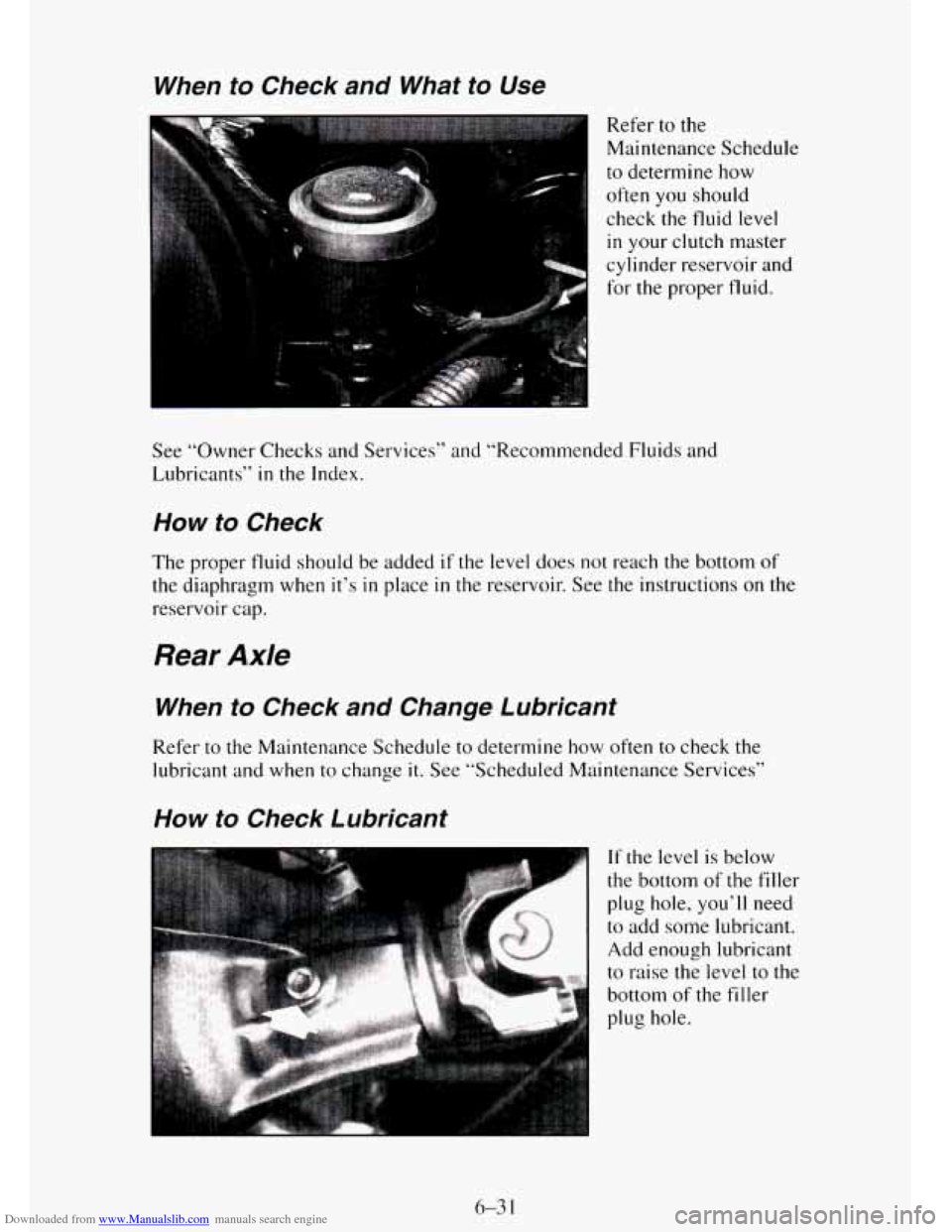
Refer to the
Maintenance Schedule
to determine how
often you should
check the fluid level
in your clutch master
cylinder reservoir and
for the proper fluid.
See “Owner Checks and Services” and “Recommended Fluids and
Lubricants”
in the Index.
How to Check
The proper fluid should be added if the level does not reach the bottom of
the diaphragm when it’s in place in the reservoir. See the instructions on the
reservoir cap.
Rear Axle
When to Checkand Change Lubricant
Refer to the Maintenance Schedule to determine how often to check the
lubricant and when to change
it. See “Scheduled Maintenance Services”
How to Check Lubricant
6-3 1
Page 309 of 486
Downloaded from www.Manualslib.com manuals search engine What to Use
Refer to the Maintenance Schedule to determine what kind of lubricant to
use. See “Recommended Fluids and Lubricants”
in the Index.
Four- Wheel Drive
Most lubricant checks in this section also apply to four-wheel-drive
vehicles. However, they have two additional systems that need lubrication.
Transfer Case
When to Check Lubricant
Refer to the Maintenance Schedule to determine how often to check the
lubricant. See “Periodic Maintenance Inspections”
in the Index.
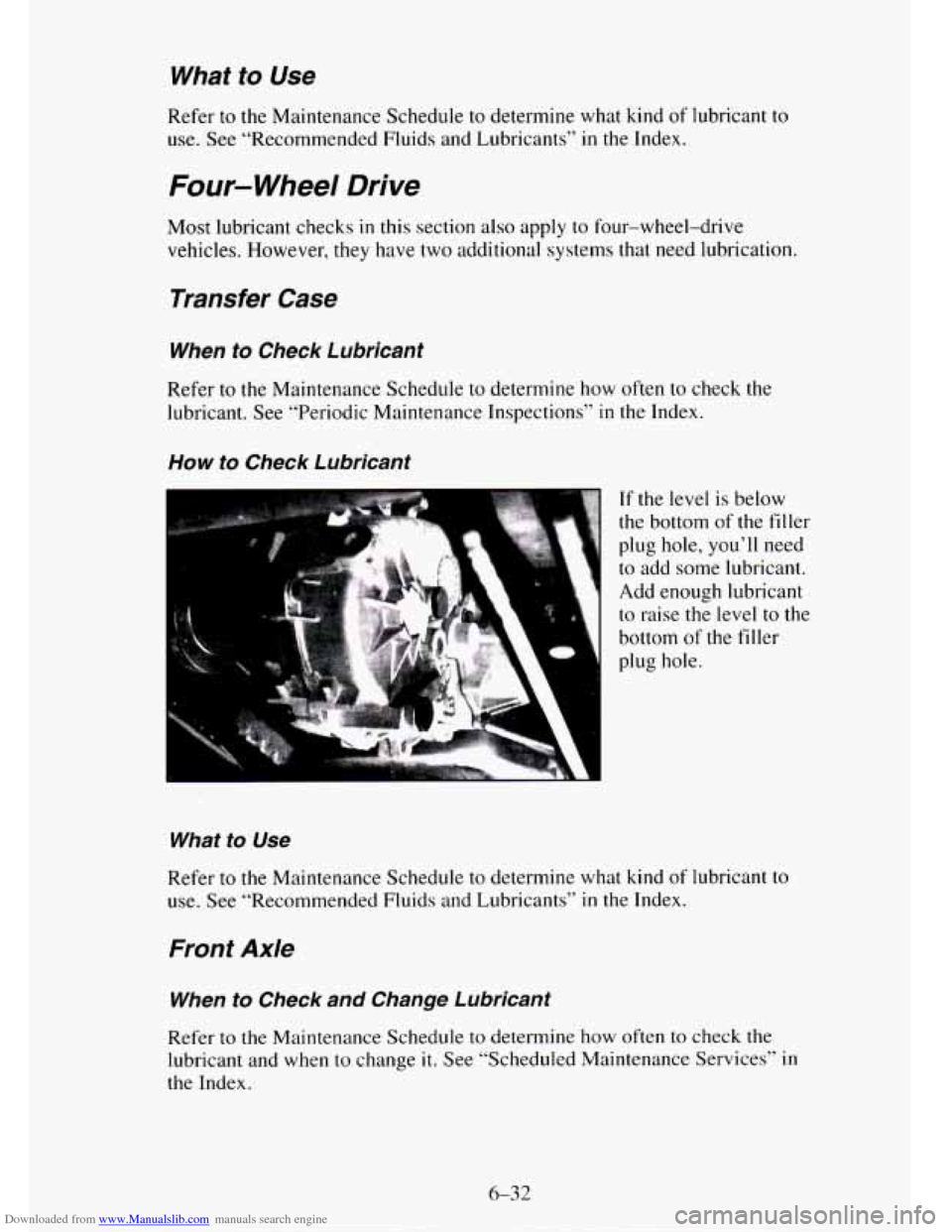
How to Check Lubricant
If the level is below
the bottom of
the filler
plug hole, you’ll need
to add some lubricant.
Add enough lubricant
to raise the level
to the
bottom
of the filler
plug hole.
What to Use
Refer to the Maintenance Schedule to determine what kind of lubricant to
use. See “Recommended Fluids and Lubricants” in the Index.
Front Axle
When to Check and Change Lubricant
Refer to the Maintenance Schedule to determine how often to check the
lubricant and when to change
it. See “Scheduled Maintenance Services” in
the Index.
6-32
Page 320 of 486
Downloaded from www.Manualslib.com manuals search engine Brake Wear
Your vehicle has front disc brakes and rear drum brakes.
Disc brake pads
have built-in wear indicators that make a high-pitched
warning sound when the brake pads are worn and new pads are needed. The
sound may come and
go or be heard all the time your vehicle is moving
(except when you are pushing on the brake pedal firmly).
I NOTICE:
Continuing to drive with worn-out brake pads could result in
costly brake repair.
Some driving conditions or climates may cause a brake squeal when the
brakes are first applied or lightly applied. This does not mean something is
wrong with your brakes.
Your rear drum brakes don’t have wear indicators, but
if you ever hear a
rear brake rubbing noise, have the rear brake linings inspected. Also, the
rear brake drums should be removed and inspected each time the tires are
removed for rotation or changing. When
you have the front brakes replaced,
have
the rear brakes inspected, too.
Brake linings should always be replaced as complete axle sets.
Brake Pedal Travel
See your dealer if the brake pedal does not return to normal height, or if
there
is a rapid increase in pedal travel. This could be a sign of brake
trouble.
Brake Adjustment
Every time you make a brake stop, your disc brakes adjust for wear.
If your brake pedal goes down farther than normal, your rear drum brakes
may need adjustment. Adjust them by backing up and firmly applying the
brakes a few times.
6-43
Page 339 of 486
Downloaded from www.Manualslib.com manuals search engine Tire Chains
NOTICE:
If your vehicle has LT265/75R16 size tires, don't use tire chains;
they can damage your vehicle.
If you have
a tire size other than LT26975R16, use tire chains
only where legal and only when you must. Use chains that are
the proper size for your tires. Install them on the tires
of the rear
axle.
Don't
use chains on the tires of the front axle.
Tighten them as tightly as possible with the ends securely
fastened. Drive slowly and follow the chain manufacturer's
instructions. If you can hear the chains contacting your vehicle,
stop and retighten them. If the contact continues, slow down
until it stops. Driving too fast or spinning the wheels with chains
on will damage your vehicle.
Appearance Care
. ..
. ..
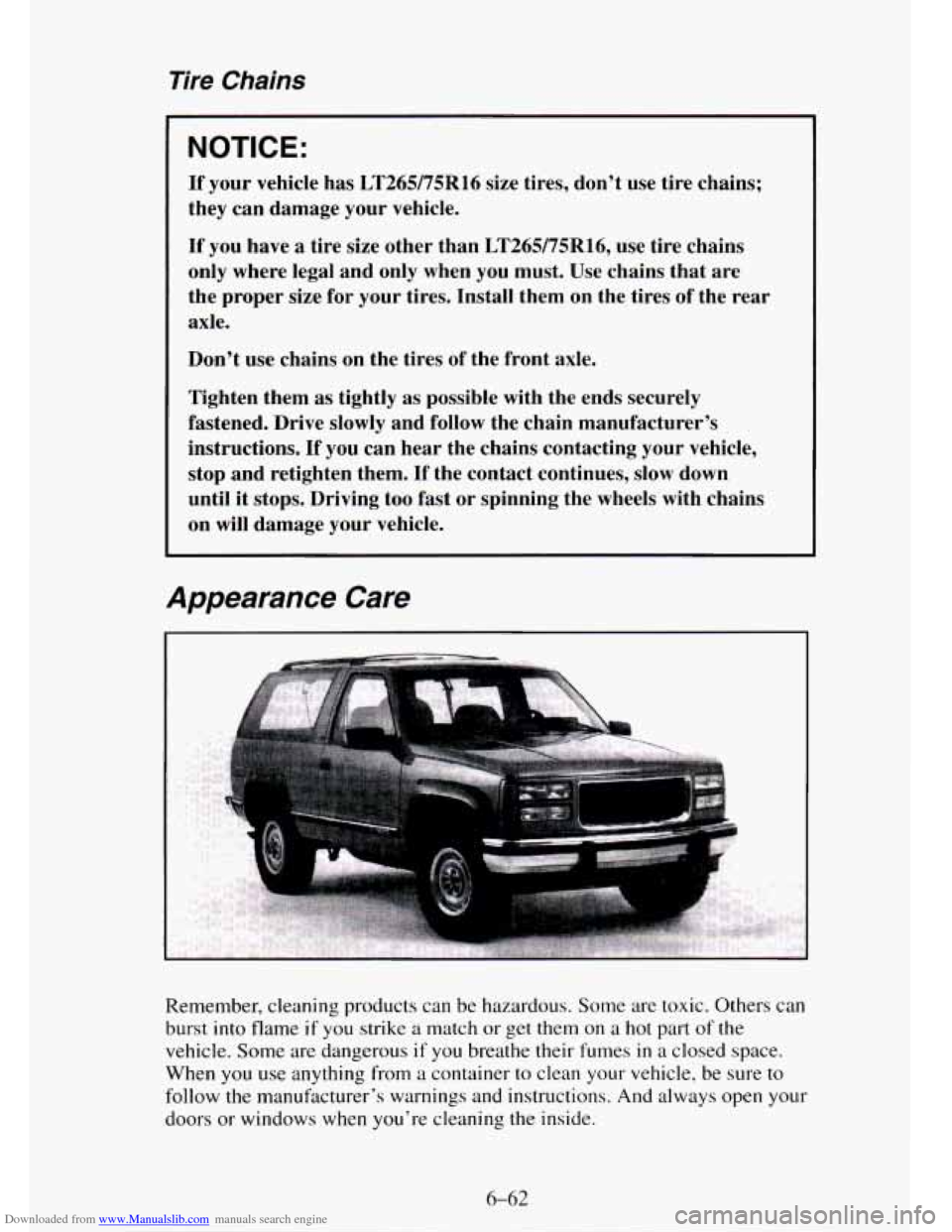
Remember, cleaning products can be hazardous. Some are toxic. Others can
burst into flame if
you strike a match or get them on a hot part of the
vehicle. Some are dangerous
if you breathe their fumes in a closed space.
When
you use anything from a container to clean your vehicle, be sure to
follow the manufxturer's warnings and instructions. And always open your
doors or windows when you're cleaning
the inside.
6-62
Page 359 of 486
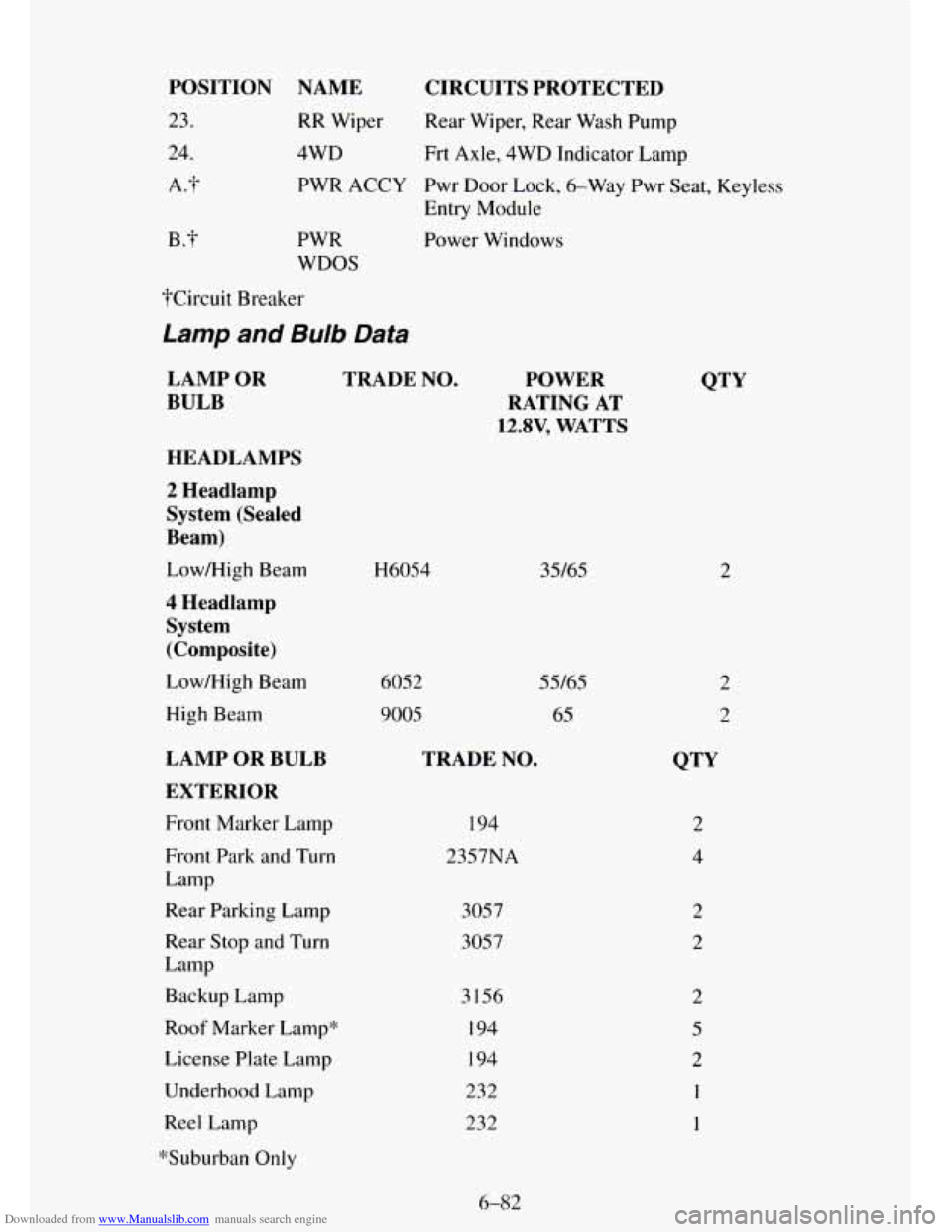
Downloaded from www.Manualslib.com manuals search engine POSITION NAME CIRCUITS PROTECTED
RR Wiper Rear Wiper, Rear Wash Pump
4WD Frt Axle, 4WD Indicator Lamp
PWR ACCY Pwr Door Lock, 6-Way Pwr Seat, Keyless
Entry Module 23.
24.
A3
B.? PWR
WDOS Power Windows
?Circuit Breaker
Lamp and Bulb Data
LAMP OR
BULB TRADE NO. POWER
RATING AT
12.8V, WATTS
HEADLAMPS
2 Headlamp
System (Sealed
Beam)
H6054 35/65 2 Low/High Beam
4 Headlamp
System
(Composite)
Low/High Beam
High Beam 6052
9005 55/65
65 2 2
TRADE NO. LAMP
OR BULB
EXTERIOR
194
2357NA 2
4
Front
Marker Lamp
Front Park and Turn
Lamp
Rear Parking Lamp
Rear Stop and Turn
Lamp
Backup Lamp
Roof Marker Lamp"
License Plate Lamp
Underhood Lamp 3057
3057
2
2
3156
194
194
232
232
Reel
Lamp
*Suburban Only
Page 367 of 486
Downloaded from www.Manualslib.com manuals search engine If your engine has more than one emissions classification, the classification
is determined by the Gross Vehicle Weight Rating (GVWR) of your vehicle
as shown on the Certification Label. See “Loading Your Vehicle” in the
Index.
Once you’ve determined your engine type and,
if necessary, emissions
classification, you’ll need
to decide which of the two schedules is right for
your vehicle. See Definitions for Maintenance Schedule I and Maintenance
Schedule I1 following.
Schedule I Definition - Gasoline Engines With Light Duty
Emissions
Follow Maintenance Schedule I if any one of these is true for your vehicle:
0 Most trips are less than 5 to 10 miles (8 to 16 km). This is particularly
important when outside temperatures are below freezing.
stop-and-go traffic).
0 Most trips include extensive idling (such as frequent driving in
0 You operate your vehicle in dusty areas or off-road frequently.
You frequently tow a trailer or use a carrier on top of your vehicle.
Schedule
I should also be followed if the vehicle is used for delivery
service, police, taxi, or other commercial application.
Schedule I Intervals - Gasoline Engines With Light Duty
Emissions
Every
3,000 Miles (5 000 km) or 3 Months
Engine Oil and Filter Change
Chassis Lubrication
Drive Axle Service
At 6,000 Miles (10 000 km) - Then Every 12,000 Miles (25 000 km)
Tire Rotation
Every 15,000 Miles (25 000 km)
Air Cleaner Filter Inspection, if driving in dusty conditions
Front Wheel Bearing Repack (or at each brake relining)
(2WD Only)
7-4
Page 368 of 486
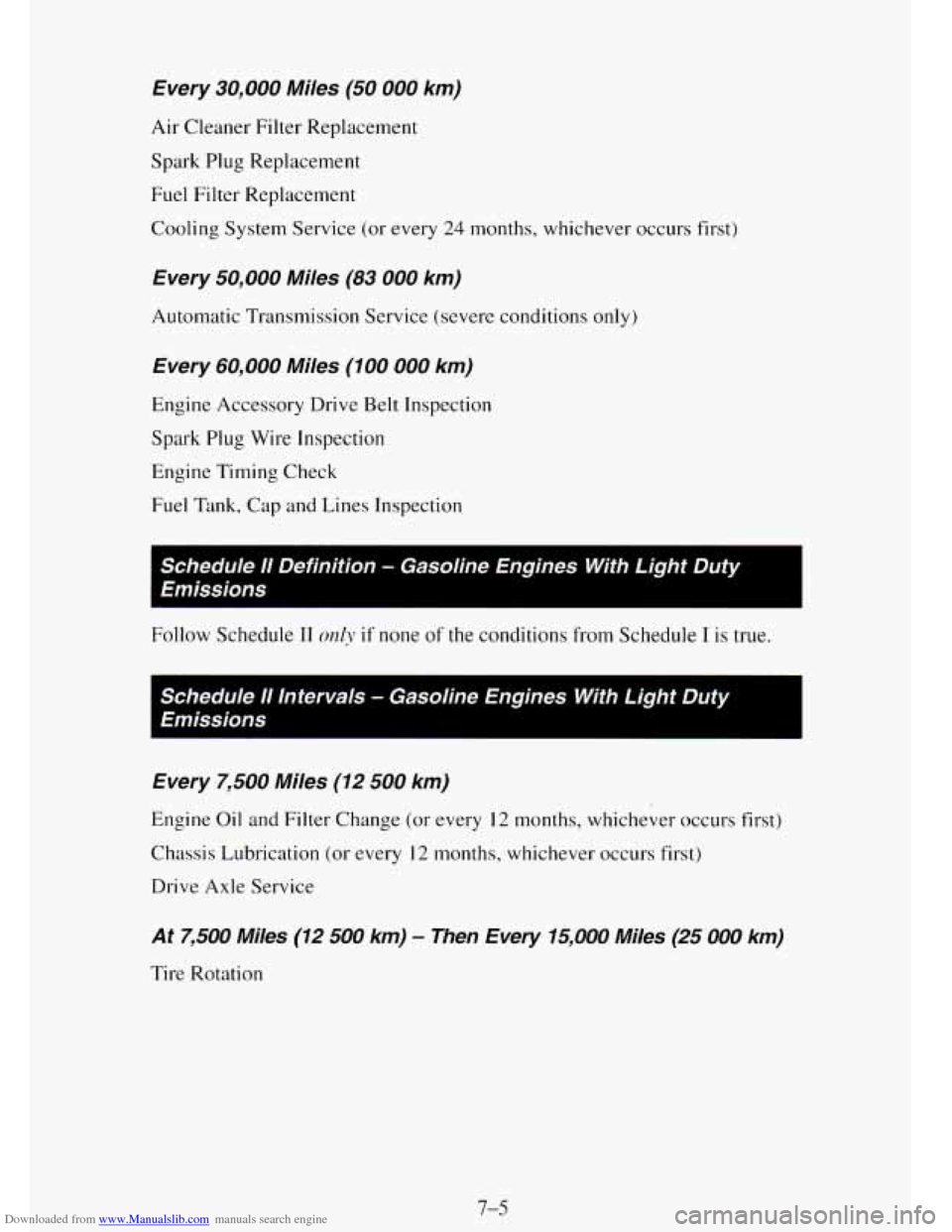
Downloaded from www.Manualslib.com manuals search engine Every 30,000 Miles (50 000 km)
Air Cleaner Filter Replacement
Spark Plug Replacement
Fuel Filter Replacement
Cooling System Service (or every
24 months, whichever occurs first)
Every 50,000 Miles (83 000 km)
Automatic Transmission Service (severe conditions only)
Every 60,000 Miles (100 000 km)
Engine Accessory Drive Belt Inspection
Spark Plug Wire Inspection
Engine Timing Check Fuel Tdnk, Cap and Lines Inspection
I
Schedule lI Definition - Gasoline Engines With Light Duty
Emissions
Follow Schedule 11 orzly if none of the conditions from Schedule I is true.
Every 7,500 Miles (12 500 km)
Engine Oil and Filter Change (or every 12 months, whichever occurs first)
Chassis Lubrication (or every
12 months, whichever occurs first)
Drive
Axle Service
At 7,500 Miles (12 500 km) - Then Every 15,000 Miles (25 000 km)
Tire Rotation
7-S
Page 369 of 486
Downloaded from www.Manualslib.com manuals search engine Every 30,000 Miles (50 000 km)
Cooling System Service (or every 24 months, whichever occurs first)
Spark Plug Replacement
Fuel Filter Replacement
Air Cleaner Filter Replacement Front Wheel Bearing Repack
Every 50,000 Miles (83 000 km)
Automatic Transmission Service (severe conditions only)
Every 60,000 Miles (100 000 km)
Spark Plug Wire Inspection
Engine Accessory Drive Belt Inspection
Fuel Tank, Cap and Lines Inspection
Engine Timing Check
Schedule 1 Definition - Gasoline Engines With Heavy Duty
Emissions
Follow Maintenance Schedule I if any one of these is true for your vehicle:
e
e
e
e
Most trips are less than 5 to 10 miles (8 to 16 km). This is particularly
important when outside temperatures are below freezing.
Most trips include extensive idling (such as frequent driving
in stop and
go traffic).
You operate
your vehicle in dusty areas or off-road frequently.
You frequently tow
a trailer or use a carrier on top of your vehicle.
Schedule
I should also be followed if the vehicle is used for delivery
service, police, taxi, or other commercial application.
Schedule I Intervals - Gasoline Engines with Heavy Duty
Emissions
Every
3,000 Miles (5 000 km)
Engine Oil and Filter Change (or every 3 months, whichever occurs first)
Chassis Lubrication (or every
3 months, whichever occurs first)
Drive Axle Service
7-6