Page 313 of 486
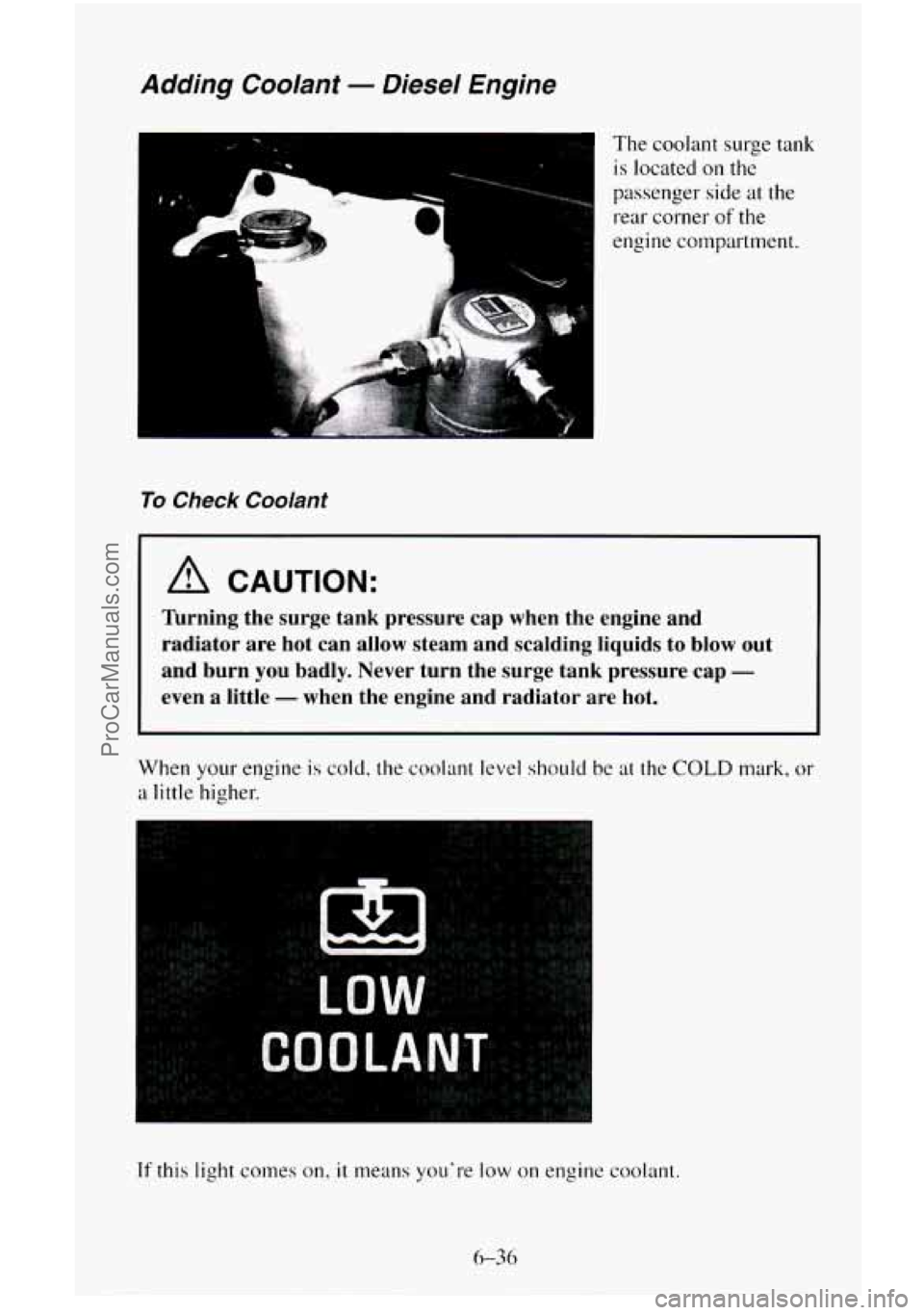
Adding Coolant - Diesel Engine
x " The coolant surge tank is located on
the
passenger side at the
rear corner of the
engine compartment.
To Check Coolant
A CAUTION:
lbrning the surge tank pressure cap when the engine and
radiator are hot can allow steam and scalding liquids to blow \
out
and burn you badly. Never turn the surge tank pressure
cap -
even a little - when the engine and radiator are hot.
When your engine is cold, the coolant level should be at the COLD mark. or
a little higher.
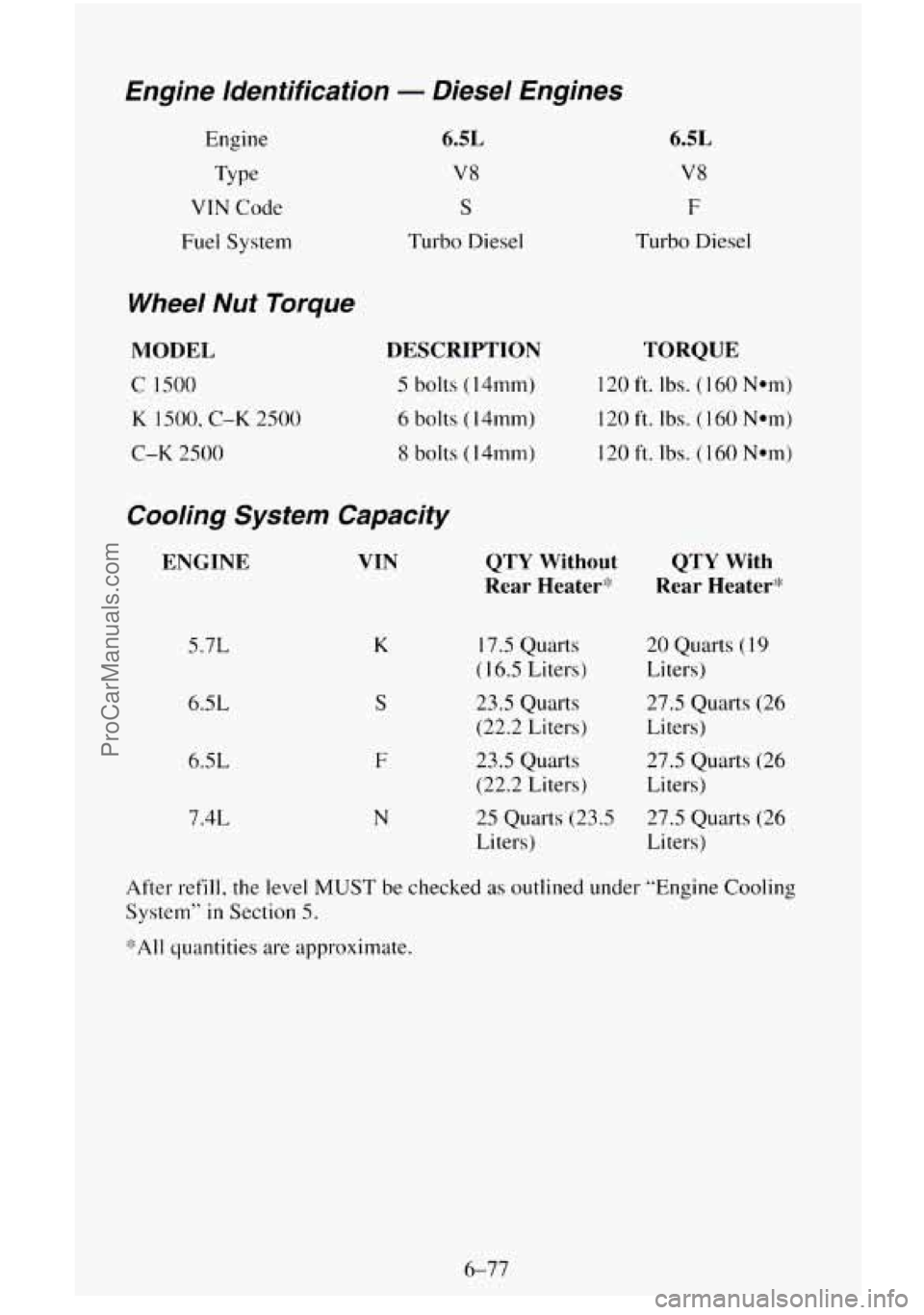
If this light comes on, it means you're low on engine coolant.
6-36
ProCarManuals.com
Page 316 of 486
Power Steering Fluid
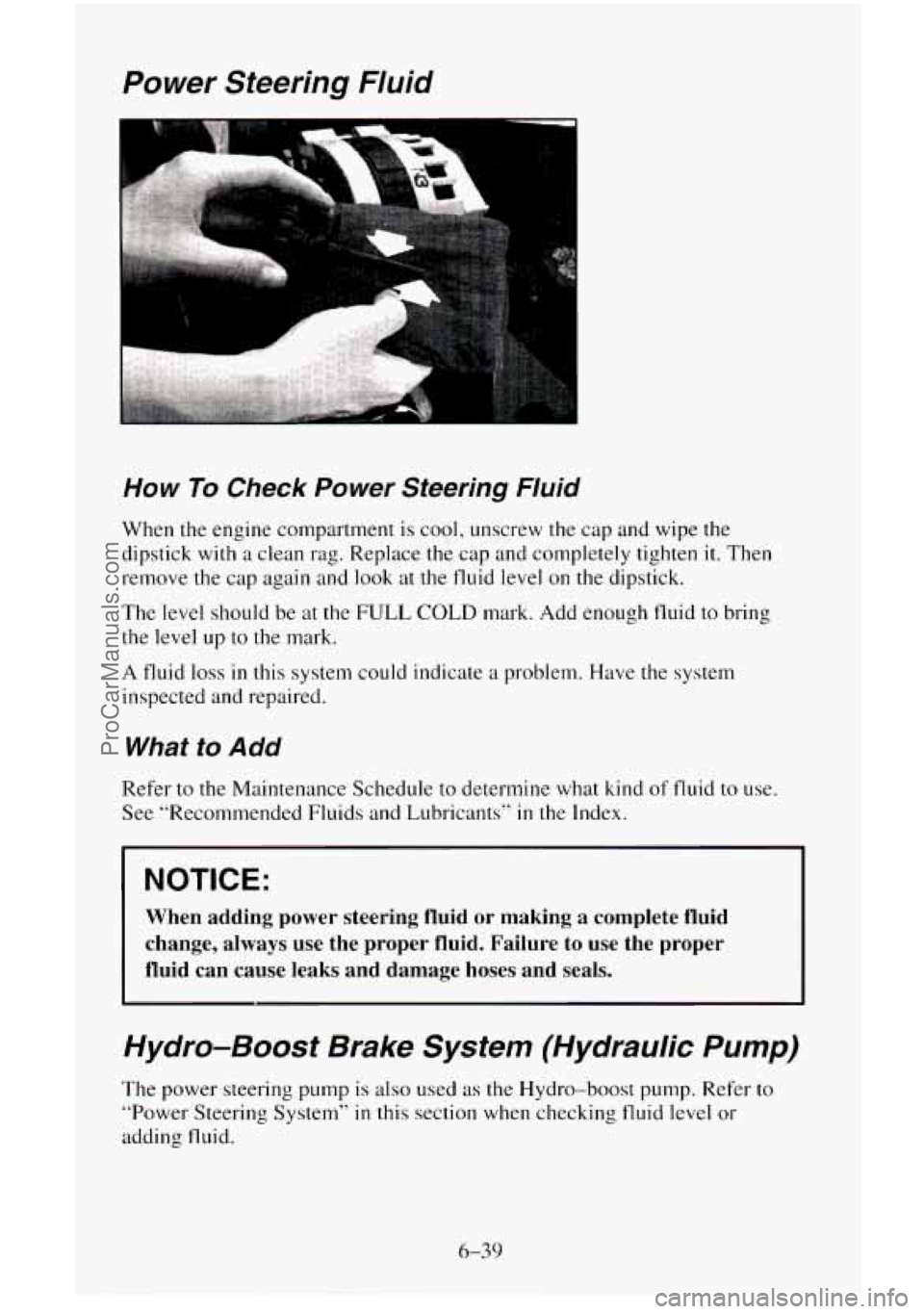
How To Check Power Steering Fluid
When the engine compartment is cool, unscrew the cap and wipe the
dipstick
with a clean rag. Replace the cap and completely tighten it. Then
remove the cap again
and look at the fluid level on the dipstick.
The level should be at the FULL COLD mark. Add enough fluid to bring
the level up
to the mark.
A fluid
loss in this system could indicate a problem. Have the system
inspected and repaired.
What to Add
Refer to the Maintenance Schedule to determine what kind of fluid to use.
See “Recommended Fluids and Lubricants”
in the Index.
I
I NOTICE:
When adding power steering fluid or making a complete fluid
change, always use the proper fluid. Failure to use the proper\
fluid can cause leaks and damage hoses and seals.
Hydro-Boost Brake System (Hydraulic Pump)
The power steering pump is also used as the Hydro-boost pump. Refer to
“Power Steering System” in this section when checking fluid level or
adding fluid.
6-39
ProCarManuals.com
Page 319 of 486
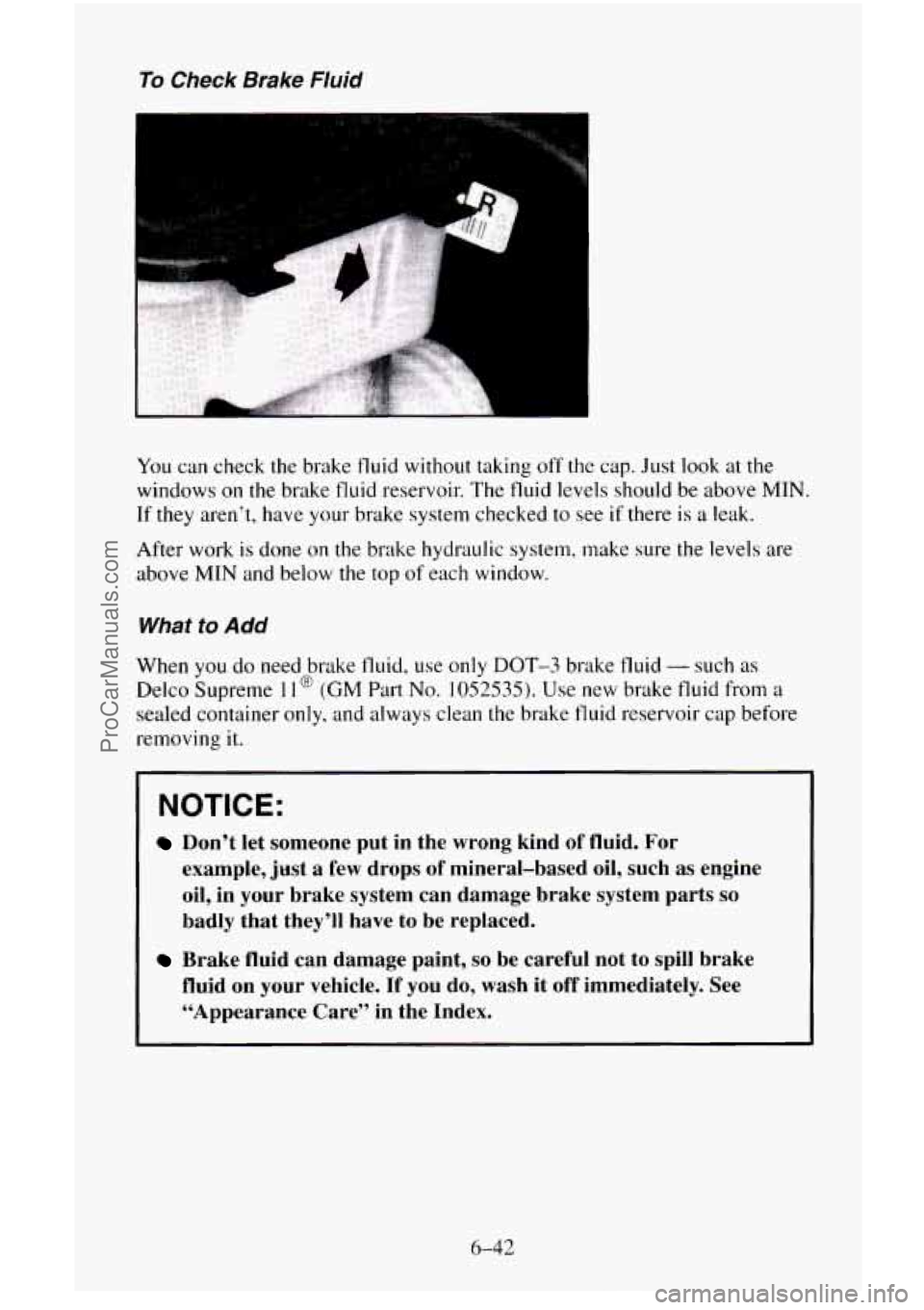
To Check Brake Fluid
You can check the brake fluid without taking off the cap. Just look at the
windows
on the brake fluid reservoir. The fluid levels should be above MIN.
If
they aren’t, have your brake system checked to see if there is a leak.
After work
is done on the brake hydraulic system, make sure the levels are
above
MIN and below the top of each window.
What to Add
When you do need brake fluid, use only DOT-3 brake fluid - such as
Delco Supreme 1 1 @ (GM Part No. 1052535). Use new brake fluid from a
sealed container only, and always clean the brake fluid reservoir cap before
removing it.
NOTICE:
Don’t let someone put in the wrong kind of fluid. For
example, just a few drops of mineral-based oil, such
as engine
oil, in your brake system can damage brake system parts so
badly that they’ll have to be replaced.
Brake fluid can damage paint, so be careful not to spill brake
fluid on your vehicle. If you do, wash it off immediately. See
“Appearance Care” in the Index.
6-42
ProCarManuals.com
Page 354 of 486
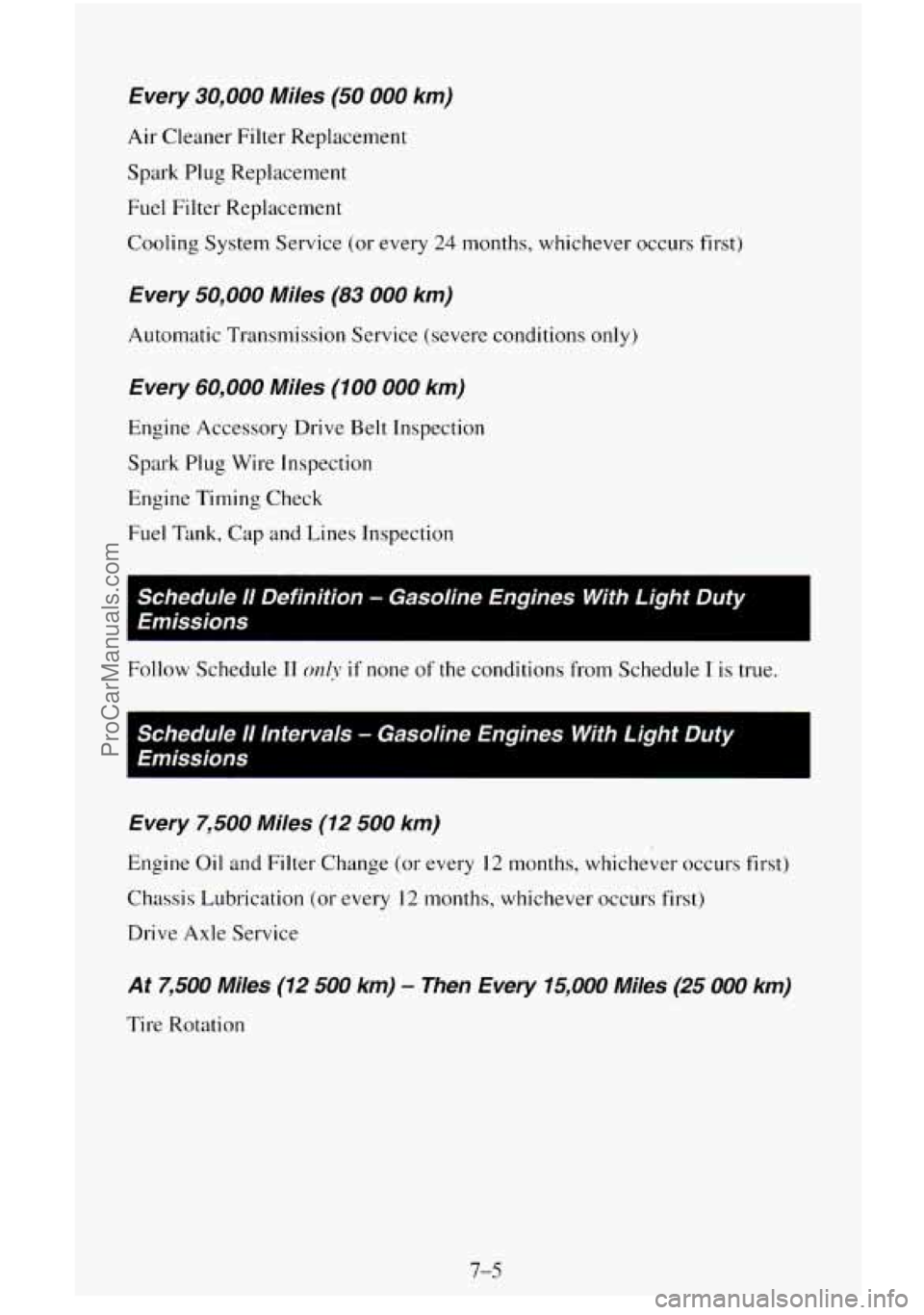
Engine Identification - Diesel Engines
Engine Type
VTN Code
Fuel System
Wheel Nut Torque
MODEL
C 1500
K 1500, C-K 2500
C-K 2500
6.5L
V8
S
Turbo Diesel
DESCRIPTION
5 bolts (14mm)
6 bolts
(1 4mm)
8 bolts ( 14mm)
Cooling System Capacity
ENGINE
5.7L
6.5L
6.5L 7.4L
VIN
K
S
F
N
6.5L
V8
F
Turbo Diesel
TORQUE
120 ft. Ibs. ( 160 N*m)
120 ft. Ibs. (1 60 Nom)
I20
ft. lbs. ( 160 Nom)
QTY Without
Rear Heater*
1 7.5 Quarts
( 16.5 Liters)
23.5 Quarts (22.2 Liters)
23.5 Quarts
(22.2 Liters)
25 Quarts
(23.5
Liters)
QTY With
Rear Heater4’
20 Quarts (1 9
Liters)
27.5 Quarts (26
Liters)
27.5 Quarts (26
Liters)
27.5 Quarts (26
Li ters)
After refill. the level MUST be checked
as outlined under “Engine Cooling
System” in Section 5.
‘$All quantities are approximate.
6-77
ProCarManuals.com
Page 355 of 486
Crankcase Capacity
ENGINE
5.7L
6.5L
6.5L
7.4L
VIN
K
S
F
N
QUANTITY WITH
FILTER?
5 Quarts (4.8 Liters)
7 Quarts (6.5 Liters)
7 Quarts (6.5 Liters)
7 Quarts (6.5 Liters)
After refill, the level
MUST be checked as outlined under “Engine Oil And
Filter Recommendations”
in Section 5.
All quantities are approximate.
?Oil filter should be changed at EVERY oil change.
Fuel Tank Capacity
TYPE
Gasoline/Diesel
Utility Models - Standard
Suburban
- Standard
QUANTITY
30 Gallons ( I 1 3 Liters)
42 Gallons
( I59 Liters)
All quantities are for a completely dry tank and are approximate.
Service Replacement Part and Filter
Recommendations
- Gasoline Engines
Engine
VIN
Oil Filter
Air Cleaner Filter
PCV Valve
Spark Plugs”
Fuel Filter
Radiator Cap
5.7L
K
PF1218T A348C
cv774c
CR43TS
GF48 1
RC36
?Four Wheel Drive Vehicle
- use a PF52 oil filter
*Use AC copper-cored resistor type spark plugs
7.4L
N
PF1218
A348C
cv774c
.CR43TS GF48
1
RC36
ProCarManuals.com
Page 361 of 486
LAMP OR BULB
INSTRUMENT
PANEL
SIR (Air Bag)
Safety Belt Warning
Check Gages Indicator
Malfunction Indicator (”Service Engine
Soon”) Lamp
Upshift Indicator
Glow
Plugs Lamp**
Low Coolant Lamp**’
Water
in Fuel Lamp**
Service Throttle Soon
Lamp**
**Diesel only
?Canadian Vehicles only
TRADE NO.
74
74
74
74
74
74
74
74
74
ProCarManuals.com
Page 366 of 486
Part A: Scheduled Maintenance Services
Using Your Maintenance Schedule
We at General Motors want to help you keep your vehicle in good working
condition. But we don’t know exactly how
you’ll drive it. You may drive
very short distances
only a few times a week. Or you may drive long
distances all the time
in very hot, dusty weather. You may use your vehicle
in making deliveries. Or you may drive it to work, to do errands or in many
other ways.
Because of all the different ways people use their GM vehicles, maintenance
needs vary. You may
even need more frequent checks and replacements than
you’ll find
in the schedules in this section. So please read this section and
note how
you drive. If you have any questions on how to keep your vehicle
in good condition, see your GM dealer.
This part tells you the maintenance services
you should have done and when
you should schedule them. If you go to your dealer for your service needs,
you’ll know that GM-trained and supported service people will perform the
work using genuine GM parts.
The proper fluids and lubricants to use are listed in Part D. Make sure
whoever services your vehicle uses these. All parts should be replaced and
all necessary repairs done before you or anyone else drives the vehicle.
These schedules are
for vehicles that:
carry passengers and cargo within recommended limits. You will find
these limits on your vehicle’s CertificatiodTire label. See “Loading
Your Vehicle”
in the Index.
are driven on reasonable road surfaces within legal driving limits.
are driven off-road in the recommended manner. See “Off Road
Driving With Your Four-wheel Drive Vehicle”
in the Index.
use the recommended unleaded fuel. See “Fuel” in the Index.
Selecting the Right Schedule
The proper maintenance schedule for your vehicle depends on which engine
you have in your vehicle and how you use your vehicle.
Gasoline engine vehicles and diesel engine vehicles have different
maintenance requirements. If you have a diesel engine, follow
a schedule
designated for diesel engine vehicles
only. If you have a gasoline engine,
you must first determine whether your engine has a light duty or a heavy
duty emissions classification. Follow a maintenance schedule designated for
gasoline engines with the emissions classification (light duty or heavy duty)
for your engine. See “Engine Identification”
in the Index to find your
engine’s emission classification.
7-3
ProCarManuals.com
Page 368 of 486
Every 30,000 Miles (50 000 km)
Air Cleaner Filter Replacement
Spark Plug Replacement
Fuel Filter Replacement
Cooling System Service (or every
24 months, whichever occurs first)
Every 50,000 Miles (83 000 km)
Automatic Transmission Service (severe conditions only)
Every 60,000 Miles (100 000 km)
Engine Accessory Drive Belt Inspection
Spark Plug Wire Inspection
Engine Timing Check Fuel Tdnk, Cap and Lines Inspection
I
Schedule lI Definition - Gasoline Engines With Light Duty
Emissions
Follow Schedule 11 orzly if none of the conditions from Schedule I is true.
Every 7,500 Miles (12 500 km)
Engine Oil and Filter Change (or every 12 months, whichever occurs first)
Chassis Lubrication (or every
12 months, whichever occurs first)
Drive
Axle Service
At 7,500 Miles (12 500 km) - Then Every 15,000 Miles (25 000 km)
Tire Rotation
7-S
ProCarManuals.com