1995 CHEVROLET SUBURBAN heating
[x] Cancel search: heatingPage 228 of 486
Turn Signals When Towing a Trailer
When you tow a trailer, your vehicle has to have extra wiring (included in
the optional trailering package). The green arrows
on your instrument panel
will flash whenever
you signal a turn or lane change. Properly hooked up,
the trailer lamps will
also flash, telling other drivers you’re about to turn,
change lanes or stop.
When towing a trailer, the green arrows on your instrument panel will flash
for turns even if the bulbs
on the trailer are burned out. Thus, you may think
drivers behind you are seeing your signal when they are not. It’s important
to check occasionally to be sure the trailer bulbs are still working.
Driving On Grades
Reduce speed and shift to a lower gear before you start down a long or steep
downgrade. If
you don’t shift down, you might have to use your brakes so
much that they would get hot and no longer work well.
On
a long uphill grade, shift down and reduce your speed to around 45 mph
(70 kdh) to reduce the possibility of engine and transmission overheating.
If
you have an automatic transmission you should use DRIVE (3) (or, as
you need to, a lower gear) when towing a trailer. Operating your vehicle in
DRIVE (3) when towing a trailer will minimize heat build-up and extend
the life
of your transmission.
If
you have a manual transmission and you are towing a trailer, it’s better
not to use FIFTH (5) gear. Just drive in FOURTH (4) gear (or, as you need
to,
a lower gear).
When towing at high altitude
on steep uphill grades, consider the following:
Engine coolant will boil at a lower temperature than at normal altitudes. If
you turn your engine off immediately after towing at high altitude on steep
uphill grades, your vehicle may show signs similar
to engine overheating.
To avoid this, let the engine run while parked (preferably on level ground)
with the automatic transmission
in PARK (P) (or the manual transmission
out of gear and the parking brake applied) for a few minutes before turning
the engine off.
If you do get the overheat warning, see “Engine
Overheating” in the Index.
Parking on Hills
You really should not park your vehicle, with a trailer attached, on a hill. If
something goes wrong, your rig could start to move. People can be injured,
and both your vehicle and
the trailer can be damaged.
But
if you ever have to park your rig on a hill, here’s how to do it:
1. Apply your regular brakes, but don’t shift into PARK (P) yet, or in gear
for a manual transmission.
ProCarManuals.com
Page 242 of 486
Towing From the Rear
Engine Overheating
If Steam Is Coming From Your Engine
5-9
ProCarManuals.com
Page 282 of 486
Canadian Fuels
Diesel-powered trucks are now equipped with emission control systems that
require the use of diesel fuel with low-sulfur
(.05% by weight) content.
Both low- and higher-sulfur fuels will be available
in Canada. Only
low-sulfur diesel fuels are available
in the United States. It is important that
diesel-powered trucks are refueled with low-sulfur fuel. Use of fuels with
higher-sulfur content will affect the function
of the emission components
and may cause reduced performance, excessive smoke and unpleasant odor.
Cold Weather Operation
Follow the instructions listed previously under the heading “What Fuel to
Use
.”
If you’re driving in very cold temperatures and can’t get a “winterized”
Number
2-D that has been adapted to cold weather or a Number 1-D, you
can use one gallon of kerosene for every two gallons of diesel fuel. Once
you add the kerosene, run your engine for several minutes
so the fuels will
mix. Add kerosene only when
the temperature fills below 0°F (-I 8”C),
because the fuel economy of kerosene isn’t as good as that of diesel fuel.
I NOTICE:
Never use home heating oil or gasoline in your diesel engine.
They can cause engine damage.
In cold weather, your fuel filter may become clogged (waxed). To unclog it,
warm the filter to between 32°F and 50°F (0°C to 10°C). You won’t need
to replace it.
Water in Fuel
Sometimes, water can be pumped into your fuel tank along with your diesel
fuel. This can happen if a service station doesn’t regularly inspect and clean
its fuel tanks, or if it gets contaminated fuel from its suppliers.
ProCarManuals.com
Page 285 of 486
NOTICE:
If there is water in your diesel fuel and the weather is warm or
humid, fungus and bacteria can grow in the fuel. They can
damage your fuel system. You’ll need
a diesel fuel biocide to
sterilize your fuel system. Your dealer can advise you if you ever
need this.
If your fuel tank needs to be purged to remove water,
see your
dealer or
a qualified technician. Improper purging can damage
your fuel system.
Running Out of Fuel (Diesel Engines)
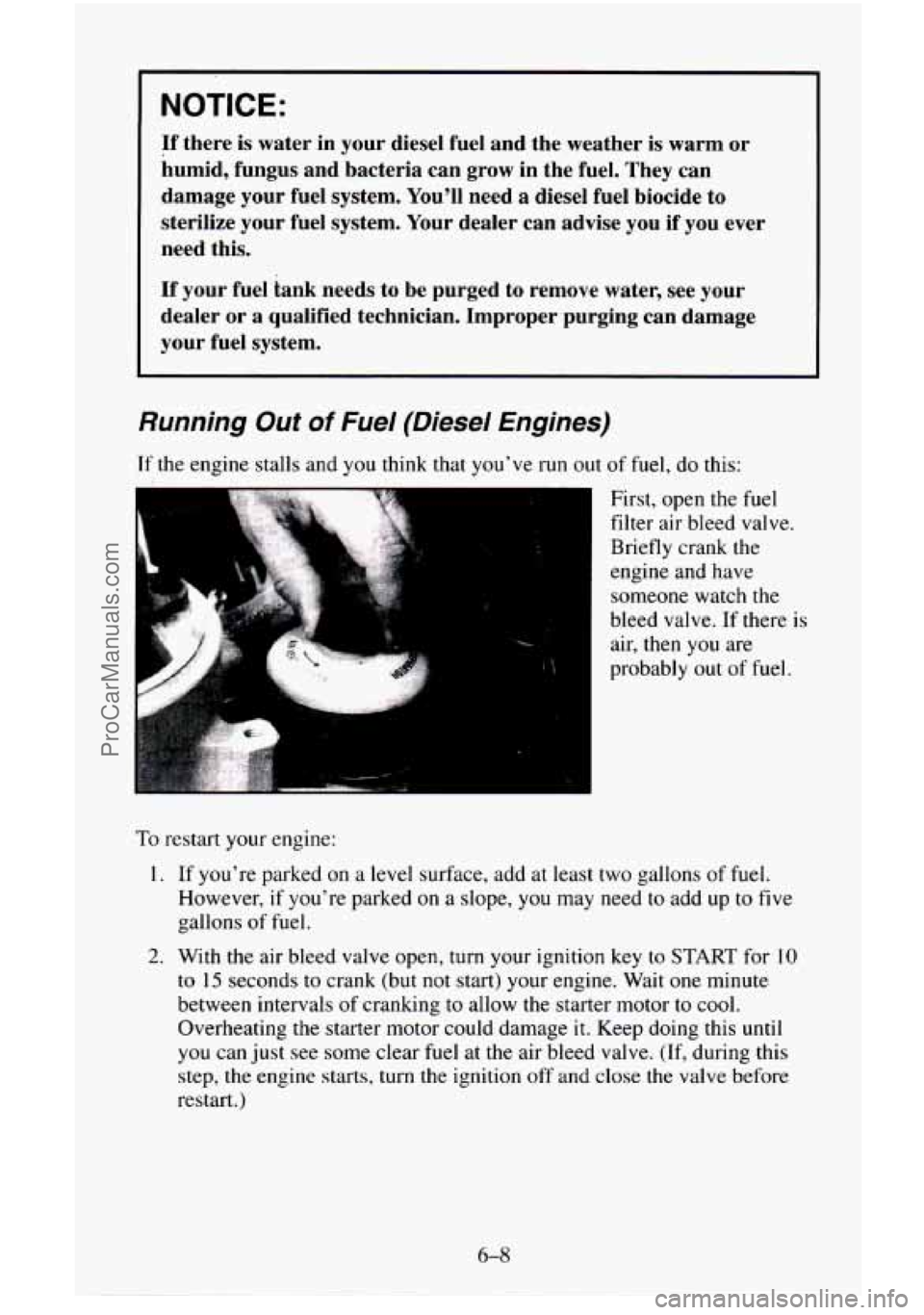
If the engine stalls and you think that you’ve run out of fuel, do this:
First, open the fuel
filter air bleed valve.
Briefly crank the
engine and have
someone watch
the
bleed valve. If there is
air,
then you are
probably
out of fuel.
To restart your engine:
1. If you’re parked on a level surface, add at least two gallons of fuel.
However, if you’re parked on a slope, you may need to add up to five
gallons of fuel.
2. With the air bleed valve open, turn your ignition key to START for 10
to 15 seconds to crank (but not start) your engine. Wait one minute
between intervals of cranking to allow the starter motor
to cool.
Overheating the starter motor could damage
it. Keep doing this until
you can just see some clear fuel at the air bleed valve. (If, during this
step, the engine starts, turn the ignition off and close the valve before
restart.)
ProCarManuals.com
Page 310 of 486
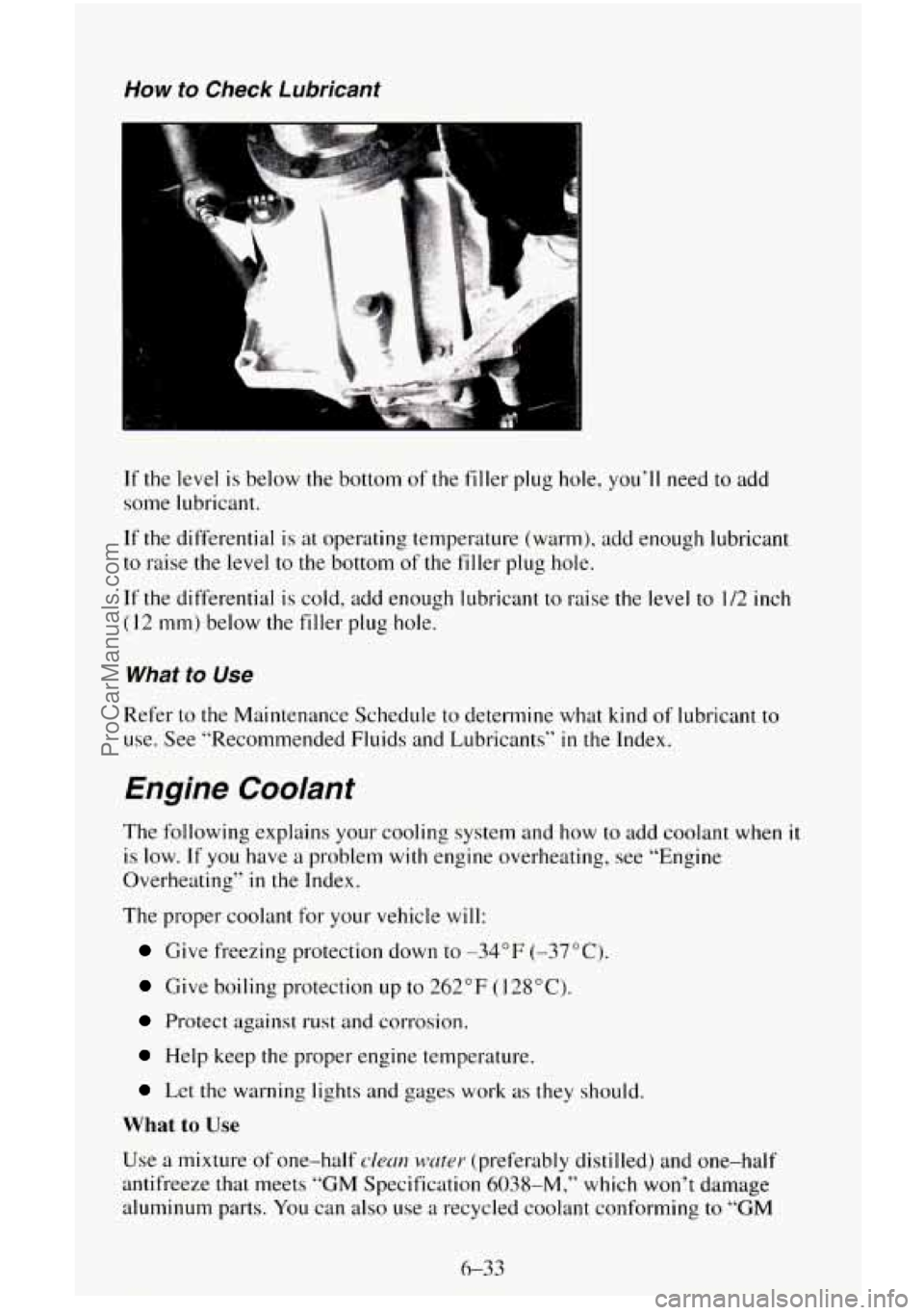
How to Check Lubricant
P
If the level is below the bottom of the filler plug hole, you’ll need to add
some lubricant.
If the differential is at operating temperature (warm), add enough lubricant
to raise the level to the bottom of the filler plug hole.
If the differential is cold, add enough lubricant to raise the level to 1/2 inch
(I 2 mm) below the filler plug hole.
What to Use
Refer to the Maintenance Schedule to determine what kind of lubricant to
use. See “Recommended Fluids and Lubricants” in the Index.
Engine Coolant
The following explains your cooling system and how to add coolant when it
is low. If you have a problem with engine overheating, see “Engine
Overheating”
in the Index.
The proper coolant for your vehicle will:
Give freezing protection down to -34°F (-37°C).
Give boiling protection up to 262°F (128°C).
Protect against rust and corrosion.
Help keep the proper engine temperature.
Let the warning lights and gages work as they should.
What to Use
Use a mixture of one-half chi? wcmr (preferably distilled) and one-half
antifreeze that meets
“GM Specification 6038-M,” which won’t damage
aluminum parts.
You can also use a recycled coolant conforming to “GM
6-33
ProCarManuals.com
Page 314 of 486
To Add Coolant
If you need more coolant, add the proper mix crt the surge tunk, but only
when the engine
is cool. If the surge tank is empty, see “Engine
Overheating”
in the Index for the proper fill procedure.
A CAUTION:
You can be burned if you spill coolant on hot engine parts.
Coolant contains ethylene glycol, and
it will burn if the engine
parts are hot enough. Don’t spill coolant on
a hot engine.
When replacing the pressure
cap, make sure it is tight.
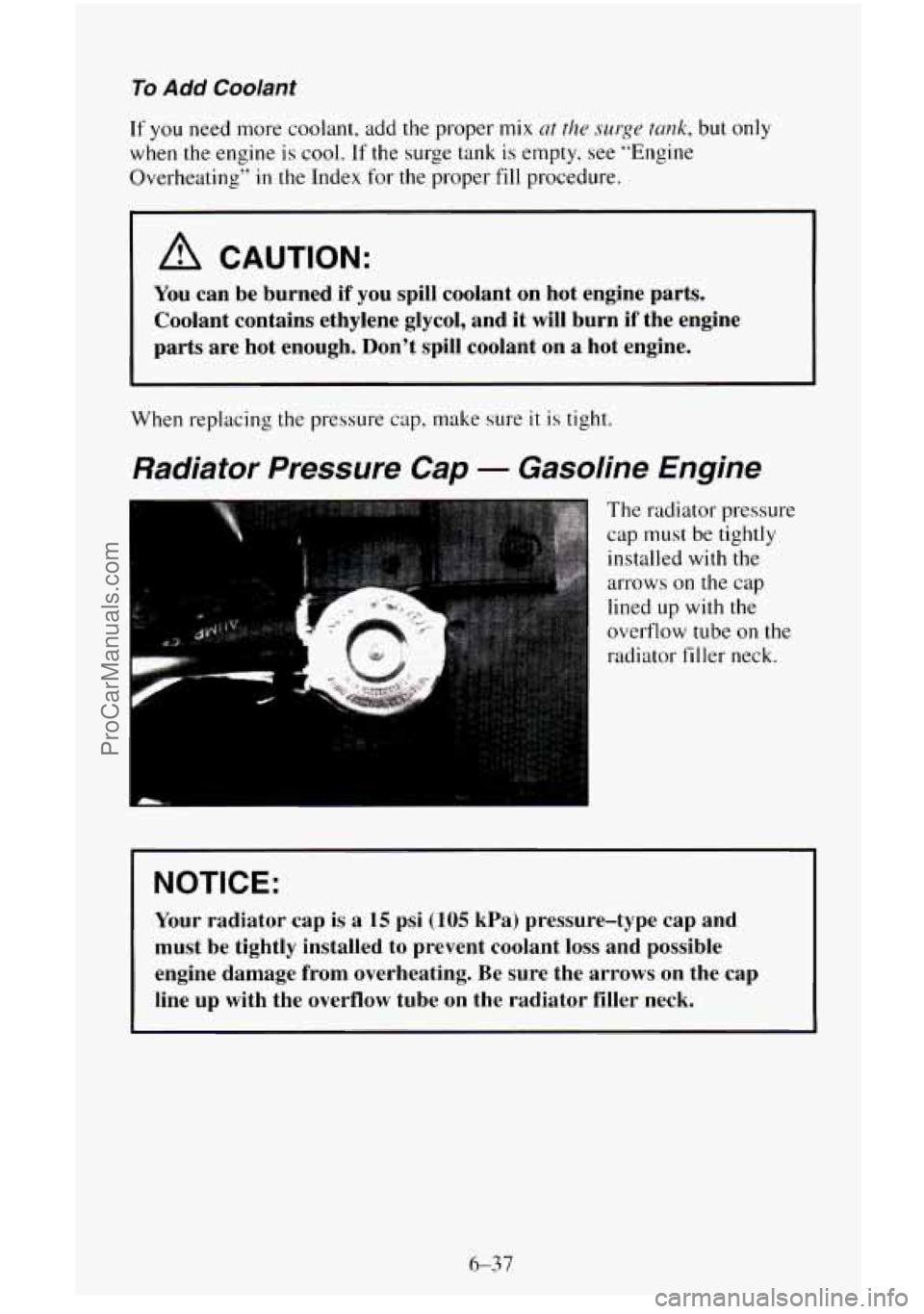
Radiator Pressure Cap - Gasoline Engine
The radiator pressure
cap
must be tightly
installed
with the
arrows on the cap
lined up with the
overflow tube
on the
radiator filler neck.
U
NOTICE:
Your radiator cap is a 15 psi (105 kPa) pressure-type cap and
must be tightly installed to prevent coolant
loss and possible
engine damage from overheating. Be sure the arrows on the cap
line up with the overflow tube on the radiator filler neck.
ProCarManuals.com
Page 315 of 486
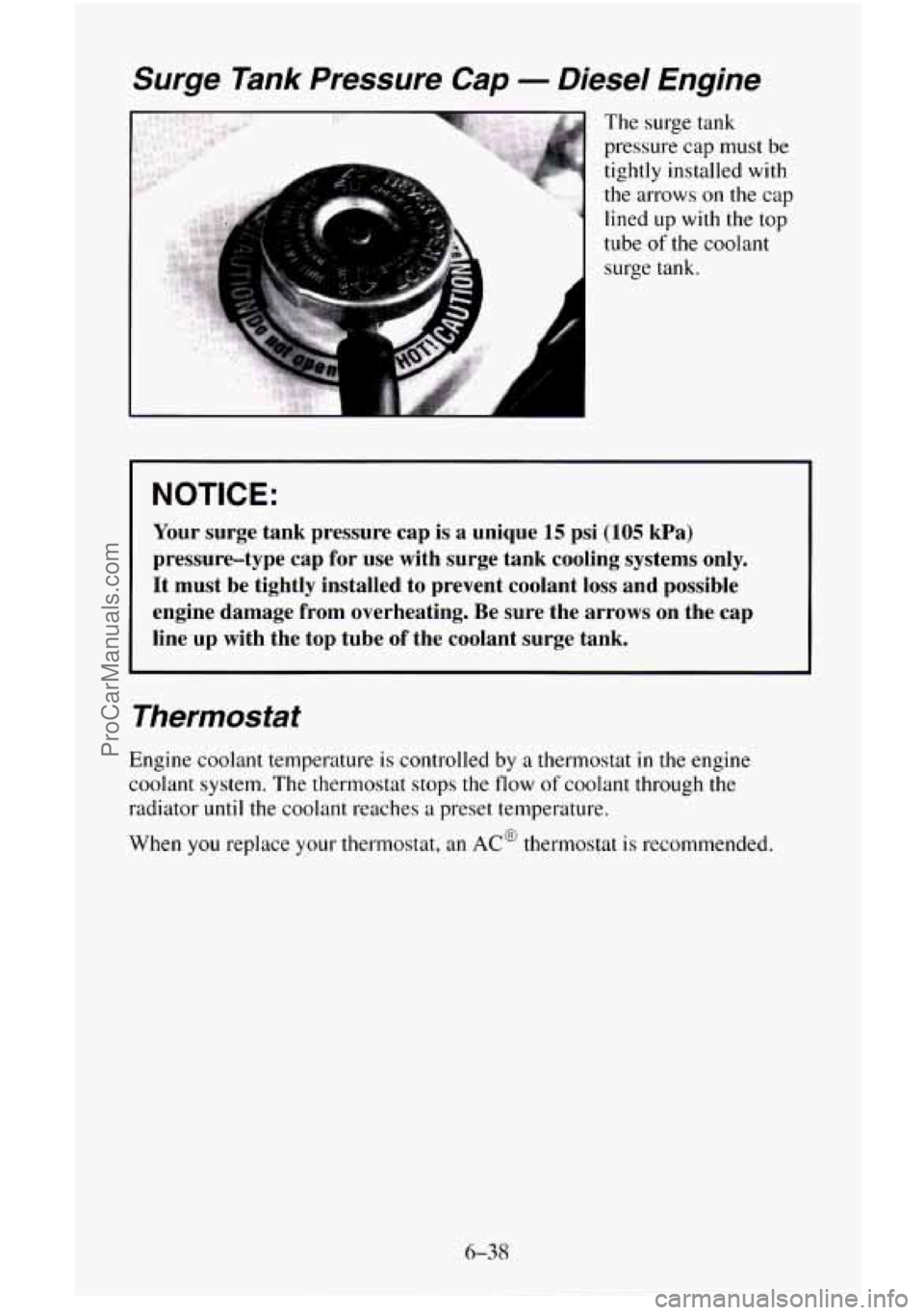
Surge Tank Pressure Cap - Diesel Engine
The surge tank
pressure cap must
be
tightly installed with
the arrows on the cap
lined up with the top
tube
of the coolant
surge tank.
NOTICE:
Your surge tank pressure cap is a unique 15 psi (105 kPa)
pressure-type cap for use with surge tank cooling systems only.
It must be tightly installed to prevent coolant
loss and possible
engine damage from overheating. Be sure the arrows on the cap
line up with the top tube of the coolant surge tank.
Thermostat
Engine coolant temperature is controlled by a thermostat in the engine
coolant system. The thermostat stops the flow
of coolant through the
radiator
until the coolant reaches a preset temperature.
When you replace your thermostat, an
AC@ thermostat is recommended.
6-38
ProCarManuals.com
Page 477 of 486
E
Eiectrical System
Engine Add-On
Equipment
........................................... 6-74
Adding Coolant
. Diesel Engine ........................... 5.18, 636
Adding Coolant
- Gasoline Engine .... , .................... 5-1 1’6-35 .
Air Cieaner
Coolant
.........................
Coolant Heater ...................
Coolant Temperature Gage (See “Gages‘
Diesel Heater Output
...............
.
......................
Control Module System ............
........................... 6-25
........................... 6-53
........................... 6-33
.................. 2-19.3-4. 6-19
1
............................ 3-4
Exhaust
..................................................... 2-31
FanNoise
................................................... 5-24
Identification .................................. 6-72.6-73.6-76. 6-77
Oil (See “Oil”)
Overheating
................................................... 5-9
RunningWhileParked ......................................... 2-32
Starting Your Gasoline Engine
................................... 2-13
Starting Your Diesel Engine
..................................... 2-15
Exhaust System
............................................... 6-53
F
Filter Replacement Chart (See “Service-Replacement Parts and Filter
Recommendations’’)
Fluid Capacities (See “Capacities and Specification”)
Fluid Leak Check
..................................... ........ 6-45
Fluids (See “Scheduled Maintenance Services”)
Four-WheelDrive
............................................... 2-33
Front Axle Locking Feature
..................................... 2-35
Transfer Case
........................................... 2-33. 6-32
Canadian
..................................................... 6-5
Diesel
....................................................... 6-4
Filling Your Tank ............................................. 6-11
Foreign Countries (Gasoline Engines)
............................. 6-11
Filter Replacement (Diesel Engines)
............................... 6-9
Gage (See “Gages”)
Gasoline
..................................................... 6-2
Gasolines for Cleaner Air
........................................ 6-3
Running Out of Fuel (Diesel Engines) .............................. 6-8
Tankcapacity ................................................ 6-78
Water in Fuel (Diesel Engines) ............................... 2-70. 6-5
Fuses and Circuit Breakers ................................... 6-75. 6-81
FuseBlock
............................................. 6-766-80
Fuel
4
ProCarManuals.com