1995 CHEVROLET S10 warning light
[x] Cancel search: warning lightPage 160 of 354
Downloaded from www.Manualslib.com manuals search engine City Driving
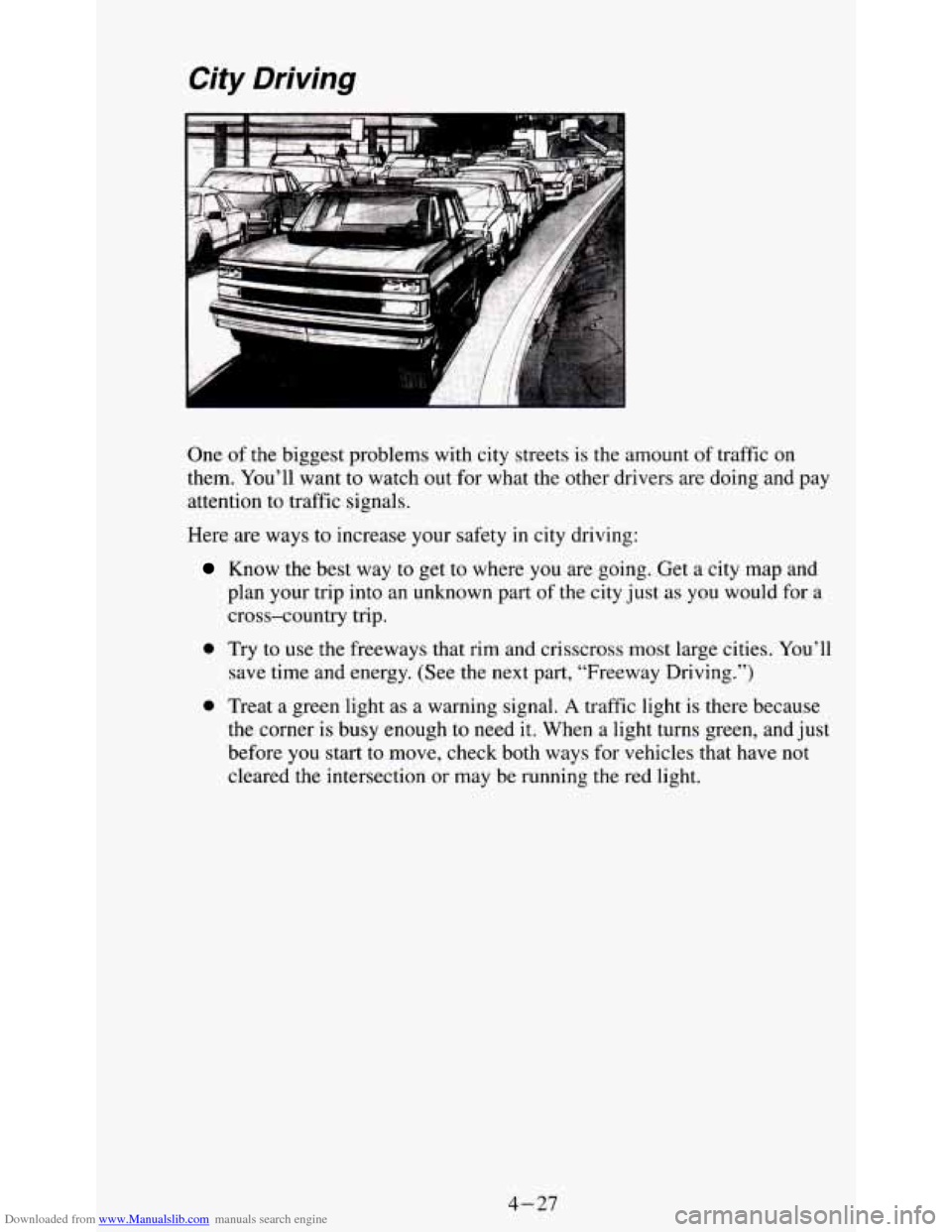
One of the biggest problems with city streets is the amount of traffic on
them. You’ll want to watch out for what the other drivers are doing and pay
attention to traffic signals.
Here are ways to increase your safety in city driving:
Know the best way to get to where you are going. Get a city map and
plan your trip into an unknown part of the city just
as you would for a
cross-country trip.
0 Try to use the freeways that rim and crisscross most large cities. You’ll
save time and energy. (See the next part, “Freeway Driving.”)
0 Treat a green light as a warning signal. A traffic light is there because
the corner is busy enough to need it. When a light turns green, and just
before you start to move, check both ways for vehicles that have not
cleared the intersection
or may be running the red light.
4-27
Page 165 of 354
Downloaded from www.Manualslib.com manuals search engine Include an ice scraper, a small brush or broom, a supply of windshield
washer fluid, a rag, some winter outer clothing, a small shovel, a flashlight,
a red cloth, and a couple
of reflective warning triangles. And, if you will be
driving under severe conditions, include a small bag of sand, a piece of old
carpet
or a couple of burlap bags to help provide traction. Be sure you
properly secure these items in your vehicle.
Driving on Snow or Ice
Most of the time, those places where your tires meet the road probably have
good traction.
However, if there is snow
or ice between your tires and the road, you can
have a very slippery situation. You’ll have a lot less traction or “grip” and
will need to be very careful.
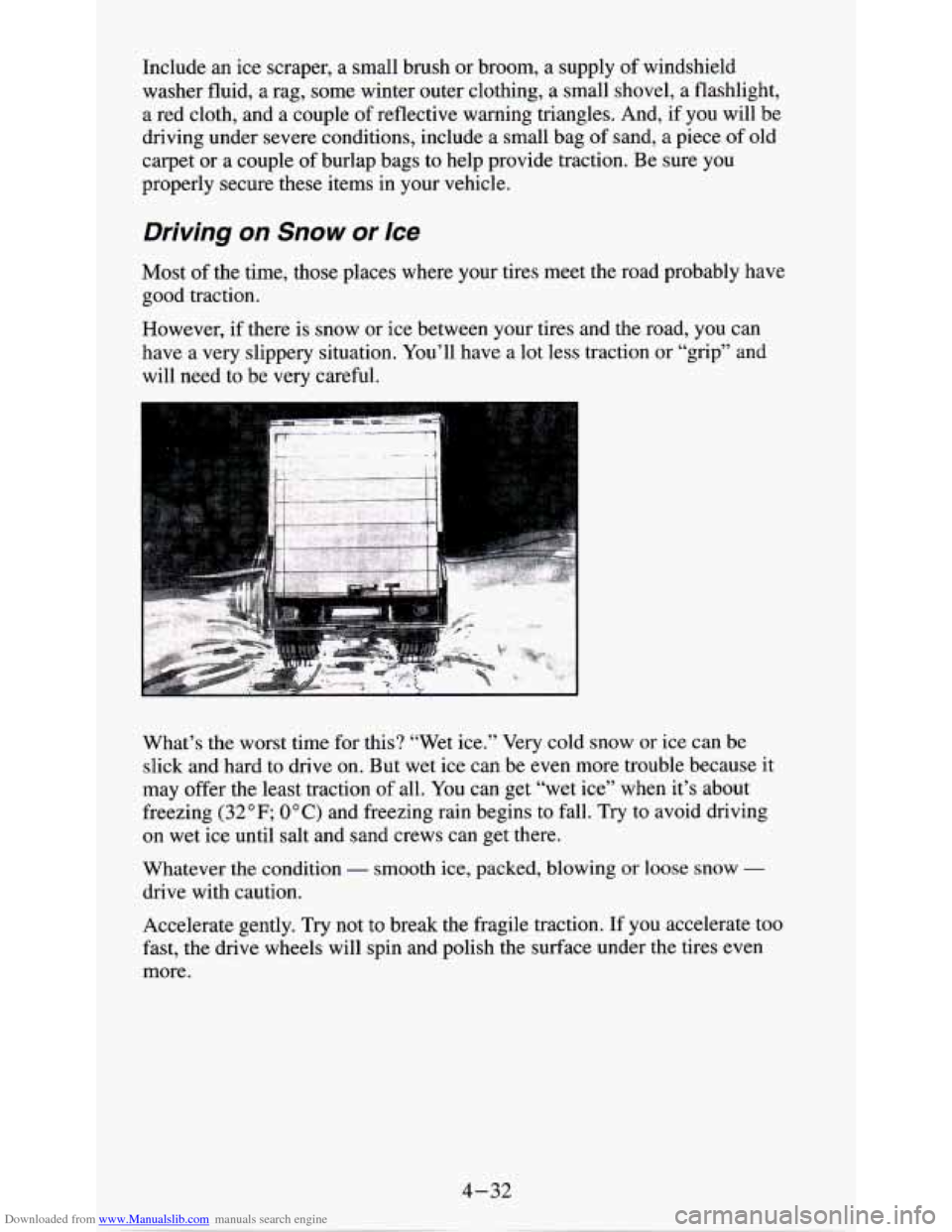
What’s the worst time for this? “Wet ice.” Very cold snow or ice can
be
slick and hard to drive on. But wet ice can be even more trouble because it
may offer the least traction
of all. You can get “wet ice” when it’s about
freezing
(32 OF; OOC) and freezing rain begins to fall. Try to avoid driving
on wet ice until salt and sand crews can get there.
Whatever the condition
- smooth ice, packed, blowing or loose snow -
drive with caution.
Accelerate gently. Try not to break the fragile traction.
If you accelerate too
fast,
the drive wheels will spin and polish the surface under the tires even
more.
4-32
Page 185 of 354
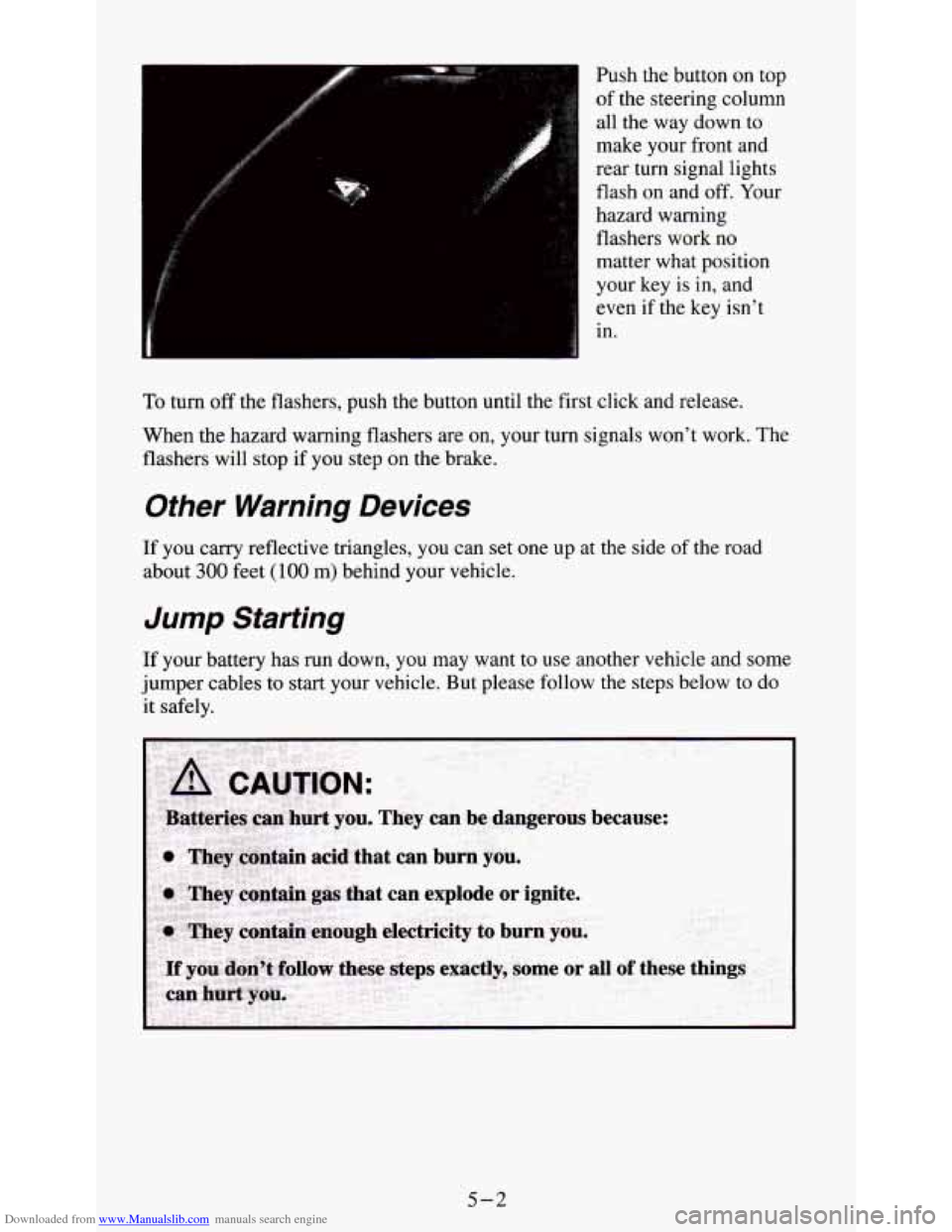
Downloaded from www.Manualslib.com manuals search engine Push the button on top
of the steering column
all the way down
to
make your front and
rear turn signal lights
flash on and
off. Your
hazard warning
flashers work
no
matter what position
your key is
in, and
even if the key isn’t
in.
To turn off the flashers, push the button until the first click and release.
When the hazard warning flashers are on, your turn signals won’t work. The
flashers will stop if you step on the brake.
Other Warning Devices
If you carry reflective triangles, you can set one up at the side of the road
about
300 feet (100 m) behind your vehicle.
Jump Starting
If your battery has run down, you may want to use another vehicle and some
jumper cables to start your vehicle. But please follow the steps below to do
it safely.
5-2
Page 238 of 354
Downloaded from www.Manualslib.com manuals search engine What to Use
Refer to the Maintenance Schedule to determine what kind of lubricant to
use. See “Recommended Fluids and Lubricants” in the Index.
Engine Coolant
The following explains your cooling system and how to add coolant when it
is low. If you have a problem with engine overheating, see “Engine
Overheating” in the Index.
The proper coolant for your vehicle will:
Give freezing protection down to -34°F (-37 “C).
Give boiling protection up to 262°F (128 “C).
Protect against rust and corrosion.
Help keep the proper engine temperature.
Let the warning lights and gages work as they should.
What to Use
Use a mixture of one-half clean water (preferably distilled) and one-half
antifreeze that meets “GM Specification 6038-M,” or “GM Specification
6043-M’ with the 2.2L (LN2) Code 4 engine, which won’t damage
aluminum parts.
You can also use a recycled coolant conforming to “GM
Specification 603%”’ or “GM Specification 6043-M” with the 2.2L
(LN2) Code 4 engine. Use GM Coolant Supplement (Sealer) with a
complete coolant flush and refill. If you use this mixture, you don’t need to
add anything else.
6-21
Page 245 of 354
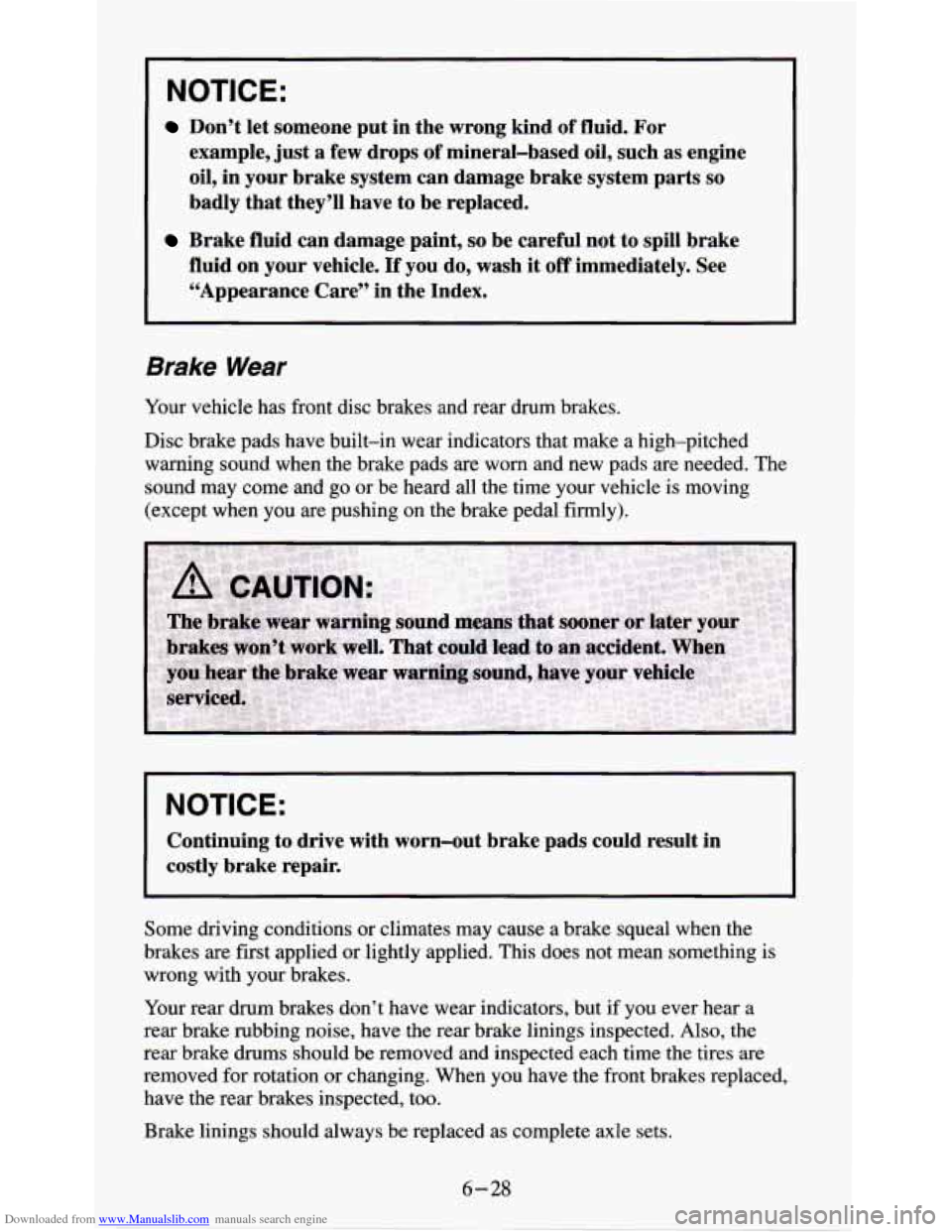
Downloaded from www.Manualslib.com manuals search engine NOTICE:
Don’t let someone put in the wrong kind of fluid. For
example, just a few drops
of mineral-based oil, such as engine
oil, in your brake system can damage brake system parts
so
badly that they’ll have to be replaced.
Brake fluid can damage paint, so be careful not to spill brake
fluid on your vehicle.
If you do, wash it off immediately. See
“Appearance Care” in the Index.
Brake Wear
Your vehicle has front disc brakes and rear drum brakes.
Disc brake pads have built-in wear indicators that make a high-pitched
warning sound when the brake pads are
worn and new pads are needed. The
sound may come and go or be heard all the time your vehicle
is moving
(except when you are pushing
on the brake pedal firmly).
I NOTICE:
Continuing to drive with worn-out brake pads could result in
costly brake repair.
Some driving conditions or climates may Cause a brake squeal when the
brakes are
first applied or lightly applied. This does not mean something is
wrong with your brakes.
Your rear drum brakes don’t have wear indicators, but if you ever hear a
rear brake rubbing noise, have the rear brake linings inspected. Also, the
rear brake drums should be removed and inspected each time the tires are
removed for rotation or changing. When you have the front brakes replaced,
have
the rear brakes inspected, too.
Brake linings should always be replaced as complete axle sets.
6-28
Page 344 of 354
Downloaded from www.Manualslib.com manuals search engine Index
A
Air Bag (See “Supplemental Inflatable Restraint System (SIR)”)
Accessory Power Outlets
.......................................... 249
Adding Equipment to Your Air Bag-Equipped Vehicle (See “Supplemental
Inflatable Restraint System (SIR)”)
Air Cleaner (See “Engine-Air Cleaner”
Air Conditioning
(See “Heater/Air Conditioning Controls”)
Antennacare
................................................... 3-19
Anti-Lock Brakes (See “Brakes”)
Appearance Care
................................................ 6-47
Materials Chart
............................................... 6-56
Arbitration Program (See “Better Business Bureau Mediation”)
Audiosystems
................................................... 3-5
AM-FM Stereo Audio Compact Disc (CD) System
................... 3-13
AM-FM Stereo Audio System
.................................... 3-6
AM-FM Stereo Audio Cassette System
............................. 3-7
AM-FM Stereo Audio Cassette System
with Equalizer ................ 3-10
Care
of Your Cassette Player and Tape ............................. 3-18
Care of Compact Discs
......................................... 3-19
Delco LOC II@ Anti-Theft Feature
............................... 3-15
Understanding Radio Reception
.................................. 3-17
Readiness Light (See “Lights”)
Automatic Transmission
( See “Transmission”)
Axle Front
....................................................... 6-20
LockingRear
................................................. 2-22
Rear
........................................................ 6-19
B
Battery ........................................................ 6-29
Belts (See “Safety Belts”)
Better Business Bureau Mediation
.................................... 8-3
Blizzard (See “Driving-If You’re Caught in a Blizzard”)
Brakes
Adjustment
.................................................. 6-29
Anti-Lock
.................................................... 4-5
Anti-Lock Warning Light (See “Lights”)
To Check Brake Fluid .......................................... 6-27
Master Cylinder
.............................................. 6-26
Parking
..................................................... 2-22
PedalTravel
................................................. 6-29
Replacingparts
............................................... 6-29
System Warning Light (See “Lights”)
Trailer (See “Trailer Brakes”)
Wear
....................................................... 6-28
Braking
......................................................... 4-5
In Emergencies
................................................ 4-7
1
Page 347 of 354
Downloaded from www.Manualslib.com manuals search engine F
Filter Replacement Chart (See “Service-Replacement Parts and Filter
Recommendations”)
Fluid Capacity (See “Capacity and Specifications”)
l;luidLeakCheck
................................................ 6-30
Fluids (See “Recommended Fluids and Lubricants”)
Four-wheel Drive
.......................................... 2-28. 6-19
Manual Transfer Case
.......................................... 2-28
Electronic Transfer Case
........................................ 2-30
FillingYourTank
.............................................. 6-4
Foreign Countries .............................................. 6-4
Gage (See “Gages”)
Gasolines for Cleaner Air
.................................... 6-3
Tankcapacity
................................................ 6-62
Fuses and Circuit Breakers
................................... 6-59, 6-65
Fuel
FuseBlock .................................................. 6-60
G
Gages
Engine Coolant Temperature Gage
................................ 2-65
FuelGage
................................................... 2-66
Odometer
................................................... 2-54
OilPressureGage
............................................. 2-65
Tachometer
.................................................. 2-55
Voltmeter
.................................................... 2-67
Speedometer
................................................. 2-54
Trip Odometer
................................................ 2-55
.............. 5-1
Halogen Bulbs (See “Bulb Replacement”)
Headlamps Hazard Warning Flashers
...........................
Replacement (See “Bulb Replacement”)
High Beam
Indicator Light (See “Lights”)
High-Low Beam Changer
................................. 2.36, 2.64
Reminder
.................................................... 2-45
Heater Controls
.................................................. 3-1
Heater/Air Conditioning Controls
.................................... 3-2
Refrigerant Capacity
........................................... 6-70
Highway Hypnosis (See “Driving-Highway Hypnosis”)
Hitches (See “Towing a Trailer”)
Wood
Horn ......................................... ............. 2-33
HydraulicClutch
................................................ 6-18
Hydroplaning (See “Driving in the Rain”)
Checking
Under, Hood Release
................................... 6-6
4
Page 348 of 354
Downloaded from www.Manualslib.com manuals search engine I
If You’re Stuck: In Sand. Mud. Ice. or Snow ........................... 5-32
Ignitionswitch
.................................................. 2-10
Inflation-Tire Pressure
( See “Tires”)
Instrument Cluster
............................................... 2-53
Instrumentpanel
................................................ 2-53
Jacking Equipment Storage
........................................ 5-20
Jumpstarting .................................................... 5-2
K
KeyLockCylinders .............................................. 6-39
Key Release Button
.............................................. 2-11
Keyless Entry System
............................................. 2-6
Keys
........................................................... 2-1
L
Labels
Lamps Certificatioflire
( See “Certification/Tire Label”)
Center High Mounted
Stop Lamp (CHMSL) ........................ 2-67
Dome
....................................................... 2-46
FogLamps
.................................................. 2-44
Headlights (See “Headlamps”)
Replacement
(See “Bulb Replacement”)
Lights
......................................................... 2-43
Air Bag Readiness Light
........................................ 2-57
Anti-Lock Brake System Warning Light
........................... 2-59
BrakeSystemLight
............................................ 2-58
Charging System Indicator Light
................................. 2-62
Check Gages Indicator Light
.................................... 2-62
Daytime Running Lamps (DRL) Indicator Light
................ 2-45. 2-63
Headlamp High Beam Indicator Light
............................. 2-64
Headlights (See “Headlamps”)
Malfunction Indicator
..................................... 2-60. 6-39
Safety Belt Reminder Light
..................................... 2-57
Service Engine Soon (See “Malfunction Indicator”) Shift Indicator Light
...................................... 2-21. 2-63
Turn Signal and Lane Change Indicator Light
....................... 2-64
Loading Your Vehicle
............................................ 4-36
Add-on Equipment
........................................... 4-39
Off-Road Driving
............................................. 4-13
Payload ..................................................... 4-38
Pickup Conversion to Chassis Cab
................................ 4-42
TraileringPackage
............................................ 4-39
Truck-Camper Loading Information
.............................. 440
Two-Tiered Loading ........................................... 4-38
Lock Cylinders (See “Key Lock Cylinders”)
Loss of Control (See “Driving-Loss of Control”)
Lubrication (See “Recommended Fluids and Lubricants”)
5