1995 CHEVROLET CORVETTE ESP
[x] Cancel search: ESPPage 21 of 386
Downloaded from www.Manualslib.com manuals search engine Here Are Questions Many People Ask
About Safety Belts
-- and the Answers
@ Won’t I be trapped in the vehicle after an
accident if I’m wearing
a safety belt?
A: You could be -- whether you’re wearing a safety
belt or not. But you can unbuckle a safety belt,
even if you’re upside down. And your chance of
being conscious during and after an accident,
so
you can unbuckle and get out, is much greater if
you are belted.
@ Why don’t they just put in air bags so people
A: Air bags are in many vehicles today and will be in
more of them in the future. But they are
supplemental systems only;
so they work with
safety belts -- not instead of them. Every air bag
system ever offered for sale has required the use of
safety belts. ,Even if you’re in a vehicle that has air
bags, you still have to buckle up to get the most
protection. That’s true not only in frontal collisions,
but especially in side and other collisions.
won’t have to wear safety belts?
QC If I’m a good driver, and I never drive far from
A: You may be an excellent driver, but if you’re in an
home, why should I wear safety belts?
accident -- even one that isn’t your fault -- you and
your passenger can be hurt. Being
a good driver
doesn’t protect you from things beyond your
control, such as bad drivers.
Most accidents occur within
25 miles (40 km) of
home. And the greatest number of serious injuries and deaths
OCCUT at speeds of less than 40 mph (65 km/h).
Safety belts are for everyone.
How to Wear Safety Belts Properly
Adults
This part is only for people of adult size.
Be aware that there are special things to know about
safety belts and children. And there are different rules for
smaller children and babies.
If a child will be riding in
your Corvette, see the part of this manual called
“Children.” Follow those rules for everyone’s protection.
First, you’ll want to know which restraint systems your
vehicle has.
We’ll start with the driver position.
1-10
Page 54 of 386
Downloaded from www.Manualslib.com manuals search engine I NOTICE:
If you put things in the hatchback area, be sure
they won’t break the glass when you close
it.
Never slam the hatch down. You could break the
glass or damage the defogger grid.
When you close the hatch, make sure you pull
down from the center, not the sides.
If you pull
the hatch down from the side too often, the
weatherstrip can be damaged.
Theft
Vehicle theft is big business, especially in some cities.
Although your Corvette has a number of theft deterrent
features, we know that nothing we put on it can make it
impossible to steal. However, there
are ways you can
help.
Key in the Ignition
If you walk away from your vehicle with the keys
inside, it’s an easy target for joy riders
or professional
thieves
-- so don’t do it.
When you park your Corvette and open the driver’s
door, you’ll hear a tone reminding
you to remove your
key from the ignition and take it with
you. Always do
this. Your steering wheel will be locked, and
so will
your ignition. If you have an automatic transmission,
taking your key out also locks your transmission. And
remember to lock the doors.
3 11
Page 74 of 386
Downloaded from www.Manualslib.com manuals search engine Selective Ride Control (Option)
RIDE CONTROL
SPORT I/
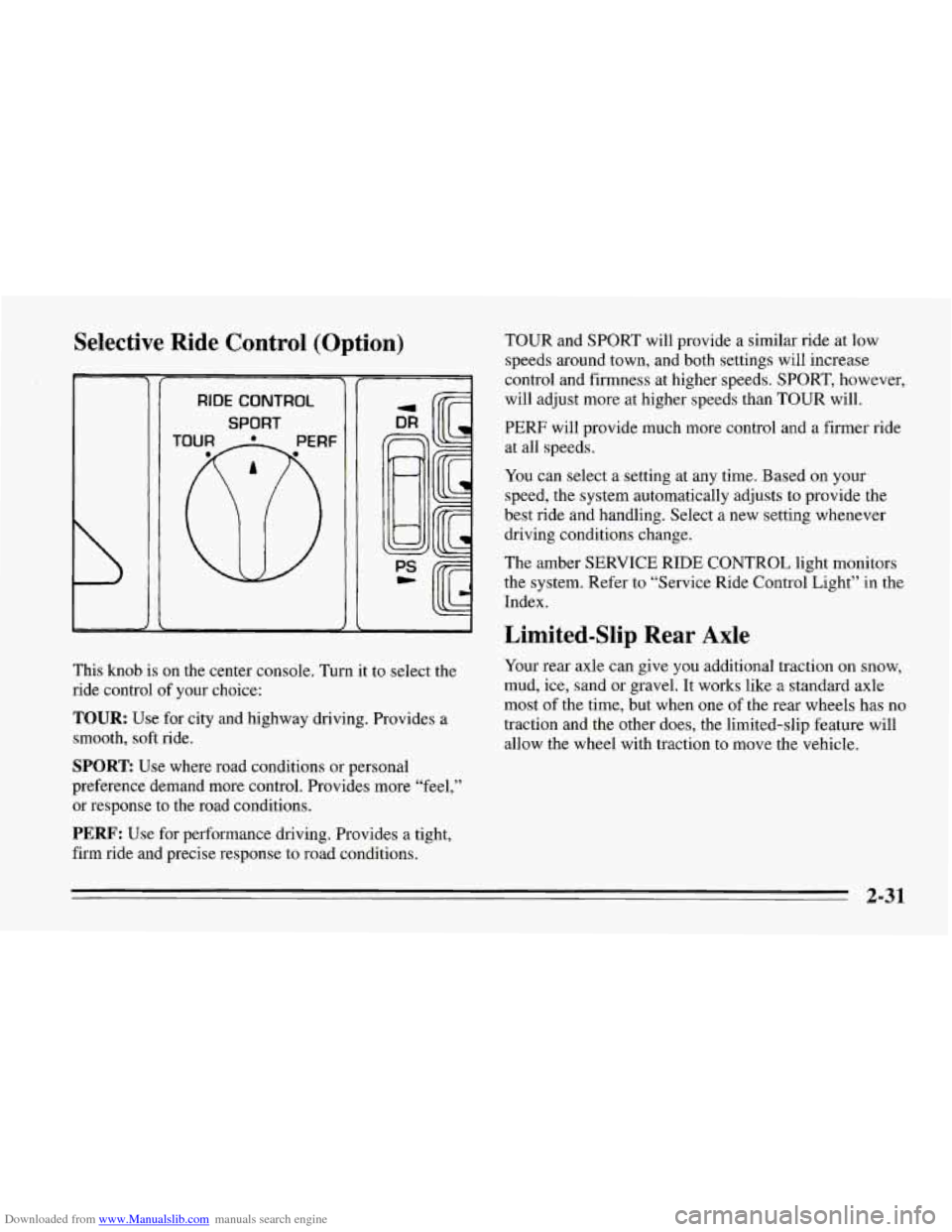
This knob is on the center console. Turn it to select the
ride control of your choice:
TOUR: Use for city and highway driving. Provides a
smooth, soft ride.
SPORT: Use where road conditions or personal
preference demand more control. Provides more “feel,”
or response to the road conditions.
PERF: Use for performance driving. Provides a tight,
firm ride and precise response to road conditions. TOUR
and SPORT will provide a similar ride at low
speeds around town, and both settings will increase
control and firmness at higher speeds. SPORT, however,
will adjust more at higher speeds than TOUR will.
PERF will provide much more control and a firmer ride
at all speeds.
You can select a setting at any time. Based on your
speed, the system automatically adjusts to provide the
best ride and handling. Select a new setting whenever
driving conditions change.
The amber SERVICE RIDE CONTROL light monitors
the system. Refer to “Service Ride Control Light” in the
Index.
Limited-Slip Rear Axle
Your rear axle can give you additional traction on snow,
mud, ice, sand or gravel. It works like a standard axle
most of the time, but when one of the rear wheels has no
traction and the other does, the limited-slip feature will
allow the wheel with traction to move the vehicle.
2-31
Page 90 of 386

Downloaded from www.Manualslib.com manuals search engine Headlamp Doors
The headlamp doors are designed to open when you
turn the headlamps on and close when you turn the
headlamps and parking lamps off. If you turn the
headlamps on, then turn the headlamp switch back to
the parking lamps setting, the headlamp doors will stay
open. You
can open the doors manually using the knob next to
the headlamp assembly. Turn the knob counterclockwise
until the doors are open.
The headlamp doors should be open when driving in icy
or snowy conditions to prevent the doors from freezing
closed and when washing the vehicle to help clean the
headlamps.
Daytime Running Lamps (Canada Only)
Daytime Running Lamps (DRL) can make it easier for
others to see the front of your vehicle during the day.
DRL can be helpful in many different driving
conditions, but they can be especially helpful in the
short periods after dawn and before sunset.
A light sensor on top of the instrument panel makes the
DRL work,
so be sure it isn’t covered.
The DRL system will make your front turn signal lamps
come on when:
The ignition is on,
The headlamp switch is off, and
0 The parking brake is released.
2-47
Page 161 of 386
Downloaded from www.Manualslib.com manuals search engine Understanding Radio Reception
FM Stereo
FM Stereo will give you the best sound. But FM signals
will reach only about 10 to
40 miles (16 to 65 km). And,
:ausing the sound to come and go.
1 tall buildings or hills can interfere with FM signals,
4M
The range for most AM stations is greater than for FM,
especially at night. The longer range, however, can
cause stations to interfere with each other. AM can pick
reducing the treble to reduce this noise if you ever get it.
1 up noise from things like storms and power lines. Try
Care of Your Cassette Tape Player
A tape player that is not cleaned regularly can cause
reduced sound quality, ruined cassettes, or a damaged
mechanism. Cassette tapes should be stored in their
cases away from contaminants, direct sunlight, and
extreme heat.
If they aren't, they may not operate
properly or cause failure of the tape player.
'
Your tape player should be cleaned regularly after every
50 hours of use. If you notice a reduction in sound
quality, try a known good cassette to see
if the tape or
the tape player is at fault. If this other cassette has no
improvement in sound quality, clean the tape player.
Cleaning may be done with a scrubbing action,
non-abrasive cleaning cassette with pads which scrub
the tape head as the hubs of the cleaner cassette turn. It
is normal for the cartridge to eject while cleaning. Insert
the cassette at least
3 times to ensure thorough cleaning.
A scrubbing action cleaning cassette is available through
your Chevrolet dealership.
You may also choose a non-scrubbing action, wet-type
cleaner which uses a cassette with a fabric belt to clean
the tape head. This type of cleaning cassette will not
eject. It may not clean as thoroughly as the scrubbing
type cleaner.
Cassettes are subject to wear and the sound quality may
degrade over time. Always make sure that the cassette
tape is in
good condition before you have your tape
player serviced.
3-18
Page 167 of 386
Downloaded from www.Manualslib.com manuals search engine But the ability to drive is affected well below a BAC of
0.10 percent. Research shows that the driving skills of
many people are impaired at a BAC approaching 0.05
percent, and that the effects are worse at night. All
drivers are impaired at
BAC levels above 0.05 percent.
Statistics show that the chance of being in
a collision
increas’es sharply for drivers who have a
BAC of 0.05
percent or above. A driver with a BAC level of 0.06
percent has doubled his or her chance of having a
collision. At a
BAC level of 0.10 percent, the chance of
this driver having a collision
is twelve times greater; at a
level
of 0.15 percent, the chance is twenty-five times
greater!
The body takes about an hour to rid itself of the alcohol
in
one drink. No amount of coffee or number of cold
showers will speed that up. “I’ll be careful” isn’t the
right answer. What
if there’s an emergency, a need to
take sudden action, as when a child darts into the street?
A person with even a moderate BAC might not be able
to react quickly enough to avoid the collision. There’s something else about drinking
and driving that
many people don’t know. Medical research shows that
alcohol in a person’s system can make crash injuries
worse, especially injuries to the brain, spinal cord or
heart. This means that when anyone who has been
drinking
-- driver or passenger -- is in a crash, that
person’s chance of being killed or permanently disabled
is higher than if the person had not been drinking.
4-4
Page 171 of 386
Downloaded from www.Manualslib.com manuals search engine Remember: Anti-lock doesn’t change the time you need
to get your foot up
to the brake pedal. If you get too
close to the vehicle in front of you, you won’t have time
to apply your brakes if that vehicle suddenly slows or
stops. Always leave enough room up ahead to stop, even
though you have anti-lock brakes.
To Use Anti-Lock
Don’t pump the brakes. Just hold the brake pedal down
and let anti-lock work for you. You may hear a motor or
clicking noise and feel the brake pedal move a little
during a hard stop, but this
is normal. When your
anti-lock system is adjusting brake pressure
to help
avoid a braking skid, the ABS ACTIVE light will come
on. See “Anti-Lock Brake System Active Light” in the
Index.
ASR (Acceleration Slip Regulation) System
Your vehicle has a traction control system called ASR
that limits wheel spin. This is especially useful in
slippery road conditions. The system operates only if it
senses that the rear wheels are spinning too much or are
beginning to lose traction. When, this happens, the
system works the rear brakes and reduces engine power
(by closing the throttle and managing engine spark) to
limit wheel spin. ‘The ASR
ACTIVE light will come on when the ASR
system
is limiting wheel spin. See “ASR System Active
Light” in the Index. You may feel the system working,
or you may notice some noise, but this is normal.
If your vehicle is in cruise control when the ASR system
begins to limit wheel spin, the cruise control will
automatically disengage. When road conditions allow
you to safely use it again,
you may re-engage the cruise
control. (See “Cruise Control” in the Index.)
SERVICE
ASR
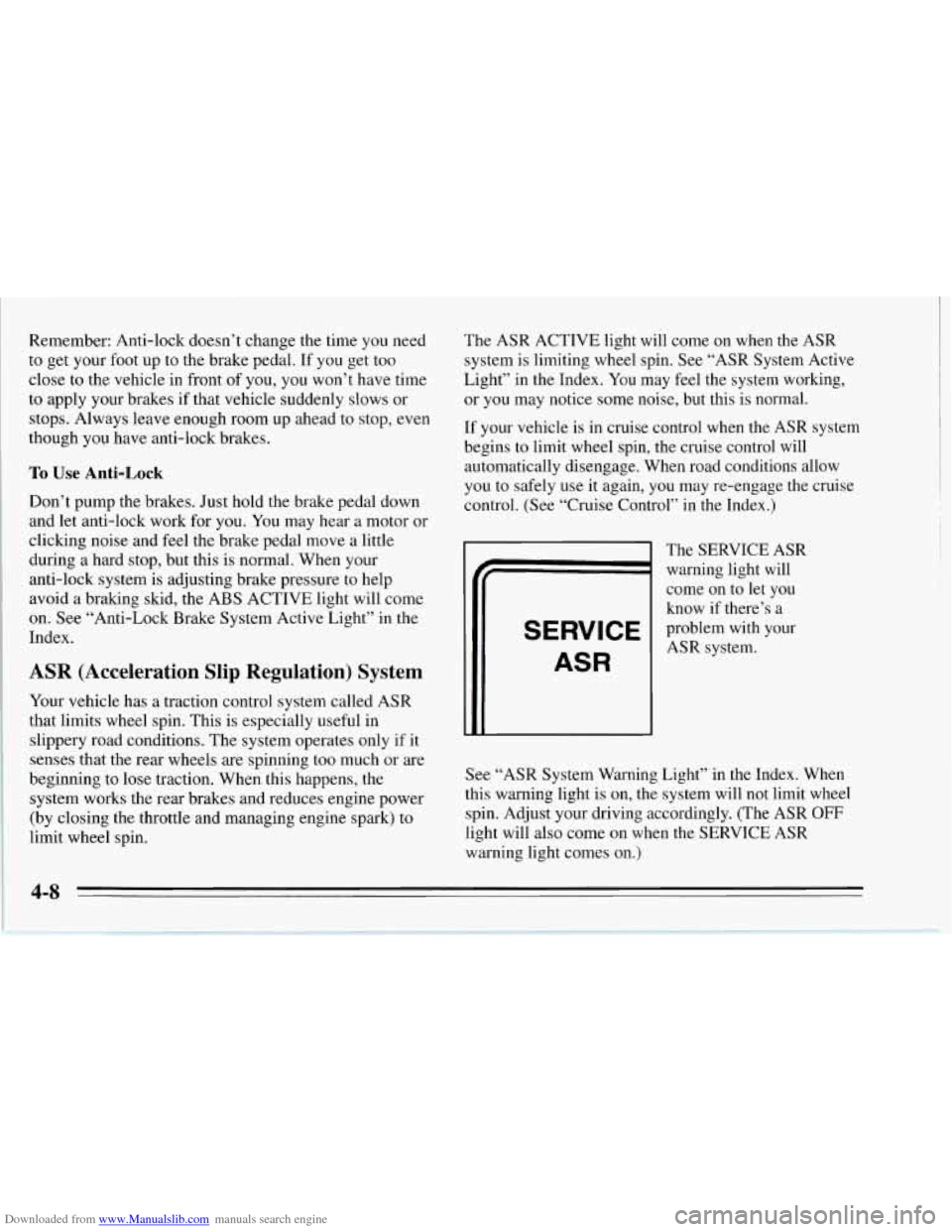
The SERVICE ASR
warning light will
come on to
let you
know if there’s a
problem with your
ASR system.
See “ASR System Warning Light’’ in the Index. When
this warning light
is on, the system will not limit wheel
spin. Adjust your driving accordingly. (The ASR
OFF
light will also come on when the SERVICE ASR
warning light comes on.)
4-8
Page 172 of 386
Downloaded from www.Manualslib.com manuals search engine The ASR system automatically comes on whenever you
start your vehicle. To limit wheel spin, especially in
slippery road conditions, you should always leave the
system on. But you can turn the ASR system off if you
ever need to. (You should turn the system
off if your
vehicle ever gets stuck in sand, mud, ice or snow. See
“Rocking Your Vehicle” in the Index.)
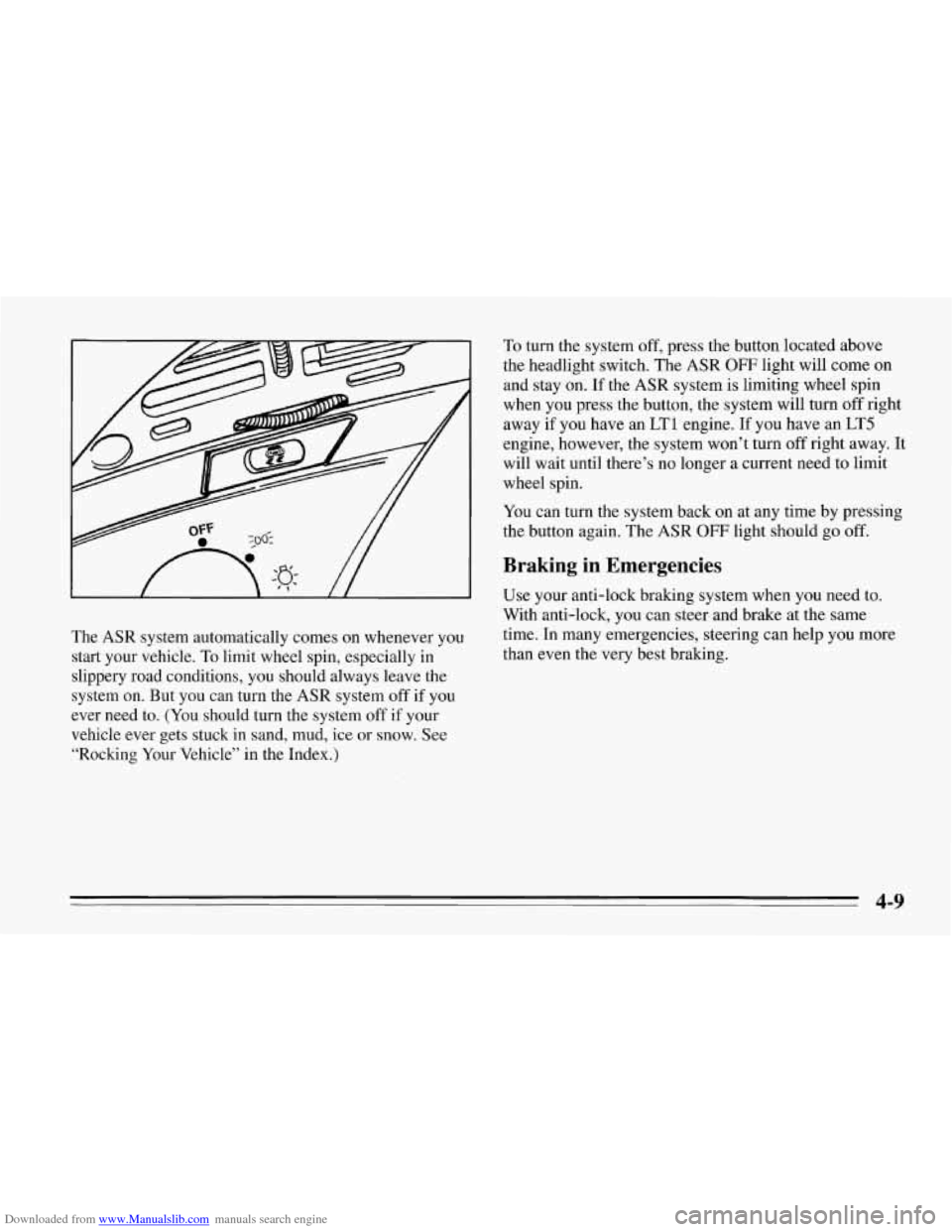
To turn the system off, press the button located above
the headlight switch. The ASR
OFF light will come on
and stay
on. If the ASR system is limiting wheel spin
when you press the button, the system will turn
off right
away if you have an
LT1 engine. If you have an LT5
engine, however, the system won’t turn off right away. It
will wait until there’s no longer a current need to limit
wheel spin.
You can turn the system back on at any time by pressing
the button again. The ASR
OFF light should go off.
Braking in Emergencies
Use your anti-lock braking system when you need to.
With anti-lock, you can steer and brake at the same
time. In many emergencies, steering can help you more
than even the very best braking.
4-9