1995 CHEVROLET BLAZER transmission
[x] Cancel search: transmissionPage 222 of 380
Downloaded from www.Manualslib.com manuals search engine 1
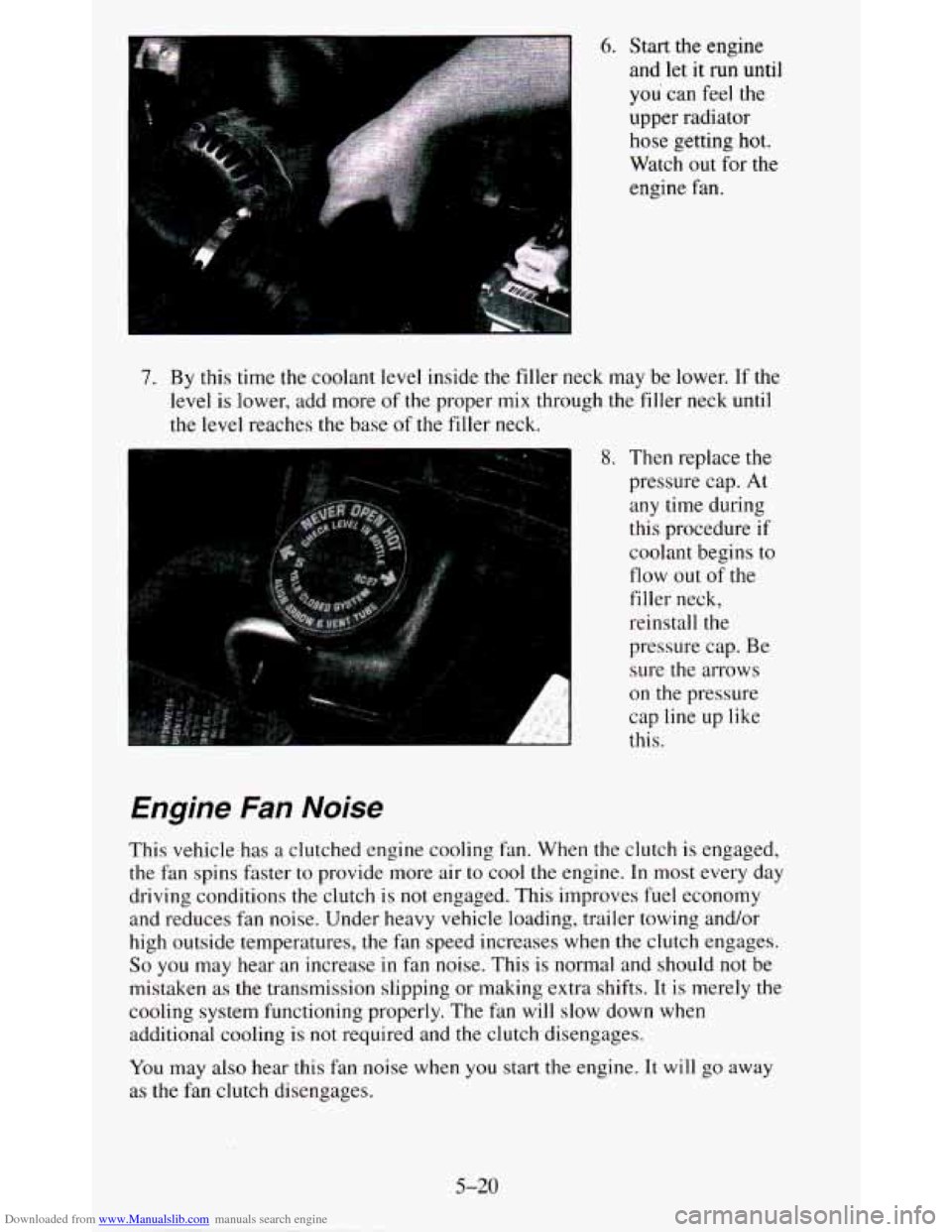
6. Start the engine
and let it
run until
you can feel'the
upper radiator hose getting hot.
Watch out for the
engine fan.
7. By this time the coolant level inside the filler neck may be lower. If the
level is lower, add more of the proper mix through the filler neck unt\
il
the level reaches the base of the filler neck.
8. Then replace the
pressure cap. At
any time during
this procedure if
coolant begins to
flow out of the
filler neck,
reinstall the
pressure cap. Be
sure the arrows
on the pressure
cap line
up like
this.
Engine Fan Noise
This vehicle has a clutched engine cooling fan. When the clutc\
h is engaged, the fan spins faster to provide more air to cool the engine. \
In most every day
driving conditions the clutch
is not engaged. This improves fuel economy
and reduces fan noise. Under heavy vehicle loading, trailer tow\
ing and/or
high outside temperatures, the fan speed increases when
the clutch engages.
So you may hear an increase in fan noise. This is normal and should not be
mistaken
as the transmission slipping or making extra shifts. It is merely \
the
cooling system functioning properly. The fan will slow down when
additional cooling is not required and
the clutch disengages.
You may also hear this fan noise when you start the engine. It will go away
as the fan clutch disengages.
5-20
Page 238 of 380

Downloaded from www.Manualslib.com manuals search engine NOTICE:
Spinning your wheels can destroy parts of your vehicle as well\
as
the tires. If
you spin the wheels too fast while shifting your
transmission back
and forth, you can destroy your transmission.
For information about using tire chains on your vehicle, see “Tire Chains”
in the Index.
Rocking your vehicle to get it out:
First, turn your steering wheel left and right. That will clear the area around
your front wheels. Then shift back and forth between REVERSE (R) and a \
forward gear (or with
a manual transmission, between FIRST (1) or
SECOND
(2) gear and REVERSE), spinning the wheels as little as possible.
Release the accelerator pedal while you shift, and press lightly on the
accelerator pedal when the transmission is in gear. If that doesn’t get you
out after
a few tries, you may need to be towed out. Or, you can use your
recovery hooks, if your vehicle has them. If you do need to be towed out,
see “Towing Your Vehicle” in the Index.
Using the Recovery Hooks
I
Your vehicle may be equipped with recovery hooks. The recovery hooks\
are
provided at the front
of your vehicle. You may need to use them if you’re
stuck off-road and need
to be pulled to some place where you can continue
driving.
5-36
Page 254 of 380
Downloaded from www.Manualslib.com manuals search engine While reassembling the air cleaner assembly, ensure that the air cleaner
cover tabs are fully inserted into the slots in the air cleaner housing. On the
4.3L (VIN W) engine, also make certain that the PCV air tube is properly
seated in the left hand valve cover.
Refer to the Maintenance Schedule to determine
when to redace the air
filter.
See “Scheduled Maintenance Services” in the Index.
NOTICE:
If the air cleaner is off, a backfire can cause a damaging engine
fire. And, dirt can easily get into your engine, which will d\
amage
it. Always have the air cleaner in place when you’re driving.
Automatic Transmission Fluid
-When to Check and Change
A good time to check your automatic transmission fluid level is when the
engine oil is changed. Refer to the Maintenance Schedule to determine
when to change your fluid. See “Scheduled Maintenance Services” in the
Index.
How to Check
Because this operation can be a little difficult, you may choose to have this
done at your GM dealership Service Department.
If you do it yourself, be sure to follow all the instructions here, or you could
get a false reading on the dipstick.
6- 14
Page 255 of 380
Downloaded from www.Manualslib.com manuals search engine NOTICE:
Too much or too little fluid can damage your transmission. Too
much can mean that some of the fluid could come out and fall on
hot engine parts or exhaust system parts, starting a fire. Be \
sure
to get an accurate reading if you check your transmission flui\
d.
Wait at least 30 minutes before checking the transmission fluid level if you
have been driving:
When outside temperatures are above 90°F (32°C).
At high speed for quite a while.
In heavy traffic - especially in hot weather.
0 While pulling a trailer.
To get the right reading, the fluid should be at normal operating
temperature, which is
180°F to 200°F (82°C to 93°C).
To check transmissionfluid hot: Get the vehicle warmed up by driving
about 15 miles (24 km) when outside temperatures are above 50°F
(10°C).
If it's colder than 50°F ( lO"C), drive the vehicle in THIRD GEAR (D) until
the engine temperature gage moves and then remains steady for ten minutes.
Then follow the hot check procedures.
To check transmissionfluid cold: A cold check is rnaae after the vehicle has
been sitting for eight hours or more with the engine
off and is used only as a
reference. Let the engine
run at idle for five minutes if outside temperatures
are
50°F (10°C) or more. If it's colder than 50°F (lO"C), you may have to
idle the engine longer. Should the fluid level be low during a cold check,
you
must perform a hot check before adding fluid. This will give you a more
accurate reading of the fluid level.
To check the fluid hot or cold
Park your vehicle on a level place. Keep the engine running.
0 With the parking brake applied, place the shift lever in Park (P).
With your foot on the brake pedal, move the shift lever through each
gear range, pausing
for about three seconds in each range. Then,
position the shift lever in Park (P).
Let the engine run at idle for three minutes or more.
6- 15
Page 257 of 380
Downloaded from www.Manualslib.com manuals search engine How to Add Fluid
Refer to the Maintenance Schedule to determine what kind of transmission
fluid to use. See “Recommended Fluids and Lubricants” in the Index.
Add fluid only after checking the transmission fluid
HOT. (A COLD check
is used only
as a reference.) If the fluid level is low, add only enough of the
proper fluid to bring the level up to the
HOT area for a hot check. It doesn’t
take much fluid, generally less than a int.
Don ’t overfill. We recommend
you use only fluid labeled DEXRON -111, because fluid with that label is
made especially for your automatic transmission. Damage caused by fluid
other than DEXRON@-I11 is not covered by your new vehicle warranty. 8
After adding fluid, recheck the fluid level as described under “How to
Check.”
0 When the correct fluid level is obtained, push the dipstick back in all
the way; then flip the handle down to lock the dipstick in place.
Manual Transmission Fluid
When to Check
A good time to have it checked is when the engine oil is changed. However,
the fluid in your manual transmission doesn’t require changin\
g.
How to Check
Because this operation can be a little difficult, you may choose to have this
done at your GM dealership Service Department.
If you do it yourself, be sure
to follow all the instructions here, or you could
get a false reading.
I NOTICE:
Too much or too little fluid can damage your transmission. Too
much can mean that some of the fluid could come out and fall on
hot engine parts or exhaust system parts, starting
a fire. Be sure
to get an accurate reading if you check your transmission fluid.
Check the fluid level only when your engine is off, the vehicle is parked on
a level place and the transmission is cool enough for you to rest your fingers
on the transmission case.
6-17
Page 310 of 380
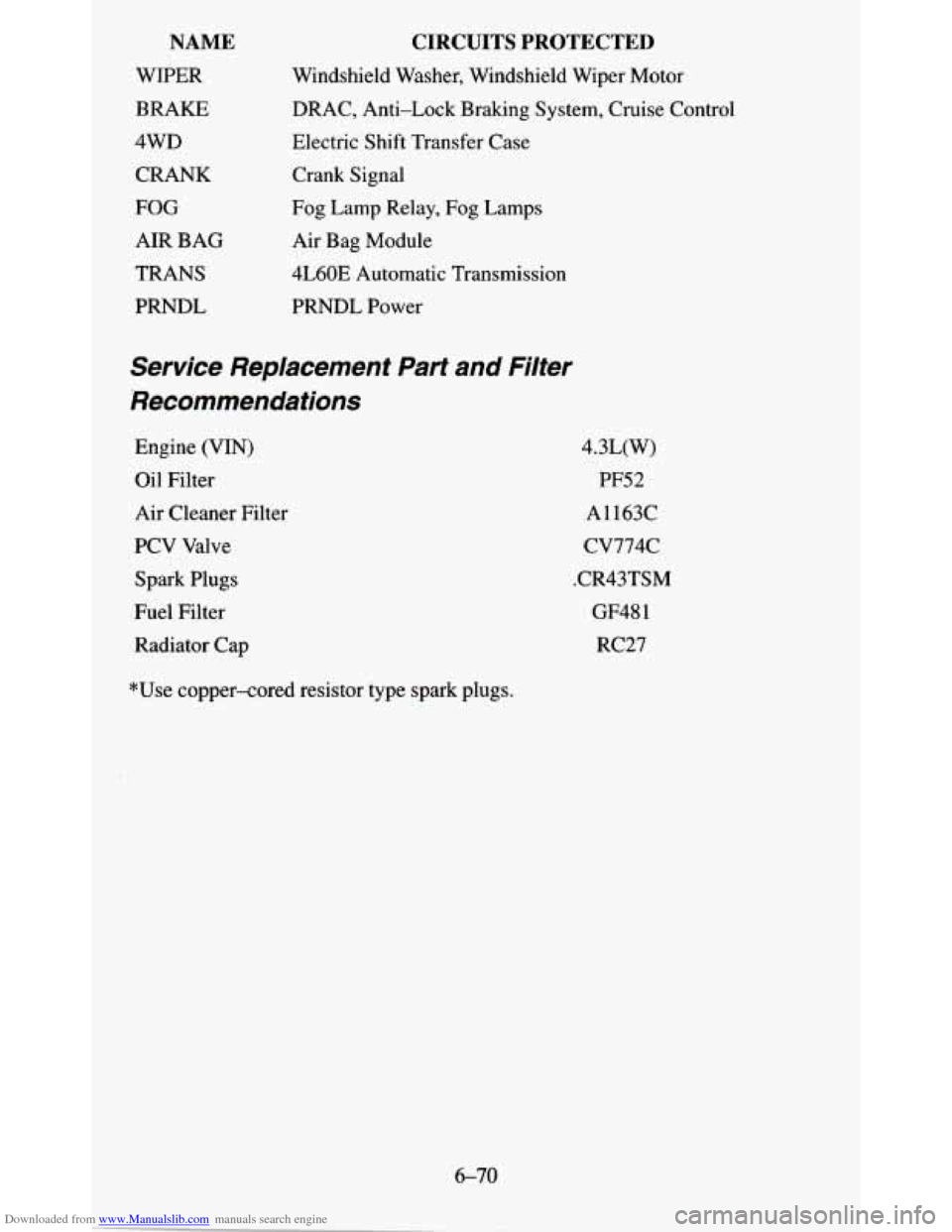
Downloaded from www.Manualslib.com manuals search engine NAME
WIPER
BRAKE
4WD
CRANK
FOG
AIR BAG
TRANS PRNDL
CIRCUITS PROTECTED
Windshield Washer, Windshield Wiper Motor
DRAC, Anti-Lock Braking
System, Cruise Control
Electric Shift Transfer Case
Crank Signal
Fog Lamp Relay, Fog Lamps
Air Bag Module
4L60E Automatic Transmission
PRNDL Power
Service Replacement Part and Filter
Recommendations
Engine (VIN)
Oil Filter
Air Cleaner Filter
PCV Valve Spark Plugs
Fuel Filter
Radiator Cap 4.3L(W)
PF52
A1163C
cv774c
.CR43TSM GF48 1
RC27
*Use copper-cored resistor type spark plugs.
6-70
Page 316 of 380
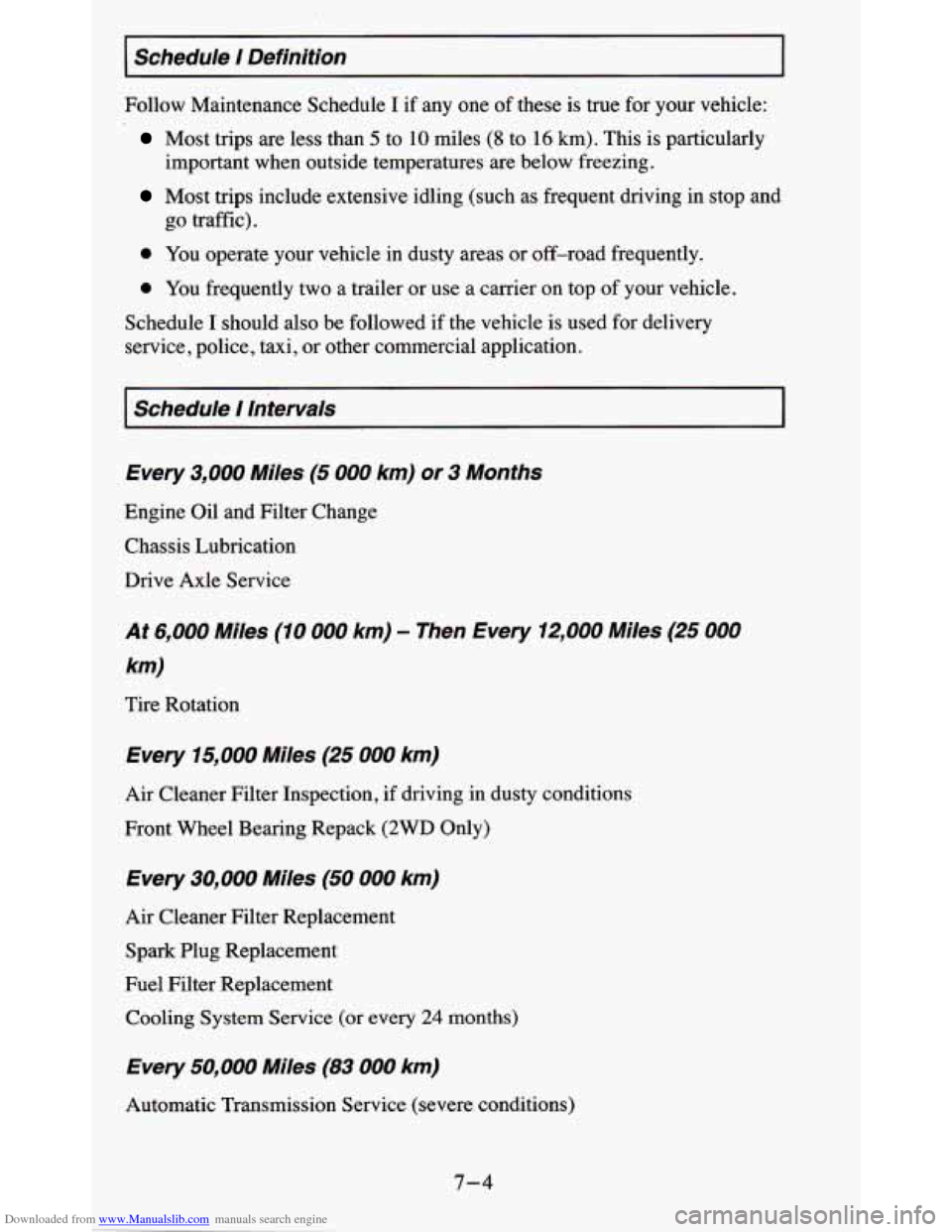
Downloaded from www.Manualslib.com manuals search engine I Schedule I Definition I
Follow Maintenance Schedule I if any one of these is true for your vehicle:
Most trips are less than 5 to 10 miles (8 to 16 km). This is particularly
important when outside temperatures are below freezing.
Most trips include extensive idling (such as frequent driving \
in stop and
go traffic).
0 You operate your vehicle in dusty areas or off-road frequently.
0 You frequently two a trailer or use a carrier on top of your vehicle.
Schedule
I should also be followed if the vehicle is used for delivery
service, police, taxi, or other commercial application.
I Schedule / Intervals I
Every 3,000 Miles (5 000 km) or 3 Months
Engine Oil and Filter Change
Chassis Lubrication
Drive Axle Service
At 6,000 Miles (10 000 km) - Then Every 12,000 Miles (25 000
km)
Tire Rotation
Every 15,000 Miles (25 000 km)
Air Cleaner Filter Inspection, if driving in dusty conditions
Front Wheel Bearing Repack
(2WD Only)
Every 30,000 Miles (50 000 km)
Air Cleaner Filter Replacement
Spark Plug Replacement
Fuel Filter Replacement
Cooling System Service (or every
24 months)
Every 50,000 Miles (83 000 km)
Automatic Transmission Service (severe conditions)
7-4
Page 317 of 380
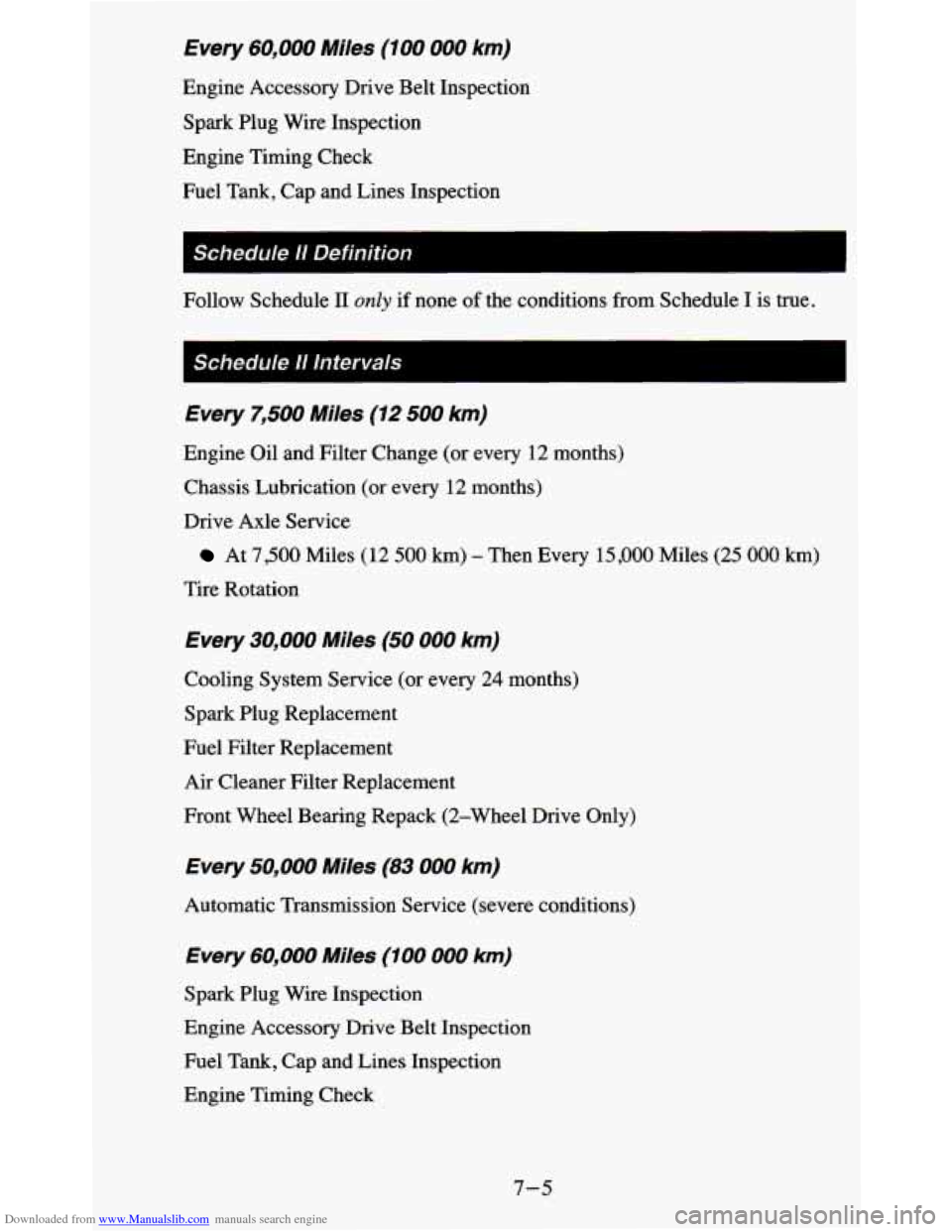
Downloaded from www.Manualslib.com manuals search engine Every 60,000 Miles (100 000 km)
Engine Accessory Drive Belt Inspection
Spark Plug Wire Inspection
Engine Timing Check
Fuel Tank, Cap and Lines Inspection
Follow Schedule I1
only if none of the conditions from Schedule I is true.
I Schedule // /nterva/s
Every 7,500 Miles (12 500 km)
Engine Oil and Filter Change (or every 12 months)
Chassis Lubrication (or every 12 months)
Drive Axle Service
At 7,500 Miles ( 12 500 km) - Then Every 15,000 Miles (25 000 km)
Tire Rotation
Every 30,000 Miles (50 000 km)
Cooling System Service (or every 24 months)
Spark Plug Replacement
Fuel Filter Replacement
Air Cleaner Filter Replacement
Front Wheel Bearing Repack (2-Wheel Drive Only)
Every 50,000 Miles (83 000 km)
Automatic Transmission Service (severe conditions)
Every 60,000 Miles (100 000 km)
Spark Plug Wire Inspection
Engine Accessory Drive Belt Inspection
Fuel Tank, Cap and Lines Inspection
Engine Timing Check
7-5