Page 171 of 342
Downloaded from www.Manualslib.com manuals search engine Maintenance When Trailer Towing
Your vehicle will need service more often when you’re pulling a trailer. See
the Maintenance Schedule for more
on this. Things that are especially
important in trailer operation are automatic transmission fluid (don’t
overfill), engine oil, axle lubricant, belt, cooling system, and brake
adjustment. Each of these is covered in this manual, and the Index will help
you find them quickly. If you’re trailering, it’s a good idea to review these
sections before you start your trip.
Check periodically to see that all hitch nuts and bolts are tight.
Trailer Lighting Systems Wiring
See “Trailer Wiring Harness” in the Index.
4-33
Page 186 of 342
Downloaded from www.Manualslib.com manuals search engine If No Steam Is Coming From Your Engine
If you get the overheat warning but see or hear no steam, the problem may
not be too serious. Sometimes the engine can get a little too hot when you:
Climb a long hill on a hot day.
Stop after high speed driving.
Idle for long periods in traffic.
Tow a trailer.
See “Driving on Grades”
in the Index.
If
you get the overheat warning with no sign of steam, try this for a minute
or
so:
1. If you have an air conditioner, turn it off.
2. Turn on your heater to full hot at the highest fan speed and open the
3. If you’re in a traffic jam, shift to NEUTRAL (N); otherwise, shift to the
highest gear while driving
- AUTOMATIC OVERDRIVE (a) or
DRIVE
(D).
window as necessary.
If you no longer have the overheat warning, you can drive. Just to be safe,
drive slower
for about ten minutes. If the warning doesn’t come back on,
you can drive normally.
If the warning continues, pull over, stop, and park your vehicle right away.
If there’s still no sign
of steam, push the accelerator until the engine speed is
about twice
as fast as normal idle speed. Bring the engine speed back to
normal idle speed after two or three minutes. Now see
if the warning stops.
But then, if you still have the warning, turn @‘the engine and get everyone
out of the vehicle until it cools down.
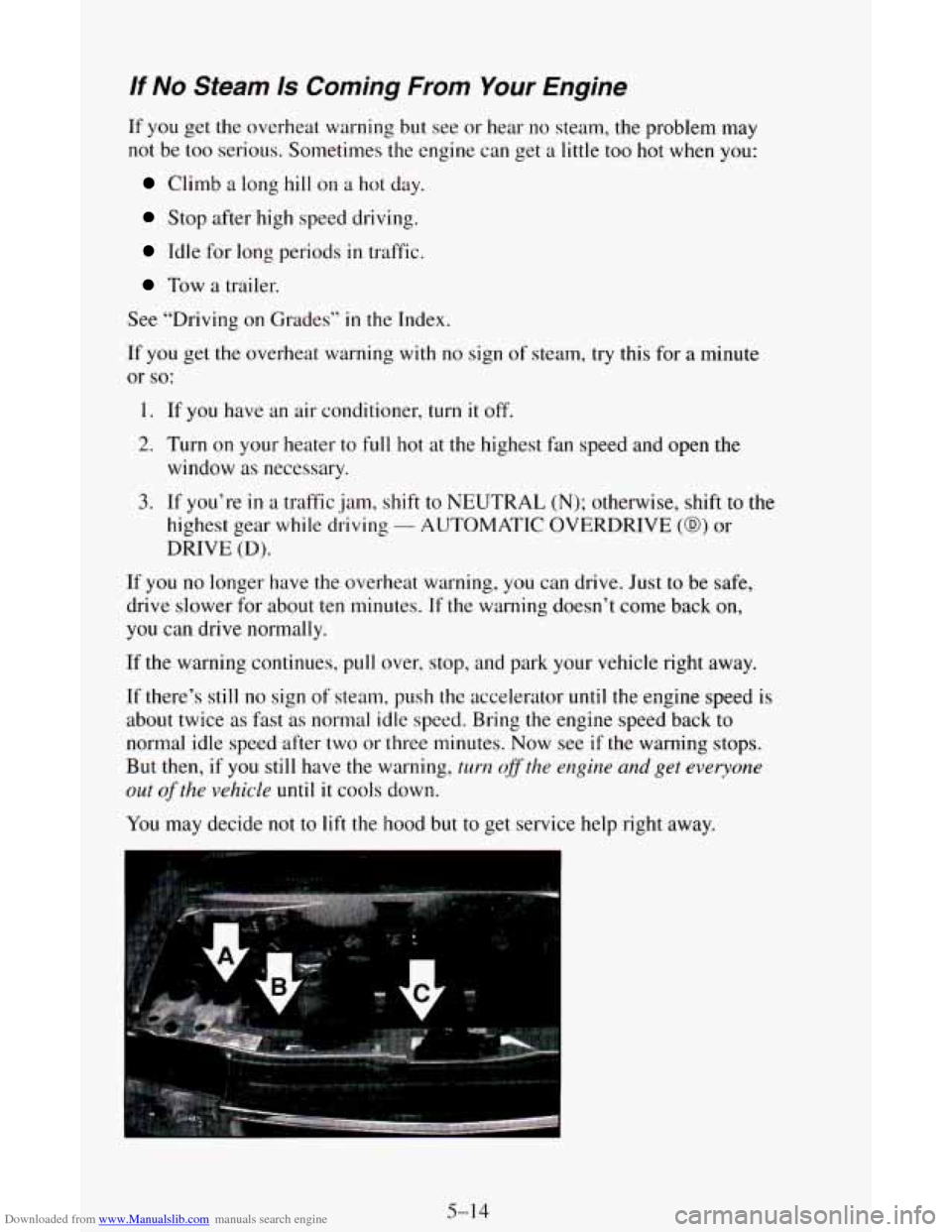
You may decide not to lift the hood but to get service help right away.
Page 192 of 342
Downloaded from www.Manualslib.com manuals search engine 7. By this time the coolant level inside the radiator filler neck may be
lower.
If the level is lower, add more of the proper mix through the
filler neck until the level reaches the base
of the filler neck.
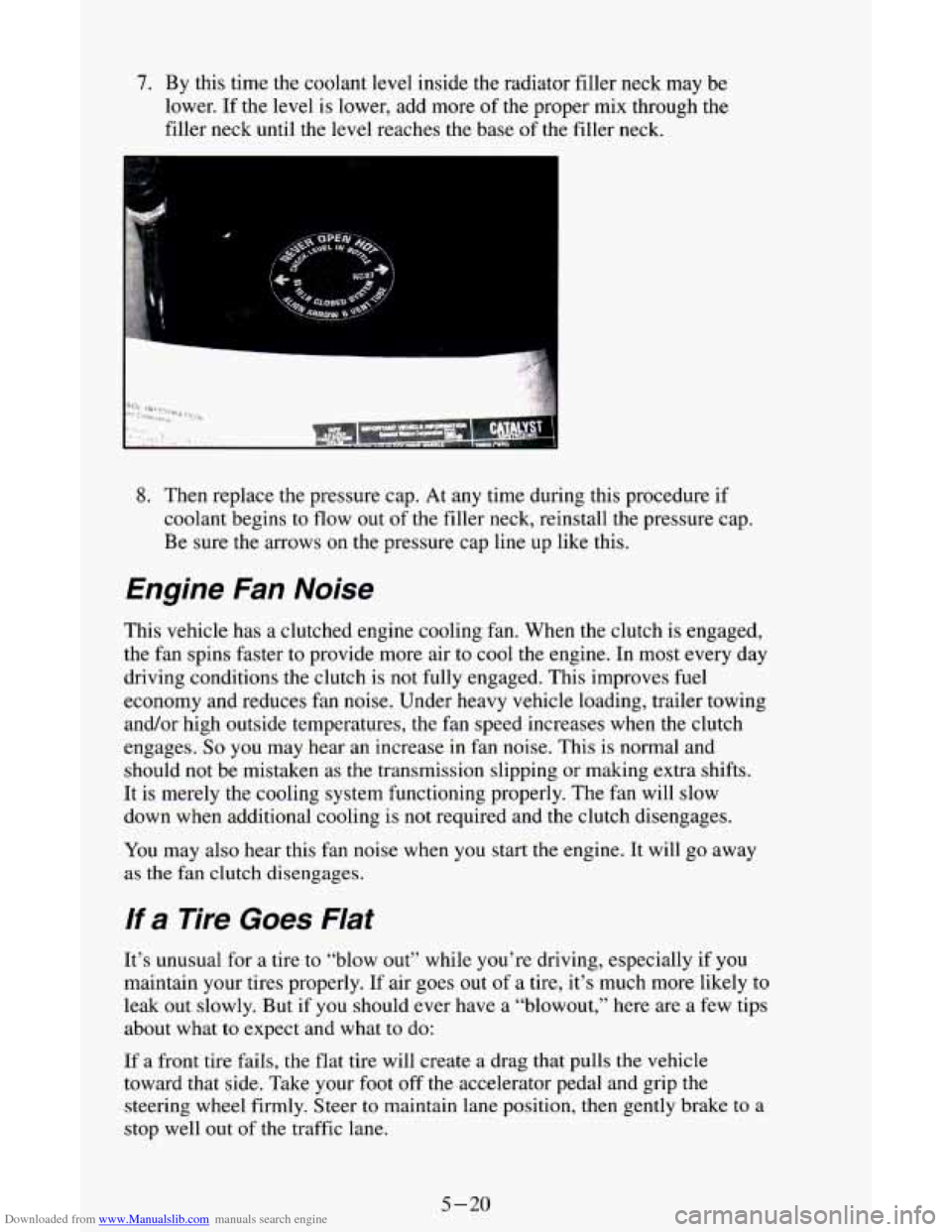
8. Then replace the pressure cap. At any time during this procedure if
coolant begins to flow out of the filler neck, reinstall the pressure cap.
Be sure the arrows on the pressure cap line
up like this.
Engine Fan Noise
This vehicle has a clutched engine cooling fan. When the clutch is engaged,
the fan spins faster to provide more air to cool the engine. In most every day
driving conditions the clutch is not fully engaged. This improves fuel
economy and reduces fan noise. Under heavy vehicle loading, trailer towing
and/or high outside temperatures, the fan speed increases when the clutch
engages.
So you may hear an increase in fan noise. This is normal and
should not be mistaken
as the transmission slipping or making extra sh
It is merely the cooling system functioning properly. The fan will slow
down when additional cooling is not required and the clutch disengage .ifts.
S.
You may
also hear this fan noise when you start the engine. It will go away
as the fan clutch disengages.
If a Tire Goes Flat
It’s unusual for a tire to “blow out” while you’re driving, especially if you
maintain your tires properly.
If air goes out of a tire, it’s much more likely to
leak out slowly. But if you should ever have a “blowout,” here are a few tips
about what
to expect and what to do:
If
a front tire fails, the flat tire will create a drag that pulls the vehicle
toward that side. Take your foot off the accelerator pedal and grip the
steering wheel firmly. Steer
to maintain lane position, then gently brake to a
stop well out of the traffic lane.
5-20
Page 210 of 342
Downloaded from www.Manualslib.com manuals search engine YOU should keep a record with all parts receipts and list the mileage and the
date of any service work
you perform. See “Maintenance Record” in the
Index.
I NOTICE:
If you try to do your own service work without knowing enough
about it, your vehicle could be damaged.
Fuel
Use regular unleaded gasoline rated at 87 octane or higher. Use premium
unleaded gasoline rated at
9 1 octane or higher for high power performance,
when towing a trailer
or with a high payload requirement. But when
operating with a light load as a normal condition, you may use middle grade
or regular unleaded gasolines.
The gasoline you use should meet specifications ASTM
D48 14 in the
United States and CGSB
3.5-92 in Canada. These fuels should have the
proper additives,
so you should not have to add anything to the fuel.
6-2
Page 220 of 342
Downloaded from www.Manualslib.com manuals search engine I NOTICE:
Use only engine oil with the American Petroleum Institute Certified For Gasoline Engines “Starburst” symbol. Failure \
to
use the proper oil can result in engine damage not covered by\
your warranty.
GM Goodwrench@ oil (in Canada, GM Engine Oil) meets all the
requirements for your vehicle.
Engine Oil Additr’ves
Don’t add anything to your oil. Your GM dealer is ready to advise if you
think something should be added.
When to Change Engine Oil
See if any one of these is true for you:
Most trips are less than 5 to 10 miles (8 to 16 km). This is particularly
Most trips include extensive idling (such as frequent driving in stop and
important
when outside temperatures are below freezing.
go traffic).
0 Most trips are through dusty areas.
You frequently tow a trailer or use a carrier on top of your vehicle.
If any one of these is true for your vehicle, then you need to change your oil
and filter every
3,000 miles (5 000 km) or 3 months - whichever comes
first.
If
none of them is true, change the oil and filter every 7,500 miles (12 500
km) or 12 months - whichever comes first.
Engine Coolant Heater
An engine coolant heater can be a big help if you have to park outside in
very cold weather,
0 OF (-1 8 O C) or colder. If your vehicle has this option,
see “Engine Coolant Heater’’ in the Index.
What to Do with Used Oil
Did you know that used engine oil contains certain elements that may be
unhealthy for your skin and could even cause cancer? Don’t
let used oil stay
on your skin for very long. Clean your skin and nails with soap and water,
or a good hand cleaner. Wash or properly throw away clothing or rags
containing used engine oil. (See the manufacturer’s warnings about the use
and disposal of oil products.)
6- 12
Page 226 of 342
Downloaded from www.Manualslib.com manuals search engine NOTICE:
If the air cleaner is off, a backfire can cause a damaging engine
fire. And, dirt can easily get into your engine, which will damage
it. Always have the air cleaner in place when you’re driving.
Automatic Transmission Fluid
When to Check and Change
A good time to check your automatic transmission fluid level is when the
engine oil
is changed. Refer to the Maintenance Schedule to determine
when
to change your fluid. See “Scheduled Maintenance Services” in the
Index.
How to Check
Because this operation can be a little difficult, you may choose to have this
done at your
GM dealer Service Department.
If you do it yourself, be sure to follow all the instructions here, or you could
get a false reading
on the dipstick.
NOTICE:
Too much or too little fluid can damage your transmission. Too
much can mean that some of the fluid could come out and fall on
hot engine parts or exhaust system parts, starting
a fire. Be sure
to get an accurate reading if you check your transmission fluid.
Wait at least
30 minutes before checking the transmission fluid level if you
have been driving:
When outside temperatures are above 90°F (32” C).
0 At high speed for quite a while.
0 In heavy traffic - especially in hot weather.
While pulling a trailer.
To get the right reading, the fluid should be at normal operating
temperature, which is 180°F to
200°F (82°C to 93°C).
6- 18
Page 268 of 342
Downloaded from www.Manualslib.com manuals search engine Fuses and Circuit Breakers
The wiring circuits in your vehicle are protected from short circuits by a
combination of fuses, circuit breakers, and fusible thermal links in
the
wiring itself. This greatly reduces the chance of fires caused by electrical
problems.
See “Fuses and Circuit Breakers” in the Index for more
information.
Headlamps
The headlamp wiring is protected by a circuit breaker in the lamp switch.
An electrical overload will cause the lamps
to go on and off, or in some
cases to remain off. If this happens, have your headlamp wiring checked
right away.
Windshield Wipers
The windshield wiper motor is protected by a circuit breaker and a fuse. If
the motor overheats due
to heavy snow, etc., the wiper will stop until the
motor cools. If the overload is caused by some electrical problem and not
snow, etc., be sure to get it fixed.
Power Windows and Other Power Options
Circuit breakers in the fuse panel protect the power windows and other
power accessories. When the current load is too heavy, the circuit breaker
opens and closes, protecting the circuit until the problem is fixed or goes
away.
Trailer Wiring Harness
The optional eight-wire trailer wiring harness is protected by an in-line fuse
in the battery feed wire. This fuse is near the junction block, See “Trailer
Wiring Harness” in the Index.
6-60
Page 275 of 342
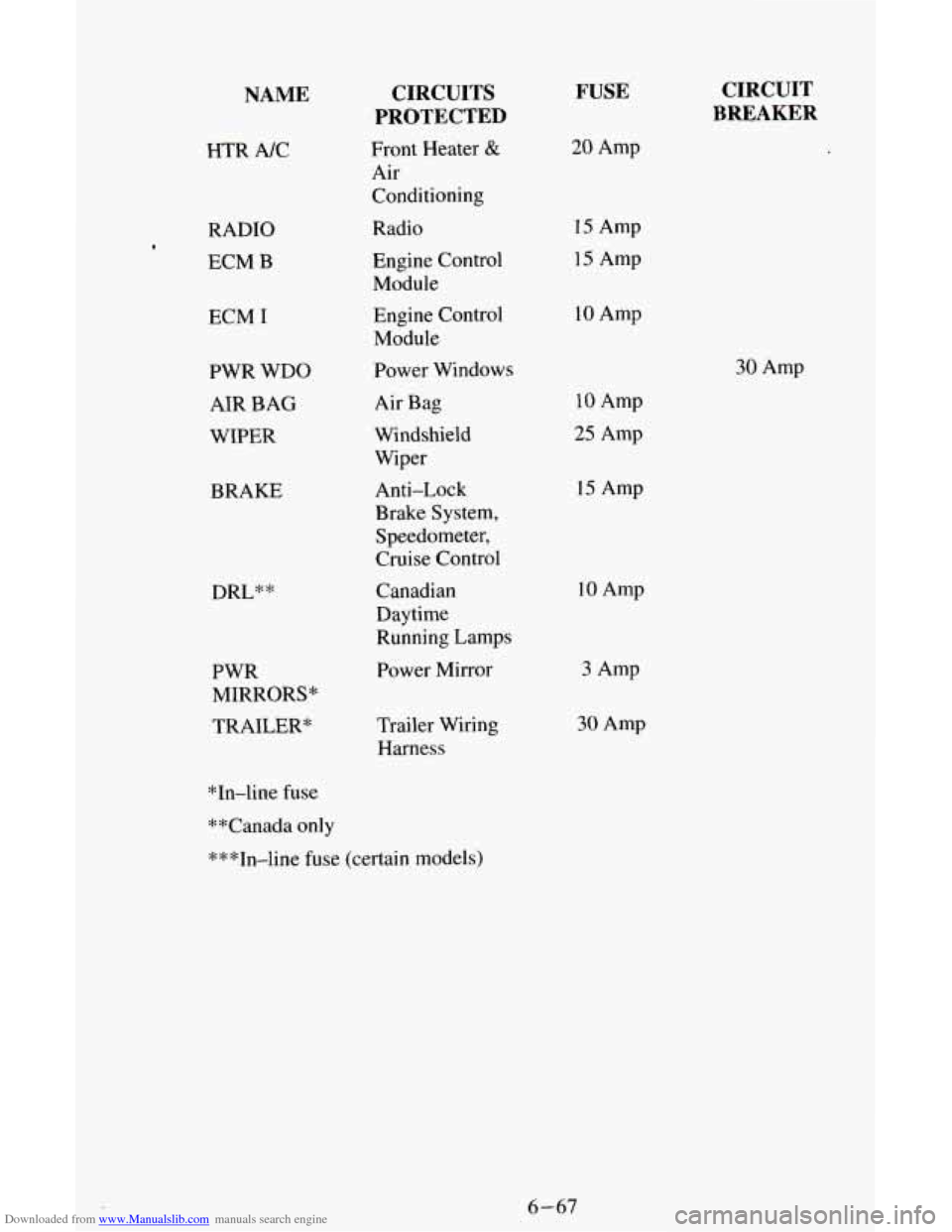
Downloaded from www.Manualslib.com manuals search engine NAME
HTR A/C
RADIO
ECM B
ECM I
PWR WDO
AIR BAG
WIPER
BRAKE
DRL** PWR
MIRRORS*
TRAILER*
CIRCUITS
PROTECTED
Front Heater &
Air
Conditioning
Radio
Engine Control
Module
Engine Control Module
Power
Windows
Air Bag
Windshield Wiper
Anti-Lock
Brake System,
Speedometer,
Cruise Control
Canadian Daytime
Running Lamps
rower Mirror
Trailer Wiring
Harness
FUSE
20 Amp
15 Amp
15 Amp
10 Amp
CIRCUIT
BREAKER
30 Amp
10 Amp
25 Amp
15 Amp
10 Amp
3 Amp
30 Amp
*In-line fuse
**Canada
only
***In-line fuse (certain models)
6-67