Downloaded from www.Manualslib.com manuals search engine A
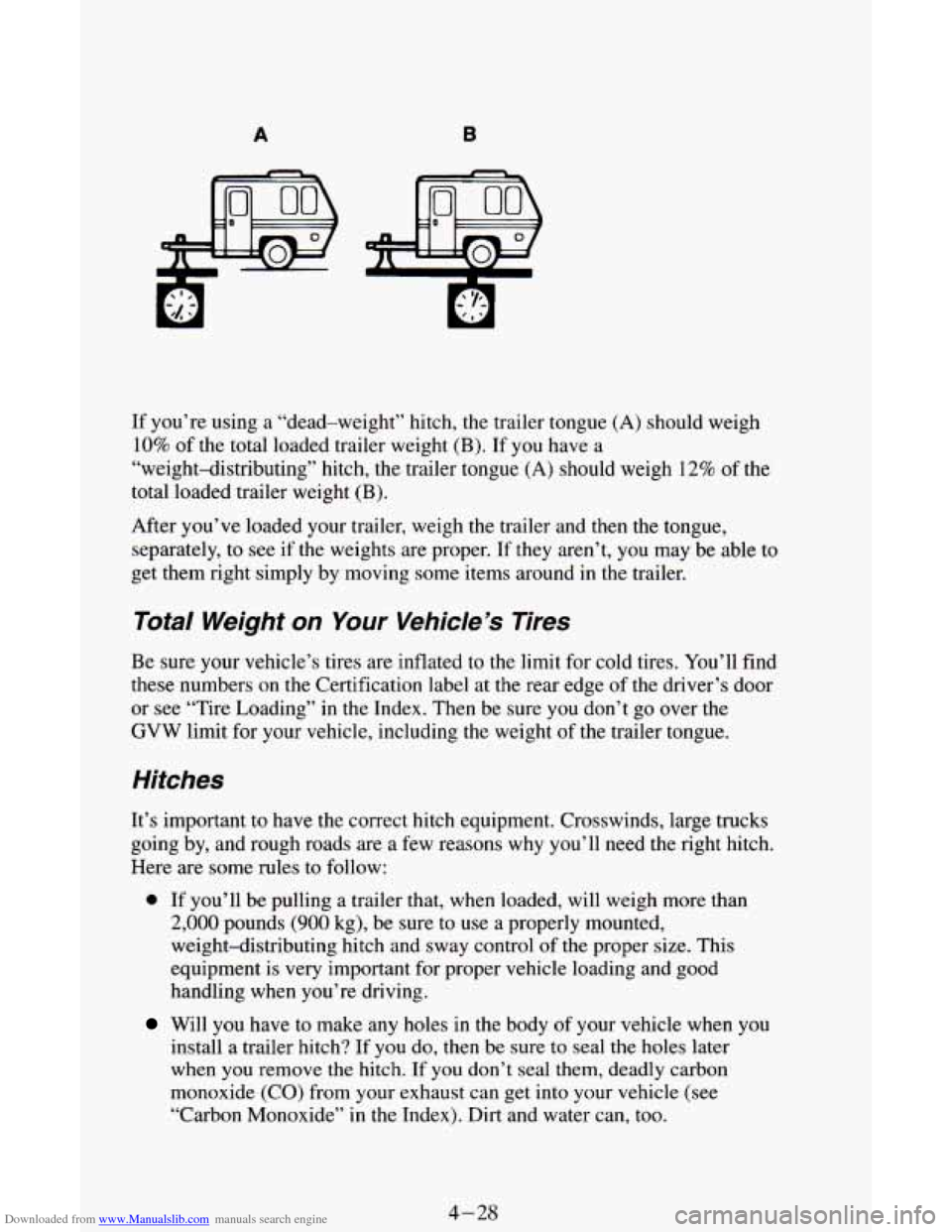
If you’re using a “dead-weight” hitch, the trailer tongue (A) should weigh
10% of the total loaded trailer weight (B). If you have a
“weight-distributing” hitch, the trailer tongue
(A) should weigh 12% of the
total loaded trailer weight
(B).
After you’ve loaded your trailer, weigh the trailer and then the tongue,
separately,
to see if the weights are proper. If they aren’t, you may be able to
get them right simply by moving some items around in the trailer.
Total Weight on Your Vehicle’s Tires
Be sure your vehicle’s tires are inflated to the limit for cold tires. You’ll find
these numbers on the Certification label at the rear edge
of the driver’s door
or see “Tire Loading” in
the Index. Then be sure you don’t go over the
GVW limit for your vehicle, including
the weight of the trailer tongue.
Hitches
It’s important to have the correct hitch equipment. Crosswinds, large trucks
going by, and rough roads are
a few reasons why you’ll need the right hitch.
Here are some rules to follow:
0 If you’ll be pulling a trailer that, when loaded, will weigh more than
2,000 pounds (900 kg), be sure to use a properly mounted,
weight-distributing hitch and sway control
of the proper size. This
equipment is very important for proper vehicle loading and good
handling when you’re driving.
Will you have to make any holes in the body of your vehicle when you
install a trailer hitch? If you do, then be sure to seal the holes later
when you remove the hitch. If
you don’t seal them, deadly carbon
monoxide (CO) from your exhaust can get into your vehicle (see
“Carbon Monoxide”
in the Index). Dirt and water can, too.
4-28
Downloaded from www.Manualslib.com manuals search engine Driving with a Trailer
Towing a trailer requires a certain amount of experience. Before setting out
for the open road, you’ll want
to get to know your rig. Acquaint yourself
with the feel
of handling and braking with the added weight of the trailer.
And always keep in mind that the vehicle you are driving is now a good
deal longer and not nearly as responsive as your vehicle is by itself.
Before you start, check the trailer hitch and platform (and attachments),
safety chains, electrical connector, lights, tires and mirror adjustment.
If the
trailer has electric brakes, start
your vehicle and trailer moving and then
apply the trailer brake controller by hand to be sure the brakes are working.
This lets
you check your electrical connection at the same time.
During your trip, check occasionally
to be sure that the load is secure, and
that the lights and any trailer brakes are still working.
Following Distance
Stay at least twice as far behind the vehicle ahead as you would when
driving your vehicle without a trailer. This can help you avoid situations that
require heavy braking and sudden turns.
4-30