Page 142 of 306
Downloaded from www.Manualslib.com manuals search engine Disabling the Theft-Deterrent Feature
Enter your secret code as follows; pause no more than
15 seconds between steps:
1.
2.
3.
4.
5.
6.
7.
Turn the ignition to the ACCESSORY or
RUN position.
Turn the radio off.
Press the
1 and 4 buttons together. Hold them down
until SEC shows
on the display.
Press
MN and 000 will appear on the display.
Press
MN again to make the last two digits agree
with your code.
Press
HR to make the first one or two digits agree
with your code.
Press
AM-FM after you have confirmed that the
code matches the secret code you have written down.
The display will show
---, indicating that the radio is
no longer secured.
If the code entered is incorrect, SEC will appear on the
display. The radio will remain secured until the correct
code is entered.
When battery power
is given to a secured radio, the
radio won’t turn on and LOC will appear on the display.
Understanding Radio Reception
FM Stereo
FM stereo will give you the best sound. But FM signals
will reach only about
10 to 40 miles (16 to 65 km). Tall
buildings or hills can interfere with FM signals, causing
the sound to come and go.
AM
The range for most AM stations is greater than for FM,
especially at night. The longer range, however, can
cause stations
to interfere with each other. AM can pick
up noise from things like storms and power lines.
Try
reducing the treble to reduce this noise if you ever get it.
3-15
Page 170 of 306
Downloaded from www.Manualslib.com manuals search engine Winter Driving
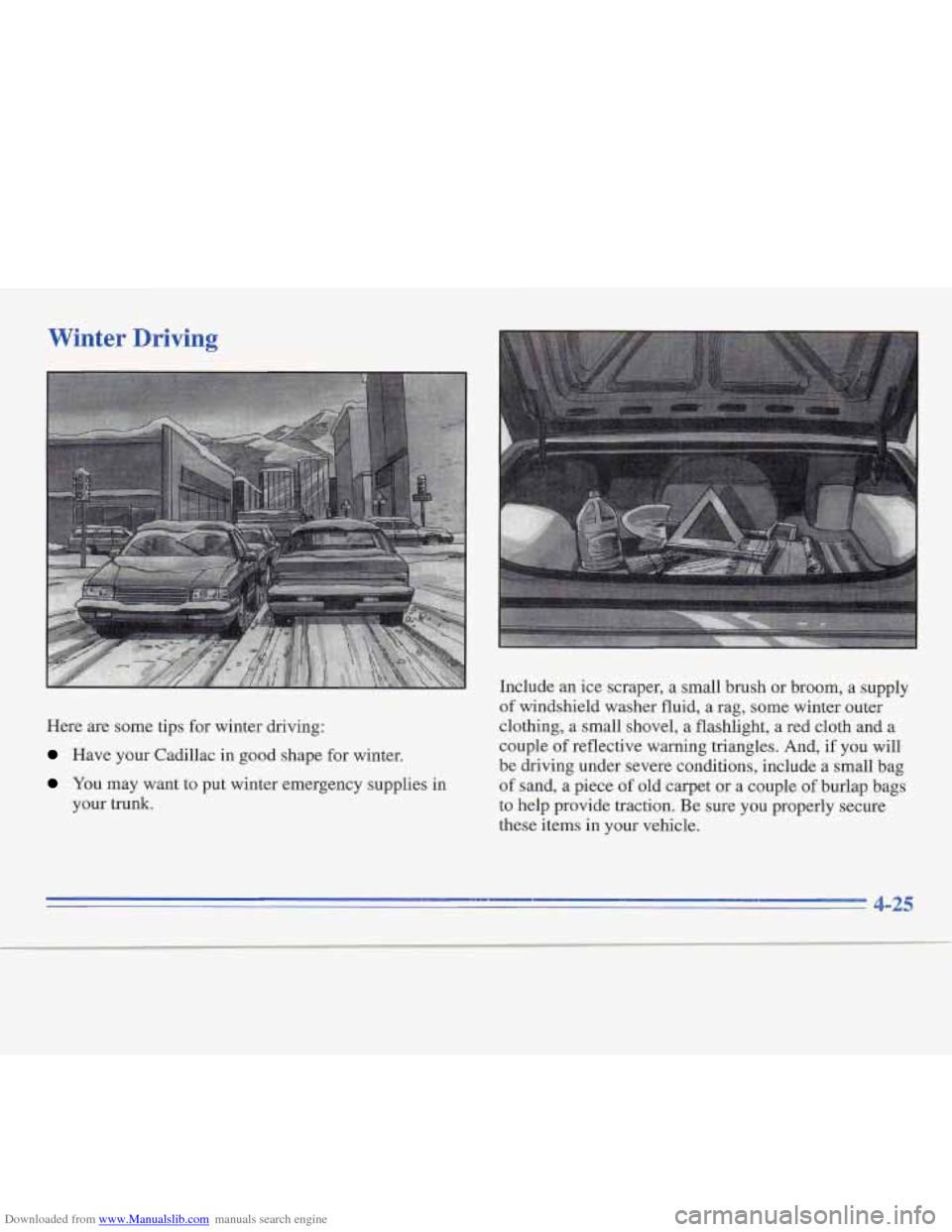
Here are some tips for winter driving:
Have your Cadillac in good shape for winter.
YOU may want to put winter emergency supplies in
your trunk. Include an
ice scraper, a small brush or broom, a supply
of windshield washer fluid, a rag, some winter outer
clothing, a small shovel,
a flashlight, a red cloth and a
couple of reflective warning triangles. And, if
you will
be driving under severe conditions, include a small bag
of sand, a piece of old carpet or a couple of burlap bags
to help provide traction. Be sure you properly secure
these items in your vehicle.
4-25
Page 176 of 306
Downloaded from www.Manualslib.com manuals search engine Things you put inside your vehicle can strike
and injure people in a sudden stop or turn, or
in
a crash.
Put things in the trunk of your vehicle. In a
trunk, put them as far forward as you can.
Try to spread the weight evenly.
Never stack heavier things, like suitcases,
inside the vehicle
so that some of them are
above the tops of the seats.
Don’t leave an unsecured child restraint in
your vehicle.
When you carry something inside the
vehicle, secure
it whenever you can.
Towing a Trailer
CAUTION:
If you don’t use the correct equipment and drive
properly, you can lose control when you pull a
trailer. For example, if the trailer
is too heavy, the
brakes may not work well
-- or even at all. You
and your passengers could be seriously injured.
Pull
a trailer only if you have followed all the
steps in this section. Ask your Cadillac dealer for
advice and information about towing a trailer
with your vehicle.
1 NOTICE:
Pulling a trailer improperly can damage your
vehicle and result in costly repairs not covered by
your warranty.
To pull a trailer correctly, follow
the advice in this part.
Page 192 of 306
Downloaded from www.Manualslib.com manuals search engine Towing Your Vehicle
Try to have a Cadillac dealer or a professional towing
service tow your Fleetwood. They can provide the right
equipment and know how to tow your vehicle without
damage. See “Roadside Assistance” in the Index.
If your vehicle has been changed or modified since it
was factory new
by adding aftermarket items like fog
lamps, aero skirting, or special tires and wheels, these
instructions and illustrations may not be correct.
Before you do anything, turn on the hazard
warning flashers.
When you call, tell the towing service:
That your vehicle can be towed from the front or rear
with wheel lift equipment.
That your vehicle has rear-wheel drive.
The make, model and year of your vehicle.
Whether you can still move the shift lever.
If there was an accident, what was damaged.
When
the towing service arrives, let the tow operator know
that
this manual contains detailed towing instructions and
illustrations. The operator may want to see them.
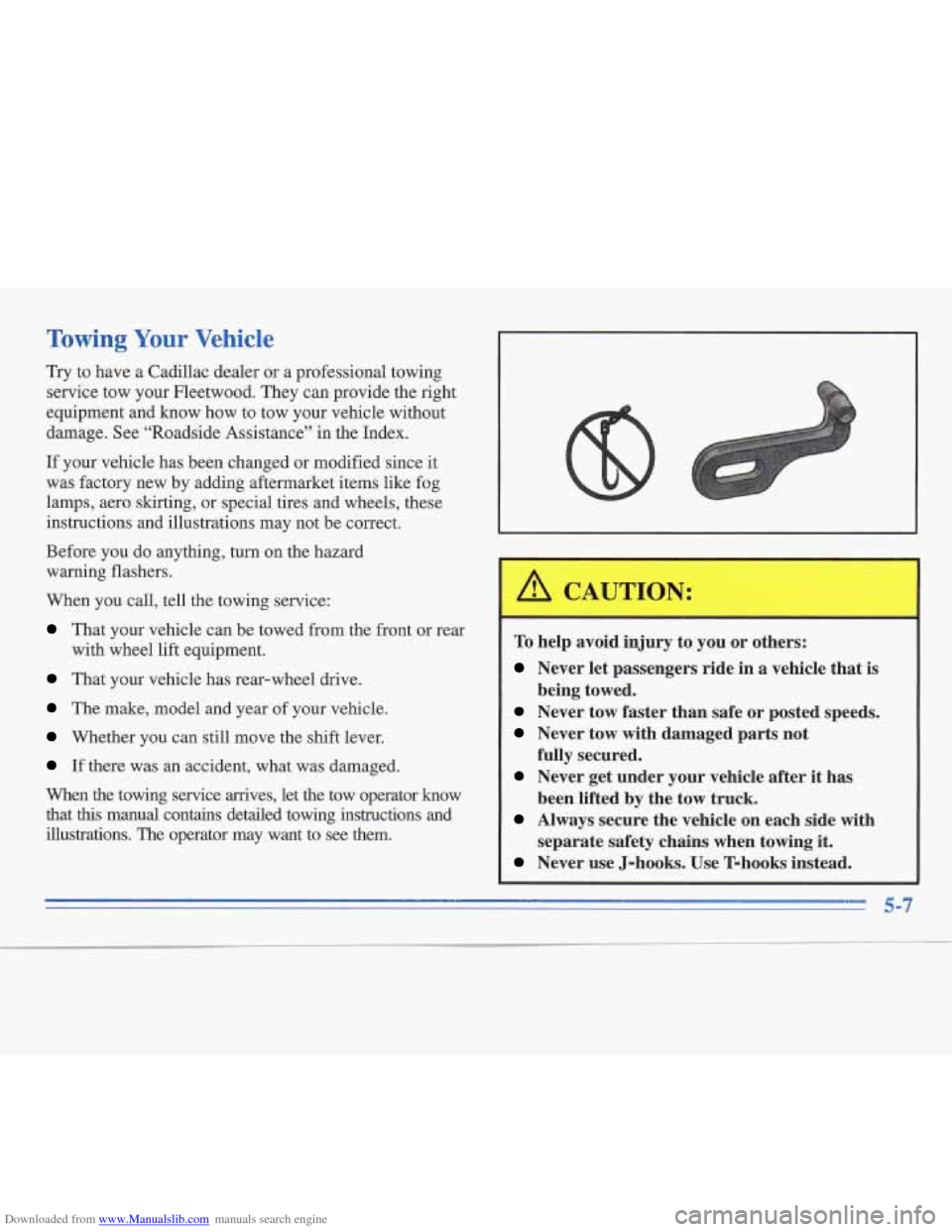
To help avoid injury to you or others:
Never let passengers ride in a vehicle that is
Never tow faster than safe or posted speeds.
Never tow with damaged parts not
fuIly secured.
Never get under your vehicle after it has
been lifted by the tow truck.
Always secure the vehicle on each side with
separate safety chains when towing it.
Never use J-hooks. Use T-hooks instead.
being towed.
- 5-7
Page 193 of 306
Downloaded from www.Manualslib.com manuals search engine A CAUTION:
A vehicle can fall from a car carrier if it isn’t
adequately secured. This can cause a collision,
serious personal injury and vehicle damage. The
vehicle should be tightly secured with chains
or
steel cables before it is transported.
Don’t use substitutes (ropes, leather straps,
canvas webbing, etc.) that can be cut
by sharp
edges underneath the towed vehicle. Always use
T-hooks inserted in the T-hook slots. Never use
J-hooks. They will damage drivetrain and
suspension components.
When your vehicle is being towed, have the ignition key
OFF. The steering wheel should be clamped in a
straight-ahead position, with a clamping device
designed
for towing service. Do not use the vehicle’s
steering column
lock for,this. The transmission should
be in
NEUTRAL (N) and the parking brake released.
Page 194 of 306
Downloaded from www.Manualslib.com manuals search engine Front Towing
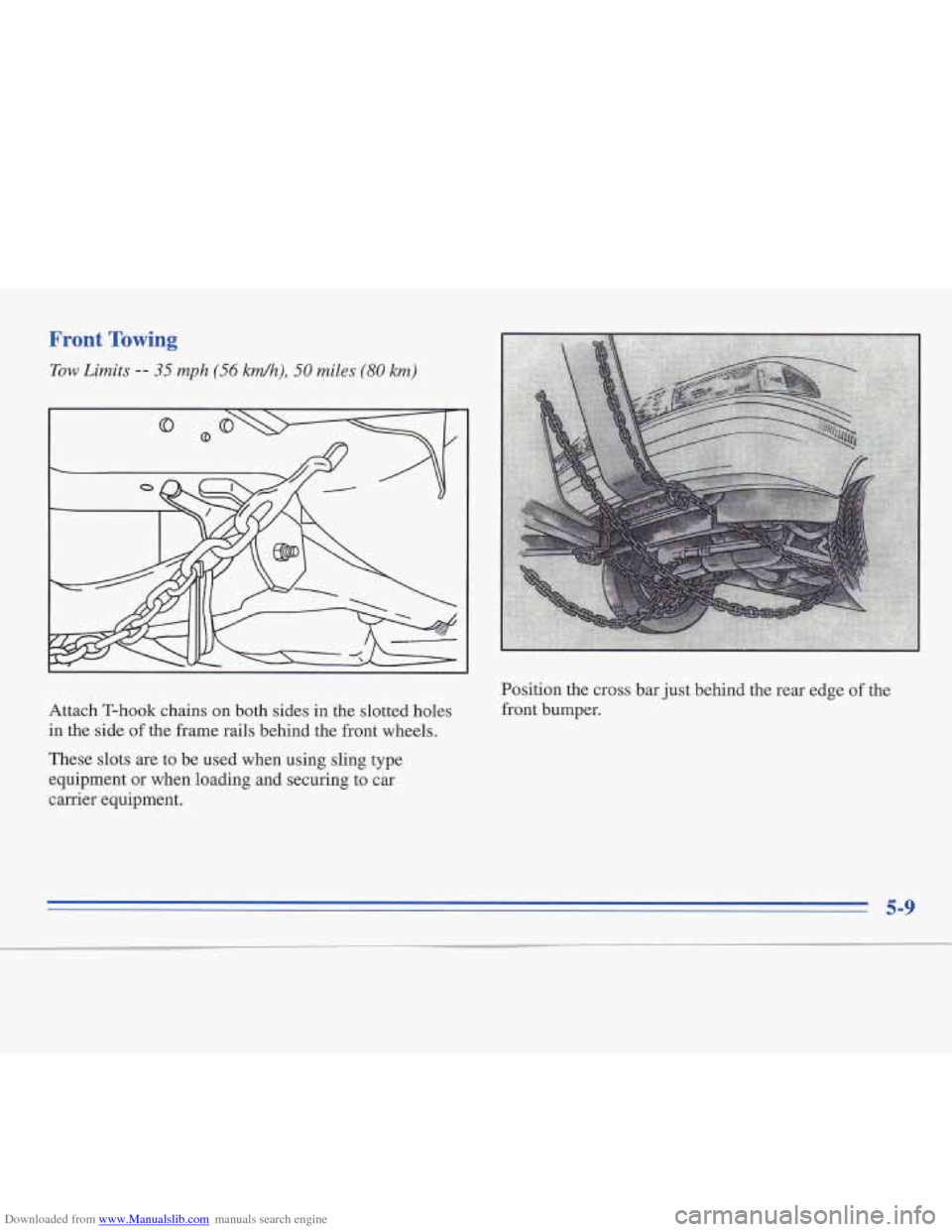
Tow Limits -- 35 mph (56 kmh), 50 miles (80 krn)
Attach T-hook chains on both sides in the slotted holes
in the side
of the frame rails behind the front wheels.
These
slots are to be used when using sling type
equipment or when loading and securing to
car
carrier equipment. Position the
cross bar just
behind the rear edge of the
front bumper.
Page 195 of 306
Downloaded from www.Manualslib.com manuals search engine I
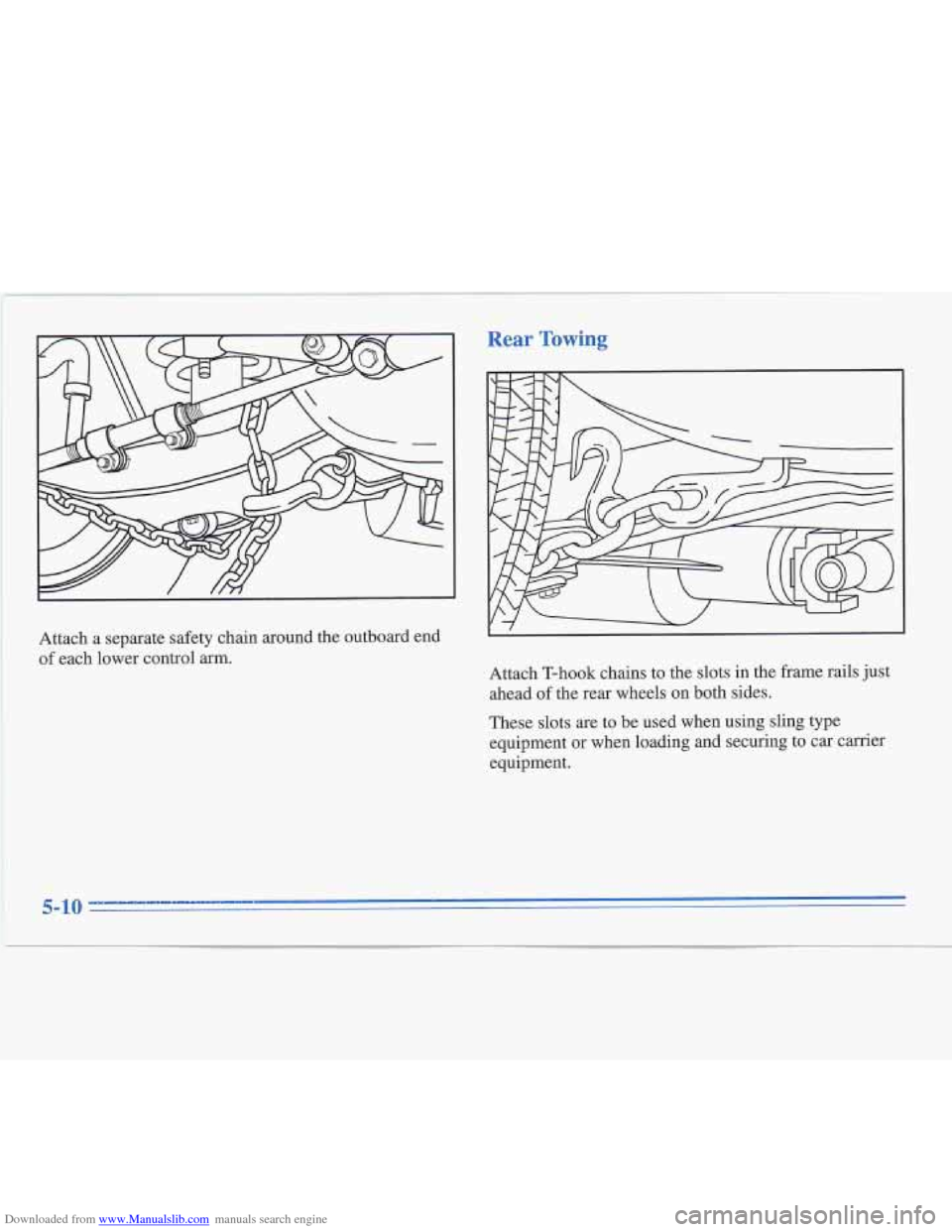
Attach a separate safety chain around the outboard end
of each lower control arm.
Rear Towing
Attach T-hook chains to the slots in the frame rails just
ahead
of the rear wheels on both sides.
These slots are to be used when using sling type
equipment or when loading and securing
to car carrier
equipment.
Page 264 of 306
Downloaded from www.Manualslib.com manuals search engine Used Replacement Wheels
~
Putting a used wheel on your vehicle is
dangerous. You can’t know how
it’s been used or
how many miles
it’s been driven. It could fail
suddenly and cause an accident.
If you have to
replace
a wheel, use a new GM original
equipment wheel.
Tire Chains
I NOTICE:
Use tire chains only where legal and only when
you must. Use only
SAE Class “S” type chains
that are the proper size for your tires. Install
them
on the rear tires and tighten them as tightly
as possible with the ends securely fastened. Drive
slowly and follow the chain manufacturer’s
instructions.
If you can hear the chains
contacting your vehicle, stop and retighten them.
If the contact continues, slow down until it stops.
Driving too
fast or spinning the wheels with
chains on will damage your vehicle.
6-47