1995 CADILLAC FLEETWOOD maintenance
[x] Cancel search: maintenancePage 241 of 306
Downloaded from www.Manualslib.com manuals search engine Power Steering Fluid How To Check Power Steering Fluid
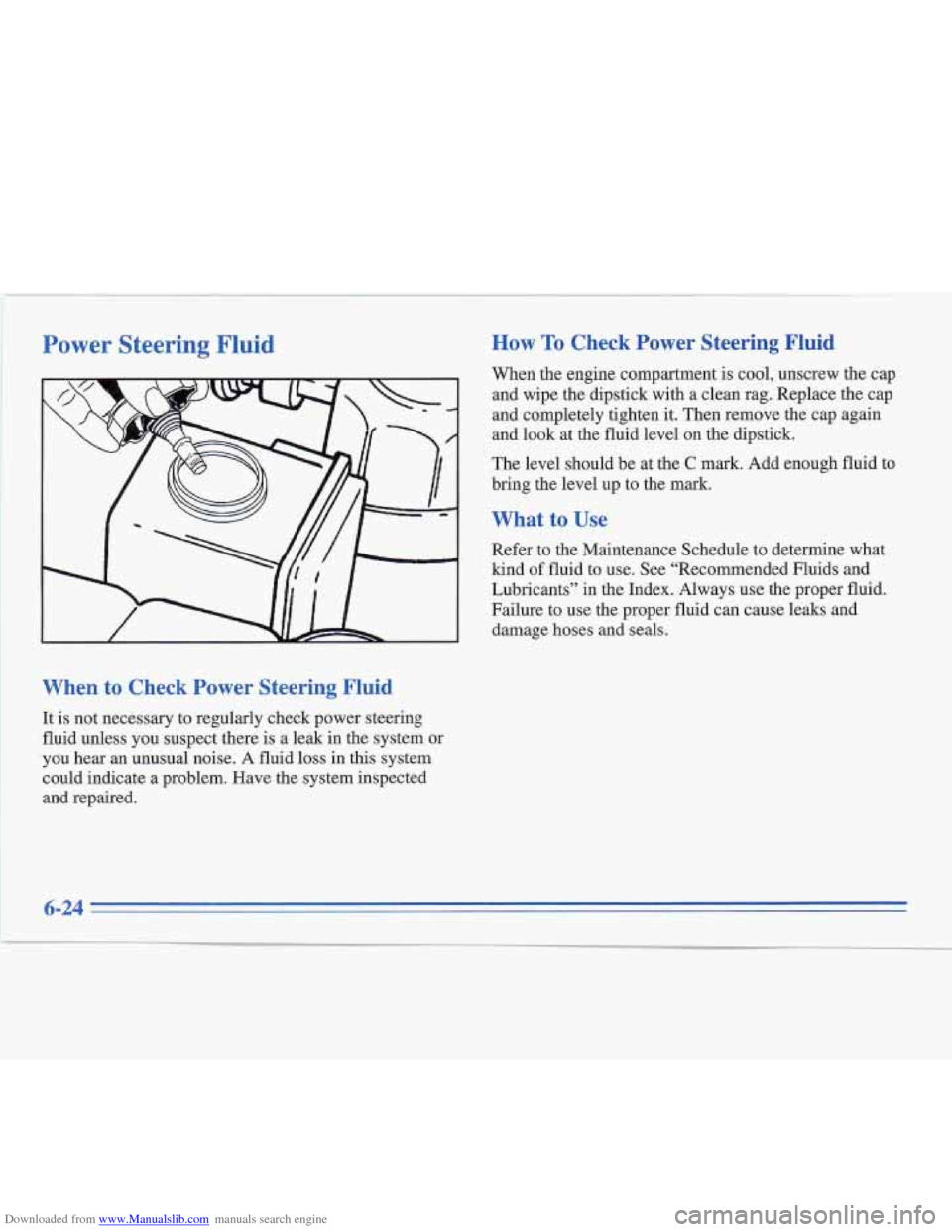
When the engine compartment is cool, unscrew the cap
and wipe the dipstick with a clean rag. Replace the cap
and completely tighten it. Then remove the cap again
and look at the fluid level on the dipstick.
The level should be at the
C mark. Add enough fluid to
bring the level up to the mark.
What to Use
Refer to the Maintenance Schedule to determine what
kind
of fluid to use. See “Recommended Fluids and
Lubricants” in the Index. Always use the proper fluid.
Failure to use the proper fluid can cause leaks and
damage hoses and seals.
When to Check Power Steering Fluid
It is not necessary to regularly check power steering
fluid unless you suspect there is a leak in the system or
you hear an unusual noise. A fluid loss in this system
could indicate a problem. Have the system inspected
and repaired.
6-24
I f
Page 244 of 306
Downloaded from www.Manualslib.com manuals search engine I A CAUTION:
If you have too much brake fluid, it can spill on the
engine. The fluid
wiIl burn if the engine is hot
enough. You or others could be burned, and your
vehicle could be damaged. Add brake fluid only when work is done on the brake hydraulic system. Checking Brake Fluid
I
Refer to
the Maintenance Schedule to determine when to
check your brake fluid. See “Periodic Maintenance
Inspections” in the Index.
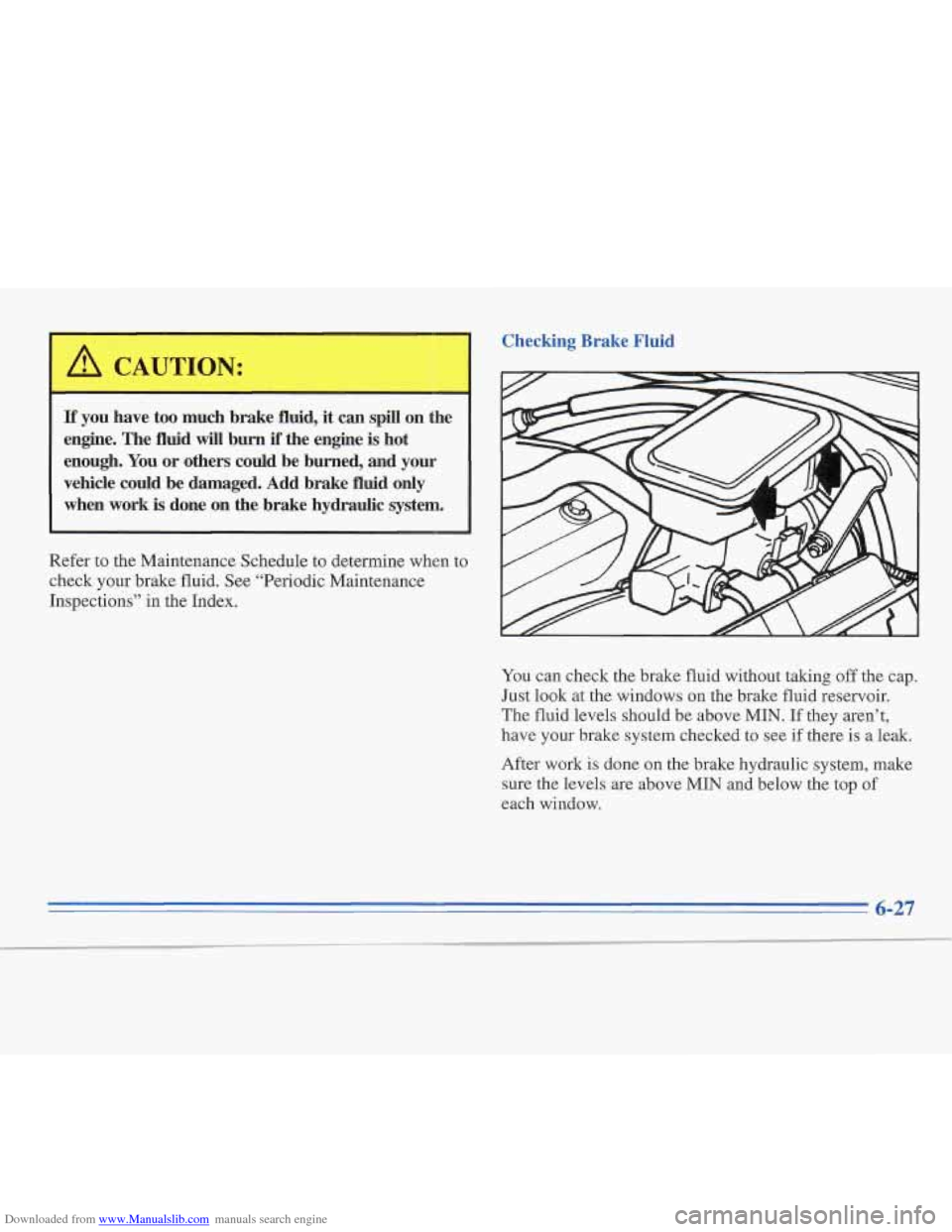
You can check the brake fluid without taking off the cap.
Just look at the windows on the brake fluid reservoir.
The fluid levels should be above
MIN. If they aren’t,
have your brake system checked
to see if there is a leak.
After work is done
on the brake hydraulic system, make
sure the levels are above MIN and below the top of
each window..
6-27
Page 258 of 306
Downloaded from www.Manualslib.com manuals search engine Tire Inspection and Rotation
Tires should be inspected every 6,000 to 8,000 miles
(10 000 to 13 000 km) for any signs of unusual wear. If
unusual wear is present, rotate your tires as soon as
possible and check wheel alignment. Also check for
damaged tires or wheels. See “When It’s Time for New
Tires” and “Wheel Replacement” later in this section for
more information.
J.
Q
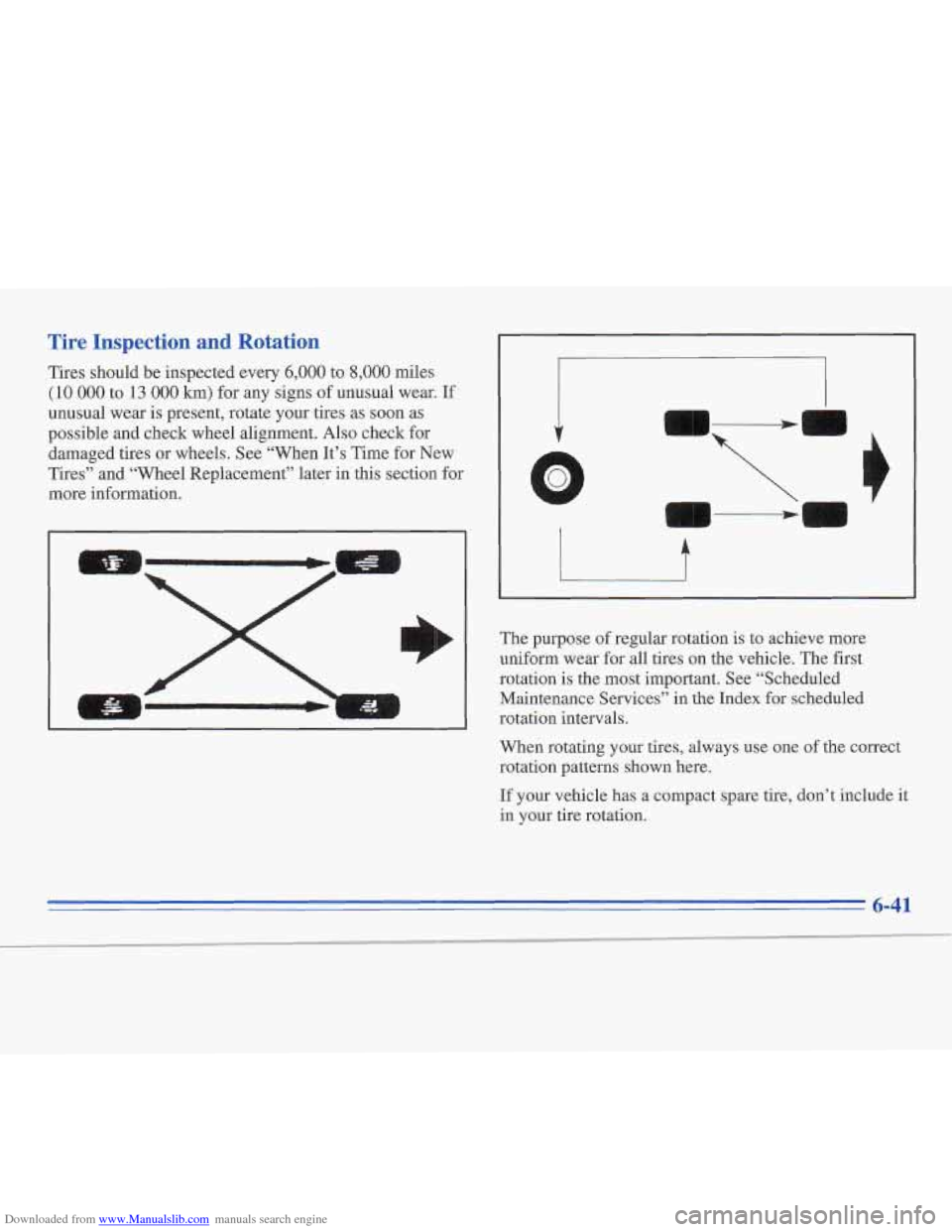
The purpose of regular rotation is to achieve more
uniform wear for all tires on the vehicle. The first
rotation is the most important. See “Scheduled
Maintenance Services” in the Index for scheduled
rotation intervals.
When rotating your tires, always use one
of the correct
rotation patterns shown here.
If your vehicle has a compact spare tire, don’t include it
in your tire rotation.
6-41
Page 271 of 306
Downloaded from www.Manualslib.com manuals search engine 9 b
Tires
To clean your tires, use a stiff brush with a tire cleaner.
NOTICE:
When applying a tire dressing always take care to
wipe
off any overspray or splash from all painted
surfaces on the body or wheels
of the vehicle.
Petroleum-based products may damage the
paint finish.
Sheet Metal Damage
If your vehicle is damaged and requires sheet metal
repair or replacement, make sure the body repair shop
applies anti-corrosion material to the parts repaired or
replaced to restore corrosion protection.
Finish Damage
Any stone chps, fractures or deep scratches in the finish
should be repaired right away. Bare metal will corrode
quickly and may develop into a major repair expense.
Minor chips and scratches can be repaired with touch-up
materials available from your dealer or other service
outlets. Larger areas
of finish damage can be corrected
in your dealer’s body and paint shop.
Underbody Maintenance
Chemicals used for ice and snow removal and dust
control can collect on the underbody.
If these are not
removed, accelerated corrosion (rust) can occur on the
underbody parts such as fuel lines, frame, floor pan
and exhaust system even though they have
corrosion protection.
At least every spring, flush these materials from the
underbody with plain water. Clean any areas where mud
and other debris can collect.
Dirt packed in closed areas
of the frame should be loosened before being flushed.
Your dealer or an underbody car washing system can do
this for you.
Chemical Paint Spotting
Some weather and atmospheric conditions can create a
chemical fallout. Airborne pollutants can fall upon and
attack painted surfaces on your vehicle. This damage
can take two forms: blotchy, ringlet-shaped
discolorations, and small irregular dark spots etched into
the paint surface.
Although no defect in the paint job causes
this, Cadillac
will repair, at
no charge to the owner, the surfaces of
new vehicles damaged by this fallout condition within
12 months or 12,000 miles (20 000 km) of purchase,
whichever occurs first.
Page 295 of 306
Downloaded from www.Manualslib.com manuals search engine Service Manuals
Service manuals contain diagnostic and repair
information for all chassis and body systems. They may
be useful for owners who wish to get a greater
understanding of their vehicle. They
are also useful for
owners with the appropriate skill level or training who
wish to perform “do-it-yourself” service. These are
authentic General Motors service manuals meant for
professional, qualified technicians.
service^ Bulletins
Service bulletins covering various subjects are regularly sent to all General Motors dealerships. GM monitors
product performance in the field. When service methods
are found which promote better service on GM vehicles,
bulletins are created to help the technician perform
better service. Service bulletins may involve any
number of vehicles. Some will describe inexpensive service; others will describe expensive service. Some
will advise of new or unexpected conditions, and others
may help avoid future costly repairs. Service bulletins
are meant for qualified technicians.
In some cases
bulletins refer to service manuals, specialized tools,
equipment and safety procedures necessary to service
the vehicle. Since these bulletins are issued throughout
the model year and beyond, an index is required and
published quarterly to help identify specific bulletins.
Subscriptions are available. You can order an index at
the toll-free numbers listed previously, or ask
a GM
dealer to see an index or individual bulletin.
Owner Publications
Owner’s manuals, warranty folders and various owner
assistance booklets provide owners with general
operation and maintenance information.
7-12
Page 300 of 306
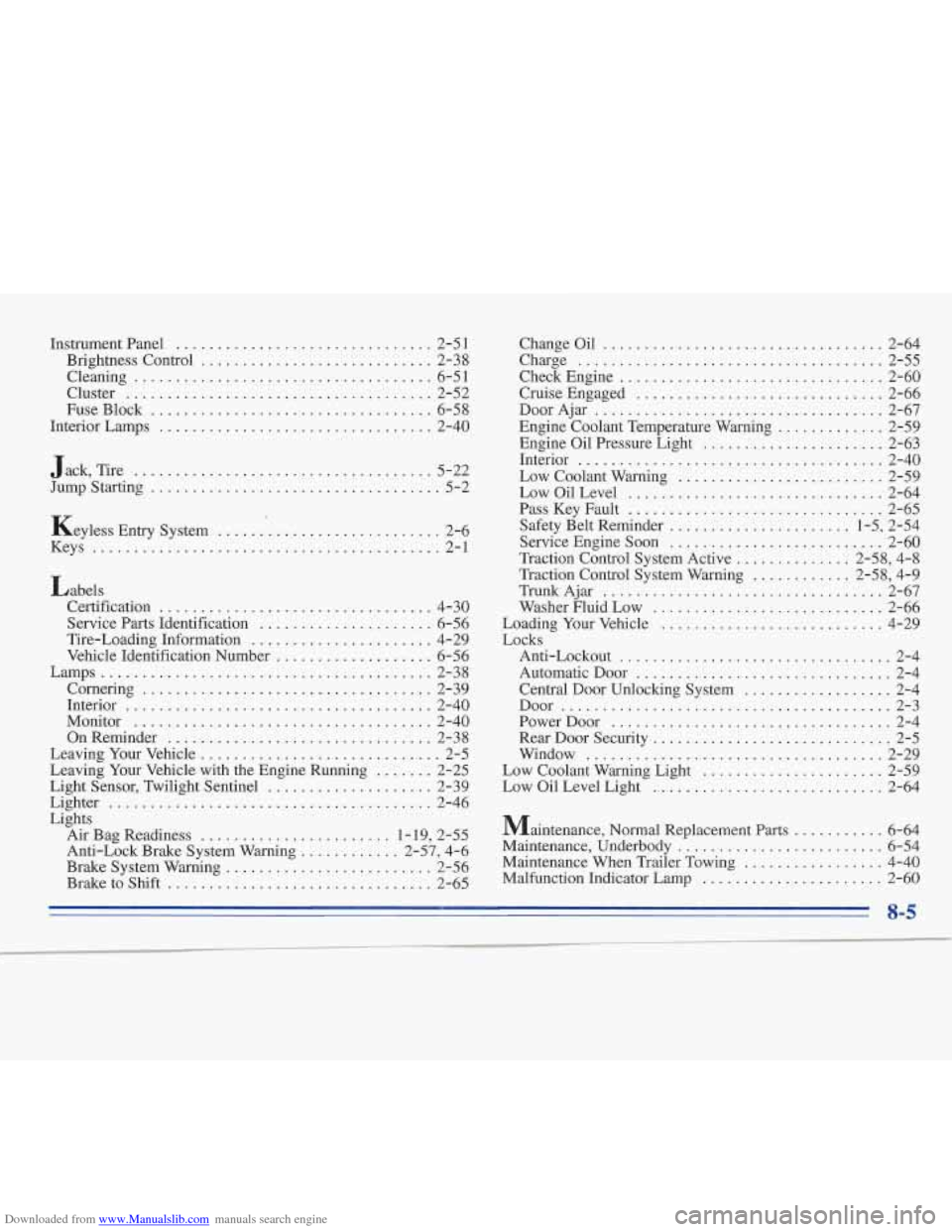
Downloaded from www.Manualslib.com manuals search engine Instrument Panel ............................... 2-5 1
Brightness Control
............................ 2-38
Cleaning
.................................... 6-51
Cluster
..................................... 2-52
FuseBlock
.................................. 6-58
Interior Lamps
................................. 2-40
Jack. Tire
.................................... 5-22
Jumpstarting
................................... 5-2
Keyless Entry System
............................ 2-6
Keys
.......................................... 2-1
Labels Certification
................................. 4-30
Service Parts Identification
..................... 6-56
Tire-Loading Information
...................... 4-29
Vehicle Identification Number
................... 6-56
Lamps
........................................ 2-38
Interior
..................................... 2-40
Monitor
.................................... 2-40
OnReminder
................................ 2-38
Leaving Your Vehicle
............................. 2-5
Light Sensor. Twilight Sentinel
.................... 2-39
Lighter
....................................... 2-46
Lights Cornering
................................... 2-39
Leaving Your Vehicle with the Engine Running
....... 2-25
Air Bag Readiness ....................... 1.19. 2.55
Anti-Lock Brake System Warning
............ 2.57. 4.6
Brake System Warning
......................... 2-56
Brake to Shift
................................ 2-65 Changeoil
.................................. 2-64
Charge
..................................... 2-55
DoorAjar
................................... 2-67
Engine Coolant Temperature Warning
............. 2-59
Engine Oil Pressure Light
...................... 2-63
Interior
..................................... 2-40
Low Coolant Warning
......................... 2-59
Low Oil Level
............................... 2-64
Pass Key Fault
............................... 2-65
Safety Belt Reminder
...................... 1-5, 2-54
ServiceEngineSoon
.......................... 2-60
CheckEngine
................................ 2-60
CruiseEngaged
.............................. 2-66
Traction Control System Active
.............. 2-58, 4-8
Traction Control System Warning
............ 2-58, 4-9
TrunkAjar
.................................. 2-67
Washer Fluid Low
............................ 2-66
Loading Your Vehicle
........................... 4-29
Locks Anti-Lockout
................................. 2-4
Automatic Door
............................... 2-4
Door ........................................ 2-3
PowerDoor
.................................. 2-4
Rear Door Security
............................. 2-5
Window
.................................... 2-29
Low Coolant Warning Light ...................... 2-59
LowOilLevelLight
............................ 2-64
Central
Door Unlocking System
.................. 2-4
Maintenance, Normal Replacement
parts ........... 6-64
Maintenance, Underbody
......................... 6-54
Maintenance When Trailer Towing
................. 4-40
Malfunction Indicator Lamp
...................... 2-60
. 8-5
Page 304 of 306
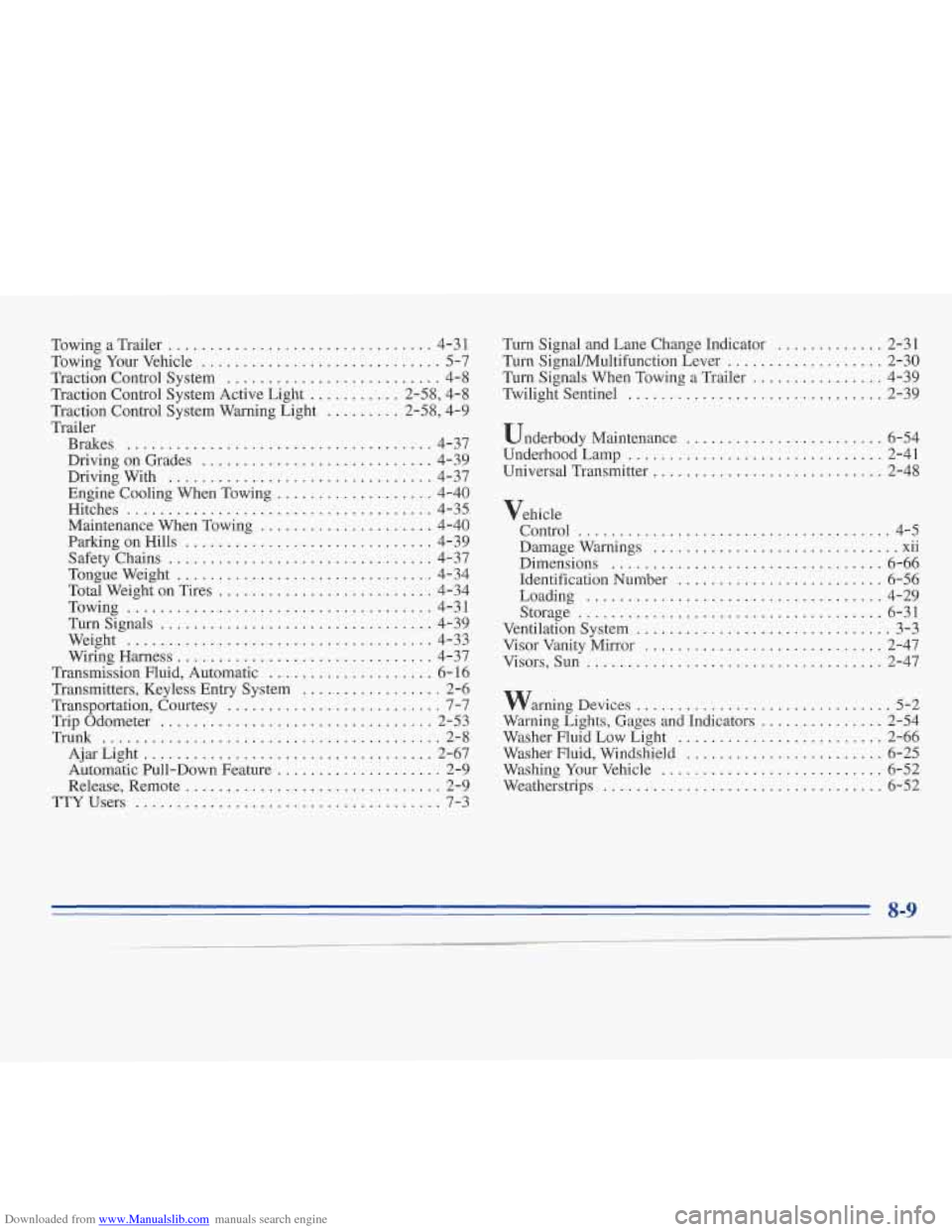
Downloaded from www.Manualslib.com manuals search engine Towing a Trailer ................................ 4-31
Towing Your Vehicle
............................. 5-7
Traction Control System
.......................... 4-8
Traction Control System Active Light
........... 2.58. 4.8
Traction Control System Warning Light
......... 2.58. 4.9
Trailer Brakes
..................................... 4-37
Driving on Grades
............................ 4-39
Engine Cooling When Towing
................... 4-40
Hitches
..................................... 4-35
Maintenance When Towing
..................... 4-40
Safety Chains
................................ 4-37
Tongueweight
............................... 4-34
Total Weight on Tires
.......................... 4-34
Towing
..................................... 4-31
Turnsignals
................................. 4-39
Wiring Harness
............................... 4-37
Transmission Fluid. Automatic
.................... 6- 16
Transmitters. Keyless Entry System
................. 2-6
Trip Odometer
................................. 2-53
AjarLight
................................... 2-67
Automatic Pull-Down Feature
.................... 2-9
Release. Remote
............................... 2-9
TTYUsers
..................................... 7-3
DrivingWith
................................ 4-37
ParkingonHills
.............................. 4-39
Weight
..................................... 4-33
Transportation. Courtesy
.......................... 7-7
Tr~nk
......................................... 2-8 Turn
Signal and Lane Change Indicator
.............
Underbody Maintenance ........................ 6-54
Underhood Lamp
............................... 2-41
Universal Transmitter
............................ 2-48
Vehicle Control
...................................... 4-5
Damage Warnings
.............................. xii
Dimensions
................................. 6-66
Identification Number ......................... 6-56
Loading
.................................... 4-29
Ventilation System
............................... 3-3
Visor Vanity Mirror
............................. 2-47
Visors, Sun
.................................... 2-47
Storage
..................................... 6-31
warning
Devices ............................... 5-2
Warning Lights. Gages and Indicators ............... 2-54
Washer Fluid Low Light
......................... 2-66
Washer Fluid. Windshield
........................ 6-25
Washing Your Vehicle
........................... 6-52
Weatherstrips
.................................. 6-52
... 8-9