1995 CADILLAC FLEETWOOD light
[x] Cancel search: lightPage 66 of 306
Downloaded from www.Manualslib.com manuals search engine Operation
Press the unlock symbol to unlock the driver’s door.
Press
it again within five seconds to unlock the other
doors. Pressing this symbol will also disarm the optional
Theft-Deterrent System and
turn on the interior lamps.
Press the lock symbol to lock your doors. This also arms
the optional Theft-Deterrent System.
Press the opened trunk symbol to open the trunk.
Press the lamp symbol to turn on the interior lamps only.
Matching Transmitter(s) To Your Vehicle
Each key chain transmitter is coded to prevent another
transmitter from unlocking your vehicle.
If a transmitter
is lost or stolen,
a replacement can be purchased through
your dealer. Remember to bring any remaining
transmitters with you when you go to your dealer. When
the dealer matches the replacement transmitter to your
vehicle, any remaining transmitters must also be
matched. Once the new transmitter is coded, the lost
transmitter will not unlock your vehicle. Each vehicle
can have only two transmitters matched to it.
Battery Replacement
Under normal use, the batteries in your key chain
transmitter should last about two years.
You can tell the batteries are weak if the transmitter
won’t work at the normal range in any location. If you
have to get close to your vehicle before the transmitter
works, it’s probably time to change the batteries.
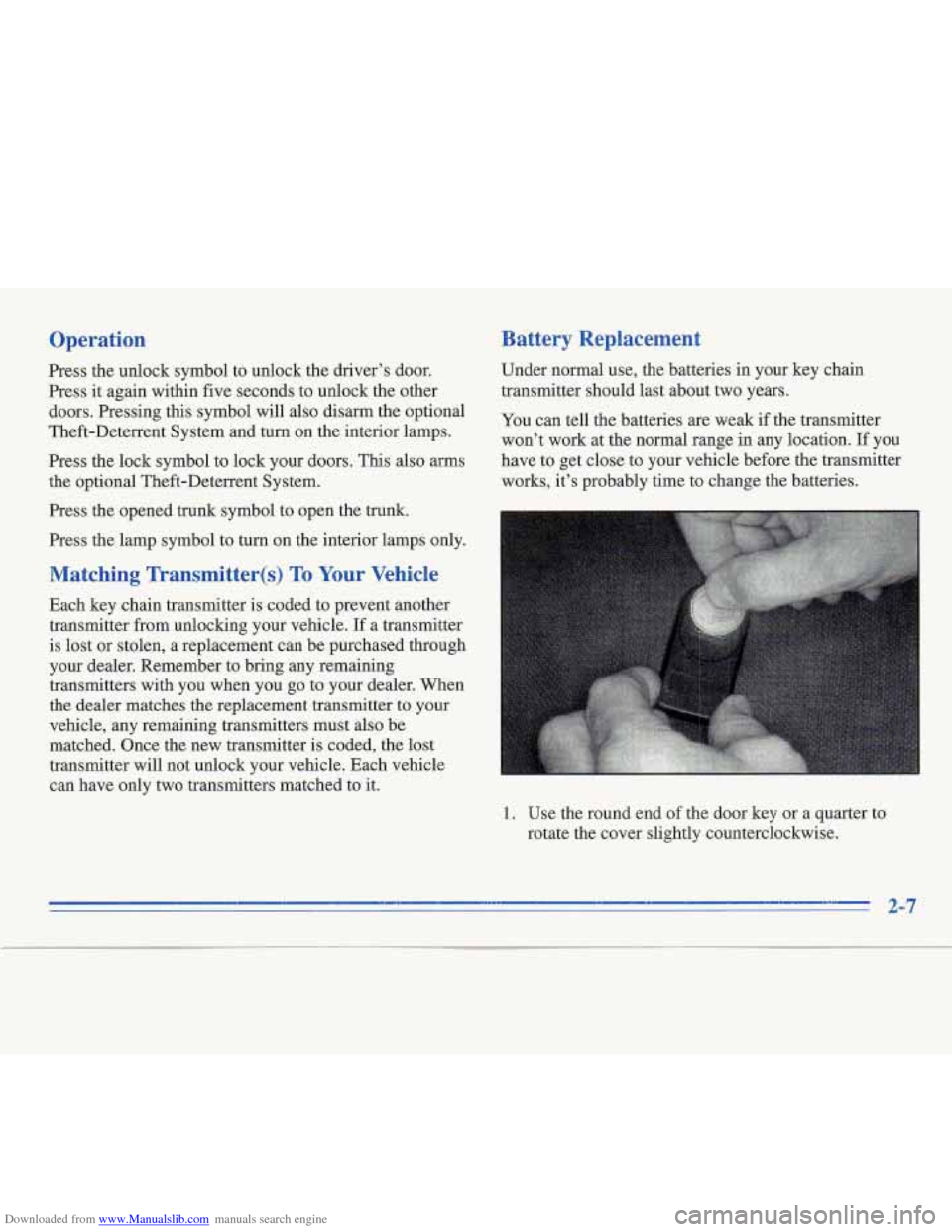
1. Use the round end of the door key or a quarter to
rotate the cover slightly counterclockwise.
Page 69 of 306
Downloaded from www.Manualslib.com manuals search engine Theft Parking at Night
Vehicle theft is big business, especially in some cities.
Although your Cadillac has a number of theft-deterrent
features, we know that nothing we put
on it can make it
impossible to steal. However, there are ways you can help.
Key in the Ignition
If you leave your vehicle with the keys inside, it’s an
easy target for joy riders or professional thieves
-- so
don’t do it.
When you park your Cadillac and open the driver’s
door, you’ll hear a chime reminding you to remove your
key from the ignition and take it with you. Always do
this. Your
steering wheel will be locked, and so will
your ignition and transmission. And remember to lock
the doors. Park in
a lighted spot, close all windows and lock your
vehicle. Remember to keep your valuables out of sight.
Put them in a storage area, or take them with you.
Parking Lots
If you park in a lot where someone will be watching
your vehicle, it’s best to lock
it up and take your keys.
But what if you have to leave your ignition key? What if
you have to leave something valuable in your vehicle?
Put your valuables in a storage area, like your trunk
or glove box.
0 Lock the glove box.
Lock all the doors except the driver’s.
Then take the door key and Keyless Entry key chain
with you.
Page 70 of 306
Downloaded from www.Manualslib.com manuals search engine Tbeft-Deterrent System (Option)
SECURITY
SYSTEM
If your Cadillac has this
option, it has a
theft-deterrent alarm system
and a
fuel filler door lock
release.
If the ignition is off,
the SECURITY SYSTEM
light will flash as you open
the door, reminding you to
activate the system.
1. Open the door.
2. Lock the door with the power door locks or the
Keyless Entry System. The SECURITY SYSTEM
light should come on and stay on.
3. Close all the doors. The SECURITY SYSTEM light
should go
off.
The horn will sound and the lamps will flash when the
door or trunk are opened without the key or the Keyless
Entry System or if the locks are damaged.
Remember, the Theft-Deterrent System won’t activate if
you lock the doors with a key or manual door lock. It
arms only
if you use the power door locks or the
Keyless Entry System.
To avoid setting off the alarm by accident:
The vehicle should be locked with the door key after
the doors are closed
if you don’t want to activate
the system.
Always unlock a door with a key or the Keyless
Entry System. Unlocking a door any other way will
activate the alarm.
If you activate the alarm by accident, unlock any door
with your key or the Keyless Entry System. The alarm
won’t
stop if you try to unlock a door any other way.
Page 72 of 306
Downloaded from www.Manualslib.com manuals search engine The ignition key must be clean and dry before it’s inserted
in the ignition or the engine may not start. If the engine
does not
start and the PASS KEY FAULT light comes on,
the key may be
drty or wet. Turn the ignition off.
Clean and dry the key. Wait about three minutes and try
again. The PASS KEY FAULT light may remain on
during this time. If the starter still won’t work, and the
key appears to be clean and dry, wait about three
minutes and try another ignition key. At this time, you
may also want to check the fuse (see “Fuses and Circuit
Breakers” in the Index).
If the starter won’t work with
the other key, your vehicle needs service.
If your vehicle
does start, the first ignition key may be faulty. See your
Cadillac dealer or a locksmith who can service the
PASS-Key
II.
If you accidentally use a key that has a damaged or
missing resistor pellet, the starter won’t work and the
PASS
KEY FAULT light will flash. But you don’t have
to wait three minutes before trying another ignition key.
See your Cadillac dealer or a locksmith who can service
the PASS-Key
11 to have a new key made.
If you’re ever driving and the PASS KEY FAULT light
comes on and stays on, you will be able to restart your
engine if you turn
it off. Your PASS-Key I1 system,
however, is not working properly and must be serviced
by your Cadillac dealer. Your vehicle
is not protected by
the PASS-Key
11 system.
If
you lose or damage a PASS-Key 11 ignition key, see
your Cadillac dealer or a locksmith who can service
PASS-Key
11 to have a new key made.
2-13
Page 81 of 306
Downloaded from www.Manualslib.com manuals search engine Parking Brake
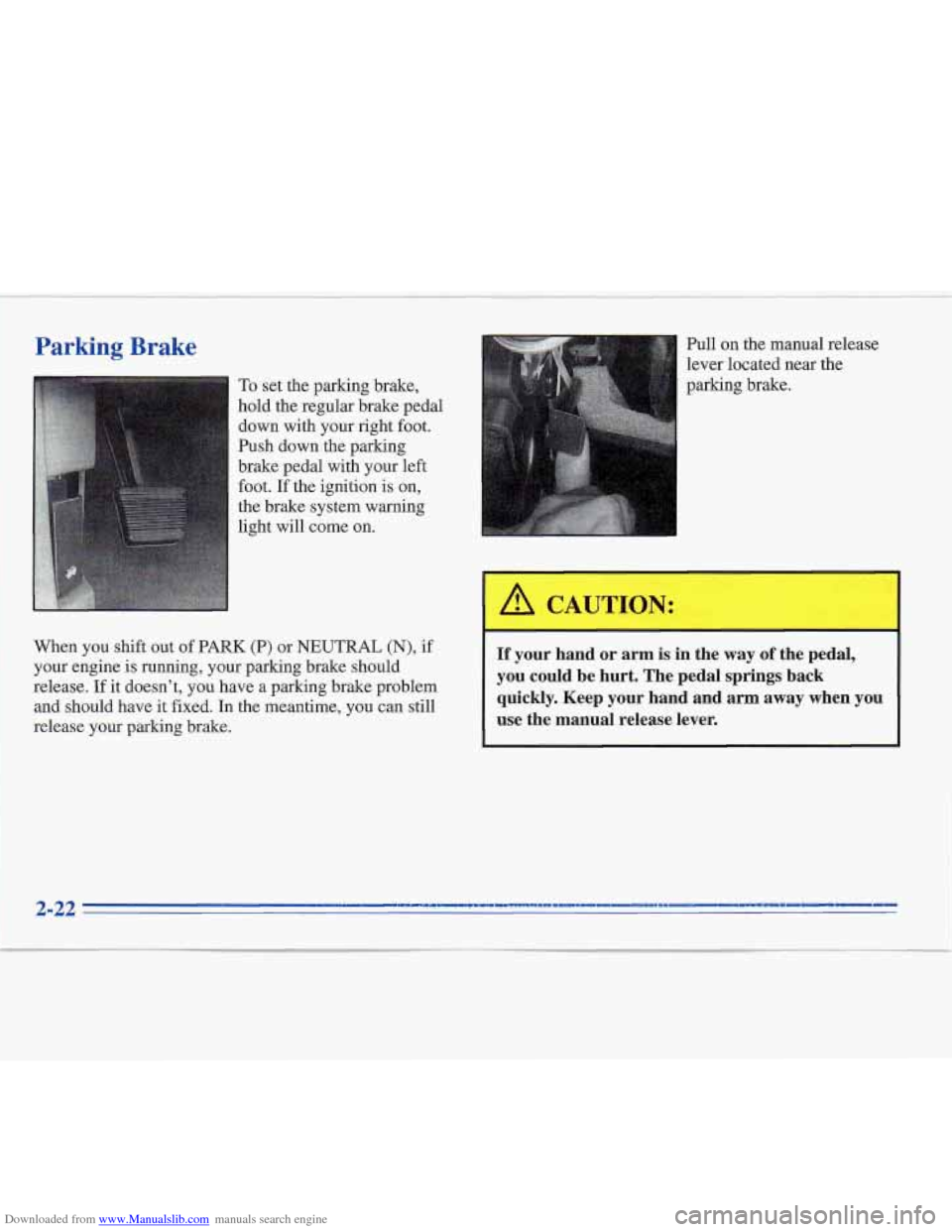
To set the parking brake,
hold the regular brake pedal down with your right foot.
Push down the parking
brake pedal with your left
foot.
If the ignition is on,
the brake system warning
light will come on. Pull
on the manual release
lever located near the
parking brake.
When you shift out
of PARK (P) or NEUTRAL (N), if
your engine is running, your parking brake should
release.
If it doesn’t, you have a parking brake problem
and should have it fixed.
In the meantime, you can still
release your parking brake.
If your hand or arm is in the way of the pedal,
you could be hurt. The pedal springs back
quickly. Keep your hand and arm away when you
use the manual release lever.
Page 91 of 306
Downloaded from www.Manualslib.com manuals search engine Headlamp High/L~w Beam Changer
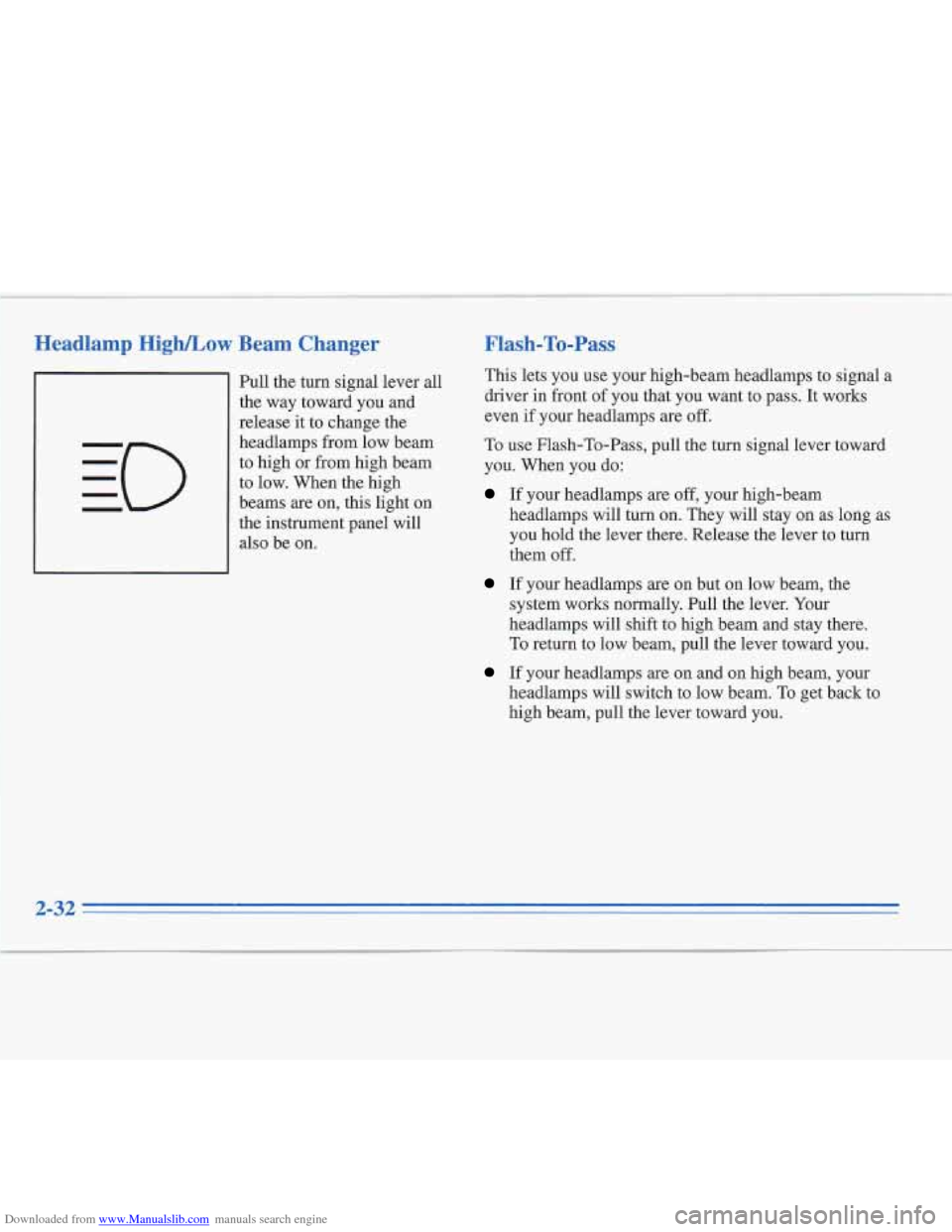
Pull the turn signal lever all
the way toward you and
release it to change the
headlamps from low beam
to high or from high beam
to low. When the high
beams are on, this light
on
the instrument panel will
also be on.
Flash-To-Pass
This lets you use your high-beam headlamps to signal a
driver in front of you that you want to pass. It works
even
if your headlamps are off.
To use Flash-To-Pass, pull the turn signal lever toward
you. When you do:
If your headlamps are off, your high-beam
headlamps will turn on. They will stay on as long as
you hold the lever there. Release the lever to turn
them
off.
If your headlamps are on but on low beam, the
system works normally. Pull
the lever. Your
headlamps will shift to high beam and stay there.
To return to low beam, pull the lever toward you.
If your headlamps are on and on high beam, your
headlamps will switch
to low beam. To get back to
high beam, pull the lever toward you.
2-32
Page 96 of 306
Downloaded from www.Manualslib.com manuals search engine Reducing Speed While Using Cruise Control
There are two ways to reduce your speed while using
cruise control:
Press in the button at the end of the lever until you
reach the lower speed you want, then release it.
To slow down in very small amounts, press the
button for less than
half a second. Each time you do
this, you’ll go
1 mph (1.6 km/h) slower.
Passing Another Vehicle While Using Cruise Control
Use the accelerator pedal to increase your speed. When
you take your foot
off the pedal, your vehicle will slow
down to the cruise control speed you set earlier.
Using Cruise Control on Hills
How well your cruise control will work on hills depends
upon your speed, load and the steepness of the hills.
When going up steep hills, you may have to step on the
accelerator pedal to maintain your speed. When going
downhill, you may have to brake or shift to a lower gear
to keep your speed down. Of course, applying the brake
takes you out of cruise control. Many drivers find this to
be too much trouble and don’t use cruise control on
steep hills.
Ending Cruise Control
There are two ways to turn off the cruise control:
Step lightly on the brake pedal, OR
0 Move the CRUISE switch to OFF.
Erasing Speed Memory
When you turn off the cruise control or the ignition,
your cruise control set speed memory is erased.
2-37
Page 97 of 306
Downloaded from www.Manualslib.com manuals search engine Lamps
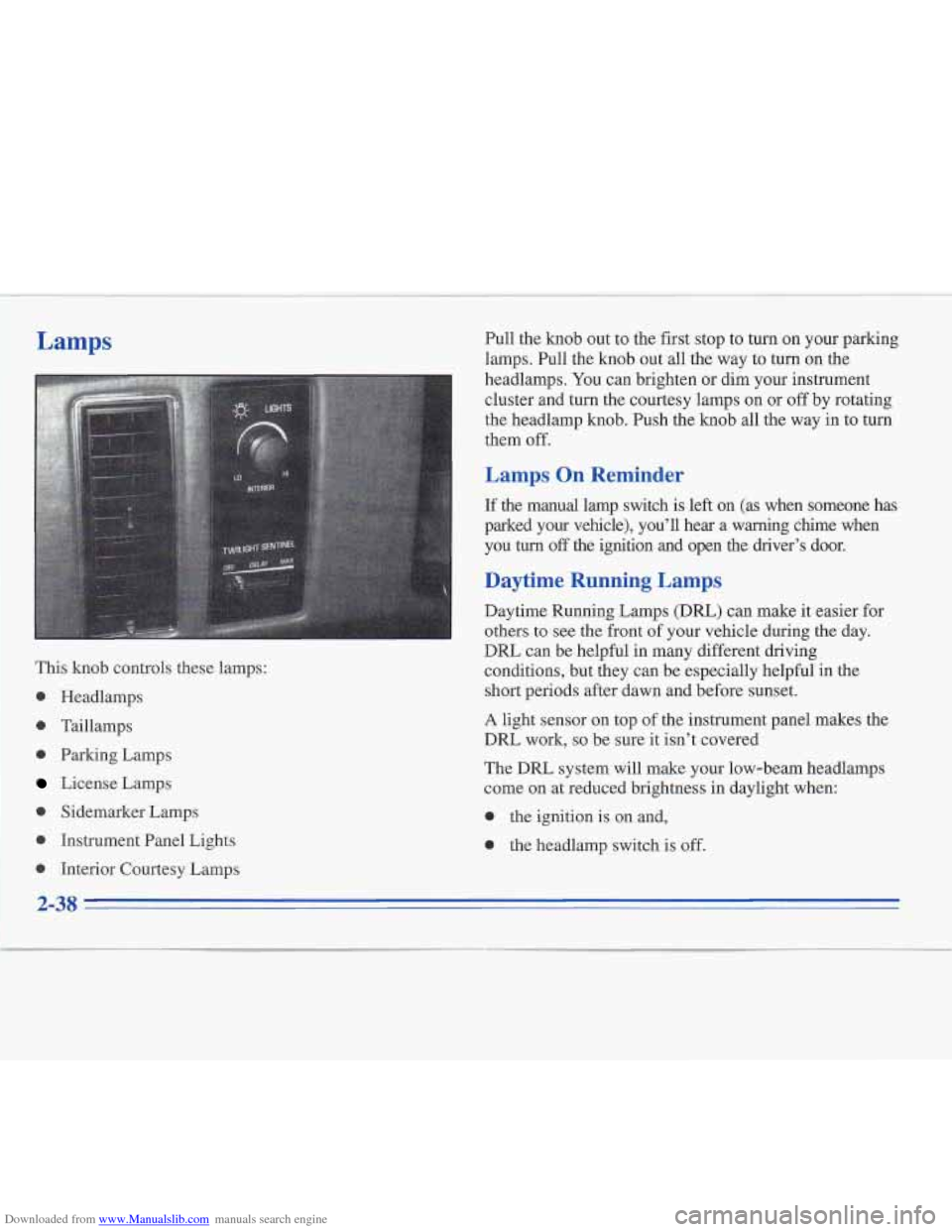
This knob controls these lamps:
0
0
0
0
0
0
Headlamps
Taillamps Parking Lamps
License Lamps
Sidemarker Lamps
Instrument Panel Lights
Interior Courtesy Lamps Pull
the knob out to the first stop
to turn on your parking
lamps. Pull the knob out all the way to turn on the
headlamps.
You can brighten or dim your instrument
cluster and turn the courtesy lamps on or
off by rotating
the headlamp knob. Push the knob all the way in to turn
them
off.
Lamps On Reminder
If the manual lamp switch is left on (as when someone has
parked your vehicle), you’ll hear a warning chime when
you turn
off the ignition and open the driver’s door.
Daytime Running Lamps
Daytime Running Lamps (DRL) can make it easier for
others to see the front
of your vehicle during the day.
DRL can be helpful in many different driving
conditions, but they can be especially helpful in the
short periods after dawn and before sunset.
A light sensor on top of the instrument panel makes the
DRL work,
so be sure it isn’t covered
The
DRL system will make your low-beam headlamps
come on at reduced brightness
in daylight when:
0 the ignition is on and,
0 the headlamp switch is off.
2-38