1995 CADILLAC DEVILLE mirror
[x] Cancel search: mirrorPage 175 of 403

Downloaded from www.Manualslib.com manuals search engine REAR DEFOGGER
Press this button to
turn on the rear
defogger.
With it, your rear window and both outside rearview mirrors arc heated.
The system
will automatically shut off after 10 minutes. If further
defogging
is desired, simply press the button again.
I NOTICE:
Scraping the inside of your rear window could cut and damage
the heating grids. Your warranty would not cover this damage.
And don't put decals there; you might have to scrape them off.
C I
j
Electronic Solar Sensor
The Electronic Solar Sensor is part of the Electronic Climate Control
System.
The sensor monitors
the
sun's solar
radiation. The
Electronic Climate
Control system
uses
this information to
automatically make the
necessary temperature
and airflow
adjustments to maintain
your comfort.
3-6
Page 207 of 403
Downloaded from www.Manualslib.com manuals search engine So here are some tips for passing:
0
0
e
e
0
e
0
"Drive ahead." Look down the road, to the sides, and to crossroads for
situations that might affect your passing patterns. If you have any
doubt whatsoever about
making a successful pass, wait for a better
time.
Watch for traffic signs, pavement markings, and lines.
if yo^ can see a
sign up ahead that might indicate a turn or an intersection, delay your
pass.
A broken center line usually indicates it's all right to pass
(providing the road ahead is clear). Never cross a solid line on your
side
of the lane or a double solid line, even if the road seems empty of
approaching traffic.
Do not get too close to the vehicle you want to pass while you're
awaiting an opportunity. For one thing, following too closely reduces
your area
of vision, especiallv if you're following a larger vehicle. Also,
you won't have adequate space if the vehicle ahead suddenly slows or
stops. Keep back
a reasonable distance.
When
it looks like a chance to pass is coming up, start to accelerate
but stay
in the right lane and don't get too close. Time your move so
you will be increasing specd as the time comes to move into the other
lane.
If the way is clear to pass, you will have a "running start" that
more than makes up
for the distance you would lose by dropping back.
And
if something happens to cause you to cancel your pass. you need
only
slow down and drop back again and wait for another opportunity
If other cars are lined up
to pass a slow vehicle, wait your turn. But
take care that someone
isn't trying c to pass you as you pull out to pass
the slow vehicle. Remember to glance over your shoulder ;ind check
the blind spot.
Check your mirrors. glancc
OVC~ your shoulder. ;~nd start your lcft 1;tnc
change signal bcfortj moving out of thc right 12111~ to pass. Whcn you
are far enough ahead of the passul vehicle to see its front in your
inside mirror, activate your right lane change signal and move back
into the right lane. (Remember that your right outside mirror is
convex. The vehicle
you just passed may seem to be farther away from
you than it really is.)
Try not to pass more than one vehicle at a time on two-lane roads.
Reconsider before passing
the next vehicle.
4-1 4
Page 209 of 403
Downloaded from www.Manualslib.com manuals search engine While driving on a surface with reduced traction, try Vour best to avoid
sudden steering, acceleration?
or braking (including engine braking by
shifting to a lower gear). Any sudden changes could cause the tires to
slide. You may not realize the surfdce is slippery until your vehicle is
skidding.
Leain to recognize warning clues -- such as enough water, ice or
packed snow on the road to make a “mirrored surface” -- and slow down
when
you have any doubt.
Remember:
Any anti-lock brake system (ABS) helps avoid only the
braking L. skid.
DRIVING AT NIGHT
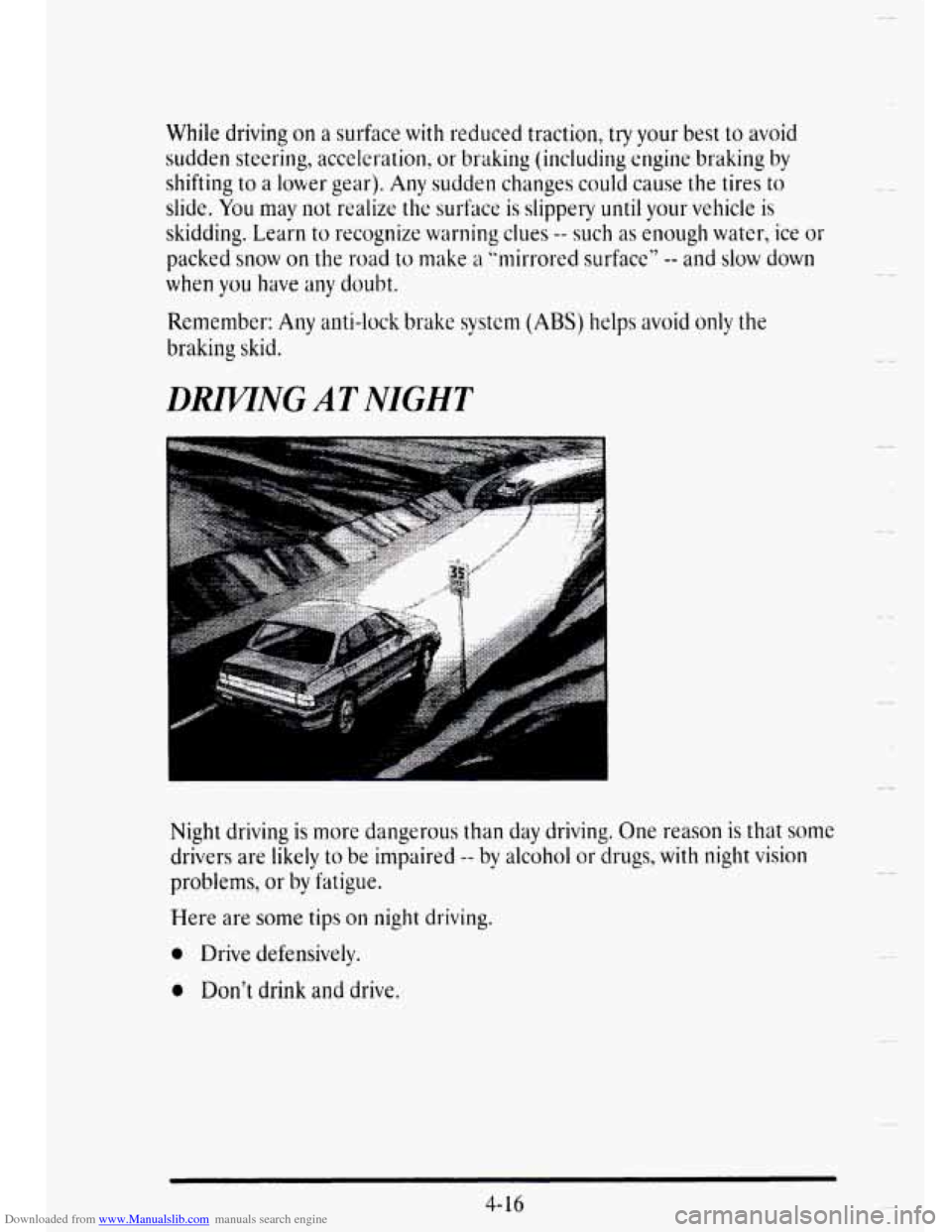
Night driving is more dangerous than day driving. One reason is that some
drivers are likely to be impaired -- by alcohol or drugs, with night vision
problems,
or by fatigue.
Here are some tips on night driving.
0 Drive defensively.
0 Don’t drink and drive.
4-16
.I
Page 210 of 403

Downloaded from www.Manualslib.com manuals search engine 0
0 0
0
Adjust your inside rearview mirror to reduce the glare from headlamps
behind you.
Since you can‘t see
as well, you may need to slow down and keep more
space between
you and other vehicles.
Slow down, especially on higher speed roads. Your headlamps can
light up only
so much road ahead.
In remote areas, watch for animals.
If you’re tired, pull off the road in a safe place and rest.
Night Vision
No one can see as well at night as in the daytime. But as we get older
these differences increase. A 50-year-old driver may require at least twice
as much light to see the same thing at night as a 20-year-old.
What
you do in the daytime can also affect your night vision. For example,
if you spend the day in bright sunshine you are wise to wear sunglasses.
Your eyes
will have less trouble adjusting to night. But if you’re driving,
don’t wear sunglasses at night. They may cut down on glare from
headlamps, but they also make a lot of things invisible.
You can be temporarily blinded
bv approaching lights. It can take a
second or two, or even several seconds, for your eves to readjust to the
dark. When
YOU are faced with severe glare (as frim a driver who doesn’t
lower the
high beams, or a vehicle with misaimed headlamps), slow down
a little. Avoid staring directly into the approaching lights.
Keep
your windshield and all the glass on your vehicle clean -- inside and
out. Glare at night is made much worse
by dirt on the glass. Even the
inside
of the glass can build up a film caused by dust. Dirty glass makes
lights dazzle and flash more than clean glass would, making the pupils of
your eyes contract repeatedly.
Remember that your headlamps light up far
less of a roadway when you
are in a turn or curve. Keep your eyes moving; that way, it’s easier to pick
out dimly lighted objects. Just as
your headlamps should be checked
regularly for proper aim,
so should your eyes be examined regularly.
Some drivers suffer
from night blindness -- the inability to see in dim
light
-- and aren’t even aware of it.
4- 3.7
Page 215 of 403

Downloaded from www.Manualslib.com manuals search engine FREEWAYDRM-NG
Mile for mile, freeways (also called thruways, parkways, expressways,
turnpikes, or superhighways) are the safest of all roads. But they have
their own special rules.
The
most important advice on freeway driving is: Keep up with traffic and
keep
to the right. Drive at the same speed most of the other drivers are
driving. Too-fast
or too-slow driving breaks a smooth traffic flow. Treat
the left lane on a freeway as a passing lane.
At
the entrance there is usually a ramp that leads to the freeway. If you
have a clear view of the freeway as you drive along the entrance ramp, you
should begin
to check traffic. Try to determine where you expect to blend
with the flow. Try to merge into the gap at close to the prevailing speed.
Switch
on your turn signal, check your mirrors and glance over your
shoulder as often as necessary.
Try to blend smoothly with the traffic flow.
Once you are on the freeway, adjust your speed
to the posted limit or to
the prevailing rate
if it’s slower. Stay in the right lane unless you want to
pass.
Before changing lanes, check your mirrors. Then use your turn signal.
Just before
you leave the lane, glance quickly over your shoulder to make
sure there isn’t another vehicle
in your “blind” spot.
4-22
Page 217 of 403

Downloaded from www.Manualslib.com manuals search engine HIGmAY HYPNOSIS
Is there actually such a condition as “highway hypnosis”? Or is it just plain
falling asleep at the wheel‘? Call
it highway hypnosis, lack of awareness, or
whatever.
There
is something about an easy stretch of road with the same scenery,
along
with the hum of the tires on the road, the drone of the engine, and
the
rush of the wind against the vehicle that can make you sleepy. Don’t
let it happen to you! If it does, your vehicle can leave the road in less tlm
n secmd, and you could crash and be injured.
What can
you do about highway hypnosis‘? First, be aware that it can
happen.
Then here are some tips:
0 Make sure your vehicle is well ventilated, with a comfortably cool
interior.
0 Keep your eyes moving. Scan the road ahead and to the sides. Check
your rearview mirrors and your instruments frequently.
If you get sleepy, pull off the road into a rest, service, or parking area
and take a nap, get some exercise, or both. For safety, treat drowsiness
on the highway as an emergency.
4-24
Page 232 of 403

Downloaded from www.Manualslib.com manuals search engine Driving with a Trailer
Towing a trailer requires a certain amount of experience. Before setting
out for the open road, you’ll want to get to know your rig. Acquaint
yourself
with the feel of Ilandling and braking with the added weight of
the trailer. And always keep in mind that thc vehicle you are driving is
now a good deal longer and not nearly as responsivs as your vehicle is by
itself.
Before you start, check thc trailer hitch
and platform (and attachments),
safety chains, electrical connector, lamps, tires
and mirror adjustment. If
the trailer has electric brakes, start your vehicle and trailer moving and
then apply the trailer brake controlier by hand
to be sure the brakes are
working.
This lets you check your electrical connection at the same time.
During \Tour trip, check occasionally to
be sure that the load is secure, and
that the’lights and any trailer brakes are still working.
Following Distance
Stay at least twice as far behind the vehicle ahead as you would when
driving your vehicle without a trailer. This can help
you avoid situations
that require heavy braking and sudden turns.
Passing
You’ll need more passing distance up ahead when you’re towing a trailer.
And, because you‘re a good deal longer,
you’ll need to go much farther
beyond
the passed vehicle before you can return to your lane.
Bucking Up
Hold the bottom of the steering wheel with one hand. Then, to move the
trailer
to the left, just move that hand to the left. To move the trailer to
the right, move your hand to the right. Always back up slowly and, if
possible, havc someone guide you.
4-39
Page 339 of 403

Downloaded from www.Manualslib.com manuals search engine BULB CHART
Description Bulb No.
Ashtray Illumination ................................... 1445
Backup Lamps ........................................ 2057
Cornering
Lamp ....................................... 3156
Courtesy Reading Lamp ................................. 168
Glove Compartment Lamp ............................... 194
Headlamps, Composite
Inner High Beam ..................................... 9005
Outer Low Beam ..................................... 9006
License Plate Lamp ..................................... I94
Park and Thn Signal ................................ 3157 NA
Stop/Tail/Turn Signal ................................... 2057
Trunk Lamp .......................................... 1003
Underhood Lamp ....................................... 56 1
Vanity Mirror Illumination ............................... 123
Sidemarker Lamps ...................................... 194