1995 BUICK REGAL oil
[x] Cancel search: oilPage 12 of 340
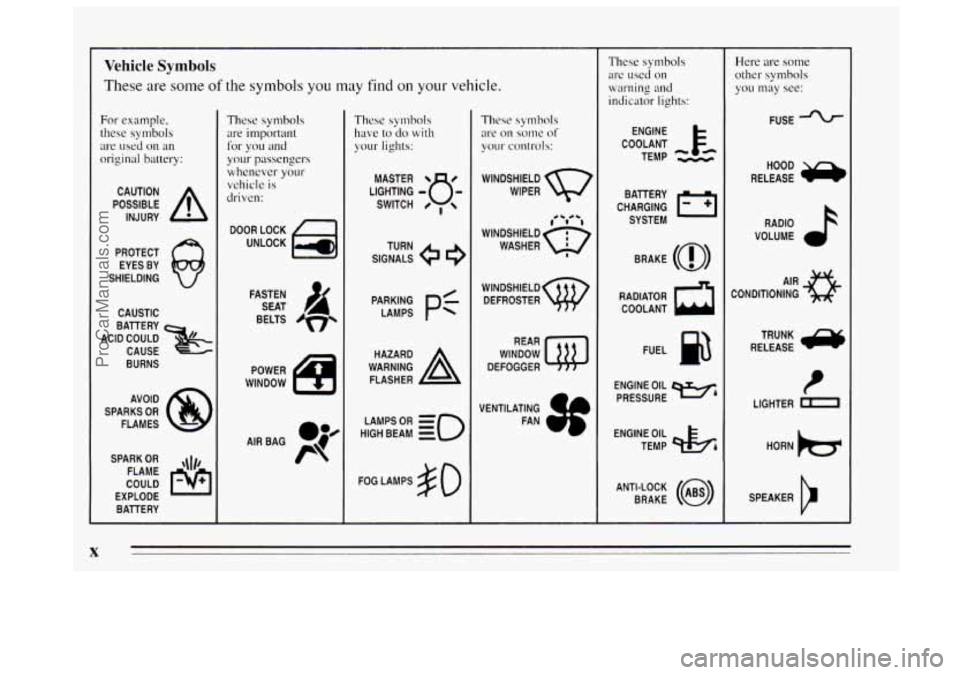
Vehicle Symbols
These are some of the symbols you may find on your vehicle.
For example,
these symbols
are used
on an
original battery:
POSSIBLE A
CAUTION
INJURY
PROTECT EYES BY
SHIELDING
CAUSTIC
BATTERY
CAUSE
BURNS
ACID COULD
x
AVOID
SPARKS
OR
FLAMES
SPARK
OR ,\I/,
COULD FLAME
EXPLODE BATTERY
These symbols are important
for you and
your passengers whenever your
vehicle
is
driven:
DOOR LOCK
UNLOCK
BELTS
4
These symbols
have
to do with
your lights:
SIGNALS e
TURN
POWER
WINDOW
HIGH LAMPSoR BEAM
= =o
FOG LAMPS $0
These symbols
are on
some of
your controls:
WINDSHIELD
WIPER
1. *td -1
WINDSHIELD c)
WASHER a
WINDSHIELD DEFROSTER
WINDOW
DEFOGGER
VENTILATING FAN
These symbols
are used on
warning and
indicator lights:
COOLANT F-
TEMP --
ENGINE
CHARGING BATTERY
SYSTEM
BRAKE
(0)
RADIATOR COOLANT
a
FUEL
ENGINE OIL
PRESSURE
w4
TEMP OIL 4%
ANTI-LOCK (@)
BRAKE
Here are some other symbols
you may
see:
FUSE
RADIO
VOLUME
AIR
CONDITIONING
TRUNK
e
RELEASE
t
LIGHTER n
SPEAKER
b
X
ProCarManuals.com
Page 77 of 340
NOTICE:
After you’ve used the coolant heater, be sure to
store the cord as it was before to keep it away
from moving engine parts. If you don’t, it could
be damaged.
How long should you keep the coolant heater plugged
in? The answer depends on the weather, the kind of oil
you have, and some other things. Instead of trying to list
everything here, we ask that you contact your Buick
dealer in the area where you’ll be parking your vehicle.
The dealer can give you the best advice for that
particular area.
Automatic Transaxle
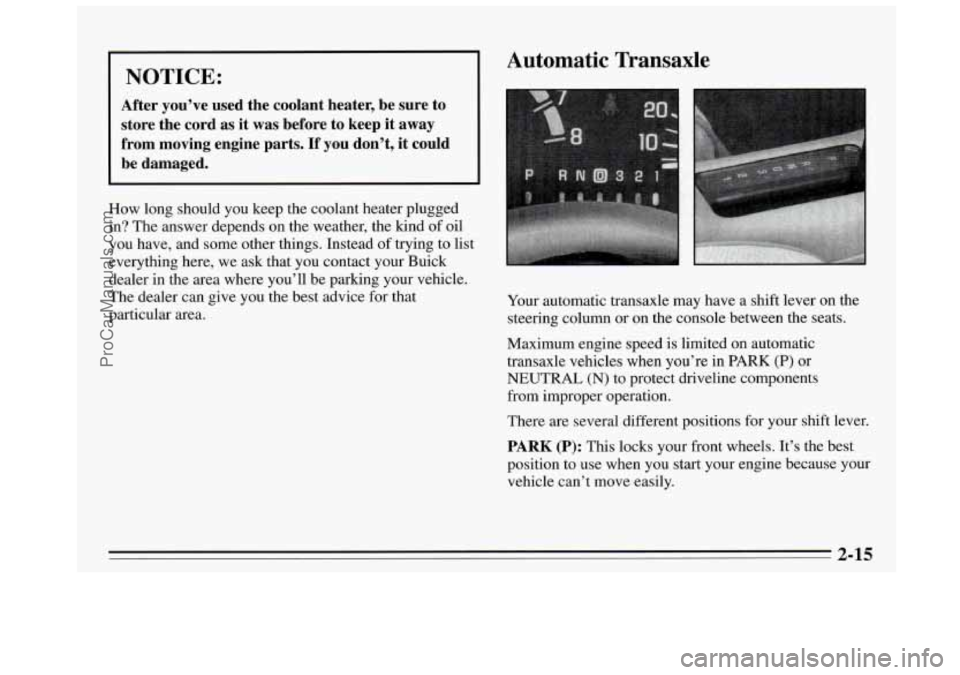
Your automatic transaxle may have a shift lever on the
steering column or on the console between the seats.
Maximum engine speed is limited on automatic
transaxle vehicles when you’re in
PARK (P) or
NEUTRAL (N) to protect driveline components
from improper operation.
There are several different positions for your shift lever.
PARK (P): This locks your front wheels. It’s the best
position to use when you start your engine because your vehicle can’t move easily.
2-15
ProCarManuals.com
Page 113 of 340

Malfunction Indicator Lamp (Check Engine Light)
111 A computer monitors
operation of your fuel,
ignition and
emission
control systems. This light
should come on when the
SOON ignition is on, but the
engine is not running, as a
check to show you it is
working.
If it does not come on at all, have it fixed right away. If
it stays on, or it comes on while you are driving, the
computer is indicating that you have a problem. You
should take your vehicle in for service soon.
NOTICE:
If you keep driving your vehicle with this light on,
after a while the emission controls won’t work as
well, your fuel economy won’t be as good and your
engine may
not run as smoothly. This could lead to
costly repairs not covered by your warranty.
Oil Warning Light
If you have a problem with
your oil, this light may stay
on after you start your
engine, or come on when
you are driving.
This indicates that oil is not going through your engine
quickly enough to keep it lubricated. The engine could
be low on oil or could have some other oil problem.
Have it fixed right away.
The oil light could also come on in three other
situations:
0 When the ignition is on but the engine is not running,
the light will come on as a test to show you
it is
working, but the light will go out when you turn the
ignition to START. If it doesn’t come
on with the
ignition on, you may have a problem with the fuse or
bulb. Have it fixed right away.
2-51
ProCarManuals.com
Page 114 of 340

Sometimes when the engine is idling at a stop, the
0 If you make a hard stop, the light may come on for a
light
may blink
011 and off. This is normal.
moment. This is normal.
1 NOTICE:
Damage to your engine from neglected oil
problems can be costly and
is not covered by your
warranty.
Low Oil Level Light
Your engine is equipped
with an oil level monitoring
system. When the ignition
key
is turned on, the LOW
OIL LEVEL light will
briefly flash. If the light
does not flash, have it fixed
so it will be ready to warn
you
if there’s a problem.
If the light stays on, stop the vehicle on a level surface
and turn
the engine off. Check the oil level using the
engine oil dipstick. (See “Engine Oil” in the Index.) If
the light does not flash, have the low oil level sensor
system repaired
so it will be ready to warn you if there’s
a problem.
The oil level monitoring system only checks oil level
during
the brief period between key on and engine
crank. It does not monitor engine oil level when the
engine is running. Additionally, an oil level check is
only performed if the engine has been turned off for a
considerable period of time, allowing the oil normally in
circulation
to drain back into the oil pan.
ProCarManuals.com
Page 134 of 340
Care of Your Cassette Tape Player
A tape player that is not cleaned regularly is subject to
reduced sound quality, ruining the cassette, or damaging
the mechanism. Tape cassettes that are
not properly
stored in their plastic cases away from contaminants,
direct sunlight, and extreme heat may not operate
properly and could cause premature failure of the tape
player.
Your tape player should be cleaned with every
50 hours
of use to provide optimum performance. Your radio may
display Cln to indicate that
you have used your tape
player for
50 hours without resetting the tape clean
timer. If you notice a reduction in sound quality,
regardless
of when the tape player was last cleaned, try
playing a different cassette to see if the tape or the tape
player is at fault.
Tf the second cassette results in no
improvement
in sound quality, try cleaning the tape
player.
Proper tape player cleaning should be done with a
scrubbing action, nonabrasive cleaner cassette. This is a
wet-type cleaning system that uses
a cleaning cassette
with pads which scrub the tape head as the hubs of the
cleaner cassette turn.
To properly clean your tape player,
follow
the instructions with the cleaning cassette. If you
use this type of cleaner, the radio may display an error
and eject the cartridge. This is normal and is the result of an
added feature
in the tape player that detects broken
tapes. If an error occurs, you
will need to insert the
cleaning cassette at least three times to thoroughly clean
the tape player.
You may prefer to use a non-scrubbing action, wet-type
cleaner. This type
of cleaner uses a fabric belt to clean
the tape head. This type of cleaner cassette will not
cause an error,
but it may not clean the tape player as
thoroughly as the scrubbing type cleaner.
A scrubbing action cleaner is available through your
dealer
(GM Part No. 12344600).
Cassettes are subject to wear and the sound quality may
degrade over time. Always verify that the cassette tape
is in good condition and the tape player is clean before
obtaining service on your tape player.
Care of Your Compact Discs
Handle discs carefully. Store them in their original cases
or other protective cases and away from direct sunlight
and dust.
If the surface of a disc is soiled, dampen a
clean, soft cloth
in a mild, neutral detergent solution and
clean
it, wiping from the center to the edge.
Be sure never
to touch the signal surface when handling
discs. Pick up discs
by grasping the outer edges or the
edge of the hole and the outer edge.
ProCarManuals.com
Page 157 of 340
Once you are moving on the freeway, make certain you
allow a reasonable following distance. Expect to move
slightly slower at night.
When you want to leave the freeway, move to the proper
lane
well in advance. If you miss your exit do not, under
any circumstances, stop and back up. Drive
on to the
next exit.
The exit ramp can be curved, sometimes quite sharply.
The exit speed is usually posted.
Reduce your speed according to your speedometer, not
to
your sense of motion. After driving for any distance
at higher speeds,
you may tend to think you are going
slower than
you actually are.
Before Leaving on a Long Trip
Make sure you’re ready. Try to be well rested. If you
must start when you’re not fresh -- such as after a day’s
work
-- don’t plan to make too many miles that first part
of the journey. Wear comfortable clothing and shoes you
can easily drive in.
Is your vehicle ready for a long trip? If you keep it
serviced and maintained. it’s ready to go. If it needs
service, have
it done before starting out. Of course,
you’ll find experienced and able service experts
in
Buick dealers all across North America. They’ll be
ready and willing to help if you need
it.
Here are some things you can check before a trip:
0
0
0
0
0
0
Windshield Wc~slwr Fluid: Is the reservoir full‘? Are
all windows clean inside and outside?
Wiper Blades: Are they in good shape?
Fuel, Eqirze Oil, Other Fluids: Have you checked
all levels‘?
Lamps: Are they all working? Are the lenses clean?
Tires: They are vitally important to a safe,
trouble-free trip.
Is the tread good enough for
long-distance driving? Are the tires all inflated
to the recommended pressure‘?
Weather Fowcvzsrs: What’s the weather outlook
along your route? Should you delay your trip
a short
time to avoid a major storm system‘?
A4up.s: Do you have up-to-date maps?
4-19
ProCarManuals.com
Page 172 of 340
Parking on Hills
You really should not park your vehicle, with a trailer
attached, on
a hill. If something goes wrong, your rig
could start to move. People can be injured, and both
your vehicle and
the trailer can be damaged.
But
if you ever have to park your rig on a hill, here’s
how
to do it:
1. Apply your regular brakes, but don’t shift into
PARK
(P) yet.
2. Have someone place chocks under the trailer wheels.
3. When the wheel chocks are in place, release the
regular brakes until the chocks absorb the load.
4. Reapply the regular brakes. Then apply your parking
brake, and then
shift to PARK (P).
5. Release the regular brakes.
When You Are Ready to Leave After
Parking on a
Hill
I. Apply your regular brakes and hold the pedal down
while you:
Start your engine;
0 Shift into a gear; and
0 Release the parking brake.
2. Let up on the brake pedal.
3. Drive slowly
until the trailer is clear of the chocks.
4. Stop and have someone pick up and store the chocks.
Maintenance When Trailer Towing
Your vehicle will need service more often when you’re
pulling a trailer. See the Maintenance Schedule for more
on this. Things that are especially important
in trailer
operation are automatic transaxle fluid (don’t overfill),
engine oil, belt, cooling system, and brake adjustment.
Each of these is covered in this manual, and
the Index
will help you find them quickly. If you’re trailering, it’s
a good idea to review these sections before you start
your trip.
Check periodically to see that all hitch nuts and bolts are
tight.
4-34
ProCarManuals.com
Page 190 of 340
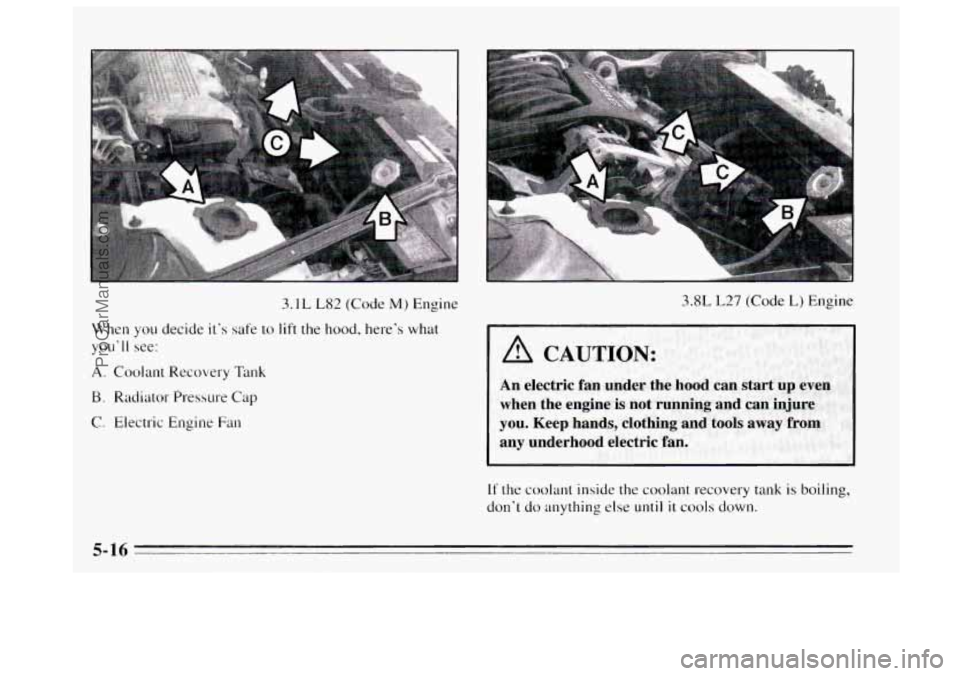
3.1 L L82 (Code M) Engine
When
you decide it’s safe to lift the hood, here’s what
you’
I1 see:
A. Coolant Recovery Tank
B. Radiator Pressure Cap
C. Electric Engine Fan
3.8L L27 (Code L) Engine
An electric fan under the hood can start up even
when the engine
is not running and can injure
you.
Keep hands, clothing and tools away from
any underhood electric fan.
If the coolant inside the coolant recovery tank is boiling,
don’t
do anything else until it cools down.
5-16
ProCarManuals.com