Page 194 of 340
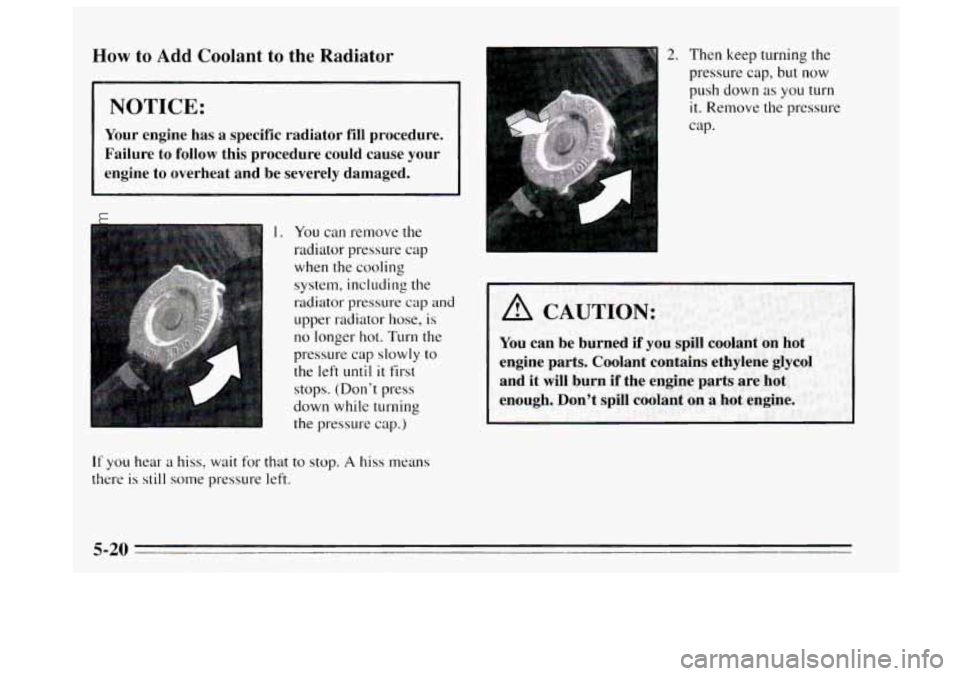
How to Add Coolant to the Radiator
NOTICE:
Your engine has a specific radiator fill procedure.
Failure to
follow this procedure could cause your
engine to overheat and be severely damaged.
1. You can remove the
radiator pressure cap
when the cooling
system, including the
radiator pressure
cap and
upper radiator hose,
is
no longer hot. Turn the
pressure
cap slowly to
the left until it first
stops. (Don’t press
down while turning
the pressure cap.)
IC you hear a hiss, wait for that to stop. A hiss means
there
is still some pressure left.
2. Then keep turning the
pressure cap, but now
push down
as you turn
it. Remove the pressure
cap.
5-20
ProCarManuals.com
Page 225 of 340

How to Add Fluid
Refer to the Maintenance Schedule to determine what
kind of transaxle fluid to use. See “Recommended
Fluids and Lubricants”
in the Index.
If the fluid level is low, add only enough of the proper
fluid to bring the level into the cross-hatched area on the
dipstick.
1. Pull out the dipstick.
2. Using a long-neck funnel, add enough fluid at the
dipstick hole
to bring it to the proper level.
It doesn’t take much fluid, generally less than a pint
(OSL). Don ’t ouefill. We recommend you use only fluid
labeled DEXRON@-111, because fluid with that label is
made especially for your automatic transaxle. Damage
caused by fluid other than DEXRON@-I11 is not covered
by your new vehicle warranty.
After adding fluid, recheck the fluid level as
described under “How
to Check.”
When the correct fluid level is obtained, push the
dipstick back in all the way.
Engine Coolant
The following explains your cooling system and how to
add coolant when it is low. If you have a problem with
engine overheating or if
you need to add coolant to your
radiator, see “Engine Overheating” in the Index.
The proper coolant for your Buick will:
Give freezing protection down to -34°F (-37°C).
Give boiling protection up to 262 OF (1 28 O C).
Protect against rust and corrosion.
Help keep the proper engine temperature.
Let the warning lights work as they should.
What to Use
Use a mixture of one-half clean water (preferably
distilled) and one-half antifreeze that meets “GM
Specification
1825-M,” which won’t damage aluminum
parts. You can also use a recycled coolant conforming to
GM Specification 1825-M with a complete coolant flush
and refill. Use GM Engine Coolant Supplement (sealer)
with any complete coolant flush and refill.
If you use
this mixture, you don’t need to add anything else.
~
6-17
ProCarManuals.com
Page 244 of 340
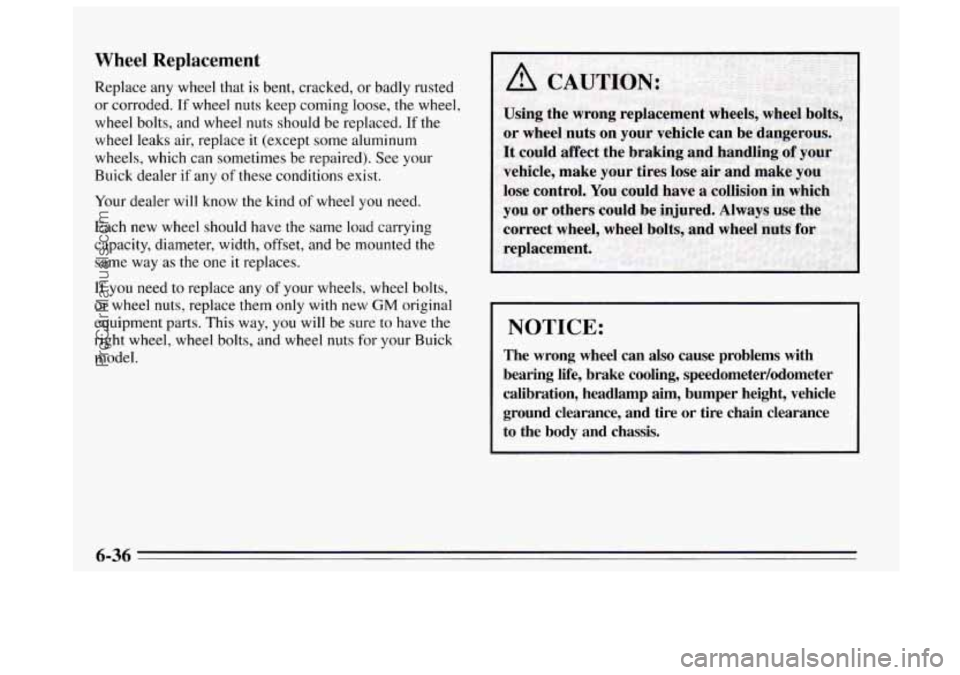
Wheel Replacement
Replace any wheel that is bent, cracked, or badly rusted
or corroded. If wheel nuts keep coming loose,
the wheel,
wheel bolts, and wheel nuts should be replaced. If
the
wheel leaks air, replace it (except some aluminum
wheels, which can sometimes be repaired). See your
Buick dealer
if any of these conditions exist.
Your dealer will know the kind
of wheel you need.
Each new wheel should have the same load carrying
capacity, diameter, width, offset, and be mounted
the
same way as the one it replaces.
If you need to replace any of your wheels, wheel bolts,
or wheel nuts, replace them only with new
GM original
equipment parts. This way, you will be sure to have
the
right wheel, wheel bolts, and wheel nuts for your Buick
model. NOTICE:
The wrong wheel can also cause problems with
bearing life, brake cooling, speedometer/odometer
calibration, headlamp aim, bumper height, vehicle
ground clearance, and tire or tire chain clearance
to the body and chassis.
ProCarManuals.com
Page 259 of 340
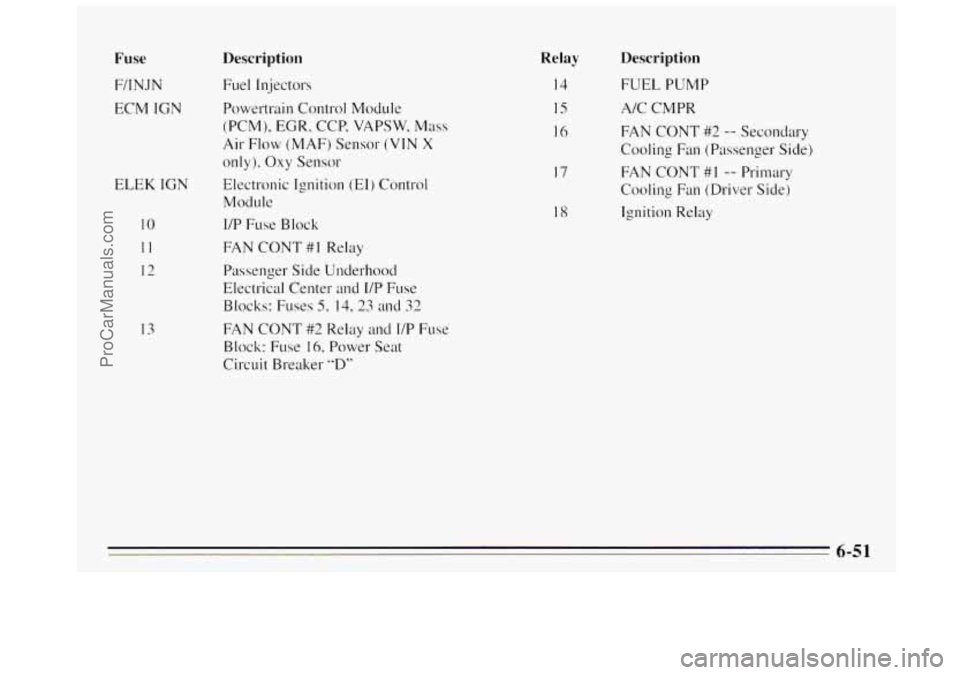
Fuse
F/INJN
ECM IGN
ELEK
IGN
10
I1
12
13
Description
Fuel Injectors
Powertrain Control Module
(PCM), EGR, CCP, VAPSW, Mass
Air Flow (MAF) Sensor (VIN X
only). Oxy Sensor
Electronic Ignition
(EI) Control
Module
I/P Fuse Block
FAN CONT
#I Relay
Passenger Side Underhood
Electrical Center and
I/P FLW
Blocks: Fuses 5, 14, 23 and 32
FAN CONT #2 Relay and I/P Fuse
Block: Fuse
16. Power Seat
Circuit Breaker
“D”
Relay
14
1s
16
17
18
Description
FUEL PUMP
A/C CMPR
FAN CONT
#2 -- Secondary
Cooling Fan (Passenger Side)
FAN CONT #1 -- Primary
Cooling Fan (Driver Side)
Ignition Relay
6-51
ProCarManuals.com
Page 263 of 340

Capacities and Specifications
Automatic Transaxle
Pan Removal and Replacement ....... 7 quarts (6.7 L)
When drainingheplacing converteq more fluid muy be
needed.
Cooling System Including Reservoir
3. IL (Code M) ................ 11.6 quarts (10.93 L)
3.8L (Code L) ................. 10.7 quarts (10.1 L)
Engine Specifications ..............................
Type ............................................
Displacement .....................................
Compression Ratio .................................
Firing Order ......................................
Thermostat Temperature ............................
ValveArrangement ................................
Refrigerant (R-l34a), Air Conditioning*
Engine Crankcase Oil
and Filter Change .............. 5 quarts (4.7 L)
Fuel Tank ..................... 17.1 gallons (64.7 L)
*See “Air Conditioning Rejrigerunts” later irz this
section.
.............................. 2.0 pounds (0.91 kg)
3.1L (Code M)
V6
191 CID (3.1L)
9.6:
1
1-2-3-4-5-6
195°F (91OC)
In-Head
3.8L (Code L)
V6
231 CID (3.8L)
9.0: I
1-2-3-4-5-6
195°F (91
“C)
In-Head
6-55
ProCarManuals.com
Page 272 of 340
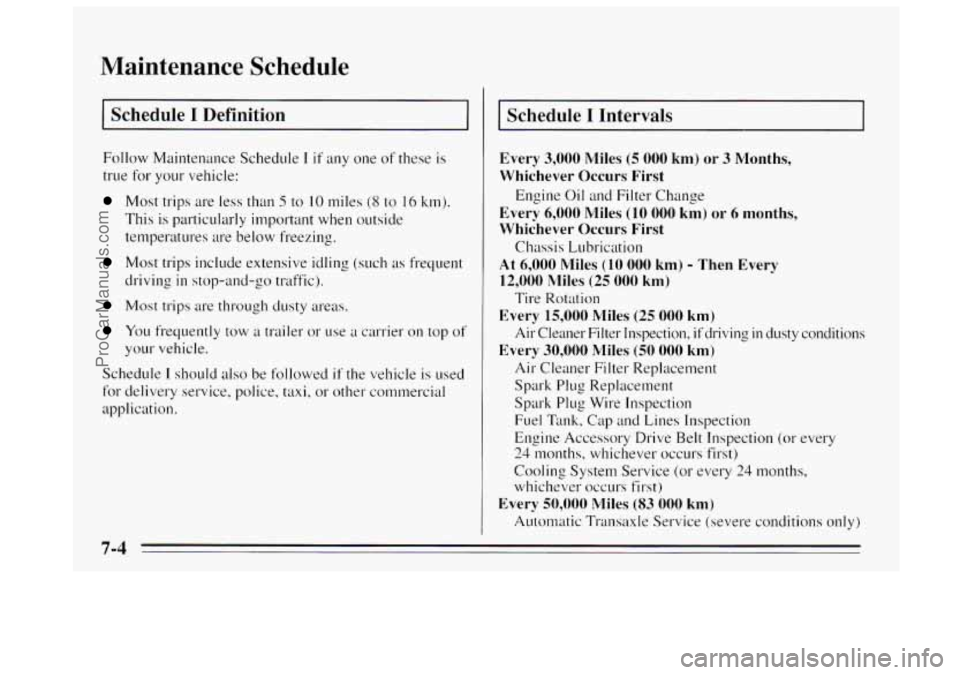
Maintenance Schedule
I Schedule I Definition I
Follow Maintenance Schedule I if any one of these is
true for your vehicle:
Most trips are less than 5 to IO miles (8 to 16 kin).
This is particularly important when outside
temperatures are below freezing.
Most trips include extensive idling (such as frequent
driving
in stop-and-go traffic).
Most trips are through dusty areas.
You frequently tow a trailer or use a can-ier on top of
your vehicle.
Schedule
1 should also be followed if the vehicle is used
for delivery service, police, taxi, or other commercial
application.
Schedule I Intervals
Every 3,000 Miles (5 000 knl) or 3 Months,
Whichever Occurs First
Every 6,000 Miles (10 000 km) or
6 months,
Whichever Occurs First
Chassis Lubrication
At 6,000 Miles ( 10 000 km) - Then Every
12,000 Miles
(25 000 km)
Tire Rotation
Every 15,000 Miles (25 000 km)
Air Cleaner Filter Inspection, if driving in dusty conditions
Every 30,000 Miles (50 000 kin)
Air Cleaner Filter Replacement
Spark Plug Replacement
Spark Plug Wire Inspection
Fuel Tank, Cap and Lines Inspection
Engine Accessory Drive Belt Inspection
(or every
24 months, whichever occurs first)
Cooling System Service
(or every 24 months,
whichever occurs first)
Automatic T~-ansaxle Service (severe conditions only)
Engine
Oil and Filter Change
Every 50,000 Miles (83 000 km)
7-4
ProCarManuals.com
Page 273 of 340
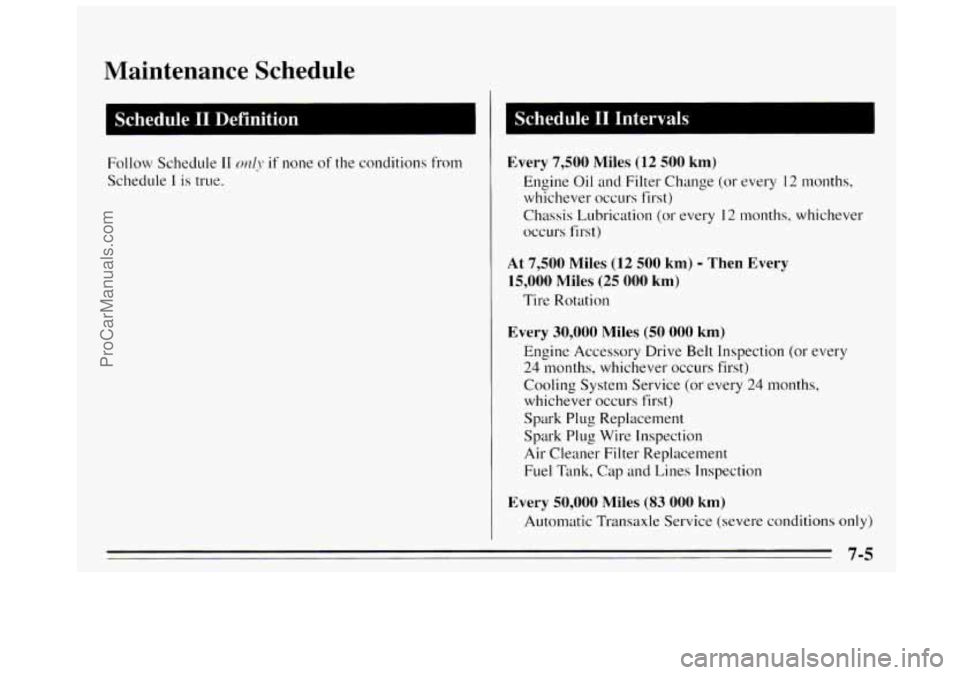
Maintenance Schedule
Follow Schedule I1 od~? if none of the conditions from
Schedule
I is true.
Every 7,500 Miles (12 500 km)
Engine Oil and Filter Change (or every 12 nmnths,
whichever occurs first)
Chassis Lubrication
(or every 12 months, whichever
occurs first)
At 7,500 Miles (12 500 km) - Then Every
15,000 Miles
(25 000 km)
Tire Rotation
Every 30,000 Miles (50 000 km)
Engine Accessory Drive Belt Inspection (or every
24 months, whichever occurs first)
Cooling System Service (or every 24 months,
whichever occurs first)
Spark Plug Replacement
Spark
Plug Wire Inspection
Air Cleaner Filter Replacement
Fuel Tank, Cap and Lines Inspection
Every 50,000 Miles (83 000 km)
Automatic Transaxle Service (severe conditions only)
7-5
ProCarManuals.com
Page 279 of 340

Maintenance Schedule I
30,000 Miles (50 000 km)
0 Change engine oil and filter (or every
3 months, whichever occurs first).
An Emission Control Service.
0 Lubricate the shift linkage, parking brake
cable guides, underbody contact points and
linkage (or every
6 months, whichever
occurs first).
0 Inspect engine accessory drive belt (or
every 24 months, whichever occurs first).
An Emission Control Service
0 Drain, flush and refill cooling system (or
every 24 months, whichever occurs first).
See “Engine Coolant” in the Index for what
to use. Inspect hoses. Clean radiator,
condenser, pressure cap and neck. Pressure
test the cooling system and pressure cap.
An Emission Control Service.
0 Replace spark plugs. An Emission Control
Service.
0 Inspect spark plug wires. An Emission Control
0 Replace air cleaner filter. Replace filter
Service. T
more often under dusty conditions.
An Emission Control Service.
0 Inspect fuel tank, cap and lines for damage
or leaks. Inspect fuel cap gasket for any
damage. Replace parts as needed.
An Emission Control Service.
0 Rotate tires. See “Tire Inspection and
Rotation” in the Index for proper rotation
pattern and additional information.
I
~~
I DATE I ACTUAL MILEAGE SERVICED BY:
7-11
ProCarManuals.com