1995 BUICK REGAL brake light
[x] Cancel search: brake lightPage 146 of 340
Remember: Anti-lock doesn’t change the time you need
to get your foot up to the brake pedal. If you get too
close to the vehicle in front of you, you won’t have time
to apply your brakes
if that vehicle suddenly slows or
stops. Always leave enough room up ahead
to stop, even
though you have anti-lock brakes.
To Use Anti-Lock
Don’t pump the brakes. Just hold the brake pedal down
and let anti-lock work for you. You may feel the system
working, or
you may notice some noise, but this is
normal. When your anti-lock system is adjusting brake
pressure to help avoid a braking skid, the
LOW TRAC
light will come on. See “Anti-Lock Brake System
Active Light”
in the Index.
Braking in Emergencies
Use your anti-lock braking system when you need to.
With anti-lock,
you can steer and brake at the same
time. In many emergencies, steering can help
you more
than even the very best braking.
Steering
Power Steering
If you lose power steering assist because the engine
stops or the system is not functioning, you can steer but
it will take much more effort.
Steering Tips
Driving on Curves
It’s important to take curves at a reasonable speed.
A lot of the “driver lost control” accidents mentioned on
the news happen on curves. Here’s why:
Experienced driver or beginner, each
of us is subject to
the same laws of physics when driving on curves. The
traction
of the tires against the road surface makes it
possible for the vehicle to change its path when you turn
the front wheels. If there’s no traction, inertia will keep
the vehicle going
in the same direction. If you’ve ever
tried to steer
a vehicle on wet ice, you’ll understand this.
The traction you can get in a curve depends on the
condition
of your tires and the road surface, the angle at
which the curve
is banked, and your speed. While
you’re
in a curve, speed is the one factor you can
control.
ProCarManuals.com
Page 150 of 340
Check your mirrors, glance over your shoulder, and
start your left lane change signal before moving out
of the right lane to pass. When you are far enough
ahead
of the passed vehicle to see its front in your
inside mirror, activate your right lane change signal
and move back
into the right lane. (Remember that
your right outside mirror is convex. The vehicle you
just passed may seem
to be farther away from you
than it really is.)
Try not to pass more than one vehicle at a time on
two-lane roads. Reconsider before passing the next
vehicle.
Don’t overtake a slowly moving vehicle too rapidly.
Even though the brake lights are
not flashing, it may
be slowing down or starting to turn.
If you’re being passed, make it easy for the
following driver
to get ahead of you. Perhaps you
can ease
a little to the right.
Loss of Control
Let’s review what driving experts say about what
happens when the three control systems (brakes, steering
and acceleration) don’t have enough friction where the
tires meet the road
to do what the driver has asked.
In any emergency, don’t give up. Keep trying to steer
and constantly seek an escape route or area
of less
danger.
Skidding
In a skid, a driver can lose control of the vehicle.
Defensive drivers avoid most skids by taking reasonable
care suited to existing conditions, and by not
“overdriving” those conditions.
But skids are always
possible.
The three
types of skids correspond to your Buick’s
three control systems. In the braking skid your wheels
aren’t rolling. In the steering or cornering skid,
too
much speed or steering in a curve causes tires to slip and
lose cornering force. And
in the acceleration skid too
much throttle causes the driving wheels to spin.
4-12
ProCarManuals.com
Page 232 of 340
should have your brake system fixed, since a leak means
that sooner or later your brakes won’t work well, or
won’t work at all.
So, it isn’t a good idea to “top off’
your brake fluid. Adding brake fluid won’t correct a
leak. If you add fluid when your linings are worn, then
you’ll have too much fluid when you get new brake
linings. You should add (or remove) brake fluid, as
necessary, only when work is done on the brake
hydraulic system.
When your brake fluid falls to a low level, your brake
warning light will come on. See “Brake System Warning
Light” in the Index. What to Add
When you do need brake fluid, use only DOT-3 brake
fluid -- such as Delco Supreme ll@ (GM Part No.
1052535). Use new brake fluid from a sealed container
only, and always clean the brake fluid reservoir cap
before removing it.
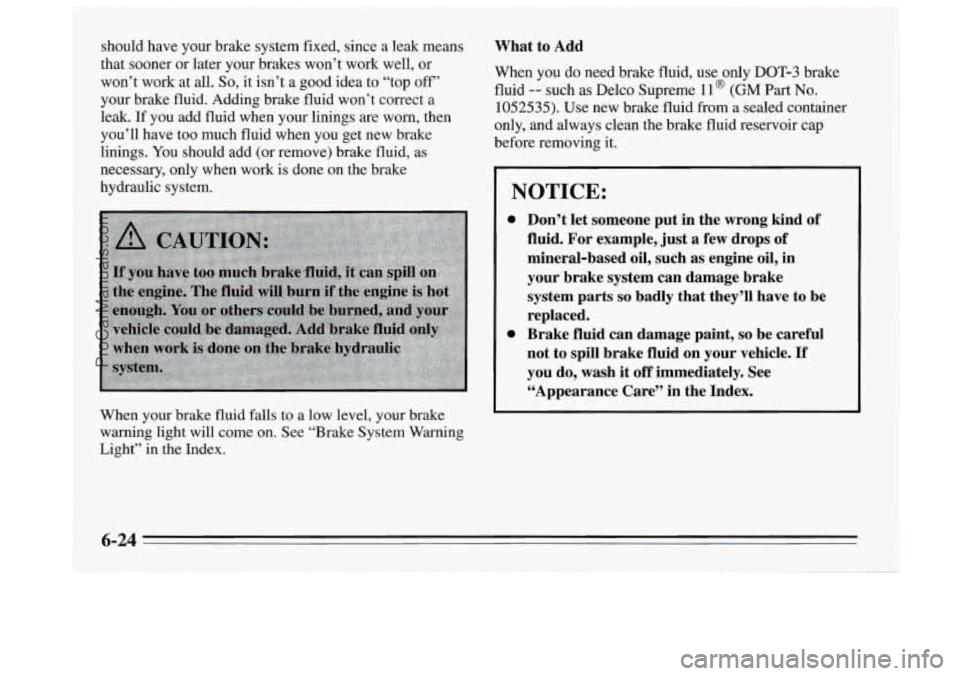
NOTICE:
0
0
Don’t let someone put in the wrong kind of
fluid. For example, just
a few drops of
mineral-based oil, such
as engine oil, in
your brake system can damage brake system parts
so badly that they’ll have to be
replaced.
Brake fluid can damage paint,
so be careful
not to spill brake fluid on your vehicle.
If
you do, wash it off immediately. See
“Appearance Care’’ in the Index.
6-24
ProCarManuals.com
Page 233 of 340
Brake Wear
Your Buick has four-wheel disc brakes.
Disc brake pads have built-in wear indicators that make
a high-pitched warning sound when the brake pads are
worn and new pads are needed. The sound may come
and go or be heard all the time your vehicle is moving
(except when you are pushing
on the brake pedal
firmly),
NOTICE:
Continuing to drive with worn-out brake pads
could result in costly brake repair.
Some driving conditions or climates may cause a brake
squeal when the brakes are first applied or lightly
applied.
This does not mean something is wrong with
your brakes.
Brake linings should always be replaced as complete
axle sets.
Brake Pedal Travel
See your dealer if the brake pedal does not return to
normal height, or
if there is a rapid increase in pedal
travel. This could be a sign of brake trouble.
Brake Adjustment
Every time you make a moderate brake stop, your disc
brakes adjust for wear.
If you rarely make a moderate
or heavier stop, then your brakes might not adjust
correctly.
If you drive in that way, then -- very
carefully
-- make a few moderate brake stops about
every
1,000 miles (1 600 km), so your brakes will adjust
properly.
6-25
ProCarManuals.com
Page 256 of 340
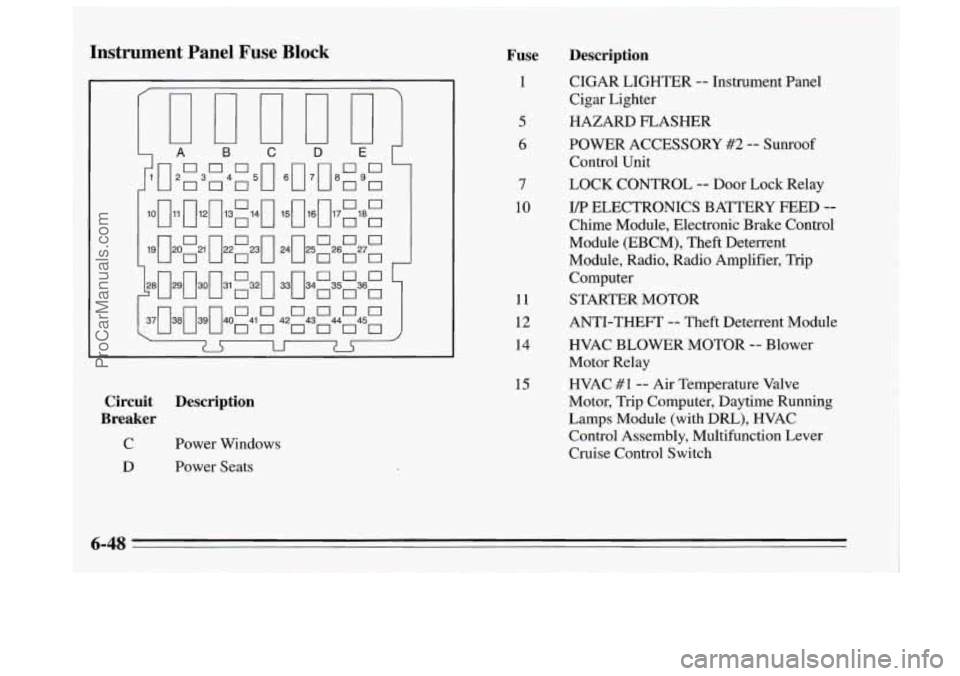
Instrument Panel Fuse Block Fuse
1
5
6
7
10
11
12
14
15
Circuit Description
Breaker
C Power Windows
Description
CIGAR LIGHTER -- Instrument Panel
Cigar Lighter
HAZARD FLASHER
POWER ACCESSORY
#2 -- Sunroof
Control Unit
LOCK CONTROL
-- Door Lock Relay
I/p ELECTRONICS BATTERY FEED --
Chime Module, Electronic Brake Control
Module (EBCM), Theft Deterrent
Module, Radio, Radio Amplifier,
Trip
Computer
STARTER MOTOR
ANTI-THEFT
-- Theft Deterrent Module
HVAC BLOWER MOTOR
-- Blower
Motor Relay
HVAC
#1 -- Air Temperature Valve
Motor,
Trip Computer, Daytime Running
Lamps Module (with
DRL), HVAC
Control Assembly, Multifunction Lever
Cruise Control Switch
D Power Seats
6-48
ProCarManuals.com
Page 257 of 340

r use
16
19
21
23
24 2s
Description
REAR DEFOG -- HVAC Control
Assembly Rear Window Defogger Switch
POWER ACCESSORY
#1-- Antenna
Relay, Power Mirror Switch, Door Lock
Switches, Door Handle Switches
AIR BAG
-- Sensing and Diagnostic
Module (SDM)
STOPLAMPS
-- TCCBrake Switch
HVAC #2
-- HVAC Control Assembly,
Solenoid Box
CTSY LAMPS
-- Vanity Mirrors, I/P
Courtesy Lamps, UP Compartment Lamp,
Trunk Courtesy Lamp, Header Courtesy
and Reading Lamp,
US Lighted Rearview
Mirror, Dome and Reading Lamp,
Quarter Courtesy Lamps
Fuse
29
30
32
33
37
3s
39
Description
WIPER -- Wiper Switch
TURN SIGNAL
-- Turn Signal Flasher
POWER LOCKS
-- Door Lock Relay
ABS -- Electronic Brake Control Module
(EBCM), ABS Relay
AUXILIARY POWER
RADIO
-- Radio, Steering Wheel Radio
Switches
I/P ELECTRONICS IGNITION FEED --
Headlamp Switch, Cruise Control
Cut-Out Switch, Sensing and Diagnostic
Module (SDM), TCCBrake Switch,
Instrument Cluster, Chime Module,
Second Gear Start Switch, Head-Up
Display (HUD) Switch, Daytime Running
Lamps Module (with DRL)
6-49
I
ProCarManuals.com
Page 327 of 340
n
Section 9 Index
ABS ......................................... 4-6
Accessory Outlet
............................... 2-39
Adding
Automatic Transaxle Fluid
..................... 6- 17
BrakeFluid
................................. 6-24
Electrical Equipment
............... 2- 12 . 3- 17. 6-47
Engine Coolant
.............................. 6- I8
Engineoil
................................... 6-9
Power Steering Fluid
......................... 6-22
Sound Equipment
............................ 3- 17
Windshield Washer Fluid ...................... 6-22
How Does It Restrain ......................... 1-22
How
It Works ............................... 1-20
Location
................................... 1-20
Readiness Light ........................ 1 - 19.2-46
Servicing
................................... 1-23
What Makes
It Inflate ......................... 1-21
What Will You See After It Inflates .............. 1-22
When Should It Inflate
........................ 1-21
AirCleane r
....................................... 13
Air Conditioning
................................ 3-3
Air Conditioning Refrigerants
..................... 6-58
AirBag
....................................... 1-18
Air Conditioning
with Electronic Controls ............ 3-1
Alignment and Balance. Tires
..................... 6-35
Antenna. Fixed Mast
............................ 3-19
Antenna. Power Mast Care
....................... 3-19
Antifreeze
..................................... 6-17
Anti-Lock Brake System Waning Light ......... 2-48.4-6
Anti-Lock Brakes
............................... 4-6
Appearance Care
............................... 6-38
Appearance Care and Materials
.................... 6-45
Armrest. Storage
............................... 2-37
Ashtrays. Front
................................. 2-41
Astroroof
..................................... 2-40
Audio System. Steering Wheel Touch Controls
....... 3-20
Audio Systems
.................................. 3-5
Auto-Down Window ............................ 2-24
Automatic Door Locks
............................ 2-4
Automatic Transaxle
............................ 2-15
First Gear
(1) Position ........................ 2-18
Neutral
(N) Position .......................... 2-16
Overdrive Position
........................... 2-17
Aluminum
Wheels. Cleaning
...................... 6-43
Anti-Lock Brake System Active Light
.............. 2-49
Ashtrays
. Rear ................................. 2-41
9-1
ProCarManuals.com
Page 328 of 340
Park (P) Position ............................. 2- I5
Second Gear (2) Position
...................... 2- 18
Reverse (R) Position .......................... 2- I6
Shifting .................................... 2-15
Third Gear (3) Position
........................ 2- I7
Automatic Transaxle Fluid ........................ 6- 15
Adding
.................................... 6-17
Checking
................................... 6- 15
Battery ...................................... 6-26
Cllarpe Light
................................ 2-45
Jump Starting
................................ 5-2
Replacement. Remote Lock Control
............... 2-6
Saver
...................................... 2- 33
Warnings .................................... 5-2
BBB Auto Line ................................. 8-3
Bleed Valves. Coolant
........................... 5-21
Blizzard ...................................... 4-24
Brake
Adjustment
................................. 6-25
Fluid. Adding
............................... 6-23
Master Cylinder
............................. 6-23
Parking
.................................... 2-19
PedalTravel ................................ 6-25
System Parts. Replacing ....................... 6-26
System Warning Light
........................ 2-47
Trailer
..................................... 4- 31
Transaxle Shift Interlock ....................... 2-22 Transaxle Shift Interlock
. Maintenance ........... 7-37
Wear
...................................... 6-25
Brakes. Anti-Lock
............................... 4-6
Brakes. Trailer .................................
Braking . In Emcrgencies .......................... 4-8
Break-In. New Vehicle .......................... 2-10
BTSI (Brake Transaxle Shift Interlock)
.............. 2-22
Maintenance
................................. 7-37
Bulb Replacen~ent ......................... 6-27. 6-54
Braking
........................................ 4-5
BTSI
(Brake Transaxle Shift Interlock).
Canada. Vehicles First Sold In 11
Canadian Roadside Assistance ...................... 8-6
Capacities and Specit'ications
...................... 6-55
Carbon Monoxide
.................... 2-23. 4-25. 4-31
Cassette Dcck. Maintenance ...................... 7-36
Cassette
Tape Player ........................ 3-8. 3-11
Casselte Tape Player Care
........................ 3-18
CDPlaye r
..................................... 3-13
Center Console
................................. 2-38
Center Passenger Position
........................ 1-24
Certification Label .............................. 4-26
Chains. Safety
................................. 4-31
Chains. Tire
................................... 6-37
Changing
a Flat Tire ............................. 5-24
Charging System Light
.......................... 2-45
Checking Your Restraint Systems .................. 1-50
.. .......................
9-2
ProCarManuals.com