Page 244 of 340
Wheel Replacement
Replace any wheel that is bent, cracked, or badly rusted
or corroded. If wheel nuts keep coming loose,
the wheel,
wheel bolts, and wheel nuts should be replaced. If
the
wheel leaks air, replace it (except some aluminum
wheels, which can sometimes be repaired). See your
Buick dealer
if any of these conditions exist.
Your dealer will know the kind
of wheel you need.
Each new wheel should have the same load carrying
capacity, diameter, width, offset, and be mounted
the
same way as the one it replaces.
If you need to replace any of your wheels, wheel bolts,
or wheel nuts, replace them only with new
GM original
equipment parts. This way, you will be sure to have
the
right wheel, wheel bolts, and wheel nuts for your Buick
model. NOTICE:
The wrong wheel can also cause problems with
bearing life, brake cooling, speedometer/odometer
calibration, headlamp aim, bumper height, vehicle
ground clearance, and tire or tire chain clearance
to the body and chassis.
ProCarManuals.com
Page 252 of 340
Underbody Maintenance
Chemicals used for ice and snow removal and dust
control can collect
on the underbody. If these are not
removed, accelerated corrosion (rust) can occur on the
underbody parts such as fuel lines, frame, floor pan, and
exhaust system even though they have corrosion
protection.
At least every spring, flush these materials from the
underbody with plain water. Clean any areas where mud
and other debris can collect. Dirt packed
in closed areas
of the frame should be loosened before being flushed.
Your dealer or an underbody vehicle washing system
can do this for you.
Fiberglass Springs
~~ ~
NOTICE:
Don’t use corrosive or acidic cleaning agents,
engine degreasers, aluminum cleaning agents or
other harsh solvents
to clean fiberglass springs;
they’ll damage the springs.
Chemical Paint Spotting
Some weather and atmospheric conditions can create
a chemical fallout. Airborne pollutants can fall upon
and attack painted surfaces on your vehicle. This
damage can take two forms: blotchy, ringlet-shaped
discolorations, and small irregular dark spots etched into
the paint surface.
Although
no defect in the paint job causes this, Buick
will repair, at
no charge to the owner, the surfaces of
new vehicles damaged by this fallout condition within
12 months or 12,000 miles (20
000 km) of purchase,
whichever comes first.
6-44
ProCarManuals.com
Page 263 of 340

Capacities and Specifications
Automatic Transaxle
Pan Removal and Replacement ....... 7 quarts (6.7 L)
When drainingheplacing converteq more fluid muy be
needed.
Cooling System Including Reservoir
3. IL (Code M) ................ 11.6 quarts (10.93 L)
3.8L (Code L) ................. 10.7 quarts (10.1 L)
Engine Specifications ..............................
Type ............................................
Displacement .....................................
Compression Ratio .................................
Firing Order ......................................
Thermostat Temperature ............................
ValveArrangement ................................
Refrigerant (R-l34a), Air Conditioning*
Engine Crankcase Oil
and Filter Change .............. 5 quarts (4.7 L)
Fuel Tank ..................... 17.1 gallons (64.7 L)
*See “Air Conditioning Rejrigerunts” later irz this
section.
.............................. 2.0 pounds (0.91 kg)
3.1L (Code M)
V6
191 CID (3.1L)
9.6:
1
1-2-3-4-5-6
195°F (91OC)
In-Head
3.8L (Code L)
V6
231 CID (3.8L)
9.0: I
1-2-3-4-5-6
195°F (91
“C)
In-Head
6-55
ProCarManuals.com
Page 266 of 340
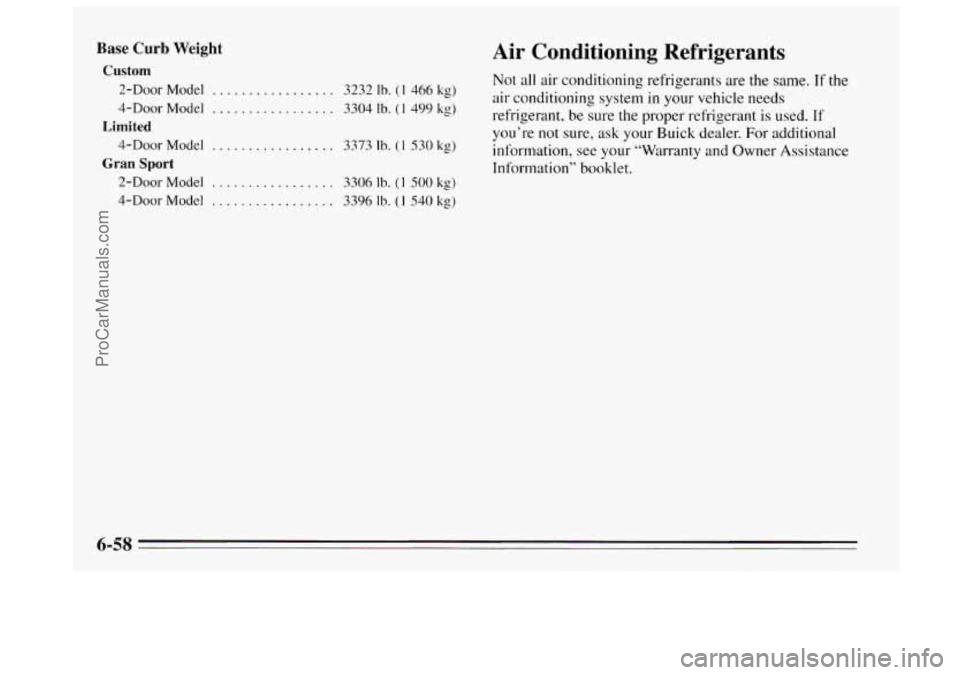
Base Curb Weight
Custom
2-Door Model ................. 3232 Ib. (1 466 kg)
4-DOOr Model ................. 3304 Ib. (1 499 kg)
4-Door Model ................. 3373 Ib. (1 530 kg)
2-Door Model ................. 3306 Ib. (1 SO0 kg)
+Door Model ................. 3396 Ib. (1 540 kg)
Limited
Gran Sport
Air Conditioning Refrigerants
Not all air conditioning refrigerants are the same. If the
air conditioning system in your vehicle needs
refrigerant, be sure the proper refrigerant is used.
If
you’re not sure, ask your Buick dealer. For additional
information, see your “Warranty and Owner Assistance
Information” booklet.
6-58
ProCarManuals.com
Page 269 of 340
Section 7 Maintenance Schedule
IMPORTANT:
KEEP ENGINE OIL
AT THE PROPER
.EVEL AND CHANGE AI
RECOMMENDED
This section covers the maintenance required for your
Buick. Your vehicle needs these services
to retain its
safety, dependability
and emission control performance.
Protection
Plan
ui
Introduction
Your Vehicle and the Environment
Proper vehicle maintenance not only helps to keep your
vehicle
in good working condition, but also helps the
environment. All recommended maintenance procedures
are important. Improper vehicle maintenance or the
removal
of important components can significantly
affect the quality
of the air we breathe. Improper fluid
levels or
even the wrong tire inflation can increase the
level of emissions from your vehicle. To help protect our
environment, and to help keep
your vehicle in good
condition, please maintain your vehicle properly.
ProCarManuals.com
Page 270 of 340
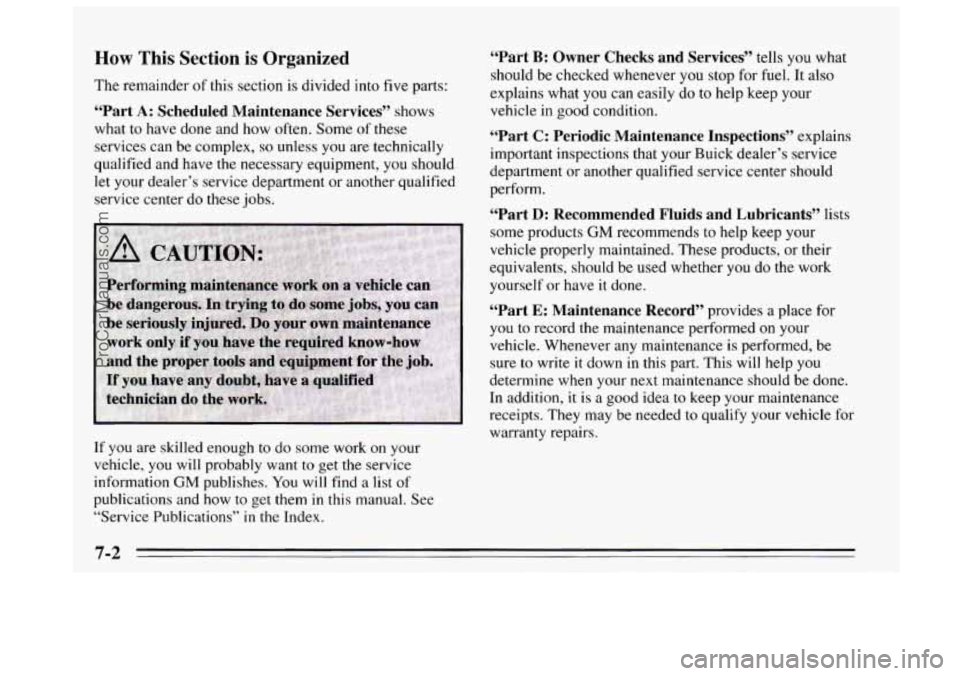
How This Section is Organized
The remainder of this section is divided into five parts:
“Part A: Scheduled Maintenance Services” shows
what
to have done and how often. Some of these
services can be complex,
so unless you are technically
qualified and have the necessary equipment, you should
let your dealer’s service department or another qualified
service center do these jobs.
If you are skilled enough
to do some work on your
vehicle, you will probably want to get the service
information
GM publishes. You will find a list of
publications and how to get them in this manual. See
“Service Publications”
in the Index.
“Part B: Owner Checks and Services” tells you what
should be checked whenever you stop for fuel. It also
explains what you can easily do to help keep your
vehicle in good condition.
“Part C: Periodic Maintenance Inspections” explains
important inspections that your Buick dealer’s service
department or another qualified service center should
perform.
“Part D: Recommended Fluids and Lubricants” lists
some products
GM recommends to help keep your
vehicle properly maintained. These products, or their
equivalents, should be used whether you do
the work
yourself or have it done.
“Part E: Maintenance Record” provides a place for
you to record the maintenance performed on your
vehicle. Whenever any maintenance
is performed, be
sure to write
it down in this part. This will help you
determine when your next maintenance should be done.
In addition, it is a good idea
to keep your maintenance
receipts. They may be needed to qualify your vehicle for
warranty repairs.
7-2
ProCarManuals.com
Page 271 of 340
Part A: Scheduled Maintenance
Services
Using Your Maintenance Schedule
We at General Motors want to help you keep your
vehicle in good working condition. But we don’t know
exactly how you’ll drive it. You may drive very short
distances only a few times a week. Or you may drive
long distances all the time in very hot, dusty weather.
You may use your vehicle in making deliveries.
Or you
may drive it to work, to do errands or in many other
ways.
Because of all the different ways people use their GM
vehicles, maintenance needs vary. You may even need
more frequent checks and replacements than you’ll find
in the schedules in this section.
So please read this
section and note how you drive.
If you have any
questions on how to keep your vehicle in good
condition, see your Buick dealer.
This part tells you the maintenance services you should
have done and when you should schedule them.
If you
go to your dealer for your service needs, you’ll know
that GM-trained and supported service people will
perform the work using genuine GM parts. The
proper fluids and lubricants to use
are listed in
Part
D. Make sure whoever services your vehicle uses
these. All parts should be replaced and all necessary
repairs done before you or anyone else drives the
vehicle.
These schedules are for vehxles that:
0
0
0
carry passengers and cargo within recommended
limits. You will find these limits
on your vehicle’s
Tire-Loading Information label. See “Loading Your
Vehicle” in the Index.
are driven on reasonable road surfaces within legal
driving limits.
use the recommended unleaded fuel. See “Fuel” in
the Index.
Selecting the Right Schedule
First you’ll need to decide which of the two schedules is
right for your vehicle. Here’s how to decide which
schedule to follow:
7-3
ProCarManuals.com
Page 272 of 340
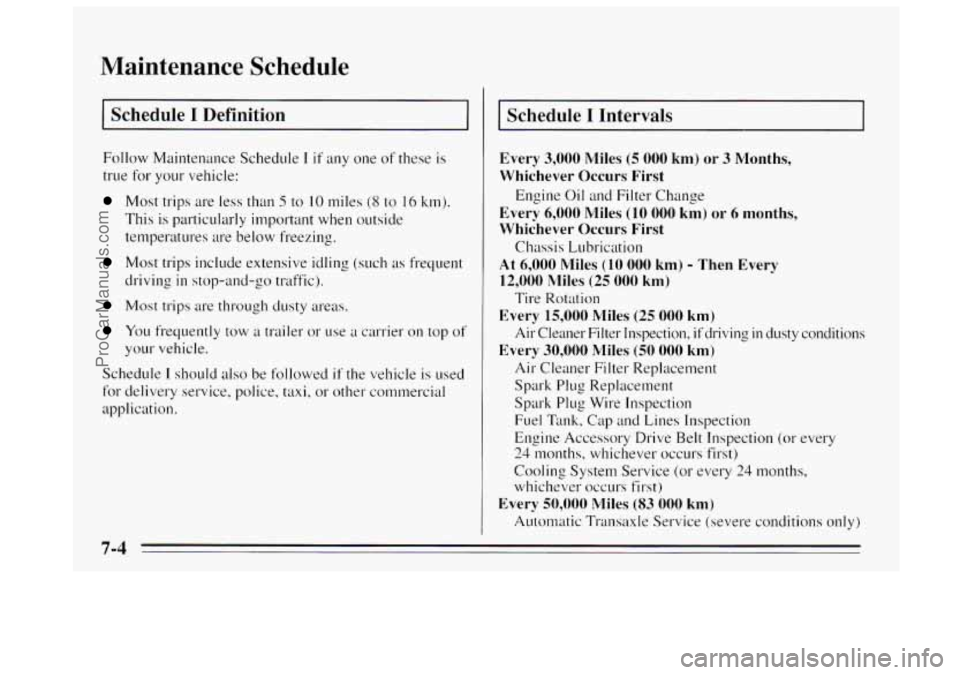
Maintenance Schedule
I Schedule I Definition I
Follow Maintenance Schedule I if any one of these is
true for your vehicle:
Most trips are less than 5 to IO miles (8 to 16 kin).
This is particularly important when outside
temperatures are below freezing.
Most trips include extensive idling (such as frequent
driving
in stop-and-go traffic).
Most trips are through dusty areas.
You frequently tow a trailer or use a can-ier on top of
your vehicle.
Schedule
1 should also be followed if the vehicle is used
for delivery service, police, taxi, or other commercial
application.
Schedule I Intervals
Every 3,000 Miles (5 000 knl) or 3 Months,
Whichever Occurs First
Every 6,000 Miles (10 000 km) or
6 months,
Whichever Occurs First
Chassis Lubrication
At 6,000 Miles ( 10 000 km) - Then Every
12,000 Miles
(25 000 km)
Tire Rotation
Every 15,000 Miles (25 000 km)
Air Cleaner Filter Inspection, if driving in dusty conditions
Every 30,000 Miles (50 000 kin)
Air Cleaner Filter Replacement
Spark Plug Replacement
Spark Plug Wire Inspection
Fuel Tank, Cap and Lines Inspection
Engine Accessory Drive Belt Inspection
(or every
24 months, whichever occurs first)
Cooling System Service
(or every 24 months,
whichever occurs first)
Automatic T~-ansaxle Service (severe conditions only)
Engine
Oil and Filter Change
Every 50,000 Miles (83 000 km)
7-4
ProCarManuals.com