Page 254 of 340
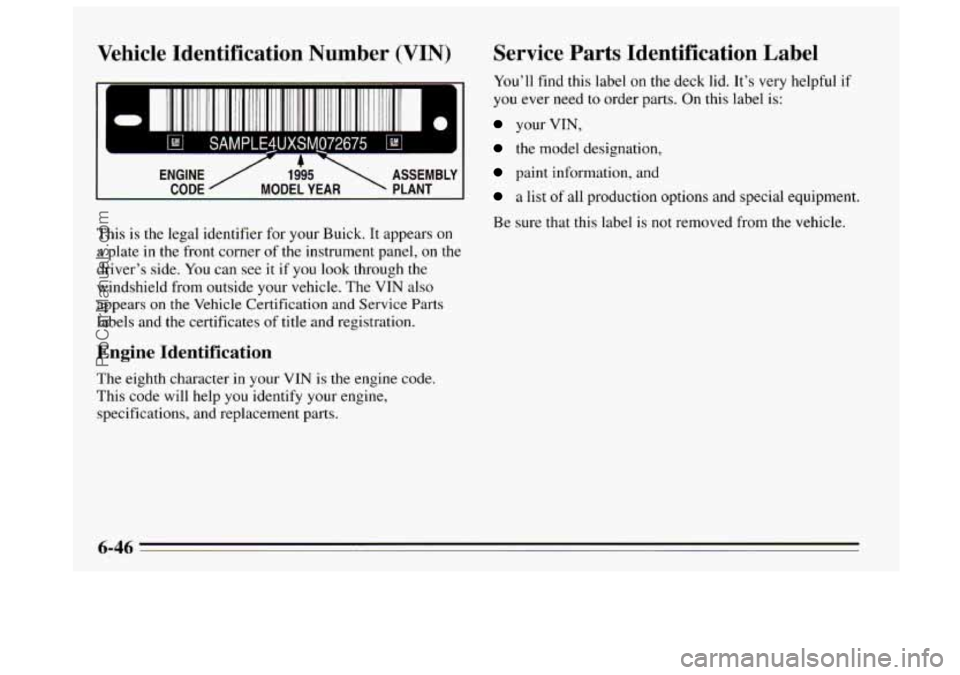
Vehicle Identification Number (VIN)
ENGINE ,/ 1995 ASSEMBLY
?
CODE MODEL YEAR PLANT
This is the legal identifier for your Buick. It appears on
a plate in the front corner
of the instrument panel, on the
driver’s side. You can see it if you
look through the
windshield from outside your vehicle. The VIN also
appears
on the Vehicle Certification and Service Parts
labels and the certificates of title and registration.
Engine Identification
The eighth character in your VIN is the engine code.
This code will help you identify your engine,
specifications, and replacement parts.
Service Parts Identification Label
You’ll find this label on the deck lid. It’s very helpful if
you ever need
to order parts. On this label is:
your VIN,
the model designation,
paint information, and
a list of all production options and special equipment.
Be sure that this label is
not removed from the vehicle.
6-46
ProCarManuals.com
Page 255 of 340
Add-on Electrical Equipment Fuses and Circuit Breakers
NOTICE:
Don’t add anything electrical to your Buick unless
you check with your dealer first. Some electrical
equipment can damage your vehicle and the
damage wouldn’t be covered by your warranty.
Some add-on electrical equipment can keep other
components from working as they should.
Your vehicle has an air bag system. Before attempting to
add anything electrical to your Buick, see “Servicing
Your Air Bag-Equipped Buick”
in the Index. The wiring
circuits
in your vehicle are protected from
short circuits by
a combination of fuses, circuit breakers,
and fusible thermal links in the wiring itself. This
greatly reduces the chance of fires caused
by electrical
problems.
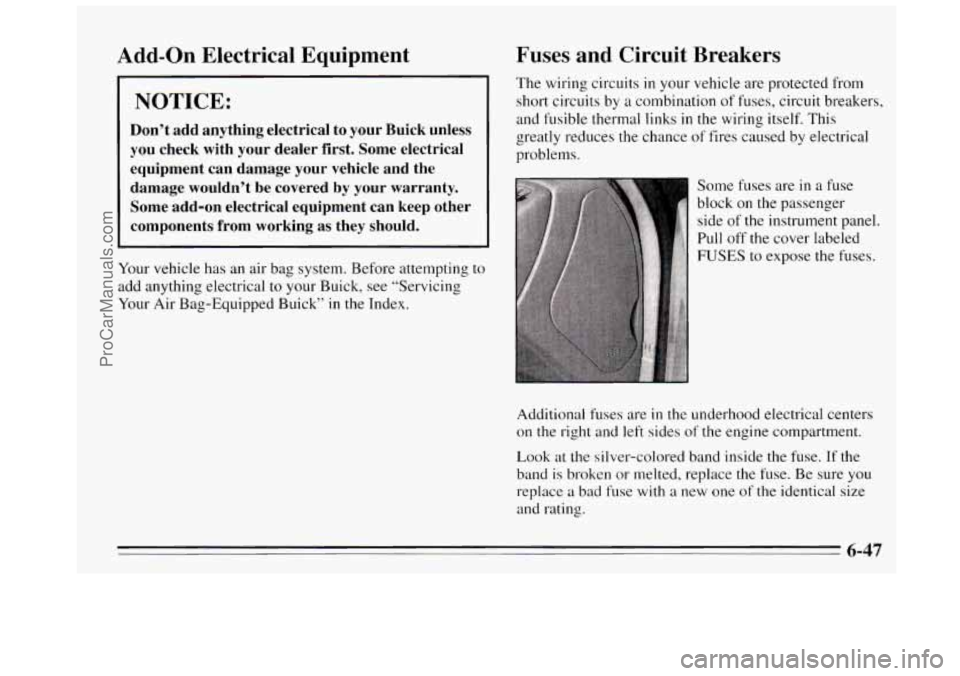
Some fuses are
in a fuse
block on the passenger
side of the instrument panel.
Pull off
the cover labeled
FUSES to expose the fuses.
Additional fuses are
in the underhood electrical centers
on the right and left sides of the engine compartment.
Look at the silver-colored band inside the fuse. If the
band is broken or melted, replace the fuse. Be sure
you
replace a bad fuse with a new one of the identical size
and rating.
6-47
ProCarManuals.com
Page 263 of 340

Capacities and Specifications
Automatic Transaxle
Pan Removal and Replacement ....... 7 quarts (6.7 L)
When drainingheplacing converteq more fluid muy be
needed.
Cooling System Including Reservoir
3. IL (Code M) ................ 11.6 quarts (10.93 L)
3.8L (Code L) ................. 10.7 quarts (10.1 L)
Engine Specifications ..............................
Type ............................................
Displacement .....................................
Compression Ratio .................................
Firing Order ......................................
Thermostat Temperature ............................
ValveArrangement ................................
Refrigerant (R-l34a), Air Conditioning*
Engine Crankcase Oil
and Filter Change .............. 5 quarts (4.7 L)
Fuel Tank ..................... 17.1 gallons (64.7 L)
*See “Air Conditioning Rejrigerunts” later irz this
section.
.............................. 2.0 pounds (0.91 kg)
3.1L (Code M)
V6
191 CID (3.1L)
9.6:
1
1-2-3-4-5-6
195°F (91OC)
In-Head
3.8L (Code L)
V6
231 CID (3.8L)
9.0: I
1-2-3-4-5-6
195°F (91
“C)
In-Head
6-55
ProCarManuals.com
Page 264 of 340
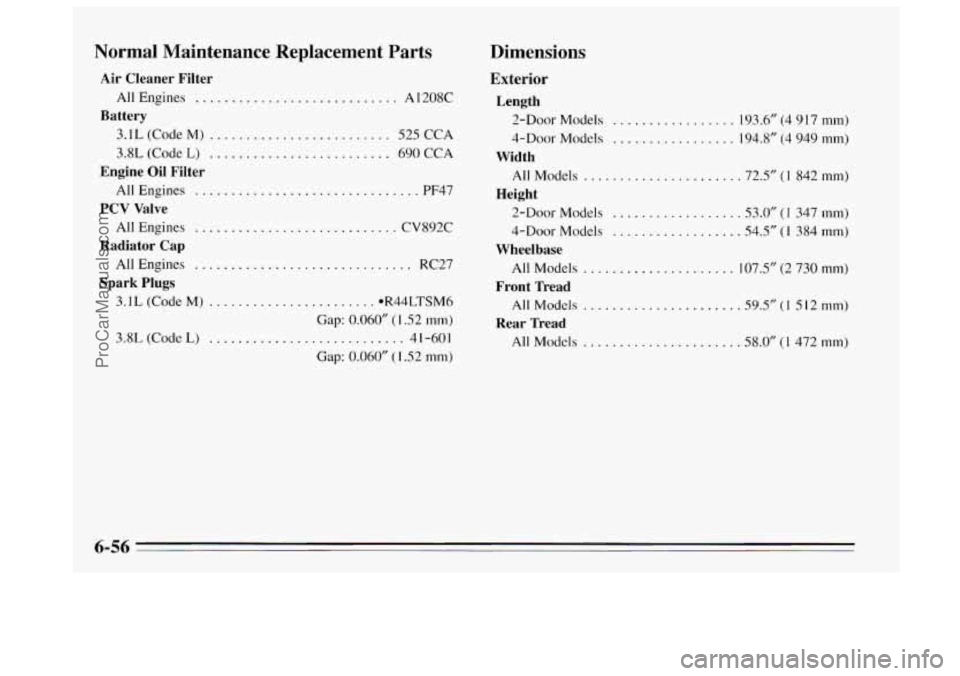
Normal Maintenance Replacement Parts
Air Cleaner Filter
Battery
AllEngines ............................ A1208C
3.1L (Code
M) ......................... 525 CCA
3.8L (Code L) ......................... 690 CCA
AllEngines ............................... PF47
All Engines
............................ CV892C
All Engines
.............................. RC27
3.1
L (Code M) ....................... mR44LTSM6
Gap: 0.060” ( 1.52 mm)
Gap: 0.060” (1.52 mm)
Engine Oil Filter
PCV Valve
Radiator
Cap
Spark Plugs
3-8L(CodeL) ........................... 41-601
Dimensions
Exterior
Length
2-Door Models ................. 193.6” (4 917 mm)
4-Door Models
................. 194.8” (4 949 mm)
All Models ..................... .72.5” (I 842 mm)
2-Door Models ................. .53.0” (1 347 mm)
&Door Models ................. .54.5“ (1 384 mm)
All Models
..................... 107.5” (2 730 mm)
All Models ..................... .59.5“(1 512 mm)
All Models ..................... .S8.0” (1 472 mm)
Width
Height
Wheelbase
Front Tread
Rear Tread
6-56
ProCarManuals.com
Page 269 of 340
Section 7 Maintenance Schedule
IMPORTANT:
KEEP ENGINE OIL
AT THE PROPER
.EVEL AND CHANGE AI
RECOMMENDED
This section covers the maintenance required for your
Buick. Your vehicle needs these services
to retain its
safety, dependability
and emission control performance.
Protection
Plan
ui
Introduction
Your Vehicle and the Environment
Proper vehicle maintenance not only helps to keep your
vehicle
in good working condition, but also helps the
environment. All recommended maintenance procedures
are important. Improper vehicle maintenance or the
removal
of important components can significantly
affect the quality
of the air we breathe. Improper fluid
levels or
even the wrong tire inflation can increase the
level of emissions from your vehicle. To help protect our
environment, and to help keep
your vehicle in good
condition, please maintain your vehicle properly.
ProCarManuals.com
Page 272 of 340
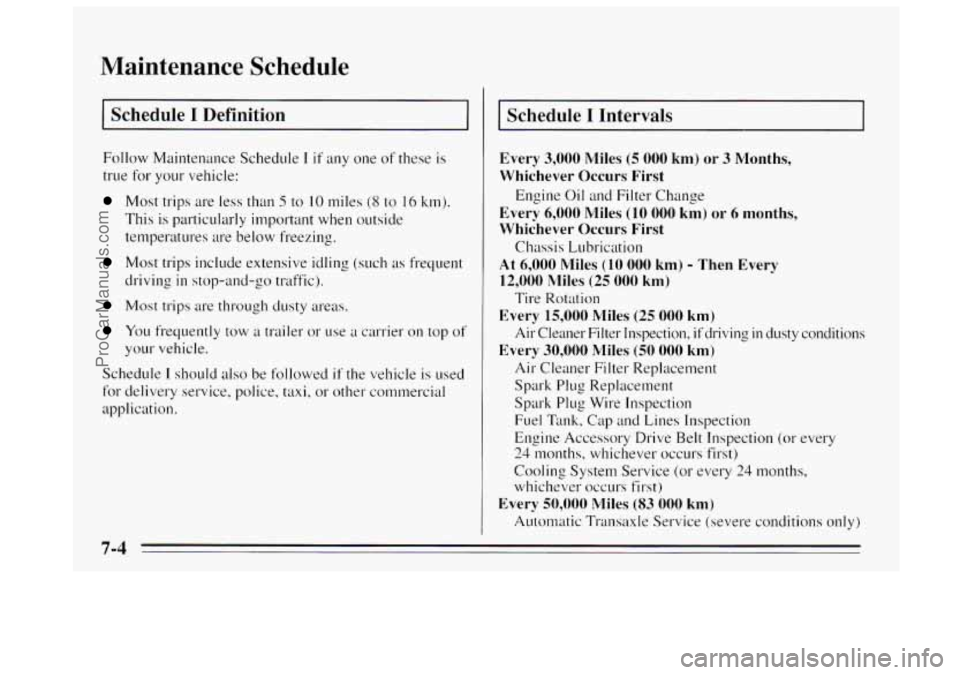
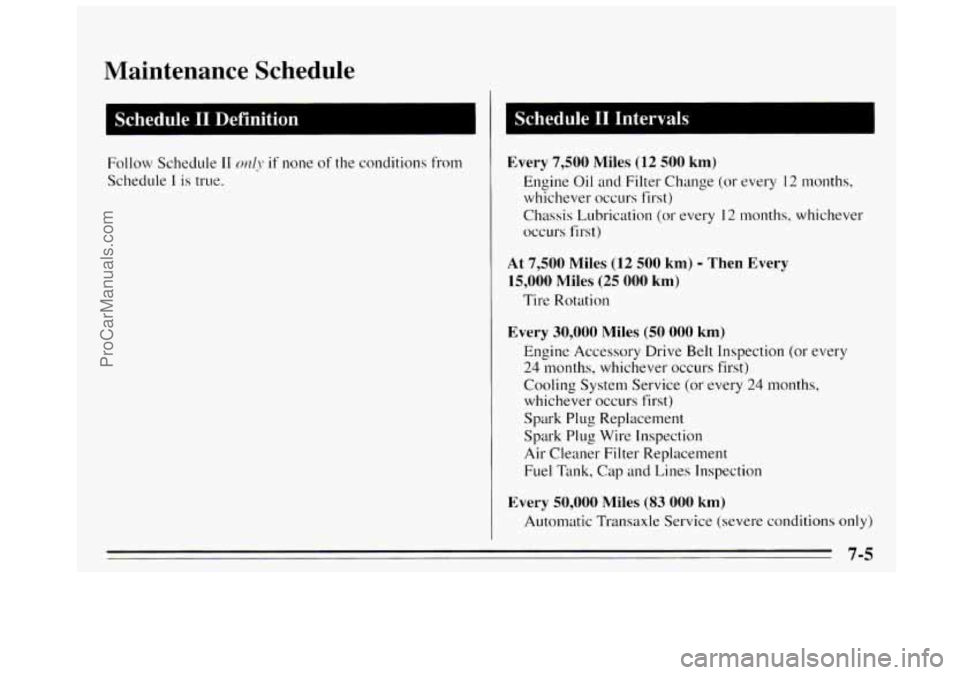
Maintenance Schedule
I Schedule I Definition I
Follow Maintenance Schedule I if any one of these is
true for your vehicle:
Most trips are less than 5 to IO miles (8 to 16 kin).
This is particularly important when outside
temperatures are below freezing.
Most trips include extensive idling (such as frequent
driving
in stop-and-go traffic).
Most trips are through dusty areas.
You frequently tow a trailer or use a can-ier on top of
your vehicle.
Schedule
1 should also be followed if the vehicle is used
for delivery service, police, taxi, or other commercial
application.
Schedule I Intervals
Every 3,000 Miles (5 000 knl) or 3 Months,
Whichever Occurs First
Every 6,000 Miles (10 000 km) or
6 months,
Whichever Occurs First
Chassis Lubrication
At 6,000 Miles ( 10 000 km) - Then Every
12,000 Miles
(25 000 km)
Tire Rotation
Every 15,000 Miles (25 000 km)
Air Cleaner Filter Inspection, if driving in dusty conditions
Every 30,000 Miles (50 000 kin)
Air Cleaner Filter Replacement
Spark Plug Replacement
Spark Plug Wire Inspection
Fuel Tank, Cap and Lines Inspection
Engine Accessory Drive Belt Inspection
(or every
24 months, whichever occurs first)
Cooling System Service
(or every 24 months,
whichever occurs first)
Automatic T~-ansaxle Service (severe conditions only)
Engine
Oil and Filter Change
Every 50,000 Miles (83 000 km)
7-4
ProCarManuals.com
Page 273 of 340
Maintenance Schedule
Follow Schedule I1 od~? if none of the conditions from
Schedule
I is true.
Every 7,500 Miles (12 500 km)
Engine Oil and Filter Change (or every 12 nmnths,
whichever occurs first)
Chassis Lubrication
(or every 12 months, whichever
occurs first)
At 7,500 Miles (12 500 km) - Then Every
15,000 Miles
(25 000 km)
Tire Rotation
Every 30,000 Miles (50 000 km)
Engine Accessory Drive Belt Inspection (or every
24 months, whichever occurs first)
Cooling System Service (or every 24 months,
whichever occurs first)
Spark Plug Replacement
Spark
Plug Wire Inspection
Air Cleaner Filter Replacement
Fuel Tank, Cap and Lines Inspection
Every 50,000 Miles (83 000 km)
Automatic Transaxle Service (severe conditions only)
7-5
ProCarManuals.com
Page 274 of 340
Maintenance Schedule I
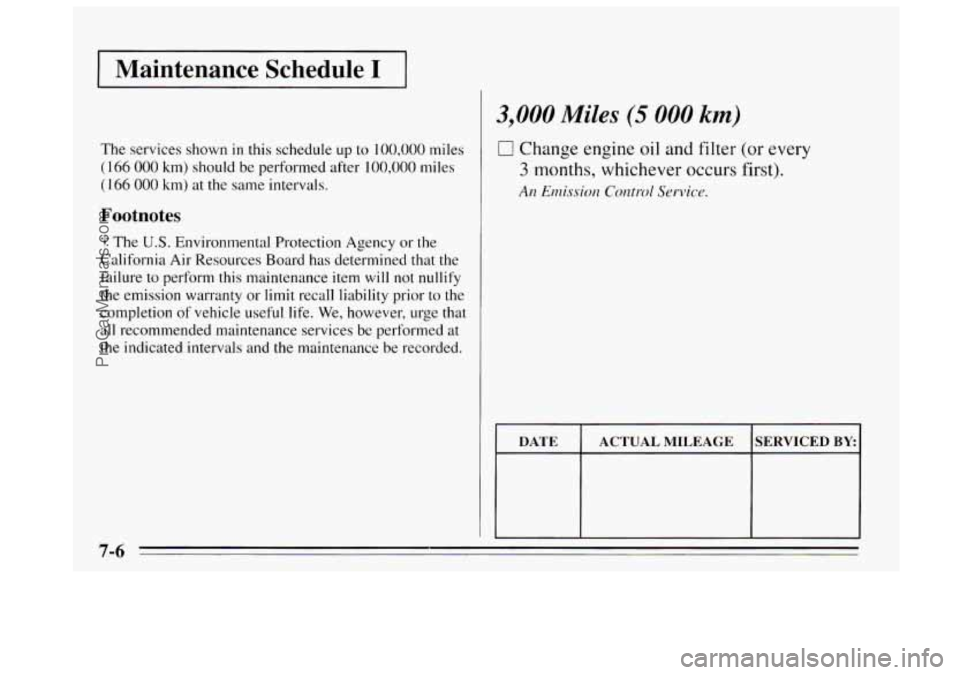
3,000 Miles (5 000 km)
The services shown in this schedule up to 100,000 miles
(166 000 km) should be performed after 100,000 miles
(1 66 000 km) at the same intervals.
Footnotes
I* The U.S. Environmental Protection Agency or the
California Air Resources Board has determined that the
failure to perform this maintenance item will not
nullify
the emission warranty or limit recall liability prior to the
completion
of vehicle useful Me. We, however, urge that
all recommended maintenance services be performed at
the indicated intervals and
the maintenance be recorded.
0 Change engine oil and filter (or every
3 months, whichever occurs first).
An Etnissiorz Cmttrol Service.
DATE SERVICED BY ACTUAL MILEAGE
ProCarManuals.com