1995 BMW 323i connector
[x] Cancel search: connectorPage 463 of 759

CAUTION
-
Always
replace
O-rings
when
reconnecting
refrig-
erant
fines
.
9
.
Before
recharging,
evacuate
system
for
at
least
30
min
.
Recharge
system
following
equipment
manufacturer's
instructions
.
See
Table
d
.
A/C
System
Refrigerant
Capacities
.
A/C
evaporator,
removing
and
installing
1
.
Followingmanufacturer's
instructions,
connectanap-proved
refrigerant
recovery/recycling/recharging
unit
to
A/C
system
and
discharge
system
.
2
.
Remove
complete
heater
boxas
described
earlier
.
3
.
Remove
expansion
valve
as
described
earlier
.
4
.
Unfasten
evaporator
sensor
electrical
harness
connec-
tor
and
puli
out
sensor
from
ieft
side
of
heater
box
.
See
Fig
.
50
.
Fig
.
49
.
Pull
out
evaporator
sensor
from
housing
in
direction
of
arrow
.
5
.
Remove
rear
heater
box
cover
.
6
.
Remove
clips
retaining
lower
evaporator
housingcover
.
Tilt
outheater
core,
then
pull
evaporator
out
of
housing
.
7
.
Installation
is
reverse
of
removal
.
CAUTION
-
Always
reptace
O-rings
when
reconnecting
refrtg-
erant
fines
.
8
.
Before
recharging,
evacuate
system
for
at
least
30
min
.
Recharge
system
following
equipment
manufacturer's
instructions
.
See
Table
d
.
A/C
System
Refrigerant
Capacities
.
HEATING
AND
AIR
CONDITIONING
640-17
8
.
Installation
is
reverse
of
removal
.
A/C
evaporator
temperature
sensor,
replacing
ou12b46
The
evaporator
temperature
sensor
is
mounted
in
the
left
(driver)
side
of
theheater
box
behind
thecenter
console
.
1
.
Remove
lower
dash
panel
and
knee
boister
on
driver
side
.
See
513
Interior
Trim
.
2
.
Remove
left
footwell
ventilation
duct
byremoving
re-
taining
rivet
in
bottom
of
duct
.
Pull
it
down
and
away
from
heater
box
.
See
Fig
.
50
.
Fig
.
50
.
Left
footwellventilatíon
duct
(arrow)
.
0o1300ba
3
.
Disconnect
sensor
electrical
connector
from
heater
box
.
Pull
sensor
straight
out
of
heater
box
.
Refer
to
Fig
.
49
.
4
.
Installation
is
reverse
of
removal
.
Table
c
.
lists
evapo-
rator
temperature
sensor
test
values
.
Tablec
.
Evaporator
Temperature
Sensor
Test
Values
Test
temp
.
Resistance
23°F
(-5°C)
11
.4
-11
.9
k
ohms
32°F
(0°C)
8
.8
-
9
.2
k
ohms
41
°F
(5°C)
6
.8
-
7
.2
k
ohms
50°F
(10°C)
5
.3-5
.6
k
ohms
59
°
F
(15°C)
4
.2
-4
.5
k
ohms
68°F
(20°C)
3
.3
-
3
.6
k
ohms
77°F
(25°C)
2
.6-2
.9
k
ohms
86°F
(30°C)
2
.1
-
2
.3
k
ohms
95°F
(35°C)
1
.7
-1
.9
k
ohms
AIR
CONDITIONING
Page 465 of 759

GENERAL
.........
.
.......
.
.
.
.
.
.
.
.
.
..
650-1
Rear
speaker,
removing
and
installing
.
.
.
.
.
.650-5
Door
panel
speaker,
AUDIO
SYSTEM
............
.
.
.
.
.
.
.
.
.
..
650-1
removing
and
installing
.
.
.
.
.....
.
.
.
.
.
.
.
.650-5
Radio
connector
..
.
.
.
.
.
.
.
.
.
.......
.
.
.
.
.
.
650-6
RADIO
AND
SPEAKER
SERVICE
.
.
.
.
.
..
650-2
Radio,
removingand
installing
.
.
.
.
.
.
...
.
..
650-2
Left
footwell
speaker,
removing
and
installing
.
....
.
.
.
.....
.
.
.
650-3
Right
footwell
speaker,
removing
and
installing
.
....
.
.
.
.....
.
..
650-4
GENERAL
AUDIO
SYSTEM
Thissection
coversthe
BMW
factory-installed
sound
sys-
The
BMW
E36
is
equipped
with
a
three
band
radio/cassette
tem,
including
radio
and
speaker
removal,
radio
connectors
player
unit
mounted
in
the
middle
of
thecenter
console
.
In
ad
and
terminal
designations
.
dítion
to
AM
and
FM
bands,
the
radio
will
receive
broadcasts
from
theNational
Weather
Service
.
The
antenna
is
incorporated
into
the
rear
window
defogger
.
650
Radio
Fig
.
1
.
Radio
amplifier
(premiumpackage)
in
luggage
compartment
behind
left
panel
.
RADIO
650-1
TABLE
a
.
Radio
Connector
Terminal
Designation
...
.
......
650-6
The
cassette
deck
is
equipped
with
the
Do1byTM
C
noise
re-
ductionsystem,
for
improved
tape
performance
with
reduced
background
tape
noise
.
A
6-speaker
audio
system
was
standard
in
the
early
years
ofthe
model
line
.
Many
additional
features
have
been
in-
stalled
as
optional
or
standard
equipment
duringthevehicle
production
run
.
"
A
200-watt
power
amplifier
with
custom-contoured
equalization
and
ten
speaker
output
.
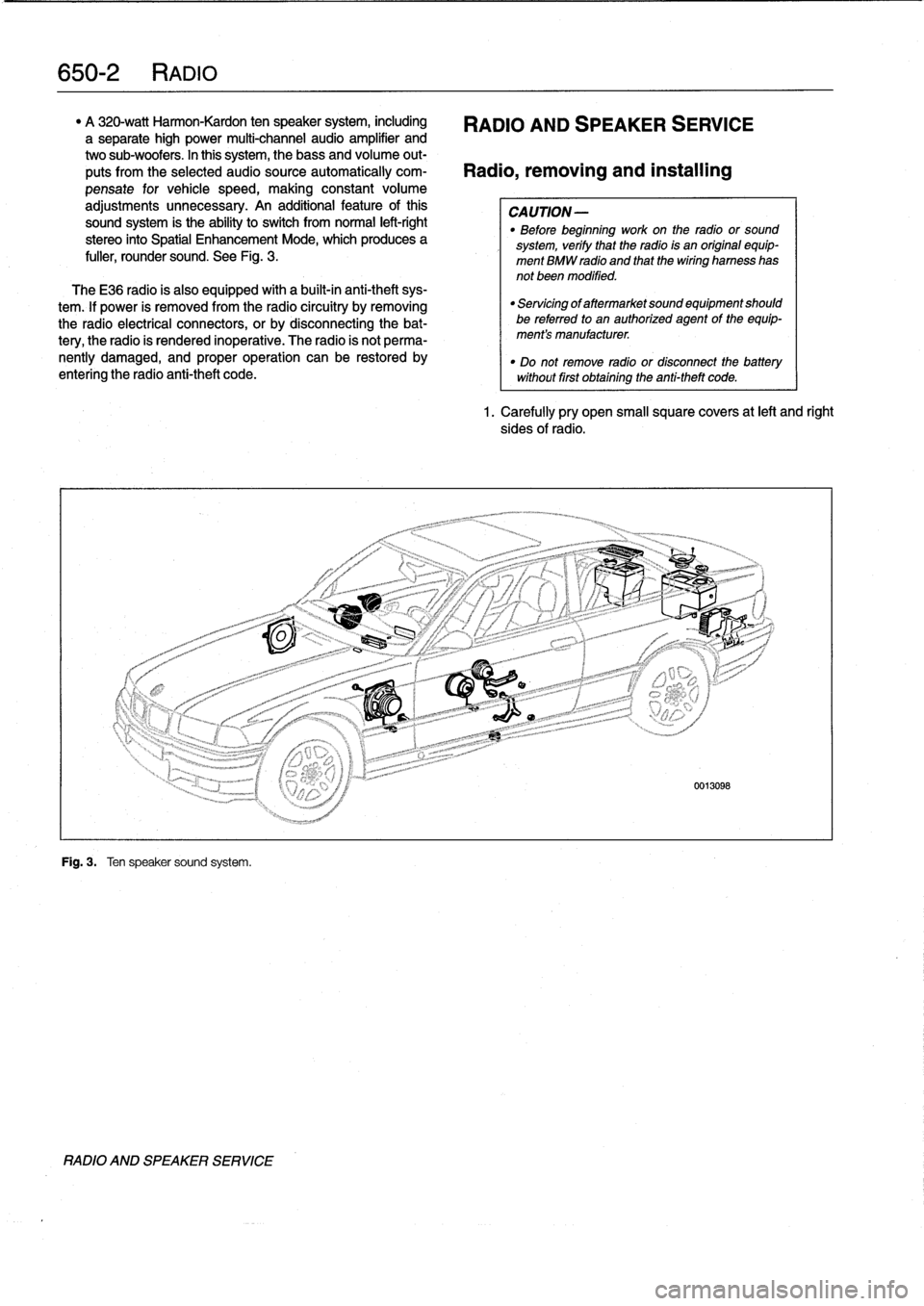
See
Fig
.
1
.
"
A
multi-disc
compact
disc
changer,
for
which
the
vehicle
and
the
radio
are
prewired
.
See
Fig
.
2
.
Fig
.
2
.
Optional
multi-disc
compact
disc
changerand
disc
cartridge
.
AUDIO
SYSTEM
Page 466 of 759
650-2
RADIO
"
A
320-watt
Harmon-Kardon
ten
speaker
system,
including
RADIO
AND
SPEAKER
SERVICE
a
separate
high
power
multi-channel
audio
amplifier
and
two
sub-woofers
.
In
this
system,
thebass
and
volume
out-
puts
from
the
selected
audiosource
automatically
com-
Radio,
removing
and
installing
pensate
for
vehicle
speed,
making
constant
volume
adjustments
unnecessary
.
An
additional
feature
ofthis
CAUTION-
sound
system
is
the
ability
to
switch
from
normal
left-right
"
Before
beginning
work
on
the
radio
or
sound
stereo
into
Spatial
Enhancement
Mode,
which
produces
a
system,
verify
that
the
radio
is
an
original
equip-
fuller,
rounder
sound
.
See
Fig
.
3
.
ment
BMW
radio
and
that
thewiring
harness
has
not
been
modified
.
TheE36
radio
is
also
equipped
with
a
built-in
anti-theft
sys-
tem
.
lf
power
is
removed
from
the
radio
circuitry
by
removing
the
radio
electrical
connectors,
or
by
disconnecting
the
bat-
tery,
the
radio
is
rendered
inoperative
.
The
radio
is
not
perma-
nently
damaged,
and
proper
operation
can
be
restored
by
entering
the
radio
anti-theft
code
.
Fig
.
3
.
Ten
speaker
sound
system
.
RADIO
AND
SPEAKER
SERVICE
"
Servicing
of
aftermarket
sound
equipment
should
be
referredto
an
authorized
agent
of
the
equip-
ment's
manufacturer
.
"
Do
not
remove
radio
or
disconnect
the
batterywithout
first
obtaining
the
anti-theft
code
.
1.
Carefully
pry
open
small
square
covers
at
left
and
right
sides
of
radio
.
Page 467 of 759

2
.
Using
special
hex
key,
turn
radio
mountingscrews
counterclockwise
to
loosen
.
See
Fig
.
4
.
0011845
Fig
.
4
.
Use
special
hexkey
or
Torx
driver
to
loosen/tighten
radio
mountingscrews
.
3
.
Pul¡
radio
out
of
instrument
panel
opening
.
4
.
Remove
connector(s)
from
rearof
radio
.
See
Fig
.
5
.
Fig
.
5
.
Radio
connector
being
removed
.
5
.
Installation
is
reverse
of
removal
.
0011846
Left
footweil
speaker,
removing
and
installing
Fig
.
6
.
Hood
release
lever
retaining
screw
(arrow)
.
RADIO
650-
3
1
.
Remove
screw
from
center
of
hood
latch
release
lever
.
Remove
lever
.
See
Fig
.
6
.
0012578
2
.
Rotate
plastic
trim
panel
retainer
1
/4
turn
.
Pul¡
off
door
sea¡
from
edge
of
speaker
cover
and
pull
speaker
trim
panel
back
toward
rear
of
car
.
See
Fig
.
7
.
0012579
Fig
.
7
.
Rotate
plastic
retainer
(black
arrow)
andremove
panel
in
di-
rection
shown
(white
arrows)
.
RADIO
AND
SPEAKER
SERVICE
Page 468 of 759

650-
4
RADIO
3
.
Remove
speakerby
removing
mountingscrews
.
See
Fig
.
8
.
Fig
.
8
.
Speaker
mounting
screws
(arrows)
.
0012580
4
.
Disconnect
harness
connector(s)
from
speaker
.
See
Fig
.
9
.
001,58
Fig
.
9
.
Disconnect
speaker
electrical
connector(s)
in
direction
shown
(arrows)
.
5
.
Installation
is
reverse
of
removal
.
Right
footwell
speaker,
removing
and
installing
1
.
Remove
glove
compartment
lower
trim
.
See
Fig
.
10
.
2
.
Rotate
speakercover
plastic
retainer
1
/a
turn
.
Remove
door
sea¡at
edge
of
speaker
cover
.
See
Fig
.
11
.
3
.
Pul¡
speaker
trim
panel
away
from
body
and
then
pul¡
panel
back
toward
rear
of
car
.
RADIO
AND
SPEAKER
SERVICE
0012582
Fig
.
10
.
Remove
lower
glove
compartment
trim
panel
retaining
screw
(black
arrow)
.
Pull
trim
in
direction
shown
(white
arrows)
.
0012583
Fig
.
11
.
Speaker
cover
retainer
(black
arrow)
.
Pulltrim
in
direction
shown
(white
arrow)
.
4
.
Remove
speaker
by
removing
mountingscrews
.
Dis-
connect
harness
connector(s)
from
speaker
.
5
.
Installation
is
reverse
of
removal
.
Page 469 of 759

Rear
speaker,
removing
and
installing
Door
panel
speaker,
removing
and
installing
NOTE
-
Rear
speakers
in
convertible
models
are
installed
un-
der
the
rear
side
panels
.
For
rearside
panelremoval
procedure,
see
411Doors
.
1
.
Working
at
rear
parcel
shelf,
pry
speakercoverby
inner
edge
and
remove
.
See
Fig
.
12
.
0011632
Fig
.
12
.
Pry
up
inner
edge
of
speaker
cover
off
rear
parcel
shelf
.
2
.
Remove
mountingscrews
and
depress
speaker
retain-
ing
clip
.
See
Fig
.
13
.
Lower
speaker
into
trunk
.
Fig
.
13
.
Remove
screws
(A)
and
depress
clip
(B)
.
4
.
Installation
is
reverse
of
removal
.
0011633
3
.
Disconnect
speaker
connector
andremove
speaker
from
box
.
RAM
650-5
1.
On
carswith
side-impact
airbags,
disconnect
negative
(-)
cable
from
battery
.
CAUTION-
Prior
to
disconnecttog
the
battery,
read
the
battery
disconnection
cautions
given
at
the
front
of
this
manual
on
page
vi¡¡
.
2
.
Remove
inner
door
panel
.
See
411
Doors
.
WARNING
-
Some
1997
and
all
1998
model
year
cars
are
equipped
with
front
side-impact
airbags
in
the
front
doors
.
When
servicing
the
doors
with
front
side-im-
pact
airbags,
alwaysdisconnect
the
negative
()
battery
terminal
.
See
721Airbag
System
(SRS)
for
cautions
and
procedures
relating
to
theairbag
sys-
tem
.
3
.
On
back
of
door
panel,
remove
nut
on
top
of
speaker
retaining
bracket
and
remove
bracket
from
behind
speaker
.
See
Fig
.
14
.
Fig
.
14
.
Speaker
retaining
nut
(arrow)
.
4
.
Disconnect
speaker
connector
from
harness
connector
and
remove
loudspeaker
forwardthrough
door
panel
.
5
.
Installation
is
reverse
of
removal
.
Install
side-impact
airbag
using
new
screws
.
See
721
Airbag
System
(SRS)
.
RADIO
AND
SPEAKER
SERVICE
Page 470 of 759

650-
6
RADIO
Radio
Connector
Tablea
.
Radio
Connector
Terminal
Designation
Table
a
lists
radio
connector
terminal
designations
.
The
pin
numbers
are
identified
in
Fig
.
15
.
20103040
50
60
90
7
0
0
80
110120130140150160
170
Fig
.
15
.
Radio
connector
.
See
Tablea
.
RADIO
AND
SPEAKER
SERVICE
Terminals
1-17
C1)
Connector
0011850
Connector
SignalTerminal
1
1
Speaker,
left
front
+
2
1
Speaker,
right
front
+
3
1
Speaker,
left
rear
+
4
1
Telephone
mute
feature
(where
applicable)
5
1
Positive
(terminal
R)
6
1
Frontspeaker,
left
7
1
I-bus
connection
(diagnostics)
8
Speaker,
left
front
9
1
Constant
positive,
Terminal
30
10
Speedometer
signal
for
speed-sensitive
volume
control
(where
applicable)
11
1
Speaker,
rightfront
12
1
Speaker,
left
rear
13
1
Illumination
(terminal
58G)
14
Speaker,
right
rear
15
1
Ground
(terminal
31)
16
Automatic
antenna
or
window
antenna
amplifier
or
premiumsound
system
amplifier
17
Notassigned
!'~_T-
Page 472 of 759

720-2
SEAT
BELTS
WARNING
-
"
For
maximum
protection
from
injury,
seat
belts
should
be
replaced
as
a
set
(including
all
hard-
ware),
if
they
are
subject
to
occupant
loading
in
a
collision
.
"
Seat
belts
should
not
be
modified
or
repaired
.
The
seat
belt
anchorage
points
should
not
be
changed
or
modified
.
"
Do
notbleach
or
dye
seat
belt
webbing
.
Webbing
that
is
severely
fadedor
re-dyed
will
not
meet
the
strength
requirements
of
a
collision
and
must
be
replaced
.
"
Seat
belts
shouldbe
periodically
inspected
for
webbing
defects
suchas
cuts
or
pulled
threads
.
FRONT
SEATBELT
ASSEMBLY
Automatic
Front
Seat
Belt
Lock
Tensioners
The
procedure
for
disabling
the
mechanical
spring
tension-
er
used
on
early
cars
is
covered
below
.
On
cars
with
thepyro-
technic(explosive
device)
tensioners,
the
orange
harness
connectorshould
be
removed
from
the
tensioner
any
time
the
seat
is
removed
.
WARNING
-
Both
the
mechanical
and
the
pyrotechnictensioners
are
powerful
devíces
and
shouldbehandled
with
extreme
care
.
Mechanical
spring
tensioner,
disarming
1
.
Remove
front
seat
.
See
520
Seats
.
2
.
Disarm
tensioner-electrically
adjustableseats
:
"
Working
at
side
of
seat,
turn
activating/deactivating
screw
clockwise
until
display
changes
from
green
to
red
.
See
Fig
.
2
.
"
Before
reinstalling
seat,
turn
screw
until
display
chang-
esback
to
green
.
NOTE-
Green
is
armed
.
Red
is
disarmed
.
3
.
Disarm
tensioner-manually
adjustable
seats
:
"
Cut
wíre
tie
next
to
tab
on
bowden
cable
.
See
Fig
.
3
.
"
Turn
and
lift
tabto
disengage
cable
housing
from
seat
bracket
.
"
Disconnect
cable
end
from
seat
lever
.
"
When
reinstalling,
correctly
engage
tab
end
of
cable
into
seat
bracket
and
fasten
in
position
using
new
wíre
tie
.
FRONT
SEATBELT
ASSEMBLY
0012737
Fig
.
2
.
Electrically
adjustable
front
seat
.
Turn
screw
(A)
to
disarm
me-
chanical
tensioner
.
Display
B
tucos
from
green
to
red
.
F19
.3
.
Manuallyadjustablefrontseat
.Turnandlifttab(arrow)todis-