1994 OLDSMOBILE BRAVADA lights
[x] Cancel search: lightsPage 119 of 248

Passing
The driver of a vehicle about to pass
another on a two-lane highway waits for
just the right moment, accelerates,
moves around the vehicle ahead, then
goes back into the right lane again.
A
simple maneuver?
Not necessarily! Passing another vehicle
on a two-lane highway is a potentially
dangerous move, since the passing
vehicle occupies the same lane as
oncoming traffic for several seconds.
A
miscalculation, an error in judgment, or
a brief surrender to frustration or anger
can suddenly put the passing driver face
to face with the worst of all traffic
accidents
- the head-on collision.
So here are some tips for passing:
“Drive ahead.” Look down the road,
to the sides, and to crossroads for
situations that might affect your
passing patterns. If you have any
doubt whatsoever about making a
successful pass, wait for a better time.
markings, and lines. If you can see a
sign up ahead that might indicate a
turn or an intersection, delay your
Watch for traffic signs, pavement pass.
A broken
center line usually
indicates it’s all right to pass
(providing the road ahead
is clear).
Never cross a solid line on your side
of the lane or a double solid line, even
if the road seems empty of
approaching traffic.
Do not get too close to the vehicle you
want to pass while you’re awaiting an
opportunity. For one thing, following
too closely reduces your area of vision,
especially
if you’re following a larger
vehicle.
Also, you won’t have
adequate space
if the vehicle ahead
suddenly slows or stops. Keep back a
reasonable distance.
When it looks like a chance to pass is
coming up, start to accelerate but stay
in the right lane and don’t get too close.
Time your move
so you will be
increasing speed as the time comes to
move into the other lane. If the way is
clear to pass, you
will have a “running
start” that more than makes up for the
distance you would lose by dropping
back. And
if something happens to
cause you to cancel your pass, you need
only slow down and drop back again
and wait for another opportunity.
If other cars are lined up to pass a
slow vehicle, wait your turn. But take
care that.someone isn’t trying to pass
you as you pull out to pass the slow
vehicle. Remember to glance over your
shoulder and check the blind spot.
Check your mirrors, glance over your
shoulder, and start your left lane
change signal before moving out of the
right lane to pass. When you are far
enough ahead of the passed vehicle to
see its front in your inside mirror,
activate your right lane change signal
and move back into the right lane.
(Remember that your right outside
mirror is convex. The vehicle you just
passed may seem to be farther away
from
you than it really is.)
Try not to pass more than one vehicle
at a time on two-lane roads. Reconsider
before passing the next vehicle.
Don’t overtake a slowly moving
vehicle
too rapidly. Even though the
brake lights are not flashing, it may be
slowing down or starting to turn.
If you’re being passed, make it easy
for the following driver to get ahead of
you. Perhaps you can ease a little to
the right.
113
ProCarManuals.com
Page 123 of 248
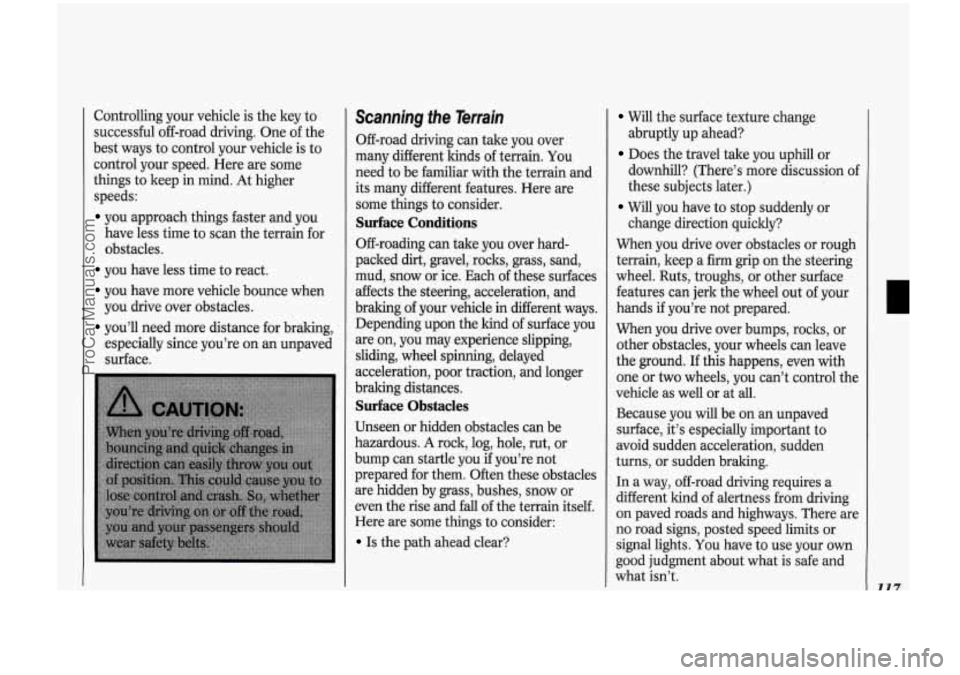
Controlling your vehicle is the key to
successful off-road driving. One of the
best ways to control your vehicle is to
control your speed. Here are some
things to keep in mind. At higher
speeds:
you approach things faster and you
have less time to scan the terrain for
obstacles.
you have less time to react.
you have more vehicle bounce when
you drive over obstacles.
you’ll need more distance for braking,
especially since you’re on an unpaved
surface.
Scanning the Terrain
Off-road driving can take you over
many different kinds of terrain.
You
need to be familiar with the terrain and
its many different features. Here are
some things to consider.
Surface Conditions
Off-roading can take you over hard-
packed
dirt, gravel, rocks, grass, sand,
mud, snow or ice. Each
of these surfaces
affects the steering, acceleration, and
braking of your vehicle in different ways.
Depending upon the kind of surface you
are on, you may experience slipping,
sliding, wheel spinning, delayed
acceleration, poor traction, and longer
braking distances.
Surface Obstacles
Unseen or hidden obstacles can be
hazardous. A rock, log, hole, rut, or
bump can startle you
if you’re not
prepared for them. Often these obstacles
are hidden by grass, bushes, snow or
even the rise and
fall of the terrain itself.
Here are some things to consider:
Is the path ahead clear?
Will the surface texture change
Does the travel take you uphill or
abruptly
up ahead?
downhill? (There’s more discussion of
these subjects later.)
change direction quickly?
Will you have to stop suddenly or
When you drive over obstacles or rough
terrain, keep a firm grip on the steering
wheel. Ruts, troughs, or other surface
features can jerk the wheel out of your
hands
if you’re not prepared.
When you drive over bumps, rocks, or
other obstacles, your wheels can leave
the ground. If this happens, even with
one or two wheels, you can’t control the
vehicle as well or at all.
Because you will be on an unpaved
surface, it’s especially important to
avoid sudden acceleration, sudden
turns, or sudden braking.
In a way, off-road driving requires a
different kind of alertness from driving
on paved roads and highways. There are
no road signs, posted speed limits or
signal lights.
You have to use your own
good judgment about what is safe and
what isn’t.
117
ProCarManuals.com
Page 125 of 248

Driving Uphi//
Once you decide you can safely drive
up the hill, you need to take some
special steps.
Use a low gear and get a firm grip on
the steering wheel.
Get a smooth start up the hill and try
to maintain your speed. Don’t use
more power than you need, because
you don’t want your wheels to start
spinning or sliding.
Try to drive straight up the hill if at all
possible. If the path twists and turns,
you might want to find another route.
Ease up on your speed as you
approach the top of the.hill..
Attach a flag to the vehicle to make
you more visible to approaching
traffic on trails or hills.
Sound the horn as you approach the
top of the hill to let opposing traffic
know you’re there.
Use your headlights even during the
day. They make you more visible to
oncoming traffic.
Q: What should I do if my vehicle
stalls,
or is about to stall, and I
can’t make it up the hill?
A: If this happens, there are some
things you should
do, and there are
some things you must not do. First,
here’s what you
should do:
Push the brake pedal to stop the
vehicle and keep it from rolling
backwards. Also, apply the parking
brake.
the transmission into reverse,
release the parking brake, and
slowly back down the hill in reverse.
If your engine has stopped running,
you’ll need
to restart it. With the
brake pedal depressed and the
parking brake still applied, shift the
transmission to
P (Park) and
restart the engine. Then, shift to
reverse, release the parking brake,
and slowly back down the hill as
straight as possible in reverse.
As you are backing down the hill,
put
your left hand on the steering
wheel at the
12 o’clock position.
This way, you’ll be able to tell if
your wheels are straight and
maneuver
as you back down. It’s
best that you back down the hill
with your wheels straight rather
than in the left or right direction.
Turning the wheel too far
to the
left or right will increase the
possibility
of a rollover.
If your engine is still running, shift
119
ProCarManuals.com
Page 130 of 248

Your Driving and the Road
124
Driving at Night
Night driving is more dangerous than
day driving. One reason is that some
drivers are likely to be impaired
- by
alcohol or drugs, with night vision
problems, or by fatigue.
Here are some tips on night driving.
Drive defensively.
Don’t drink and drive.
Adjust your inside rearview mirror to
reduce the glare from headlights
behind you.
Since you can’t see as well, you may
need to slow down and keep more
space between you and other vehicles.
Slow down, especially on higher
speed roads. Your headlights can light
up only
so much road ahead.
In remote areas, watch for animals.
If you’re tired, pull off the road in a
safe place and rest.
Night Vision
No one can see as well at night as in the
daytime. But as we get older these
differences increase. A 50-year-old
driver may require at least twice as
much light to see the same thing at
night as
a 20-year-old.
What you do in the daytime can also
affect your night vision. For example, if
you spend the day in bright sunshine
you are wise to wear sunglasses. Your
eyes will have less trouble adjusting to
night. But if you’re driving, don’t wear
sunglasses at night. They may cut down
on glare from headlights, but they also
make a lot of things invisible.
You can be temporarily blinded by
approaching lights. It can take a second
or two, or even several seconds, for your eyes
to readjust to the dark. When
you are faced with severe glare (as from
a driver who doesn’t lower the high
beams, or a vehicle with misaimed
headlights), slow down a little. Avoid
staring directly into the approaching
lights.
Keep your windshield and
all the glass
on your vehicle clean
- inside and out.
Glare
at night is made much worse by
dirt on the glass. Even the inside of the
glass can build up a film caused by
dust.
Dirty glass makes lights dazzle and
flash more than clean glass would,
malting the pupils of your eyes contract
repeatedly.
Remember that your headlights light up
far less of a roadway when
you are in a
turn or curve. Keep your eyes moving;
that way, it’s easier to pick out dimly
lighted objects. Just as your headlights
should be checked regularly for proper
aim,
so should your eyes be examined
regularly. Some drivers suffer from
night blindness
- the inability to see in
dim light
- and aren’t even aware of it.
ProCarManuals.com
Page 132 of 248

Your Driving and the Road
126
Hydroplaning
Hydroplaning is dangerous. So much
water can build up under your tires that
they can actually ride on the water. This
can happen
if the road is wet enough
and you’re going fast enough. When
your vehicle is hydroplaning, it has little
or no contact with the road.
Hydroplaning doesn’t happen often.
But it can
if your tires haven’t much
tread or
if the pressure in one or more is
low. It can happen
if a lot of water is
standing on the road.
If you can see
reflections
horn trees, telephone poles,
or other vehicles, and raindrops
“dimple” the water’s surface, there
could be hydroplaning.
Hydroplaning usually happens at higher
speeds. There just isn’t a hard and fast
rule about hydroplaning. The best advice
is to
slow down when it is raining.
Some Other Rainy Weather Tips
Turn on your low-beam headlights -
not just your parking lights - to help
make you more visible to others.
Besides slowing down, allow some
extra following distance. And be
especially careful when you pass
another vehicle. Allow yourself more
clear room ahead, and be prepared to
have your view restricted by road
spray.
Have good tires with proper tread
depth. (See
Tires in the Index.)
A , ”
I City Driving
One of the biggest problems with city
streets is the amount
of traffic on them.
You’ll want
to watch out for what the
other drivers are doing and pay
attention to traffic signals.
Here are ways to increase your safety in
city driving:
Know the best way to get to where
you are going. Get a city map and
plan your trip into an unknown part
of the city just as you would for a
cross-country trip.
ProCarManuals.com
Page 134 of 248

Your Driving und the Road
128
The exit ramp can be curved, sometimes
quite sharply.
The exit speed is usually posted.
Reduce your speed according to your
speedometer, not to your sense of
motion. After driving for any distance at
higher speeds, you may tend to think you
are going slower than you actually are.
I Before Leaving on a Long
Tip
Make sure you’re ready. Try to be well
rested. If
you must start when you’re
not fresh
- such as after a day’s work
- don’t plan to make too many miles
that first part of the journey. Wear
comfortable clothing and shoes you can
easily drive in.
Is your vehicle ready for a long trip? If
you keep it serviced and maintained, it’s
ready to go.
If it needs service, have it
done before starting out.
Of course,
you’ll find experienced and able service
experts in Oldsmobile dealerships all
across North America. They’ll be ready
and willing to help if you need it.
Here are some things you can check
before a trip:
Windshield Washer Fluid Is the
reservoir full? Are all windows clean
inside and outside?
shape?
you checked all levels?
Wiper Blades: Are they in good
Fuel, Engine Oil, Other Fluids: Have
Lights: Are they all working? Are the
lenses clean?
Tires: They are vitally important to a
safe, trouble-free trip. Is the tread
good enough for long-distance
driving? Are the tires all inflated to
the recommended pressure?
Weather Forecasts: What’s the
weather outlook along your route?
Should you delay your trip a short
time to avoid a major storm system?
Maps: Do you have up-to-date maps?
Highway Hypnosis
Is there actually such a condition as
“highway hypnosis”? Or is it just plain
falling asleep at the wheel? Call it
highway hypnosis, lack
of awareness, or
whatever.
There is something about an easy
stretch of road with the same scenery, along
with the hum of the tires on the
road, the drone of the engine, and the
rush of the wind against the vehicle that
can make you sleepy. Don’t let it
happen
to you! If it does, your vehicle
can leave the road in
less than a
second, and you could crash and be
injured.
What can you do about highway
hypnosis? First, be aware that it can
happen.
Then here are some tips:
Make sure your vehicle is well
ventilated, with a comfortably cool
interior.
Keep your eyes moving. Scan the road
ahead and to the sides. Check your
mirrors and your instruments
frequently.
If you get sleepy, pull off the road into
a rest, service, or parking area and
take a nap, get some exercise, or both.
For safety, treat drowsiness on the
highway as an emergency.
ProCarManuals.com
Page 137 of 248

If You’re Caught in a Blizzard
If you are stopped by heavy snow, you
could be in a serious situation.
You
should probably stay with your vehicle
unless you know for sure that you are
near help and you can hike through the
snow. Here are some things to do to
su~nmon help and keep yourself and
your passengers safe: Turn on your
hazard flashers. Tie a red cloth to your
vehicle to alert police that you’ve been
stopped by the snow. Put on extra
clothing or wrap a blanket around you.
If
you have no blankets or extra clothing,
make body insulators from newspapers,
burlap bags, rags, floor mats
- anything
you can wrap around yourself or tuck
under
your clothing to keep warm.
You can run the engine to keep warm,
but be careful.
~ .--- . . .. . . .. ~ ~ ~, L
Run your engine only as long as you
must. This saves fuel. When
you run the
engine, make
it go a little faster than just
idle. That is, push the accelerator
slightly. This uses less fuel for the heat
that you get and it keeps the battery
charged.
You will need a well-charged
battery to restart the vehicle, and
possibly for signaling later on with your
headlights. Let the heater run for awhile.
Then, shut the engine
off and close the
window almost all the way to preserve
the heat. Start the engine again and
repeat this only when you feel really
uncomfortable from the cold.
But do it
as little as possible. Preserve the fuel as
long as you can. To help keep warm,
you can get out of the vehicle and do
some fairly vigorous exercises every half
hour or
so until help comes.
3
131
ProCarManuals.com
Page 141 of 248

deal longer and not nearly so responsive
as your vehicle is by itself.
Before you start, check the trailer hitch
and platform, safety chains, electrical
connector, lights, tires and mirror
adjustment.
If the trailer has electric
brakes, start your vehicle and trailer
moving and then apply the trailer brake
controller by hand to be sure the brakes
are working. This lets you check your
electrical connection at the same time.
During your trip, check occasionally to
be sure that the load is secure, and that
the lights and any trailer brakes are still
working.
following Distance
Stay at least twice as far behind the
vehicle ahead as you would when
driving your vehicle without a trailer.
This can help
you avoid situations that
require heavy braking and sudden turns.
Passing
You’ll need more passing distance up
ahead when you’re towing a trailer.
And, because you’re a good deal longer,
you’ll need to go much farther beyond
the passed vehicle before you can return
to your lane.
Backing Up
Hold the bottom of the steering wheel
with one hand. Then, to move the
trailer to the left, just move that hand to
the left. To move the trailer to the right,
move your hand to the right. Always
back up slowly and, if possible, have
someone guide you.
Making Turns
When you’re turning with a trailer,
make wider turns than normal. Do this
so your trailer won’t strilte soft
shoulders, curbs, road signs, trees, or
other objects. Avoid jerky or sudden
maneuvers. Signal well in advance.
LI
ProCarManuals.com