1994 MITSUBISHI 3000GT body
[x] Cancel search: bodyPage 454 of 738

Downloaded from www.Manualslib.com manuals search engine 16-8ENGINE ELECTRICAL - Charging System
This test determines whether the generator outputs
normal current.(1) Before the test, always be sure to check the
following.l Generator installation
l
Battery (Refer to GROUP 54 - Battery.)
NOTE
The battery to be used should be slightly dis-charged. The load in a fully-charged battery
will be insufficient and the test may not be able
to be carried out correctly.l Generator drive belt tension (Refer to
GROUP 11- On-vehicle Service.)l Fusible link
l Abnormal noise from the generator while
the engine is running(2) Turn the ignition switch to the OFF position.
(3) Disconnect the negative battery cable.
(4) Disconnect the generator output wire from the
generator
“B” terminal and connect a DC testammeter with a range of O-100 A in series
between the “B” terminal and the disconnected
output wire. (Connect the
(+) lead of the amme-ter to the
“B” terminal, and then connect the(-) lead of the ammeter to the disconnected
output wire.)
Caution
Never use clips but tighten bolts and nutsto connect the line.
Otherwise loose
connections (e.g. using clips) will lead to
a serious accident because of high current.
NOTE
A clamp-type ammeter which enables measure-
ments to be taken without disconnecting the
generator output wire is recommended.(5) Connect a voltmeter with a range of 0
- 20
V between the generator “B” terminal and the
ground. (Connect the
(+) lead of the voltmeterto the “B” terminal, and then connect the (-)
lead of the voltmeter to the ground.)
(6) Connect a tachometer. (For the procedure forconnecting the tachometer, refer to GROUP
11 - On-vehicle Service.)
(7) Connect the negative battery cable.
(8) Leave the hood open.(9) Check to be sure that the reading on the
voltmeter is equal to the battery voltage.
NOTE
If the voltage is 0 V, the cause is probably an
open circuit in the wire or fusible link between
the generator “B” terminal and the battery
(+)
terminal.
(1O)After turning the light switch on and turning on
the headlights, start the engine.
(1l)lmmediately after setting the headlights to high
beam and turning the heater blower switch to
the high revolution position, increase the enginespeed to 2,500
r/min and read the maximum
current output value displayed on the ammeter.
Limit value: 70% of nominal current output
NOTEl
For the nominal current output, refer to the
Generator Specifications.l
Because the current from the battery will
soon drop after the engine is started, the
above step should be carried out as quickly
as possible in order to obtain the maximum
current output value.l The current output value will depend on
the electrical load and the temperature of
the generator body.l
If the electrical load is small while testing,the specified level of current may not be
output even though the generator is normal.
In such cases, increase the electrical load
by leaving the headlights turned on for sometime to discharge the battery or by using
the lighting system in another vehicle, and
then test again.l
The specified level of current also may not
be output if the temperature of the generator
body or the ambient temperature is too high.
In such cases, cool the generator and then
test again.
(12)The reading on the ammeter should be above
the limit value. If the reading is below the limit
value and the generator output wire is normal,
remove the generator from the engine and check
the generator.(13)Run the engine at idle speed after the test.
(14)Turn the ignition switch to the OFF position.
(15)Disconnect the negative battery cable.
(16)Disconnect the ammeter, voltmeter and
tachometer.(17)Connect the generator output wire to the
generator “B” terminal.
(18)Connect the negative battery cable.
TSB Revision
Page 470 of 738

Downloaded from www.Manualslib.com manuals search engine 16-24ENGINE ELECTRICAL - Starting System
ZlEL11327ELOOlQ
0
5
Startermotor
Carbon-pile rheostat
-I-Battery
i12v I
Voltmeter7-II27ELOO22(5) If pinion gap is out of specification, adjust by adding or
removing gaskets between magnetic switch and front
bracket.
MAGNETIC SWITCH PULL-IN TEST(1) Disconnect field coil wire from M-terminal of magnetic
switch.
(2)
Connect a 12 V battery between S-terminal and M-terminal.
Caution
This test must be performed quickly (in less than 10
seconds) to prevent coil from burning.
(3) If pinion moves out, then pull-in coil is good. If it doesn’t,
replace magnetic switch.
MAGNETIC SWITCH HOLD-IN TEST(1) Disconnect field coil wire from M-terminal of magnetic
switch.(2) Connect a 12 V battery between S-terminal and body.
Caution
This test must be performed quickly (in less than 10
seconds) to prevent coil from burning.(3) Pull out the pinion by hand until it comes into contact
with the pinion stopper.
(4)If pinion remains out, everything is in order. If pinion moves
in, hold-in circuit is open. Replace magnetic switch.
FREE RUNNING TEST
(1) Place starter motor in a vise equipped with soft jaws andconnect a fully-charged
12-volt battery to starter motor
as follows:
(2) Connect a test ammeter (loo-ampere scale) and carbon
pile rheostat in series with battery positive post and starter
motor terminal.
(3) Connect a voltmeter (15volt scale) across starter motor.
(4) Rotate carbon pile to full-resistance position.
(5)Connect battery cable from battery negative post to starter
motor body.(6) Adjust rheostat until the battery voltage shown by the
voltmeter is 11 V.
(7) Confirm that the maximum amperage is within the specifi-
cations and that the starter motor turns smoothly and freely.
Current: Max. 90 Amps
1 TSB Revision
Page 471 of 738
Downloaded from www.Manualslib.com manuals search engine ENGINE ELECTRICAL - Starting System16-25
L
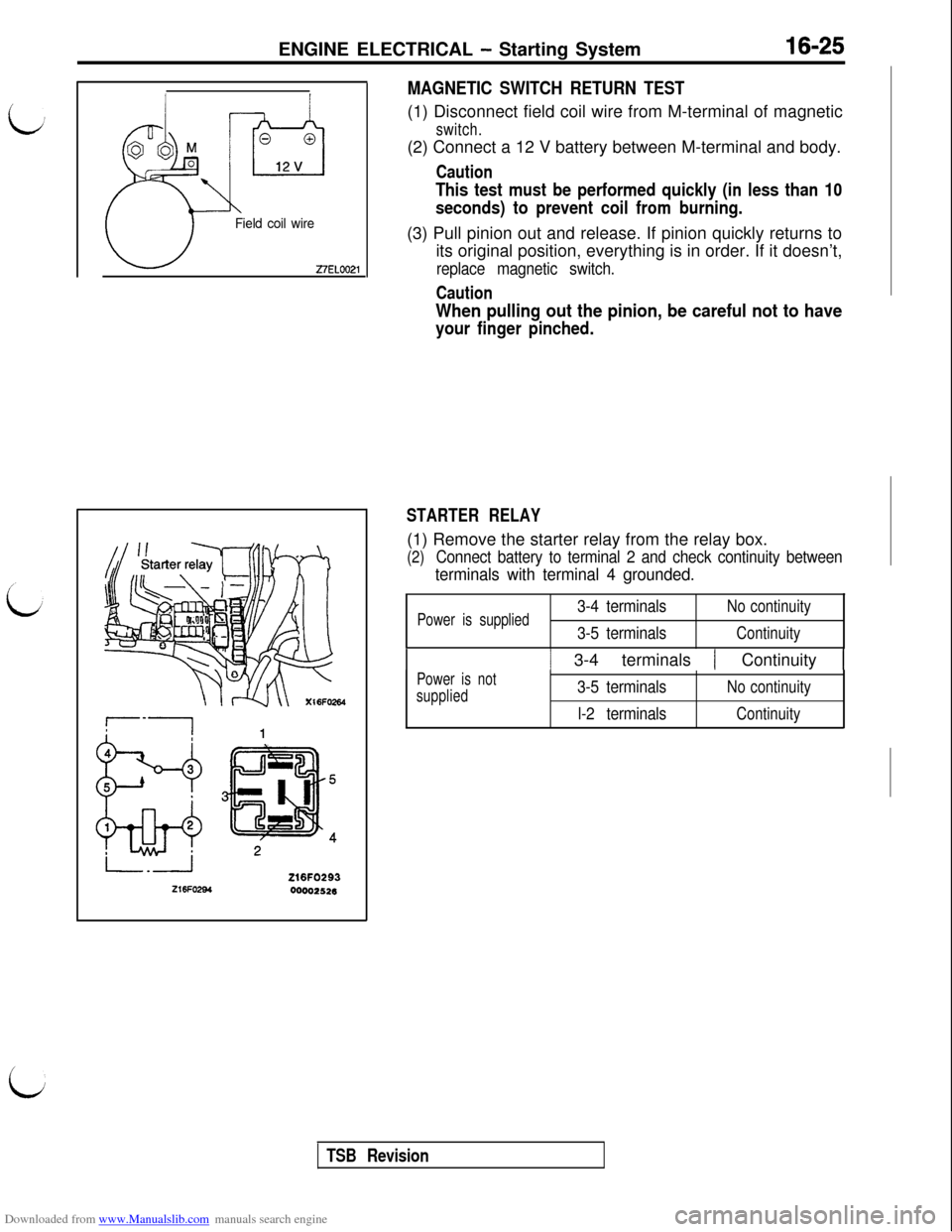
Field coil wire27EL0021216Fo264
00002526
MAGNETIC SWITCH RETURN TEST(1) Disconnect field coil wire from M-terminal of magnetic
switch.(2) Connect a 12 V battery between M-terminal and body.
Caution
This test must be performed quickly (in less than 10
seconds) to prevent coil from burning.(3) Pull pinion out and release. If pinion quickly returns to
its original position, everything is in order. If it doesn’t,
replace magnetic switch.
Caution
When pulling out the pinion, be careful not to have
your finger pinched.
STARTER RELAY(1) Remove the starter relay from the relay box.
(2)Connect battery to terminal 2 and check continuity between
terminals with terminal 4 grounded.
Power is supplied3-4 terminals
3-5 terminalsNo continuity
Continuity
/ 3-4 terminals / Continuity 1
Power is not
supplied3-5 terminals
l-2 terminalsNo continuity
Continuity
i
TSB Revision
Page 482 of 738

Downloaded from www.Manualslib.com manuals search engine 16-36ENGINE ELECTRICAL - Ignition System
Defective insulation
Defective insulation’
GoodZiELO34
ON-VEHICLE SERVICESPARK PLUG CABLE TEST
,d
(1) Disconnect, one at a time, each of the spark plug cables
while the engine is idling to check whether the engine’s
running performance changes or not.
Caution
Wear rubber gloves while doing so.(2) If the engine performance does not change, check the
resistance of the spark plug cable, and check the spark
plug itself.SPARK PLUG TEST
(1) Remove the spark plug and connect to the spark plug
cable.
(2) Ground the spark plug outer electrode (body), and crank
the engine.Check to be sure that there is an electrical discharge
between the electrodes at this time.
‘d
1 TSB Revision
Page 596 of 738

Downloaded from www.Manualslib.com manuals search engine 54-100CHASSIS ELECTRICAL - Lighting System
Unit A:Must be
used at
rear tire
“..“I. .other
Unit B:Must be used
at front tire1 -216802451.Calibration fixture2. Thumb adjusting screws
3.Level vial
4. Floor level offset dial
5. Horizontal dial knob
6. Vertical dial knob
7. Aimer level vial
8. Level vial bubble
9. Top port hole
10.Viewing portON-VEHICLE
SERVICE
HEADLIGHT AIMING
PRE-AIMING INSTRUCTIONS
(Up to 1993 models)
1. Test dimmer switch operation.
2. Observe operation of high beam light mounted in instru-
ment cluster.3. Inspect for badly rusted or faulty headlight assemblies.
These conditions must be corrected before a satisfactory
adjustment can be made.4. Place vehicle on a level floor.
5. Bounce front suspension through three (3) oscillations
by applying body weight to hood or bumper.6. Inspect tire inflation.
7.Rock vehicle sideways to allow vehicle to assume its nor-
mal position.
8.If fuel tank is not full, place a weight in trunk of vehicle
9.
to simulate weight of a full tank [3 kg (6.5 Ibs.) per gallon].
There should be no other load in the vehicle other than
driver or substituted weight of approximately 70 kg (150
Ibs.) placed in driver’s position.
10. Thoroughly clean headlight lenses.
11. Adjust headlights following the instructions of the headlight
tester manufacturer.
(From 1994 models)1. Inspect for badly rusted or faulty headlight assemblies.
These conditions must be corrected before a satisfactory
adjustment can be made.2. Place vehicle on a level floor.
3. Bounce front suspension through three (3) oscillations
by applying body weight to hood or bumper.
4. Inspect tire inflation.
5.Rock vehicle sideways to allow vehicle to assume it.snor-
mal position.
6.If fuel tank is not full, place a weight in trunk of vehicle
7.
to simulate weight of a full tank [3 kg (6.5 Ibs.) per gallon].
There should be no other load in the vehicle other than
driver or substituted weight of approximately 70 kg (150
Ibs.) placed in driver’s position.8. Thoroughly clean headlight lenses.
9. When performing the visual headlight adjustment on ve-
hicles with resin lens headlights, be sure to observe the
following precautions.
CautionWhen adjusting one headlight, the other headlight
should be turned off if possible. If this is not possible,
do not cover the other headlight for more than threeminutes while it is turned on. Otherwise, heat from
the bulb may warp the headlight lens.
NOTE
If the visual headlight adjustment at low beam is made,
the adjustment at high beam is not necessary.
TSB Revision
Page 658 of 738

Downloaded from www.Manualslib.com manuals search engine 54-I 62CHASSIS ELECTRICAL - Radio and Tape Player
A-4
Broadcasts can be heard but both AM and FM have a lot of noise.
(1)Noise occurs when the engine is stopped.
YesJ
(2)Noise occurs when the engine in running.
Do the following measures eliminate the noise?
@ Tune to a station with a strong signal.
l Extend the antenna completely. (Whip antenna)
l Adjust the sound quality to suppress high tones.
NoIs the radio body ground mounted securely?
Yes
Securely tighten the nuts for the bodyground.
Yes
YesClean the antenna plug and ground
wire mounting area. Mount the anten-
na securely. On a vehicle with a motor
antenna, check the antenna itself. (Re-fer to E-1, 2.)
If there is more noise than other radios, consult a servicecenter
NOTE
About noise encountered during FM reception only.
Due to differences in FM and AM systems, FM is
noise interference (first fading and multipath). (Refer
to A-2.)
not as susceptible as AM to interference from en-
gines, power lines, lightning, etc. On the other hand,
TSB Revision
Page 660 of 738

Downloaded from www.Manualslib.com manuals search engine 54-164CHASSIS ELECTRICAL - Radio and Tape Player
A-6There is noise when starting the engine.
Noise type
Sounds are in pa-
rentheses ( ).
AM, FM:
Ignition noise
(Popping, Snap-
ping,Cracking,
Buzzing)
Otherelectrical
components
Static electricity
(Cracking, Crin-
kling)
Conditions
0Increasing the engine speedcausing the popping sound tospeed up, and volume de-creases.0Disappears when the ignitionswitch is turned to ACC.
-
lDisappears when the vehicle is
completely stopped.Occurs when parts or wir-
Severe when the clutch is en-ing move for some reasonlgaged.and contact metal parts of
the body.
lVarious noises are produced de-pending on the body part of thevehicle.
Due to detachment from
the body of the front hood,
bumpers, exhaust pipe
and muffler, suspension,
etc.
Causel
Mainly due to the
spark plugs.l Due to the enginenoise.
Noise may appear as
electrical components be-
come older.
Parts to be Location of
inspectedparts
or remedy(next page)
Noise con- 1
denser
Ground
cable2, 3
Repair or replace electricalcomponents.
Return parts or wiring to
their proper position.
Caution
1.Connecting a high tension cable to the noise
filter may destroy the noise filter and shouldnever be done.
2.Check that there is no external noise. Since
failure to do this may result in misdiagnosis
due to inability to identify the noise source,
this operation must be performed.3. Noise prevention should be performed by
suppressing strong sources of noise step
by step.
NOTE
1. Condenser
The condenser does not pass D.C. current, butas the number of waves increases when it
passes A.C. current, impedance (resistanceagainst A.C.) decreases, and current flow is
facilitated. A noise suppressing condenser
which takes advantage of this property is in-
serted between the power line for the noise
source and the ground. This suppresses noiseby grounding the noise component (A.C. or
pulse signal) to the body of the vehicle.
2. Coil
The coil passes D.C. current, but impedance
rises as the number of waves increases relativeto the A.C. current. A noise suppressing coil
which takes advantage of this property is in-
serted into the power line for the noise source,
and works by preventing the noise componentfrom flowing or radiating out of the line.
1 TSB Revision
Ground parts by bonding.
Cases where the problem
is not eliminated by a single
response to one area are
common, due to several
bodypartsbeing
imperfectly grounded.
Page 662 of 738

Downloaded from www.Manualslib.com manuals search engine 54-166CHASSlS ELECTRICAL - Radio and Tape Player
IA-7Some noise appears when there is vibration or shocks during traveling.
‘d ~
Are connectors properly connected?
YesNo
---+ Ensure proper connection
t
Does noise appear when the radio switch is turned on while theNovehicle is stopped and the radio is struck while tuned away fromLa station?
YesStatic electricity noise:
Body static electric from the shock absorber rubber bushings used
to prevent vibration, tires, etc. occurs because of separation fromthe ground, causing a buzzing noise.
Since no measures can be taken on the radio side, steps shouldbe taken to discharge the static electricitv of the vehicle bodv.
tIs the radio correctly grounded?
(Is the mounting screw tightened securely?)
1 Yes
tIs the antenna correctly grounded? (If noise appears when the Nocantenna is moved, this means the ground is not securely con-
nected.)
If rust is present on the antenna ground screw, clean and tightenthe ground securely.
Yes
1 Reoair or reolace radio.1
TSB Revision