Page 302 of 404

Never use too much of any lubricant and be sure to wipe up any extra
lubricant when
you are finished.
Your maintenance schedule
will tell you how often to lubricant these items.
See “Recommended Fluids and Lubricants”
in the Index for the proper
lubricant
to use.
Lock Cylinders
To be sure your locks operate properly, they must be lubricated. Your
vehicle’s maintenance schedule will
tell you how often to lubricate them.
See “Recommended Fluids and Lubricants”
in the Index for the proper
lubricant
to use.
You should not use penetrating oils because they could wash
out the factory
installed lubricant and cause the lock
to bind. De-icers which contain
alcohol could
also wash away the lubricant, so be sure to lubricate the lock
after using
a de-icer of this type.
Tailgate Handle
The tailgate handle pivot points on your vehicle should be lubricated to keep
the handle working smoothly.
Your maintenance schedule
will tell you how often to lubricant the handle.
See “Recommended Fluids and Lubricants” in the Index for the proper
lubricant to use.
Battery
Every new GM vehicle has a Delco Freedom@ battery. You never have to
add water to
one of these. When it’s time for a new battery, we recommend
a Delco Freedom@ battery. Get one that has the catalog number shown on
the original battery’s label.
Vehicle Storage
If you’re not going to drive your vehicle for 25 days or more, take off the
black, negative (-) cable from the battery. This will help keep your battery
from running down.
6-52
ProCarManuals.com
Page 305 of 404

3. Unplug the
electrical
connector.
4. Turn the bulb to
the left and
i
remove it.
5. Put the new bulb in the lens assembly and turn it to the right until it is
tight.
6. Plug in the electrical connector.
7. Put the headlight lens assembly back into the vehicle. Install and
tighten the two screws.
Front Parkingflurn Signal Lights with
Sealed Beam Headlights
1. Remove the two screws at the inside edge of the parking/turn signal
2. Remove the light assembly by swinging it out from the inside edge and
3. Squeeze the tab on the side of the light socket while turning the socket
4. Pull the socket out of the light assembly.
5. Push in gently on the bulb, turn it to the left and remove it from the
6. Put the new bulb in the socket, gently press in on the bulb and turn it to
7. Put the socket back into the light assembly and turn it to the right until
8. Put the parking/turn signal light assembly back into the vehicle and
light assembly.
sliding
it out at the outside edge.
to the
left.
socket.
the right until it is tight.
it locks.
tighten the screws.
6-55
ProCarManuals.com
Page 306 of 404
Front Parkingnurn Signal Lights with
Composite Headlights
-7
I. Remove the
screws and take
out the parkinghurn
signal light
assembly.
2. Squeeze the tab
on the side of the
light socket while
turning the socket
to the left.
3.
4.
Pull the socket
out
of the light
assembly.
Push
in gently on
the bulb, turn it to
the left and
remove
it from
the socket.
5. Put the new bulb in the socket, gently press in on the bulb and turn it to
the right
until it is tight.
6. Put the socket back into the light assembly and turn it socket to the
right
until it locks.
7. Put the parkinghrn signal light assembly back into the vehicle and
tighten the screws.
6-56
ProCarManuals.com
Page 313 of 404
Trailer Wiring Harness
The optional seven-wire trailer wiring harness is protected by an in-line
fuse
in the battery feed wire. This fuse is near the junction block. See
“Trailer Wiring Harness”
in the Index for more information.
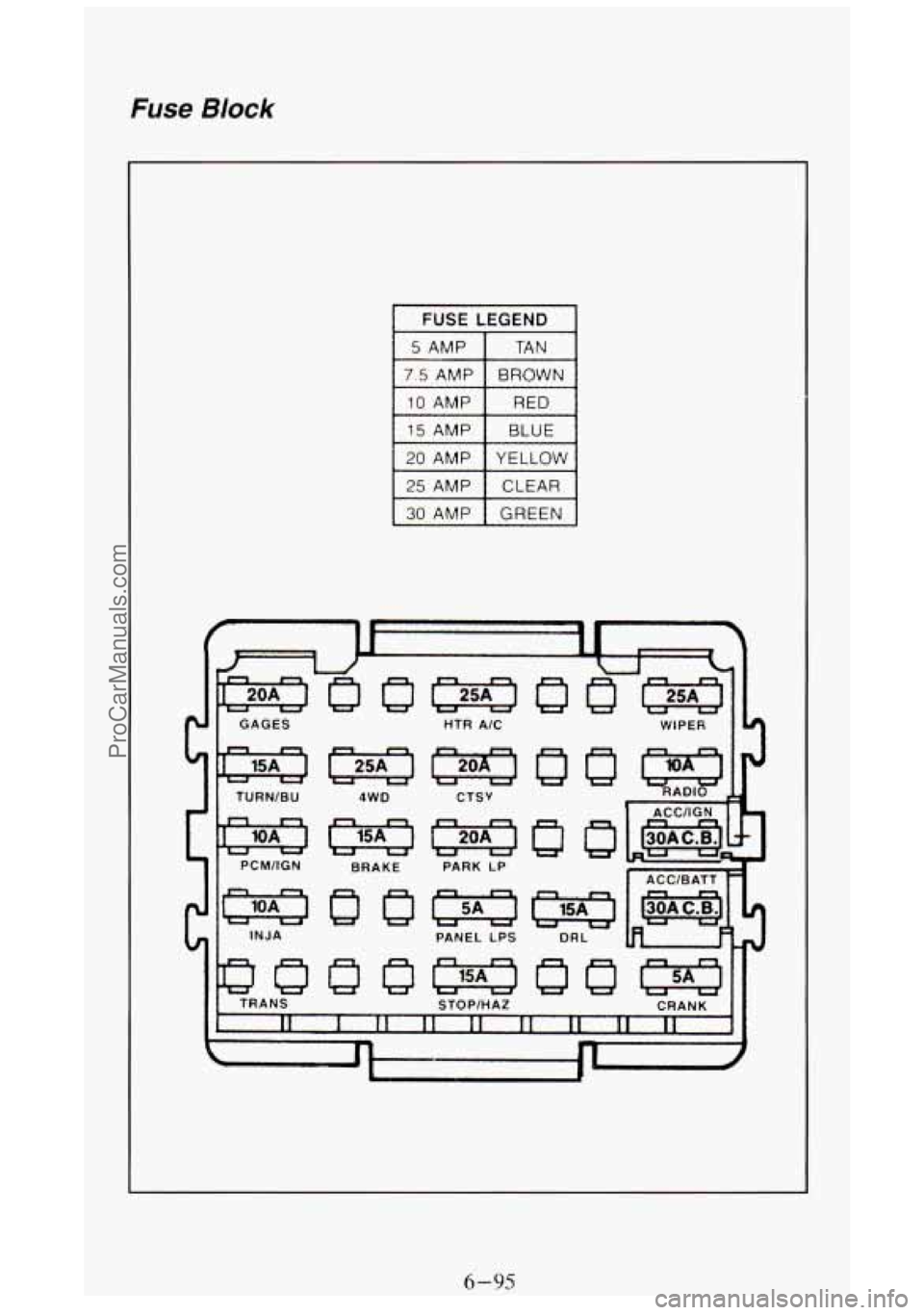
Fuse Block
The fuse block is
behind an access door
at the bottom of the
instrument panel,
next
to the parking brake
release lever.
To remove fuses if you don’t have one, hold the end of the fuse between
your thumb and index finger and pull straight out.
Be, sure to use the correct fuse.
If you ever have a problem on the road and
don’t have a spare fuse, you can “borrow” one of the correct value. Just pick
some feature
of your vehicle that you can get along without-like the radio
or cigarette lighter--and use
its fuse, if it is of the value you need. Replace
it as soon as you can. See “Fuses and Circuit Breakers“ in the Index for
more information.
6-63
ProCarManuals.com
Page 345 of 404
Fuse Block
1 FUSE LEGEND I
I 25 AMP I CLEAR I
I 30 AMP I GREEN
I GAGES
I TURN/BU
I PCM1'GN
I lNJA
STOPlHAZ WIPER
I
DRL
Wl
6-95
ProCarManuals.com
Page 346 of 404

Fuses and Circuit Breakers
NAME CIRCUITS PROTECTED
Gages
Turn-B/U EMC/Ign
Ign. A
Brake
AC/Htr
Ctsy
Park LP
P. Lps
Stop/Haz.
Wiper
Radio
Acc/Ign.
Acc/Batt.
Crank
4WD
DRL
Cruise Control, 4 WD Display
Illum. Rear Window Defogger
Timer, Aux. Batt. Relay Feed,
Safety Belt Buzzer Timer, Cluster
Ign. Feed
Back-up Lamps,
Turn Signals
T.C.C., Air Diverter,
E.S.C.,
E.G.R., E.C.M. Ign., R.W.A.L.
Brake Switch
Throttle Body Injectors
R.W.A.L., Cluster-Speedo
H.V.A.C.
4WD, Aux. Batt. Relay
Dome Lamp, Cargo Lamp, Ctsy,
and Glove Box Lps. (TR-R), Radio
(Memory-Clock) Horn Relay, Horn
Feed, Cigar Lighter, Park
Lamps C49 SW Illum., Headlamp “On”
Warning,
Radio Illum., H.V.A.C. Illum. Haz.
Flasher, Seat Belt Buzzer, Stop
Lmps., R.W.A.L. Memory
Windshield Wiper, Washer
Radio Feed
Pwr. Windows
Door Locks, Rear Window
Defogger
Crank, Discreet
Four Wheel Drive
Daytime Running Lights
FUSE CIRCUIT
BREAKER
20 Amp
15 Amp
10 Amp
10 Amp
15 Amp
25 Amp
20 Amp
20 Amp
5 Amp
15 Amp
25 Amp
10 Amp
30 Amp
30 Amp
5 Amp
25 Amp
15 Amp
*An inline fuse is used
for the underhood lamp
Do not use fuses of higher amperage than those recommended above.
6-96
ProCarManuals.com
Page 369 of 404

18. EVAPORATIVE CONTROL SYSTEM (ECS) INSPECTION* -
Check all fuel and vapor lines and hoses for proper hookup, routing,
and condition. Check that
the purge valve works properly, if equipped.
Replace as needed.
19.
SHIELDS AND UNDERHOOD INSULATION
INSPECTIONAV
- Inspect shields and underhood insulation for
damage or looseness. Adjust or replace as required.
system installation
to see that gaskets are sealed properly and all hose
connections, fasteners, and other components are tight. Also check to
be sure that the air cleaner housing is properly seated, that
the cover fits
tightly, and
the wing nuts are tight. Tighten connections and fasteners
or replace damaged parts
as required.
20. AIR INTAKE SYSTEM INSPECTIONAV - Check the air intake
2 1. THERMOSTATICALLY CONTROLLED ENGINE COOLING
FAN INSPECTIONAV
- (If so equipped.) Inspect all hoses and
ducts for proper hook-up. Be sure the valve works properly.
22. EXHAUST PRESSURE REGULATOR VALVE INSPECTION”
- Check that the valve works properly. Correct any binding. Inspect
hoses for cracks, chafing
or decay. Replace parts as needed.
23. TIRE AND WHEEL ROTATION AND INSPECTION - For
proper wear and maximum tire life, rotate tires at the first
6,000 miles
( 10 000 kilometers) for Schedule I (+) or 7,500 miles (1 2 500
kilometers) for Schedule IT (0) and then every 15,000 miles (25 000
kilometers) thereafter. Follow the instructions and patterns shown in
Section 6. Check tires for uneven wear or damage. If irregular or
premature wear is apparent, check wheel alignment. Also, check or
damaged wheels. See “Tires”
in the Index for more information.
For dual wheels, whenever the vehicle, wheels, or fasteners are new,
have the wheel fastener torque set at the first
100, 1,000 and 6,000
miles (1 60, 1600 and 10 000 km).
Block the tires opposite those being removed to keep the vehicle from
rolling.
‘i: An Emission Control Service
ANoise Emission Control Service
VApplicable only to vehicles sold
in the United States
7-21
ProCarManuals.com
Page 370 of 404

24. DRIVE AXLE SERVICE? - Check readfront axle fluid level and
add
as needed. Check constant velocity joints and axle seals for
leaking.
0
0
0
0
Locking differential - Drain fluid at first oil change and refill.
Check fluid level and add
as needed at subsequent oil changes. In
dusty areas, or trailer towing applications drain fluid at every
15,000 miles (24 135 kilometers) and refill.
Standard differential - Check fluid level and add as needed at
every
oil change. In dusty areas, or trailer towing applications,
drain fluid every
15,000 miles (24 I35 kilometers) and refill.
More frequent lubrication may be required on heavy-duty or
off-road use.
3500 HD Models - 3500 HD Models with applications requiring
extreme overload/trdiler tow conditions
and high speed conditions
(above 45 mph (72
kdh)) for extended periods of time must
change drive axle fluid every
3,000 miles (4828 kilometers) or 3
months, whichever comes first, OR must use 75W-140 synthetic
fluid meeting
GM specifications. See “Recommended Fluids and
Lubricants” at the end of this section for the proper fluid to use.
25.
BRAKE SYSTEM INSPECTION-f - When the engine oil is
changed, inspect the lines and hoses for proper hookup, binding, leaks,
cracks, chafing, etc. Check the parking brake adjust, and the fluid level
in the master cylinder. A low fluid level can indicate worn disc brake
pads which may need
to be serviced.
When the wheels are removed for rotation, inspect disc brake pads for
wear and rotors for surfxe condition. Also inspect drum brake linings
for wear and cracks. Inspect other brake parts, including drums, wheel
cylinders, parking brake, etc., at the same time. Remove any
rust or dirt
from the wheel and mounting surfaces before mounting the wheel.
Inspect brakes more often if driving habits or conditions result in
frequent braking.
?A fluid loss in these systems may indicate a problem. Have them
inspected and repaired at once.
7-22
ProCarManuals.com