1994 CHEVROLET TRACKER maintenance
[x] Cancel search: maintenancePage 169 of 258

Service and Appearance Care
Then, without shutting off the engine,
follow these steps:
1. Pull out the dipstick and wipe it with a
clean rag or paper towel.
2. Push it back in all the way, wait three
seconds and then pull it back out
again.
. . .I68
~
3. Check both sides of the dipstick, and
read the lower level. The fluid level
must be in the “COLD’ area for a
cold check or
in the “HOT” area or
cross-hatched area for a hot check.
4. If the fluid level is in the acceptable
range, push the dipstick back
in all
the way.
How to Add Fluid
Refer to the Maintenance Schedule to
determine what kind of transmission fluid
to use. See “Recommended Fluids and
Lubricants”
in the Index.
[f the fluid level is low, add only enough
of the proper fluid to bring the level up to
the “COLD” area for a cold check or the
“HOT” area for a hot check. It doesn’t take
much fluid, generally less than a
pint.
Don’t overfill. We recommend you use
only fluid labeled DEXRON@-III
or
DEXRON@-IIE, because fluids with that
label are made especially for
your
automatic transmission. Dama e caused
by fluid other than DEXRON
8 -m or
DEXRON@-IIE is not covered by your
new vehicle warranty.
0 After adding fluid, recheck the fluid
level as described under “How to
Check.”
obtained, push
the dipstick back in
all the way.
When the correct fluid level is
Manual Transmission Fluid
When to Check and Change
A good time to have it checked is when
the engine oil is changed. Refer to the
Maintenance Schedule to determine when
to change your transmission fluid. See
“Scheduled Maintenance Services”
in the
Index.
How to Check:
Because this operation can be a little
difficult, you may choose to have this
done at your Geo dealership Service
Department.
ProCarManuals.com
Page 170 of 258

If you do it yourself, be sure to follow all
the instructions here, or you could get a
false reading.
NOTICE:
Too much or too little fluid can
darnage your transmission.
Too much
can mean that some of the tluid could
come out and Pall on hot engine parts
or exhaust system parts, starting a
fire. Be sure to get an accurate read-
ing
if you check your transmission
fluid.
Check the fluid level only when your
engine is
off, the vehicle is parked on a
level place and the transmission is cool
enough for
you to rest your fingers on the
transmission case.
Then, follow these steps:
1. Remove the filler plug.
2. Check that the lubricant level is up to
the bottom
of the filler plug hole.
3. If the fluid level is good, install the
plug and
be sure it is fully seated. If
the fluid level is low, add more fluid
as described in the next steps.
How to Add Fluid:
Here’s how to add tluid. Refer to the
Maintenance Schedule to determine what
kind
of tluid to use. See “Recommended
Fluids and Lubricants”
in the Index.
1. Rernove the filler plug.
2. Add tluid at the filler plug hole. Add
only enough fluid to bring the fluid
level
LIP to the bottom of the filler
plug hole.
3. Install the filler plug. Be sure the plug
is
fully seated.
CIutch Adjustment
The clutch linkage in your vehicle
should be checked
as recommended in
your Maintenance Schedule. To check,
push the clutch pedal down
with your
hand
until you feel some resistance to
movement of the pedal.
If the pedal
moves freely up to an inch
(25 mm) or
so before you feel resistance to the travel,
adjustment isn’t needed.
If there is no free travel or very little
(less than
S/8 of an inch), see your dealer
for adjustment.
Rear Axle
WheR to Check and Change Lubricant
Refer to the Maintenance Schedule to
determine how often to check
the
lubricant and when to change it. See
“Periodic Maintenance Inspections” and
“Scheduled Maintenance Services”
in the
Index.
How to Check Lubricant
If the level is below the bottom of the
filler plug hole, you’ll need to add some
lubricant. Add enough lubricant
to raise
the level
to the bottom of the filler plug
hole.
What to Use:
Refer to the Maintenance Schedule to
determine what
kind 01‘ lubricant to use.
See “Recommended Fluids and
Lubricants”
in the Index.
169 ...
ProCarManuals.com
Page 171 of 258

~~
~~ ~ ~~~~ ~ Service and Appearance Care
Four- Wheel Drive
Most
lubricant checks in this section also
apply to four-wheel-drive vehicles.
However, they have
two additional
systems that need lubricatiog.
Transfer Case
When to Check qnd Change Lubricant
Refer to the Maintenance Schedule to
determine how often to check the
lubricant and when to change
it. See
“Scheduled Maintenance Services”
in the
Index.
How to Check Lubricant
If the level is below the bottom of the
filler plug hole, you’ll need to add some
lubricant. Add enough lubricant to raise
the level to the bottom of the filler plug
hole.
What to Use
Refer to the Maintenance Schedule to
determine what kind of lybricant to use.
See “Recommended Fluids and
Lubricants”
in the Index.
Front Axle
When
to Check and Change Lubricant
Refer to the Maintenance Schedule to a
determine how often to check the
lubricant and when to change it. See
“Periodic Maintenance Inspections” and
“Scheduled Maintenance Services”
in the
Index.
How to Check Lubricant
If the level is below the bottom of the
filler plug hole, you’ll need to add some
lubricant.
If the differential is at operating
temperature (warm), add enough lubricant
to raise the level to the bottom of the filler
plug hole.
If the differential
is cold, add enough
lubricant to raise the level to
1/2 inch (12
mm) below the filler plug hole.
What to Use
Refer to the Maintenance Schedule to
determine
what kind of lubricant to use.
See “Recommended Fluids and
Lubricants”
in the Index.
Engine Coolant
The following explains your cooling
system and how to add coolant when it is
low. If you have a problem with engine
overheating, see “Engine Overheating”
in
the Index.
The proper coolant for your Geo will:
Give freezing protection down to
-20°F (-29”C), or -34°F (-37°C)
in
Canada and for vehicles with the cold
climate option.
Give boiling protection up to 258°F
(125°C).
Protect against rust and corrosion.
Help keep the proper engine
temperature.
Let the warning lights work as they
should.
What to Use:
Use a mixture of one-half clean water
(preferably distilled) and one-half
antifreeze that meets “GM Specification
6038-M,” which won’t damage aluminum
parts.
You can also use a recycled coolant
conforming to
“GM Specification
6038-M”
with a complete coolant flush
. . .I70
ProCarManuals.com
Page 174 of 258

Power Steering FJuid
How to Check Power Steering Fluid:
Unscrew the cap and wipe the dipstick
with
a clean rag. Replace the cap and
completely tighten
it. Then remove the
cap again and look at the fluid level on
the dipstick.
D When the engine compartment is hot,
the level should
be at the “MAX”
mark.
D When the engine compartment is cool
the level should be at
the “MIN”
mark.
‘hat to Add:
:fer to the Maintenance Schedule to
terrnine what kind of fluid to use. See
[ecornmended Fluids and Lubricants”
in
2 Index.
NOTICE:
When adding power steering fluid or
making
a complete fluid change,
always use
the proper fluid. Failure
to use the proper fluid can cause
leaks and damage hoses and seals.
173 ...
ProCarManuals.com
Page 176 of 258

correct a leak. If you add fluid when your
linings are worn, then you’ll have too
much fluid when you get new brake
linings. You should add (or remove)
brake fluid, as necessary, only when work
is done on the brake hydraulic system.
Refer to the Maintenance Schedple to
determine when to check
yoqr drake
fluid. See “Periodic Maintenance
Inspections” in the Index.
To Check Brake Fluid:
You can check the brake fluid without
taking
off the cap. Just look at the
windows on the brake fluid reservoir. The
fluid levels should be above “MIN.” If
they aren’t, have your brake system
checked to see if there is a leak.
After work is done
on the brake hydraulic
system, make sure the levels are above
“MIN’ and below the top
of each
window.
What to Add:
When you do need brake fluid, use only
DOT-3 brake fluid
- such as Delco-
Supreme 11s (GM Part
No. 1052535).
Use new brake fluid from a sealed container
only, and always clean the brakl
fluid reservoir cap before removing it.
NOTICE:
Don’t let someone put in the
wrong kind of fluid. For example,
just a few drops of mineral-based
oil, such as engine oil, in your
brake system can damage brake system parts
so badly that they’ll
have to be replaced.
Brake fluid can damage paint, so
be careful not to spill brake fluid
on your vehicle. If
you do, wash it
off immediately. See “Appearance
Care” in the Index.
Brake Wear
Your Geo has front disc brakes and rear
drum brakes.
Disc brake pads have built-in wear
indicators that make a high-pitched
warning sound when the brake pads are
worn and new pads are needed. The
sound may come and
go or be heard all
the time your vehicle is moving (except
when you are pushing on the brake pedal
firmly).
175 ...
ProCarManuals.com
Page 186 of 258

I 4
’ire Inspection and Rotation
’0 make your tires last longer, have them
nspected and rotated at the mileages
ecommended
in the Maintenance
Ichedule. See “Scheduled Maintenance
lervices”
in the Index.
Jse this rotation pattern.
F your spare wheel does not match your
lther wheels, you may want to use this
lattern.
f your vehicle has front tires with
ifferent load ratings or tread designs
such as all season vs.
odoff road) than
he rear tires, don’t rotate your tires front
3 rear.
ifter the tires have been rotated, adjust
he front and rear intlation pressure as
hown on the Certificationflire label.
dake certain that all wheel nuts are
lroperly tightened. See “Wheel Nut
’orque”
in the Index.
Rust or dirt on a wheel, or on the
pas to which it is fastened, can
make wheel nuts become loose &er
a time. The wheel
could come off and
cause
an accident. When you change
a wheel, remove any rust or dirt from
places where the wheel attaches to
the vehicle. In an emergency, you
can use a cloth or a paper towel to
do this; but be sure to use a scraper
or wire brush later, if you need to,
to get all the rust or dirt off. (See
“Changing
a Rat Tire” in the Index.)
185 ... ProCarManuals.com
Page 195 of 258
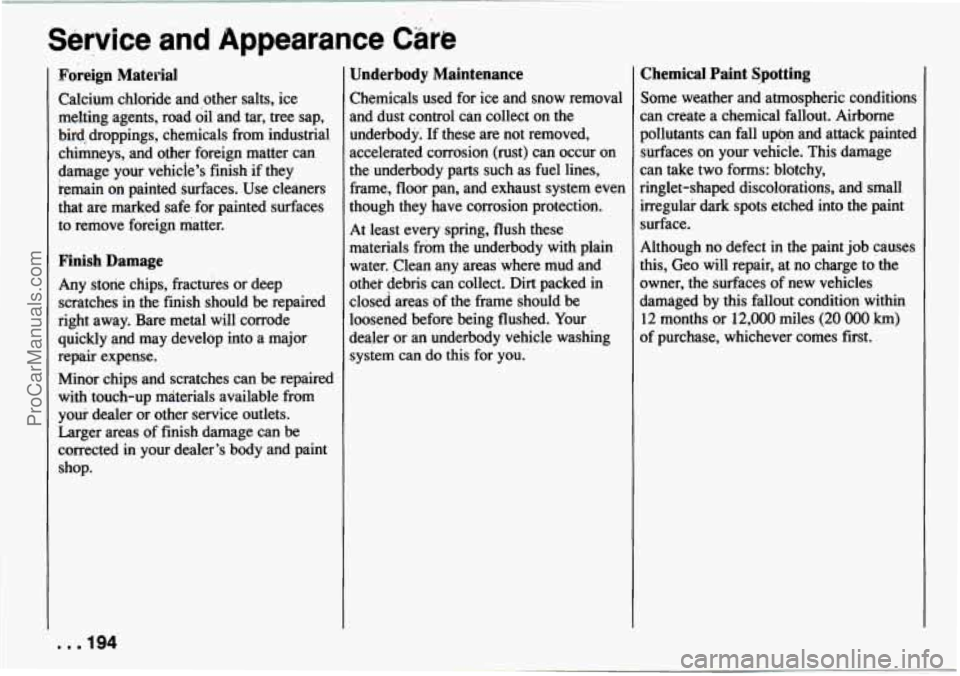
Service and Appearance Care
Foreign Material
Calcium chloride and other salts, ice
melting agents, road oil and tar,
tree sap,
bad$ droppings, chemicals from industrial
chimneys, and other foreign matter can
damage your vehicle’s finish if they
remain on painted Surfaces. Use cldners
that
&e marked safe for painted surfaces
to remove foreign matter.
Finish Damage
Any stone chips, fractui-es or deep
scratches in the finish should be repaired
right away. Bare metal will corrode
quickly and may develop into a major
repair expense.
Minor chips and scratches can be repaired
with touch-up materials available from
YOU^ dealer or other service outlets.
Larger areas
of finish damage can be
corrected in your dealer’s body and paint
shop.
Underbody Maintenance
Chemicals used for ice and snow removal
and dust control can collect on the
underbody;
If these are not removed,
accelerated corrosion (rust) can occur on
the underbody parts such as fuel lines,
frame,
floor pan, and exhaust system even
though they have corrosion protection.
At least every spring, flush these
materials
.from the underbody with plain
water. Clean any areas where mud and
othef deb& can collect.
Dirt packed in
closed areas
of the frame should be
loosened before
being flushed. Your
dealer or an underbody vehicle washing
system can do this
for you.
Chemical Paint Spotting
Some weather and atmospheric conditions
can create
a chemical fallout. Airborne
pollutants can fall up~n and attack painted
surfaces on your vehicle.
This damage
can take two forms: blotchy,
ringlet-shaped discolorations, and small
irregulai dark spots etched into the paint
surface.
Although no defect in the paint job causes
this, Geo
will repair, at no charge to the
owner, the surfaces of new vehicles
damaged by this fallout condition within
12 months or 12,000 miles (20
000 km)
of purchase, whichever comes first.
. . .I94
ProCarManuals.com
Page 204 of 258

.
IMPORTANT:
KEEP THE ENGINE OIL
AT THE PROPER
LEVEL AND CHANGE AS
RECOMMENDED
This part covers the
maintenance required
for your
Geo . Your vehicle needs these
services to retain its safety.
dependability and emission
control performance
.
Maintenance Schec
Section
Introduction: A Word about Maintenance ........................
A .
B .
C .
D .
E .
Your Vehicle and the Environment .........................
How This Part Is Organized ............................
Scheduled Maintenance Services ........................
Using Your Maintenance Schedule .......................
Selecting the Right Schedule ............................
Schedule1 .......
Schedule11 ............................................
Owner Checks and Services .........
At Each Fuel Fill .......
At Least Once a Month .................. .......
At Least Twice a Year .........
AtLeastOnceaYear ..................................
Periodic Maintenance Inspections ...........................
Recommended Fluids and Lubricants ........................
MaintenanceRecord ......................................
................................
Explanation of Scheduled Maintenance Services ..............
....................
.........................
...................
ule
Protection
Plan
Have you purchased the GM Protection Plan? The Plan
supplements
your new car warranties .
See your GM dealer for details .
204
204
204
205
205
205
206
210
214
218
218 219
219 220
223
225
228
203 ...
ProCarManuals.com