Page 21 of 385
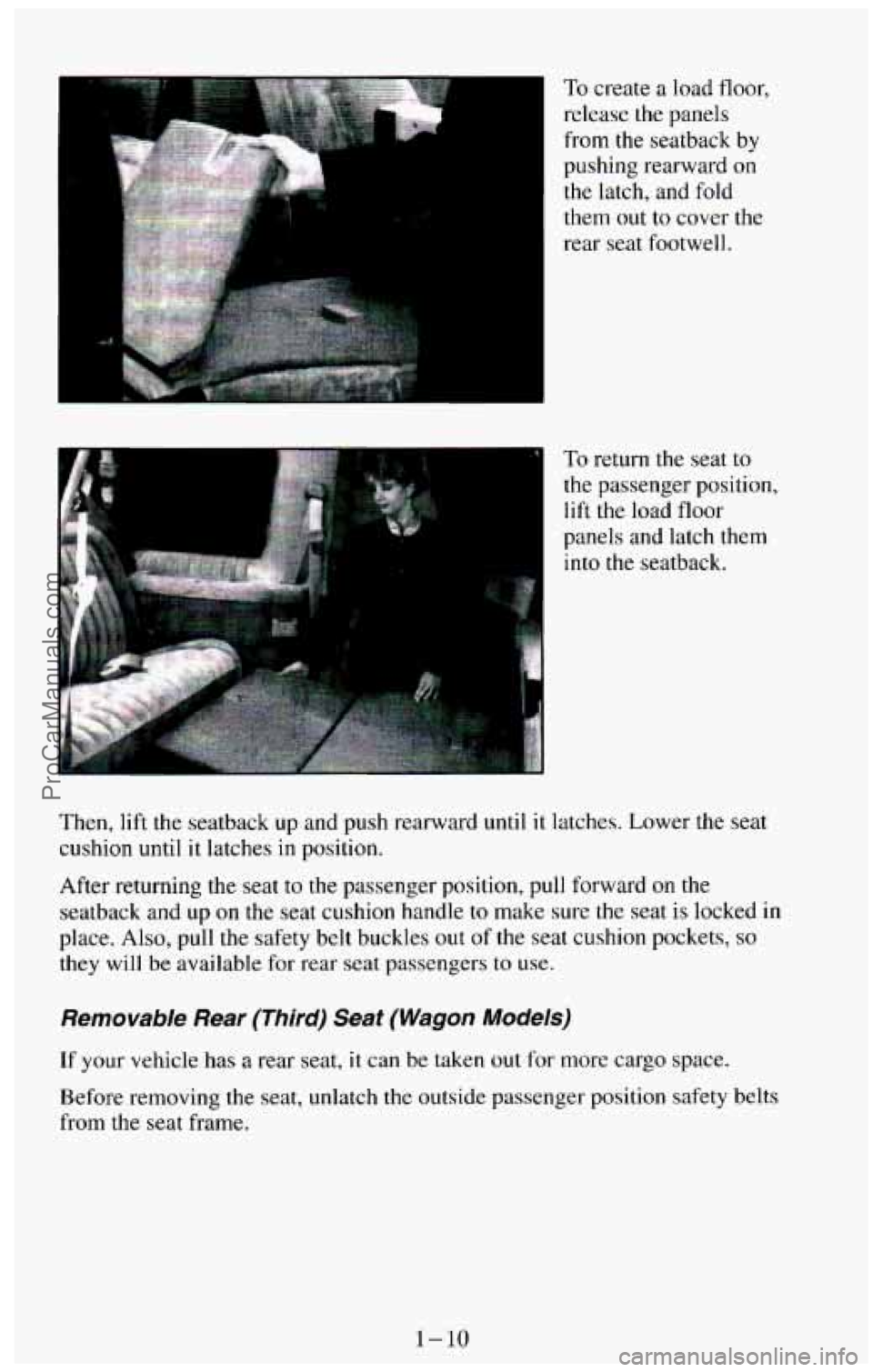
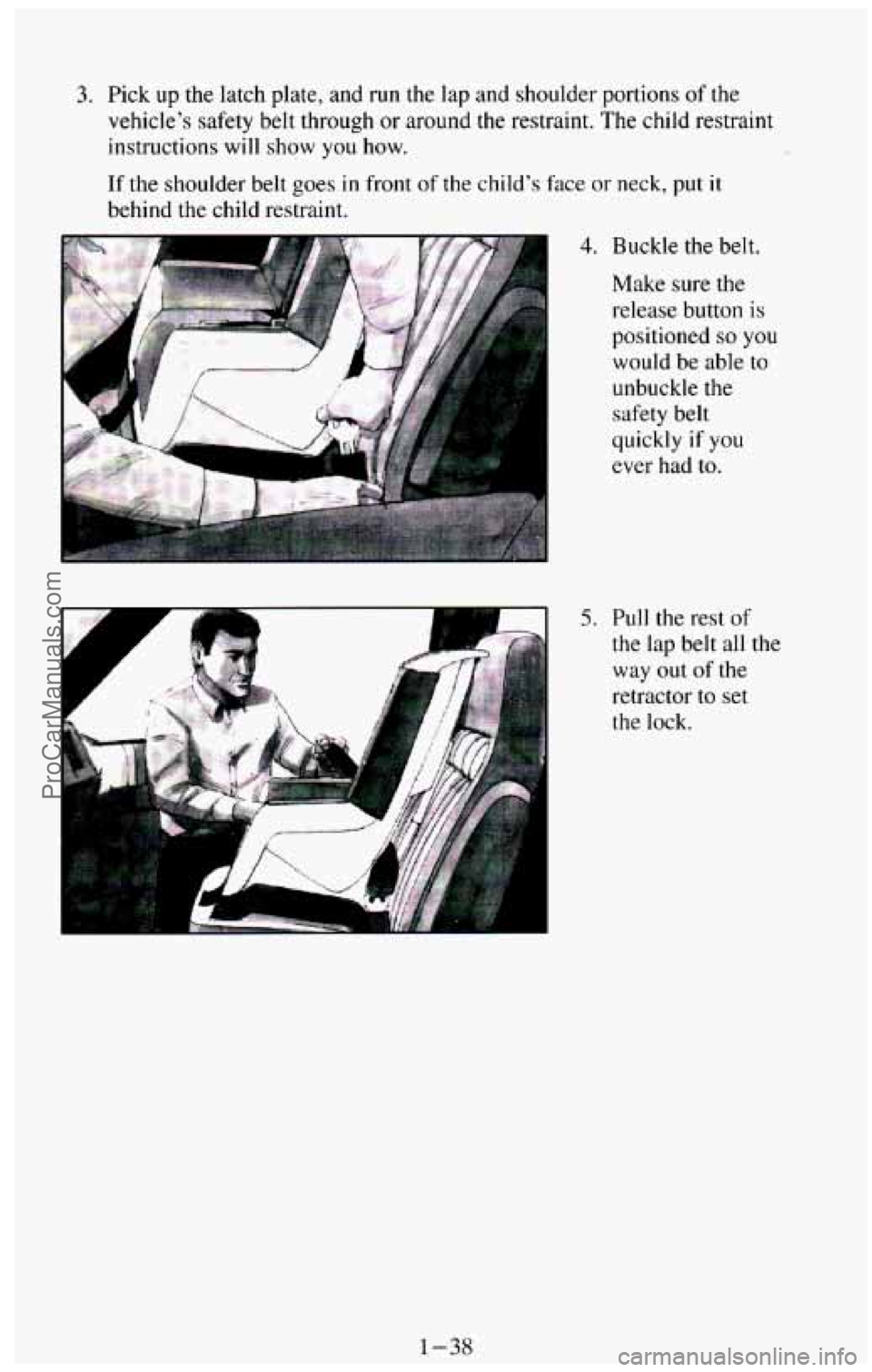
To create a load floor,
release the panels
from the seatback
by
I
pushing rearward on
the latch, and
fold
them out to cover the
rear seat footwell.
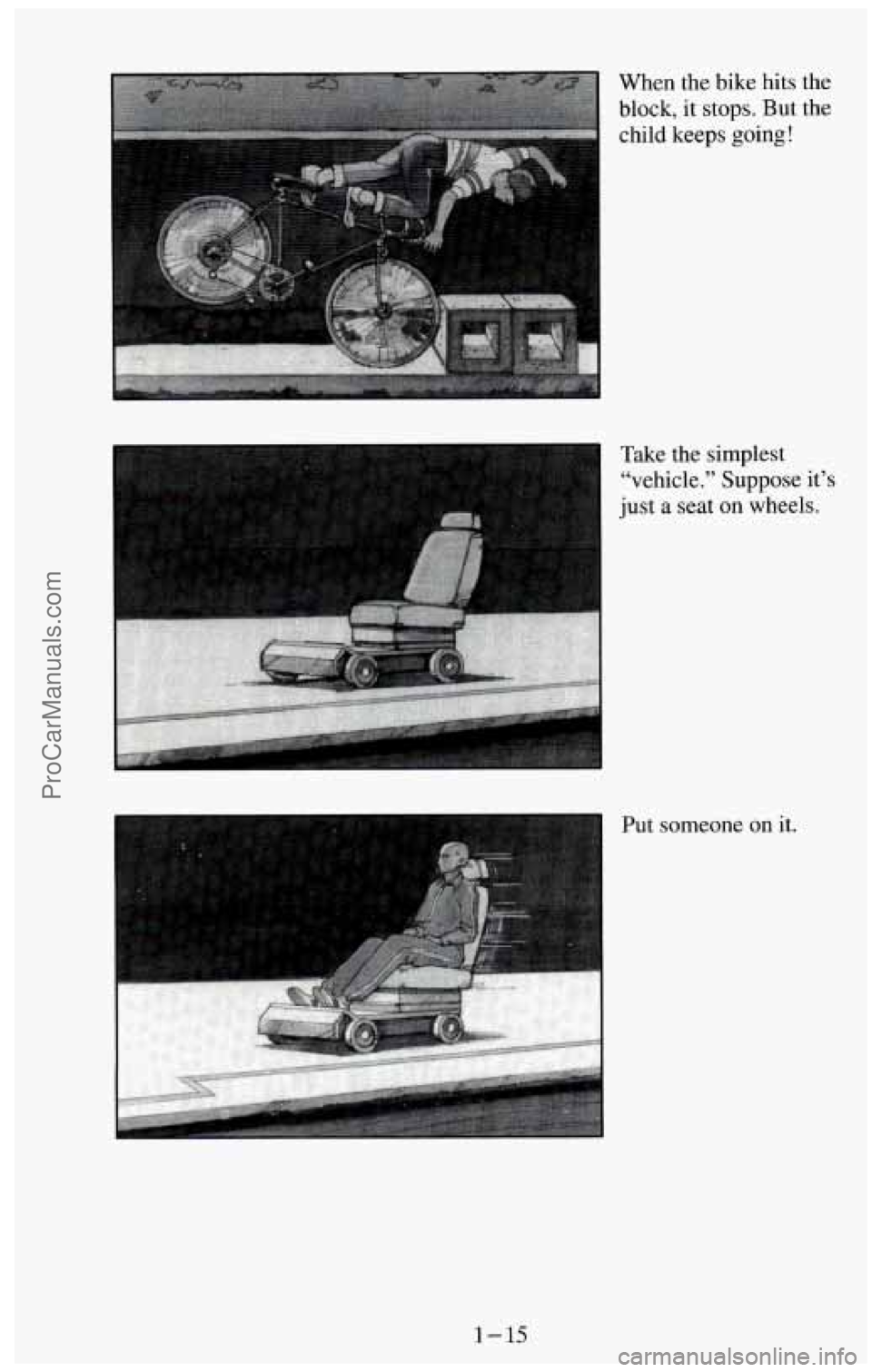
To return the seat to
the passenger position,
lift the load floor
panels and latch them
into the seatback.
Then, lift the seatback up and push rearward
until it latches. Lower the seat
cushion until it latches
in position.
After returning the seat to the passenger position, pull forward
on the
seatback and
up on the seat cushion handle to make sure the seat is locked in
place. Also, pull the safety belt buckles out of the seat cushion pockets, so
they will be available for rear seat passengers to use.
Removable Rear (Third) Seat (Wagon Models)
If your vehicle has a rear seat, it can be taken out for more cargo space.
Before removing the seat, unlatch the outside passenger position safety belts
from the seat frame.
1-10
ProCarManuals.com
Page 23 of 385
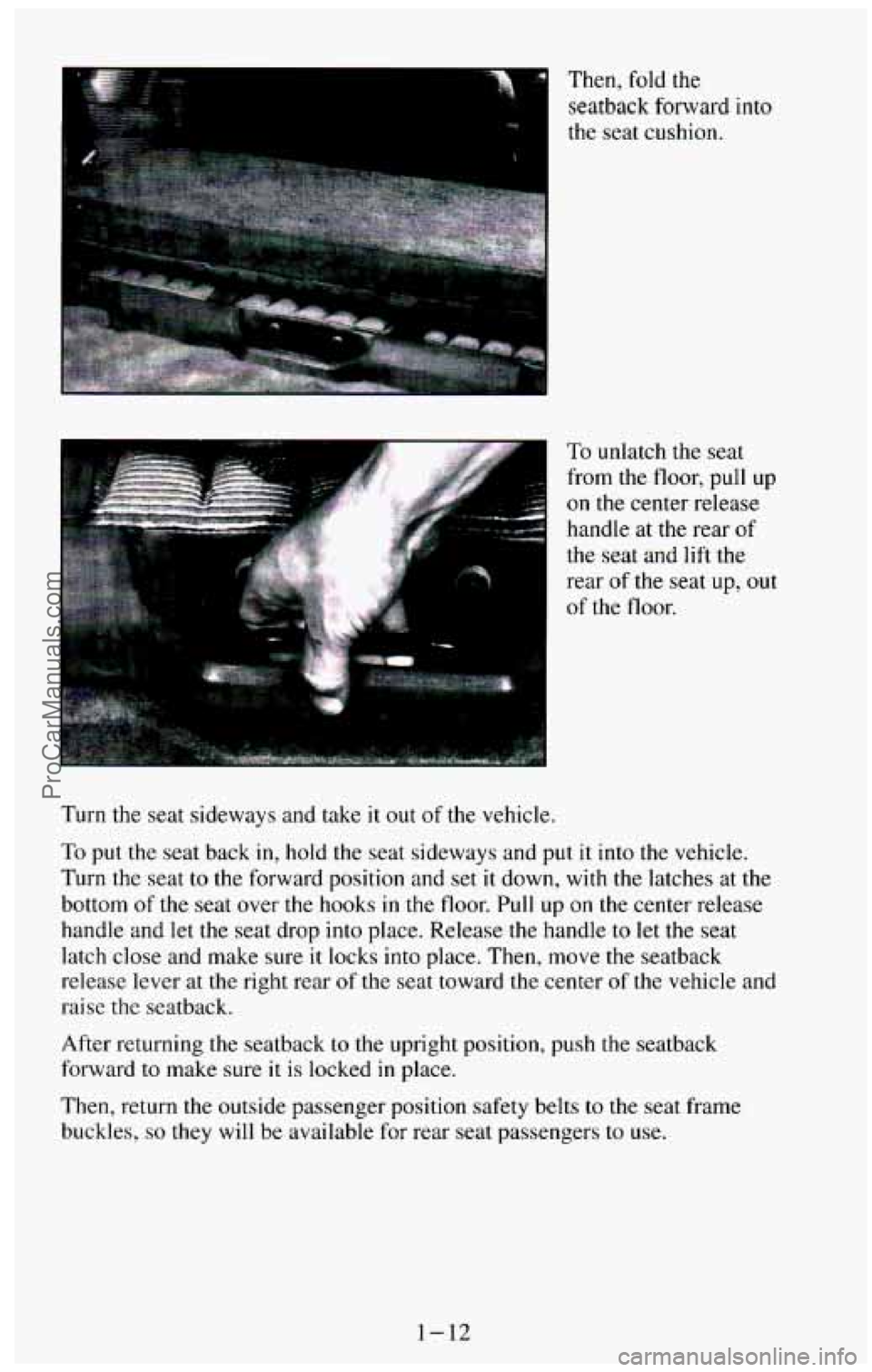
Then, fold the
seatback forward into
the seat cushion.
To unlatch the seat
from
the floor, pull up
on the center release
handle
at the rear of
the seat and lift the
rear of the seat up, out
of the floor.
Turn the seat sideways and take
it out of the vehicle.
To put the seat back in, hold the seat sideways and put it into the vehicle.
Turn
the seat to the forward position and set it down, with the latches at the
bottom
of the seat over the hooks in the floor. Pull up on the center release
handle and let the seat drop into place. Release the handle
to let the seat
latch close and make sure it locks
into place. Then, move the seatback
release lever at the right rear
of the seat toward the center of the vehicle and
raise
the seatback.
After returning the seatback
to the upright position, push the seatback
forward
to make sure it is locked in place.
Then, return the outside passenger position safety belts to the seat frame
buckles,
so they will be available for rear seat passengers to use.
1-12
ProCarManuals.com
Page 26 of 385
When the bike hits the
block, it stops. But the child keeps
going!
1
Take the simplest
“vehicle.” Suppose
it’s
just a seat on wheels.
. ....
Put someone on it.
1-15
ProCarManuals.com
Page 31 of 385
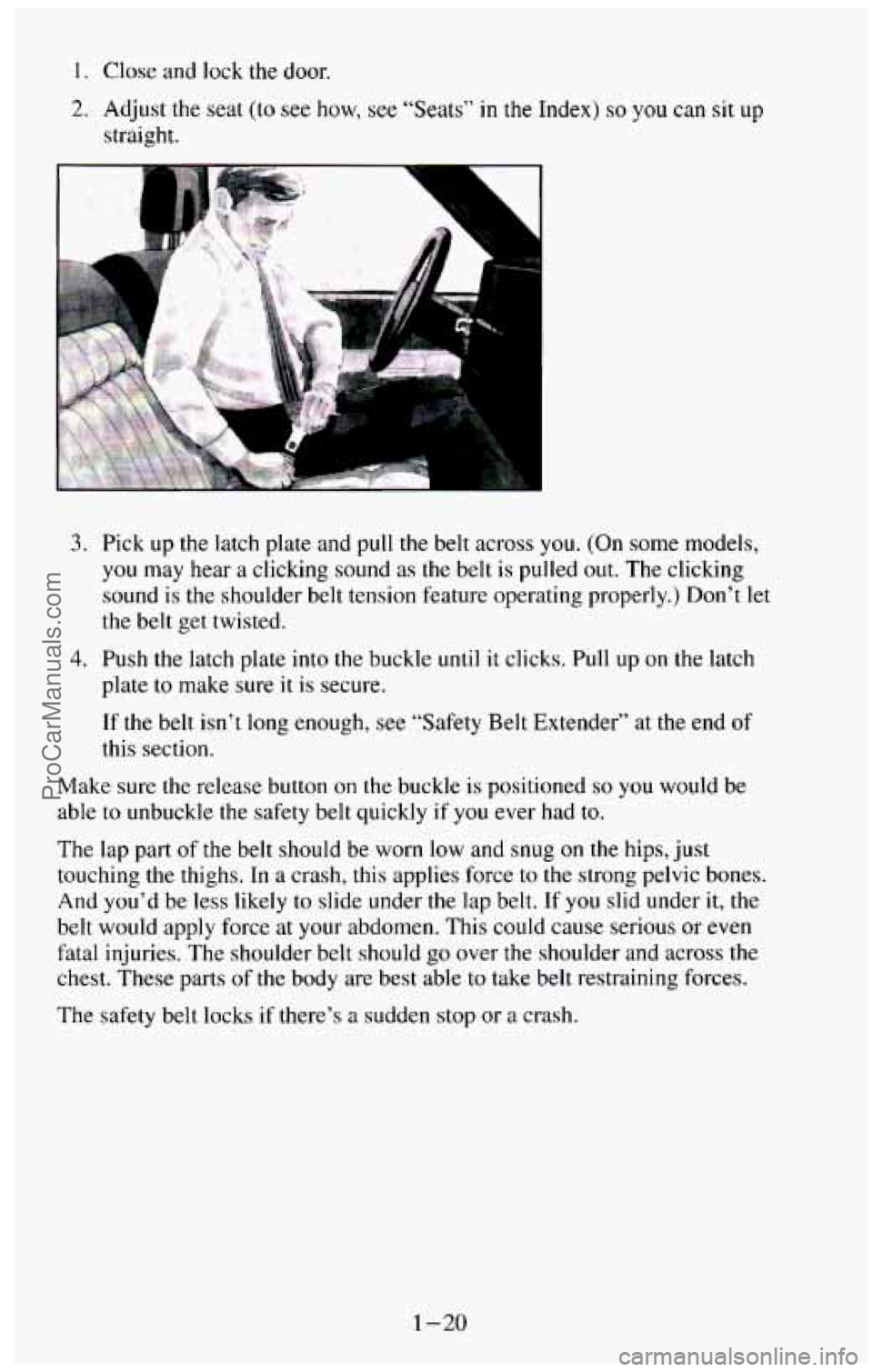
1. Close and lock the door.
2. Adjust the seat (to see how, see “Seats” in the Index) so you can sit up
straight.
L 1
3. Pick up the latch plate and pull the belt across you. (On some models,
you may hear a clicking sound as the belt is pulled out. The clicking
sound is the shoulder belt tension feature operating properly.) Don’t
let
the belt get twisted.
4. Push the latch plate into the buckle until it clicks. Pull up on the latch
plate
to make sure it is secure.
If the belt isn’t long enough, see “Safety Belt Extender’’ at the end of
this section.
Make sure the release button on the buckle
is positioned so you would be
able
to unbuckle the safety belt quickly if you ever had to.
The lap part of the belt should be worn low and snug on the hips, just
touching the thighs.
In a crash, this applies force to the strong pelvic bones.
And you’d be less likely to slide under the lap belt. If
you slid under it, the
belt would apply force
at your abdomen. This could cause serious or even
fatal injuries. The shoulder belt should go over the shoulder and across the
chest.
These parts of the body are best able to take belt restraining forces.
The safety belt locks
if there’s a sudden stop or a crash.
1-20
ProCarManuals.com
Page 37 of 385
Safety Belt Use During Pregnancy
Safety belts work for everyone, including pregnant women. Like all
occupants, they are more likely to be seriously injured
if they don’t wear
safety belts.
A pregnant woman
should wear a
lap-shoulder belt, and
the lap portion should
be worn
as low as
possible throughout
the pregnancy.
The best
way to protect the fetus is to protect the mother. When a safety belt
is worn properly, it’s more likely that the fetus won’t be hurt in a crash. For
pregnant women, as for anyone, the key to making safety belts effective
is
wearing them properly.
Right Front Passenger Position
The right front passenger’s safety belt works the same way as the driver’s
safety belt. See “Driver Position,” earlier
in this part.
When the lap portion
of the belt is pulled out all the way, it will lock. If it
does, let it go back all the way and start again.
1-26
ProCarManuals.com
Page 41 of 385
The lap part of the belt should be worn low and snug on the hips, just
touching the thighs. In
a crash, this applies force to the strong pelvic bones.
And you’d be less likely
to slide under the lap belt. If you slid under it, the
belt would apply force at your abdomen. This could cause serious or
even
fatal injuries. The shoulder belt should go over the shoulder and across the
chest.
These parts of the body are best able to take belt restraining forces.
The safety belt locks if there’s
a sudden stop or a crash.
To unlatch the belt,
just push the button on
the buckle.
1-30
ProCarManuals.com
Page 49 of 385
3, Pick up the latch plate, and run the lap and shoulder portions of the
vehicle’s safety belt through or around the restraint. The child restraint
instructions will show you how.
If the shoulder belt goes in front of the child’s face or neck, put it
behind the child restraint.
U
4. Buckle the belt.
Make sure the
release button
is
positioned so you
would be able to
unbuckle
the
safety belt
quickly
if you
ever had to.
5. Pull the rest of
the lap belt all the
way
out of the
retractor to set
the lock.
1-38
ProCarManuals.com
Page 56 of 385
Features & Controls
Section
L
r
1
Here you can learn about the many standard and optional features on your
vehicle. and information on starting. shifting and braking
. Also explained
are
the instrument panel and the warning systems that tell you if everything
is working properly-and what to do if you have a problem .
For explanation of vehicle symbols. refer to “Vehicle Symbols” in the
Introduction .
Keys ..................................................... 2-3
DoorLocks
................................................ 2-5
Your Doors and How They Work .... .................... 2-7 ..
................................................ Side Doors 2-7
Tailgate. Tailgate Glass and Rear
Doors ... ... ............... 2-8
Tailgate
........................... ...................... 2-8
PanelDoors
............................................... 2-9
Theft
.................................................... 2-10
New Vehicle Break-In
...................................... 2-11
Ignition Switch
.................................... . 2-12
Starting Your Gasoline Engine ......................... . 2-13
Driving Through Deep Standing Water
......................... 2-15
Starting Your Diesel Engine
................................. 2-16
Automatic Transmission .................................... 2-21
Five-Speed Manual Transmission
............................. 2-24
LockingRearAxle ......................................... 2-26
Parking Brake .................................... . . 2-26
2-1
ProCarManuals.com