1994 CHEVROLET SUBURBAN heating
[x] Cancel search: heatingPage 201 of 385
Making Turns
When you’re turning with a trailer, make wider turns than normal. Do this
so your trailer won’t strike soft shoulders, curbs, road signs, trees, or other
objects. Avoid jerky or sudden maneuvers. Signal well
in advance.
Turn Signals When Towing a Trailer
When you tow a trailer, your vehicle has to have a different turn signal
flasher and extra wiring, The green arrows on your instrument panel will
flash whenever you signal a turn or lane change. Properly hooked up, the
trailer lights will also flash, telling other drivers you’re about to turn,
change lanes or stop.
When towing a trailer,
the green arrows on your instrument panel will flash
for turns even if the bulbs on the trailer are burned out. Thus, you may think
drivers behind you are seeing your signal when they are not. It’s important
to check occasionally
to be sure the trailer bulbs are still working.
Driving On Grades
Reduce speed and shift to a lower gear before you start down a long or
steep downgrade. If
you don’t shift down, you might have to use your
brakes
so much that they would get hot and no longer work well.
On
a long uphill grade, shift down and reduce your speed to around 45 mph
(70 kdh) to reduce the possibility of engine and transmission overheating.
If you have an automatic transmission, you should use “D” (or, as you need
to, a lower gear) when towing
a trailer. Operating your vehicle in “D” when
towing a trailer will minimize heat buildup and extend
the life of your
transmission.
If
you have a manual transmission and you are towing a trailer, it’s better
not
to use fifth gear. Just drive in fourth gear (or, as you need to, a lower
gear).
Parking on Hills
You really should not park your vehicle, with a trailer attached, on a hill. If
something goes wrong, your rig could start to move. People can be injured,
and both your vehicle and the trailer can be damaged.
But
if you ever have to park your rig on a hill, here’s how to do it:
1. Apply your regular brakes, but don’t shift into “P’ (Park) yet, or in gear
for a manual transmission.
2. Have someone place chocks under the trailer wheels.
3. When the wheel chocks are in place, release the regular brakes until the
chocks absorb
the load.
4-42
ProCarManuals.com
Page 204 of 385
Problems On The Road
Section
.
.
Here you’ll find what to do about some problems that can occur on the road .
Hazard Warning Flasher ..................................... 5-2
Other Warning Devices .................................... 5-3
Jumpstarting .............................................. 5-3
TowingYourVehicle ........................................ 5-7
Engine Overheating ...................................... 5-10
Engine Fan Noise ...................... ................ 5-24
If a Tire Goes Flat ......................................... 5-24
Changing a Flat Tire ..................................... 5-25
SpareTire ............................................. 5-26
Jackstorage ........................................... 5-26
If You’re Stuck: In Sand. Mud. Ice or Snow ..................... 5-40
5-1
ProCarManuals.com
Page 213 of 385
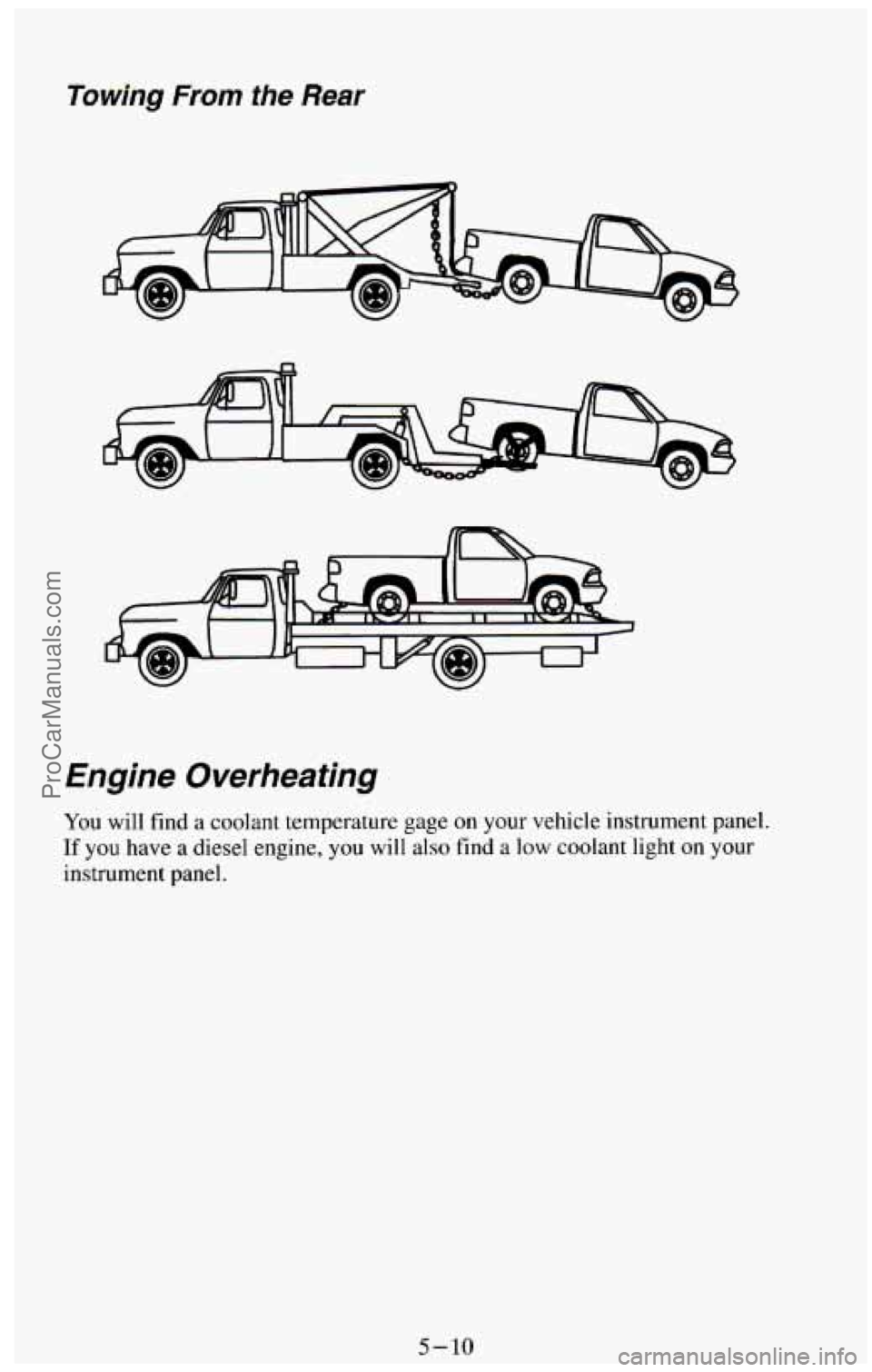
Towing From the Rear
Engine Overheating
You will find a coolant temperature gage on your vehicle instrument panel.
If you have a diesel engine, you will also find a low coolant light on your
instrument panel.
5-10 ProCarManuals.com
Page 251 of 385
What Fuel to Use
You can use either Number 1-D or Number 2-D diesel fuel, but you’ll get
better fuel economy using
2-D.
Diesel fuel may foam when you fill your tank. This can cause the automatic
pump nozzle to shut
off, even though your tank isn’t full. If this happens,
just wait
for the foaming to stop and then continue to fill your tank.
Cold Weather Operation
In cold weather (below 20”F, or -7”C), use 1-D or “Winterized” Number
2-D fuel (a blend of 1-D and 2-D). Be sure you get the right fuel. In very
cold temperatures (when it stays below
0°F or -18”C), use Number 1-D.
If you’re driving in very cold temperatures and can’t get Number 1-D or a
“winterized” Number
2-D, you can use one gallon of kerosene for every
two gallons of diesel fuel. Once you add the kerosene, run your engine for
several minutes
so the fuels will mix. Add kerosene only when the
temperature falls below
0°F (-1 8 “C), because the fuel economy of kerosene
isn’t as good
as that of diesel fuel.
NOTICE:
Never use home heating oil or gasoline in your diesel engine.
They can cause engine damage.
In cold weather, your fuel filter may become clogged, especially if you use
Number 2-D diesel fuel that hasn’t been “winterized.” To unclog it, warm
the filter to between
32°F and 50°F (0°C to 10°C). You won’t need to
replace it.
6-6
ProCarManuals.com
Page 280 of 385
Front Axle
When to Check and Change Lubricant
Refer to the Maintenance Schedule to determine how often to check the
lubricant and when to change
it. See “Scheduled Maintenance Services” in
the Index.
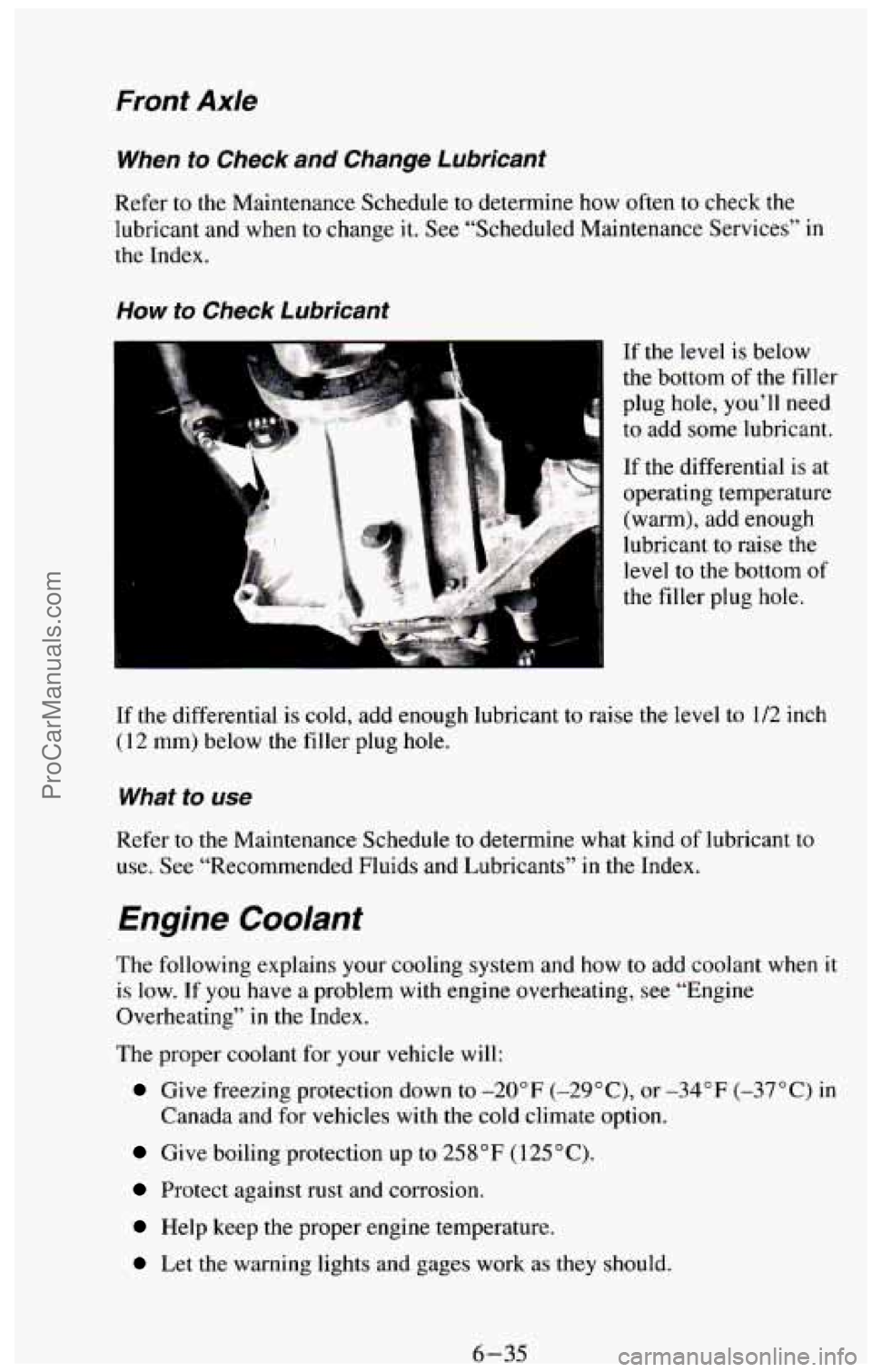
How to Check Lubricant
If the level is below
the bottom of the filler
plug hole, you’ll need
to add some lubricant.
If the differential is at
operating temperature
(warm), add enough
lubricant to raise the level
to the bottom of
the filler plug hole.
If the differential is cold, add enough lubricant to raise the level to
1/2 inch
(12 mm) below the filler plug hole.
What to use
Refer to the Maintenance Schedule to determine what kind of lubricant to
use. See “Recommended Fluids and Lubricants” in the Index.
Engine Coolant
The following explains your cooling system and how to add coolant when it
is low. If you have a problem with engine overheating, see “Engine
Overheating”
in the Index.
The proper coolant for your vehicle will:
Give freezing protection down to -20°F (-29”C), or -34°F (-37°C) in
Give boiling protection up to 258°F (1 25°C).
Protect against rust and corrosion.
Help keep the proper engine temperature.
Canada
and for vehicles with the cold climate option.
Let the warning lights and gages work as they should.
6-35 ProCarManuals.com
Page 284 of 385
Radiator Pressure Cap-Gas Engines
I I
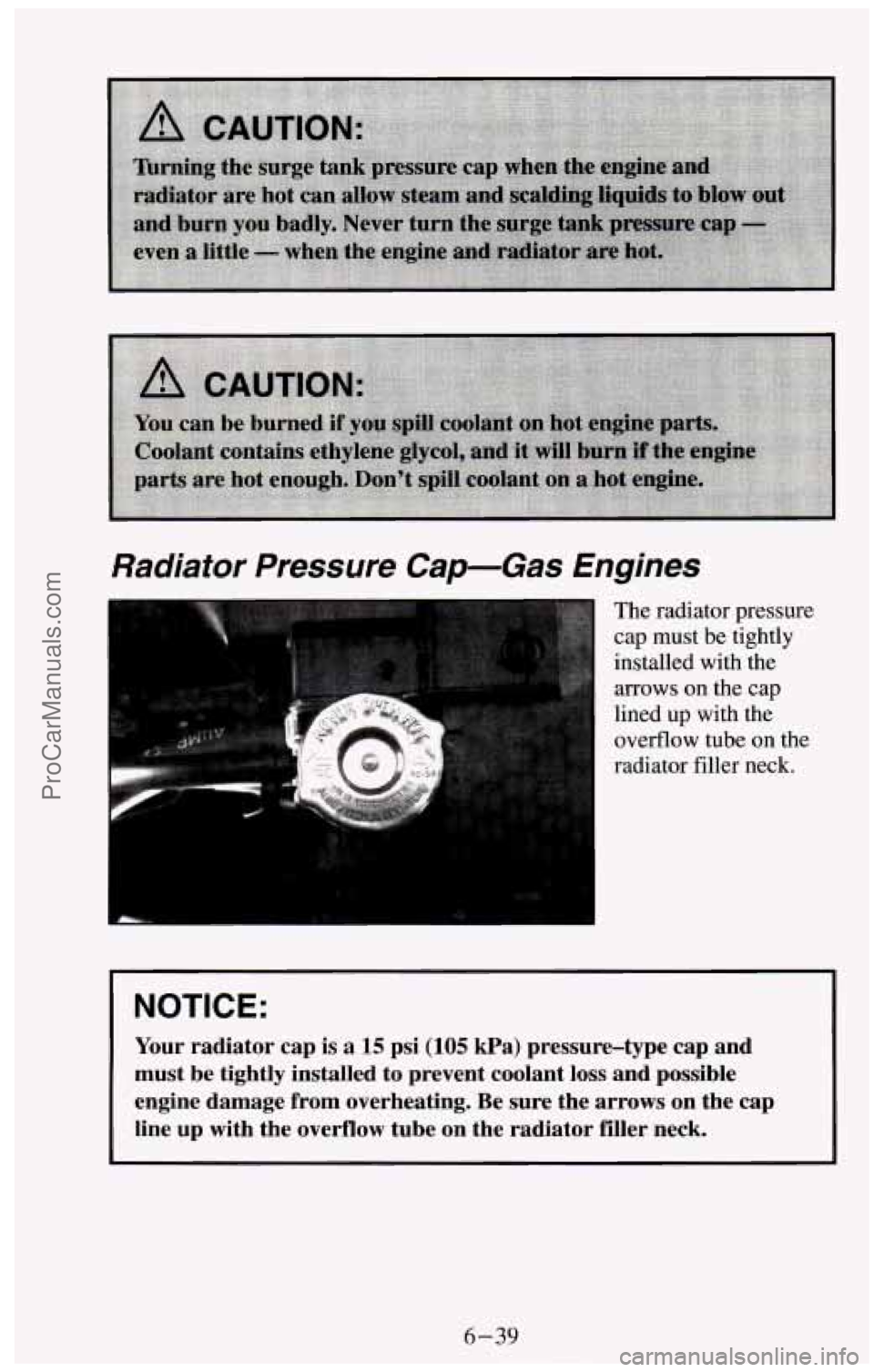
The radiator pressure
cap must be tightly
installed with the
arrows on the cap
lined up with the
ovefflow tube on the
radiator filler neck.
NOTICE:
Your radiator cap is a 15 psi (105 kPa) pressure-type cap and
must be tightly installed
to prevent coolant loss and possible
engine damage from overheating. Be sure the arrows on the cap
line up with the overflow tube on the radiator filler neck.
ProCarManuals.com
Page 285 of 385
Surge Tank Pressure Cap- Diesel Engines
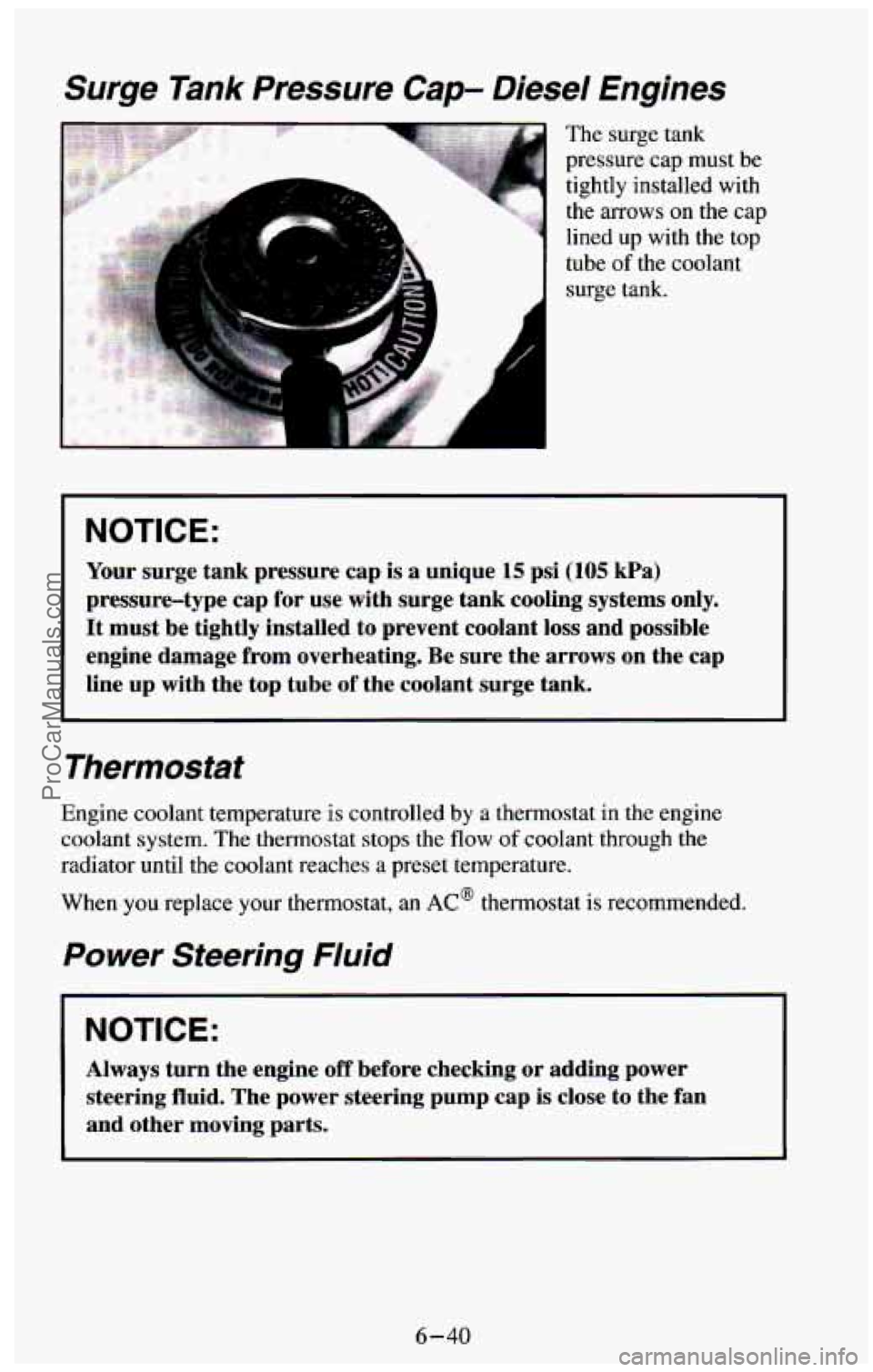
The surge tank
pressure cap must be
tightly installed with
the arrows
on the cap
lined up with the top
tube
of the coolant
surge tank.
NOTICE:
Your surge tank pressure cap 1s a unique 15 psi (105 kPa)
pressure-type cap for use with surge tank cooling systems only.
It must be tightly installed to prevent coolant loss and possible
engine damage from overheating. Be sure the arrows on the cap
line up with the top tube
of the coolant surge tank.
Thermostat
Engine coolant temperature is controlled by a thermostat in the engine
coolant system. The thermostat stops the flow
of coolant through the
radiator until the coolant reaches a preset temperature.
When you replace your thermostat, an
AC@ thermostat is recommended.
Power Steering Fluid
I NOTICE:
Always turn the engine off before checking or adding power
steering
fluid. The power steering pump cap is close to the fan
and other moving parts.
6-40
ProCarManuals.com
Page 377 of 385
Driving (continued)
Braking
...................................................... 4-5
Control
of A Vehicle ............................................ 4-4
Defensive
.................................................... 4-2
Downhill
.................................................... 4-18
Guidelines
................................................... 4-11
Highway Hypnosis
............................................ 4-29
Hydroplaning
................................................ 4-26
In Blizzard ................................................... 4-33
InCity
...................................................... 4-26
InRain
...................................................... 4-24
In Sand, Mud, Ice, Or Snow ................................ 4-21, 5-40
InWater ..................................................... 4-22
LongDistance
................................................ 4-28
LossofControl
............................................... 4-10
Nightvision
................................................. 4-24
Off-Roading
................................................. 4-12
OnCurves
.................................................... 4-7
OnGrades
................................................... 4-42
On Hill and Mountain Roads .................................... 4-29
On Off-Road
Hills ............................................ 4-15
OnSnoworIce
............................................... 4-31
Passing
...................................................... 4-9
Skidding
.................................................... 4-11
Stuck in Deep
Snow ...................................... 4-33, 5-40
Throughwater .......................................... 2-15, 4-22
Uphill
...................................................... 4-16
Winter
...................................................... 4-30
WithaTrailer ................................................ 4-36
DrunkenDriving
................................................. 4-2
Freeway
..................................................... 4-27
E
Electrical System
Engine Add-on
Equipment
...........................................
Adding Coolant ..................................... 5-14,5-20.
Aircleaner
..................................................
Block Heater ........................................ 2-1 9,3-5,
Computer Command Control System
..............................
Coolant ...................
Coolant Temperature Gage ....
Cooling System .............
Crankcase .................
Exhaust ...................
Fan Noise .................
Identification ...............
Leaving Vehicle While Running
Oil (See “Oil”)
Overheating
................
Running While Parked .......
Starting ...................
Equipment. Add-on .........
Exhaust System .............
..................................
..................................
..................................
..................................
..................................
..................................
............................. 6-79,
..................................
..................................
..................................
............................. 2-13,
..................................
..................................
6-80
6-37
6-27
6-21
6-58
6-35
2-75
5-12
6-82
5-24 2-31
6-81
2-31
5-10
2-31
2-16
6-61
6-58
3 ProCarManuals.com