Page 64 of 385
Open the tailgate by lifting up on the handle while pulling the tailgate
toward you.
Close the tailgate before closing the rear glass. After closing, make sure the
tailgate
is securely latched by pulling it toward you. After closing the rear
glass, pull up
on its handle to make sure it is locked.
Panel Doors
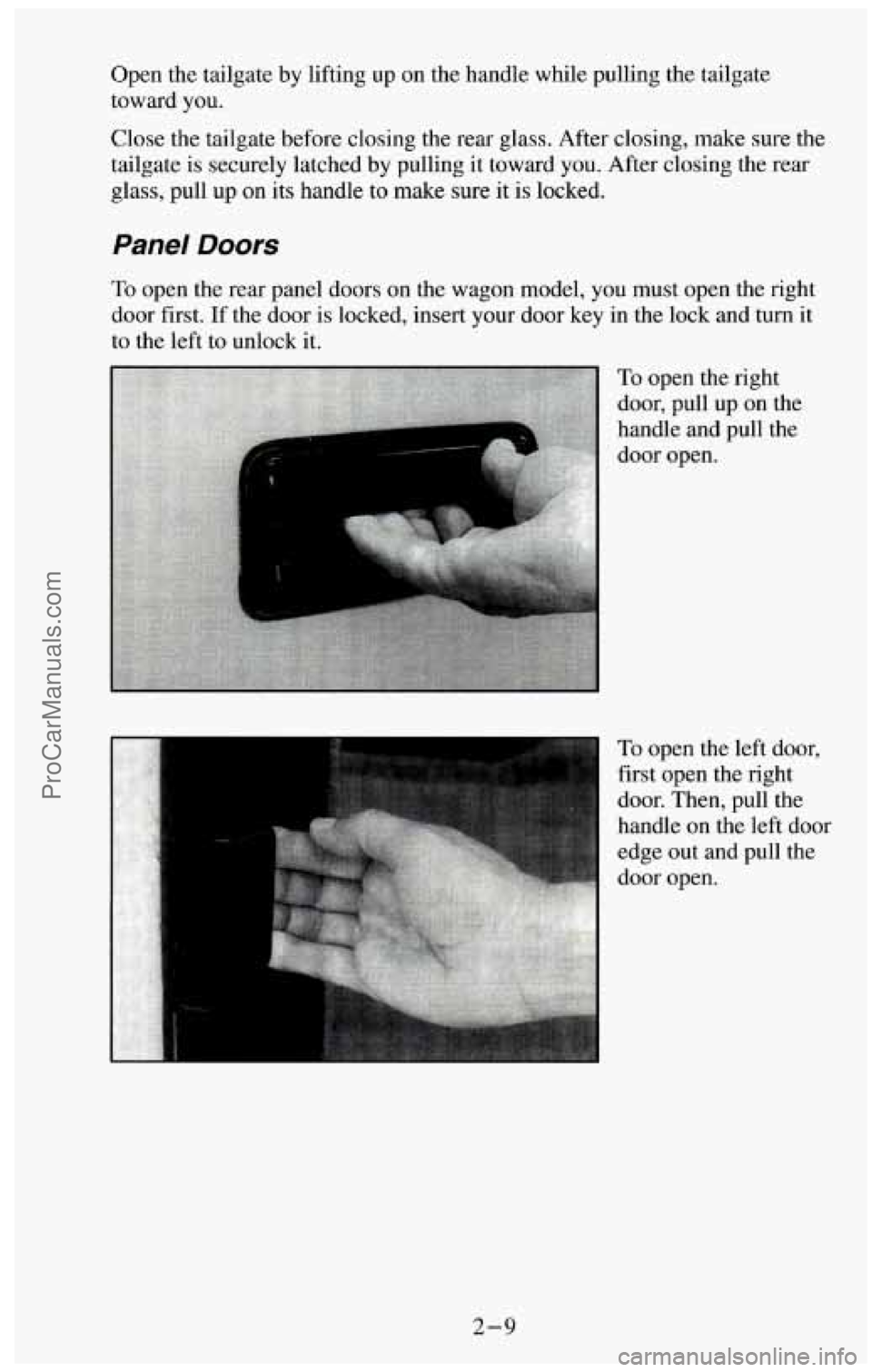
To open the rear panel doors on the wagon model, you must open the right
door first.
If the door is locked, insert your door key in the lock and turn it
to the left to unlock it.
To open the right
door, pull up on the
handle and pull the
door open.
To open the left door,
first open the right
door.
Then, pull the
handle on the left door
edge out and pull the
door
open.
2-9
ProCarManuals.com
Page 65 of 385
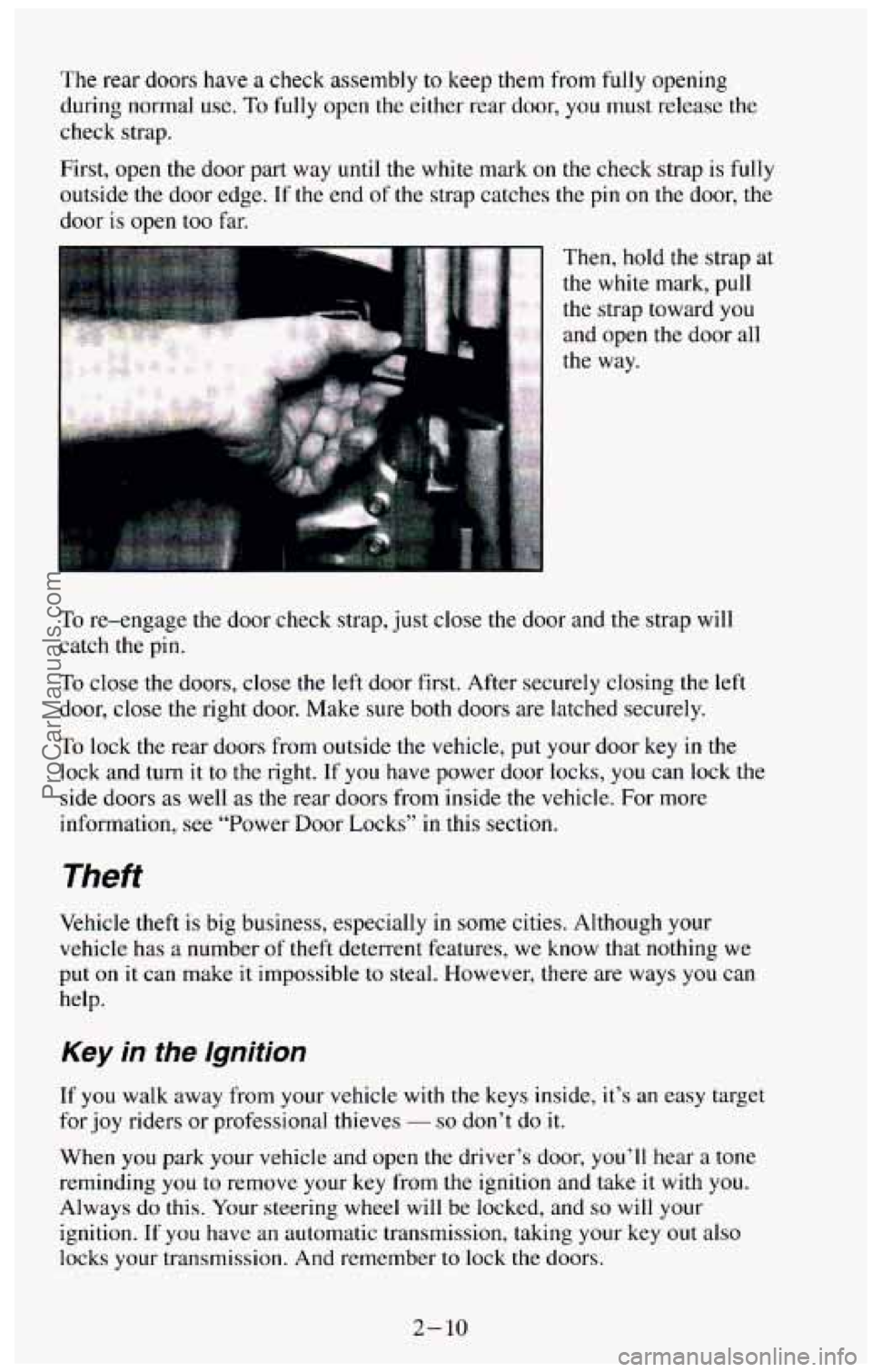
The rear doors have a check assembly to keep them from fully opening
during normal use.
To fully open the either rear door, you must release the
check strap.
First, open the door part way
until the white mark on the check strap is fully
outside the door edge. If the end of the strap catches the pin on the door, the
door is open too far,
Then, hold the strap at
the white mark, pull
the strap toward
you
and open the door all
the way.
To re-engage the door check strap, just close the door and the strap will
catch the pin.
To close the doors, close the left door first. After securely closing the left
door, close the right door. Make sure both doors are latched securely.
To lock the rear doors from outside the vehicle, put your door key in the
lock and turn it to the right. If you have power door locks, you can lock the
side doors as well as the rear doors from inside the vehicle. For more
information, see “Power Door Locks” in this section.
Theft
Vehicle theft is big business, especially in some cities. Although your
vehicle has a number of theft deterrent features, we
know that nothing we
put
on it can make it impossible to steal. However, there are ways you can
help.
Key in the lgnition
If you walk away from your vehicle with the keys inside, it’s an easy target
for
joy riders or professional thieves - so don’t do it.
When you park your vehicle and open the driver’s door, you’ll hear a tone
reminding
you to remove your key from the ignition and take it with you.
Always
do this. Your steering wheel will be locked, and so will your
ignition.
If you have an automatic transmission, taking your key out also
locks your transmission. And remember to lock the doors.
2- 10
ProCarManuals.com
Page 134 of 385
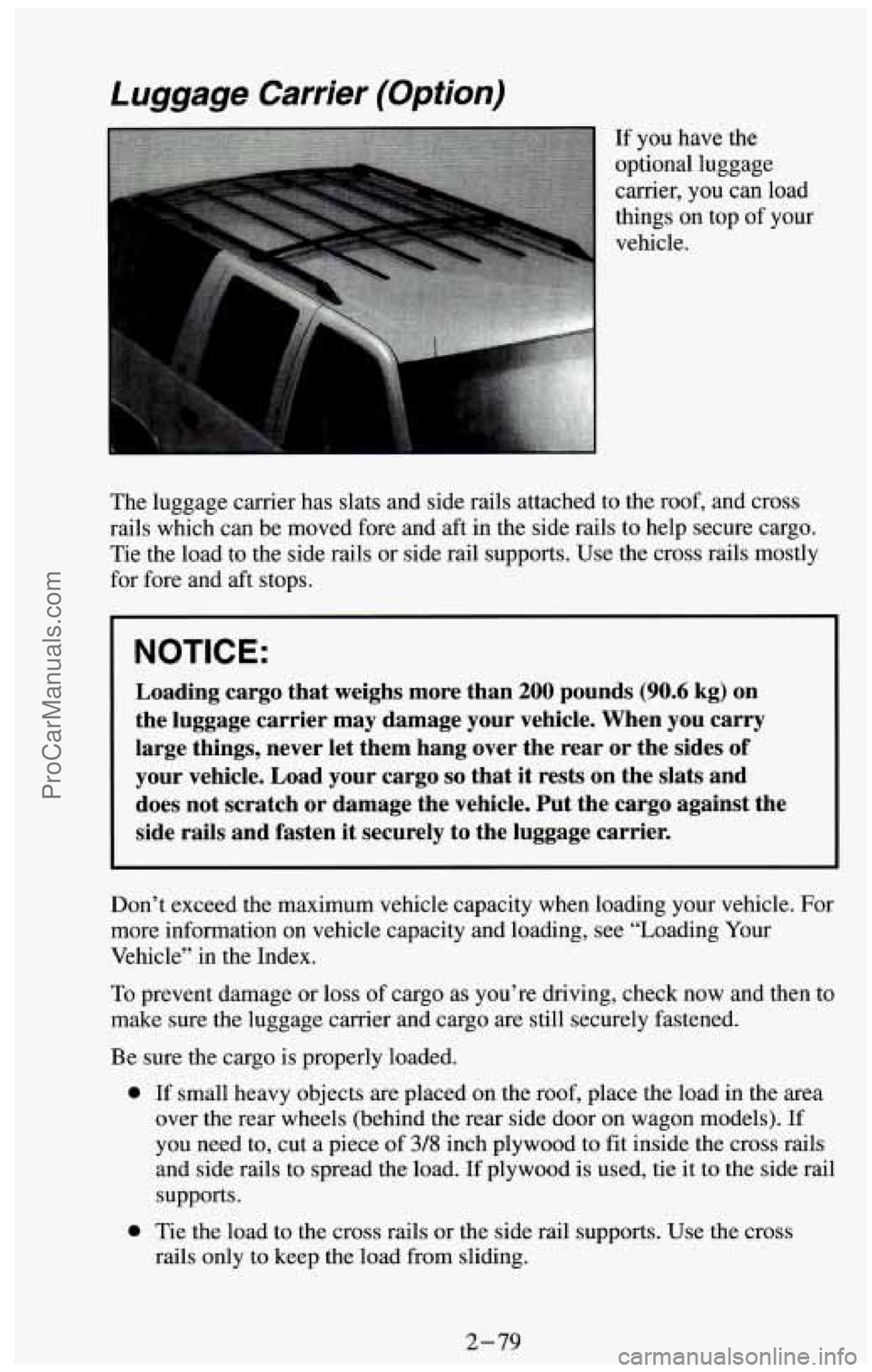
Luggage Carrier (Option)
The luggage carrier has slats and side rails attached to the roof, and cross
rails which can be moved fore and aft in the side rails to help secure cargo.
Tie the load
to the side rails or side rail supports. Use the cross rails mostly
for fore and aft stops.
NOTICE:
Loading cargo that weighs more than 200 pounds (90.6 kg) on
the luggage carrier may damage your vehicle. When you carry
large things, never let them hang over the rear or the sides of
your vehicle. Load your cargo
so that it rests on the slats and
does not scratch or damage the vehicle. Put the cargo against the
side rails and fasten
it securely to the luggage carrier.
Don’t exceed the maximum vehicle capacity when loading your vehicle. For
more information on vehicle capacity and loading, see “Loading Your
Vehicle” in the Index.
To prevent damage or loss of cargo as you’re driving, check now and then to
make sure the luggage carrier and cargo are still securely fastened.
Be sure the cargo is properly loaded.
0 If small heavy objects are placed on the roof, place the load in the area
over the rear wheels (behind the rear side door
on wagon models). If
you need to, cut a piece of 3/8 inch plywood to fit inside the cross rails
and side rails to spread the load.
If plywood is used, tie it to the side rail
supports.
0 Tie the load to the cross rails or the side rail supports. Use the cross
rails only
to keep the load from sliding.
2-79
ProCarManuals.com
Page 135 of 385
If you need to carry long items, move the cross rails as far apart as they
will go. Tie the load to the cross rails and the side rails or side rail
supports. Also tie
the load to the bumpers. Do not tie the load so tightly
that the cross rails or side rails are damaged.
After moving the cross rails, be sure to tighten all the slider screws.
Trailer Wiring Harness (Option)
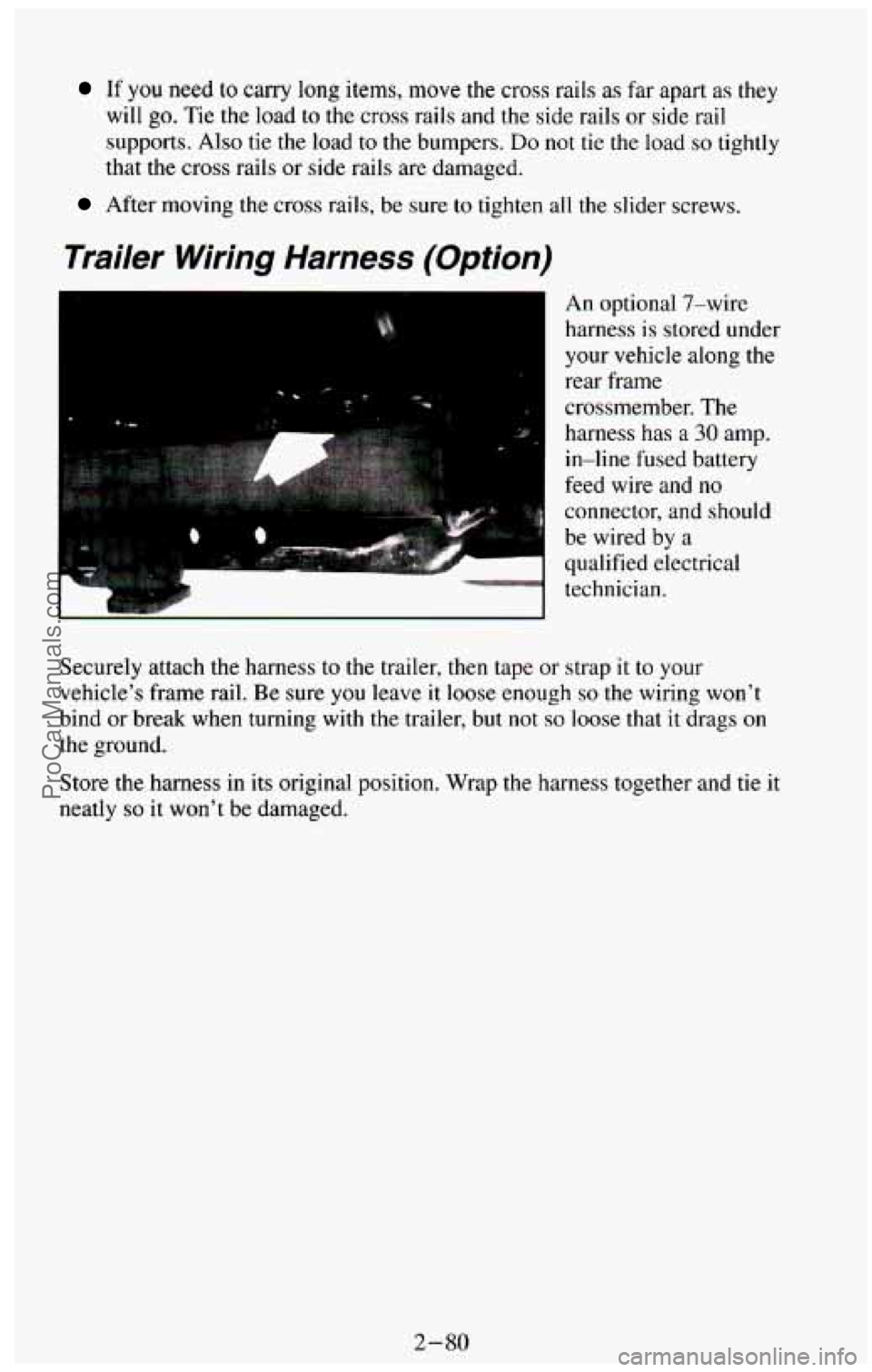
An optional 7-wire
harness
is stored under
your vehicle along the
rear frame
crossmember. The
harness has a
30 amp.
in-line fused battery
feed wire and no
connector, and should
be wired by a
qualified electrical
technician.
Securely attach the harness
to the trailer, then tape or strap it to your
vehicle’s frame rail. Be sure
you leave it loose enough so the wiring won‘t
bind or break when turning with the trailer, but
not so loose that it drags on
the ground.
Store the harness in its original position. Wrap the harness together and tie it
neatly so it won’t be damaged.
2-80
ProCarManuals.com
Page 171 of 385
Off-Road Driving with Your
Four- Wheel Drive Vehicle
This off-road guide is for vehicles that have four-wheel drive.
Also, see “Anti-lock Brakes”
in the Index.
If your vehicle doesn’t have four-wheel drive, you shouldn’t drive off-road
unless you’re
on a level, solid surface.
Off-road driving
can be great fun. But it does have some definite hazards.
The greatest of these is the terrain itself.
“Off-roading” means you’ve left the great North American road system
behind. Traffic lanes aren’t marked. Curves aren’t banked. There are no
road signs. Surfaces can be slippery, rough, uphill or downhill. In short,
you’ve gone right back
to nature.
Off-road driving involves some new skills. And that’s
why it’s very
important that you read this guide. You’ll find many driving tips and
suggestions. These will help make your off-road driving safer and more
enjoyable.
Before You Go Off-Roading
There are some things to do before you go out. For example, be sure to have
all necessary maintenance and service work done. Be sure you read
all the
information about your four-wheel drive vehicle
in this manual. Is there
enough fuel?
Is the spare tire fully inflated? Are the fluid levels up where
they should be? What are the local laws that apply to off-roading where
you’ll be driving? If you don’t know, you should check
with law
enforcement people in the area. Will you be on someone’s private land? If
so, be sure to get the necessary permission.
Loading Your Vehicle for Off-Road Driving
There are some important things to remember about how to load your
vehicle.
The heaviest things should be on the load floor and forward of your
Be sure the load is secured properly, so driving on the off-road terrain
rear axle.
Put heavier items as far forward as you can.
doesn’t toss things around.
4-12
ProCarManuals.com
Page 190 of 385
Winter Driving
Here are some tips for winter driving:
0 Have your vehicle in good shape for winter. Be sure your engine
coolant
mix is correct.
0 You may want to put winter emergency supplies in your vehicle.
Include an ice scraper, a small brush or broom, a supply
of windshield
washer fluid, a rag, some winter outer clothing, a small shovel, a flashlight,
a red cloth, and a couple
of reflective warning triangles. And, if you will be
driving under severe conditions, include a small bag of sand, a piece
of old
carpet or a couple of burlap bags to help provide traction. Be sure you
properly secure these items in your vehicle.
Driving on Snow or Ice
Most of the time, those places where your tires meet the road probably have
good traction.
However, if there is snow or ice between your tires and the road, you can
have a very slippery situation. You’ll have a lot less traction or “grip” and
will need
to be very careful.
4-31
ProCarManuals.com
Page 200 of 385
During your trip, check occasionally to be sure that the load is secure, and
that the lights and any trailer brakes are still working.
Following Distance
Stay at least twice as far behind the vehicle ahead as you would when
driving your
vehicle without a trailer. This can help you avoid situations that
require heavy braking and sudden turns.
Passing
You’ll need more passing distance up ahead when you’re towing a trailer.
And, because you’re a good deal longer, you’ll need
to go much farther
beyond the passed vehicle
before you can return to your lane.
Backing Up
Hold the bottom of the steering wheel with one hand. Then, to move the
trailer to
the left, just move that hand to the left. To move the trailer to the
right, move your hand to the right. Always back up slowly and,
if possible,
have someone guide you.
4-41 ProCarManuals.com
Page 230 of 385
e
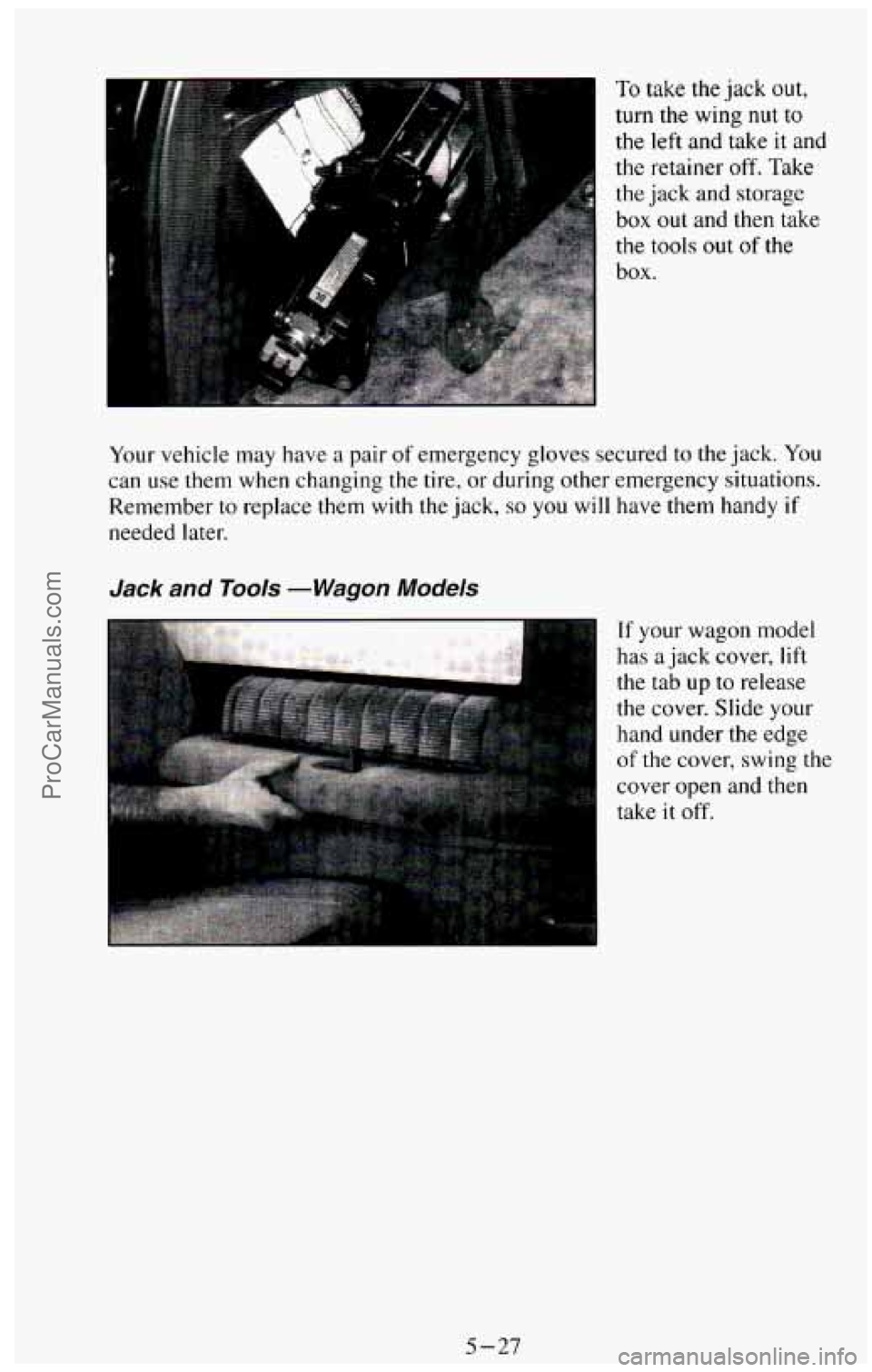
To take the jack out,
turn the wing
nut to
the left and take it and
the retainer
off. Take
the jack and storage
box
out and then take
the
tools out of the
box.
Your vehicle may have
a pair of emergency gloves secured to the jack. You
can use them when changing the tire, or during other emergency situations.
Remember to replace them
with the jack, so you will have them handy if
needed later.
Jack and Tools -Wagon Models
If your wagon model
has a jack cover,
lift
the tab up to release
the cover. Slide your
hand under the edge
of the cover, swing the
cover open
and then
take
it off.
5-27
ProCarManuals.com