1994 CHEVROLET S10 trailer
[x] Cancel search: trailerPage 201 of 340
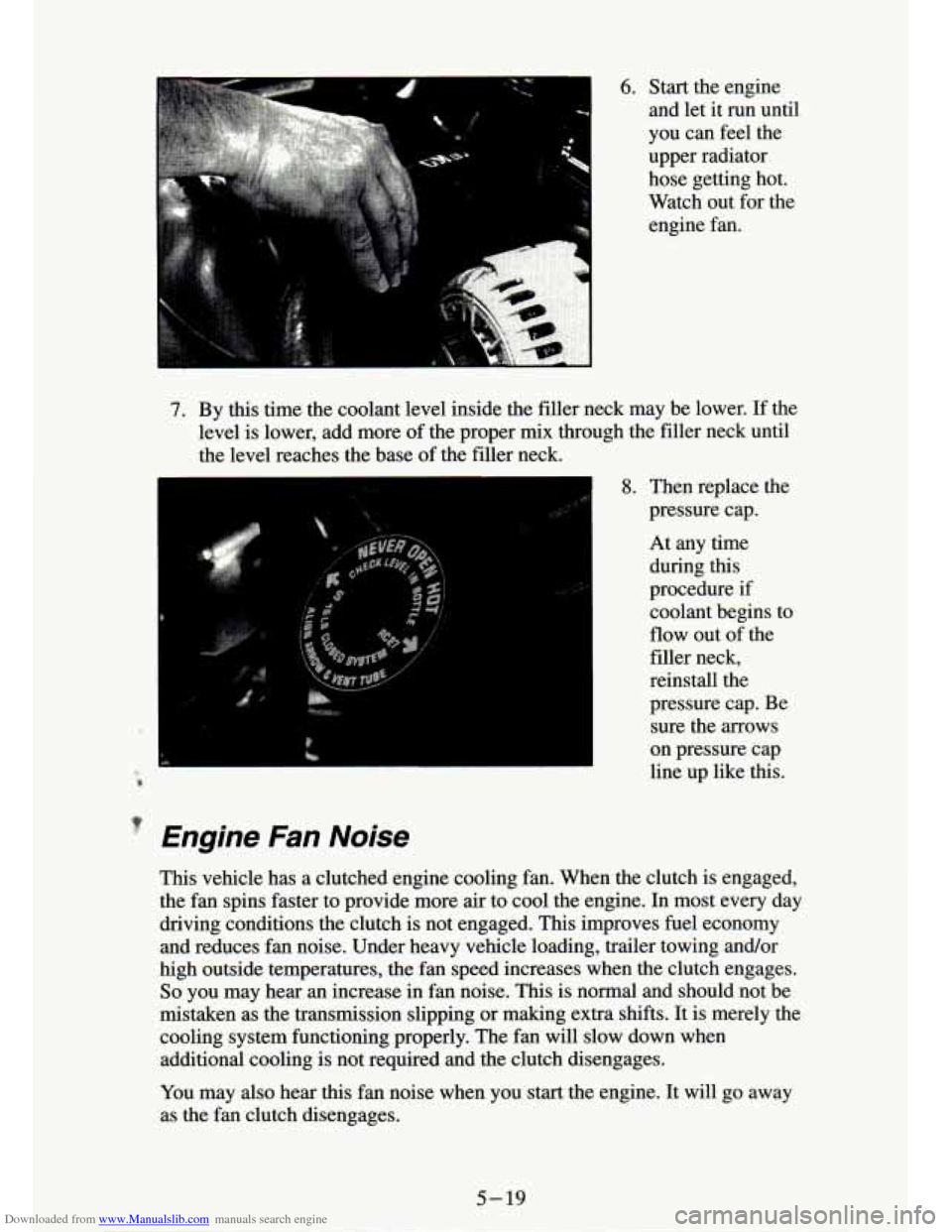
Downloaded from www.Manualslib.com manuals search engine 7. By this time the coolant level inside the filler neck may be lower. If the
level is lower, add more of the proper
mix through the filler neck until
the level reaches the base of the filler neck.
8. Then replace the
pressure cap.
At any time during
this
procedure if coolant begins to
flow out of the
filler neck,
reinstall the
pressure cap. Be sure the arrows
on pressure cap
line up like this.
P
' Engine Fan Noise
This vehicle has a clutched engine cooling fan. When the clutch is engaged,
the fan spins faster to provide more air
to cool the engine. In most every day
driving conditions the clutch is not engaged. This improves fuel economy
and reduces fan noise. Under heavy vehicle loading, trailer towing and/or
high outside temperatures, the fan speed increases when the clutch engages.
So you may hear an increase in fan noise. This is normal and should not be
mistaken as the transmission slipping or making extra shifts. It is merely the
cooling system functioning properly. The fan will slow down when
additional cooling is not required and the clutch disengages.
You may also hear this fan noise when you
start the engine. It will go away
as the
fan clutch disengages.
5-19
Page 231 of 340
Downloaded from www.Manualslib.com manuals search engine Engine Oil Additives
Don’t add anything to your oil. Your GM dealer is ready to advise if you
think something should be added.
When to Change Engine Oil
See if any one of these is true for you:
Most trips are less than 4 miles (6 km).
0 It’s below freezing outside and most trips are less than 10 miles (16
km).
The engine is at low speed most of the time (as in door-to-door
delivery, or in stop-and-go traffic).
You tow a trailer often.
Most trips are through dusty places.
0 The vehicle is frequently operated off-road.
If any one of these is true for your vehicle, then you need to change your oil
andfilter every 3,000 miles (5 000 km) or 3 months - whichever comes
first.
If none of them is true, change the oil every
7,500 miles (12 500 km) or 12
months - whichever comes first. Change the filter at the first oil change
and at every other oil change after that.
Four-wheel Drive Remote Oil Filter
If your vehicle has four-wheel drive, you will have a remote oil filter
located under the radiator support. There is a special access \
door in the
vehicle body skirt shield.
Engine Coolant Heater (Engine Block Heater)
An engine coolant heater can be a big help if you have to park outside in
very cold weather,
0 “F (-1 8 O C) or colder. If your vehicle has this option,
see “Engine Coolant Heater
” in the Index.
What to Do with Used Oil
Did you know that used engine oil contains certain elements that may be
unhealthy for your skin and could even cause cancer? Don’t let used oil stay
on your skin for very long. Clean your skin and nails with soap and water,
or a good hand cleaner. Wash or properly throw away clothing or rags
containing wed engine oil. (See the manufacturer’s warnings about the use
and disposal of oil products.)
6-13
Page 234 of 340
Downloaded from www.Manualslib.com manuals search engine . . . -*
I NOTICE:
Too much or too little fluid can damage your transmission. Too
much can mean that some of the fluid could come out and fall on
hot engine parts or exhaust system, starting a fire. Be sure to get
an accurate reading if you check your transmission fluid.
Wait at least 30 minutes before checking the transmission fluid\
level if you
have been driving:
When outside temperatures are above 90°F (32°C).
At high speed for quite a while.
In heavy traffic - especially in hot weather.
While pulling a trailer.
To get the right reading, the fluid should be at normal operating\
temperature, which is 180°F to 200°F (82°C to 93°C).
To check transmissionfluid hot: Get the vehicle warmed up by driving
about 15 miles (24
km) when outside temperatures are above 50°F (10OC).
If it's colder than 50°F (10" C), drive the vehicle in "D" (3rd Gear) until the
engine temperature gage moves and then remains steady for ten minutes.
Then follow the hot check procedures.
Tu check transmission fluid cold: A cold check is made after the vehicle has
been sitting for eight hours or more with the engine off and is used only as \
a
reference. Let the engine run at idle for five minutes if outside temperatures
are
50°F (10OC) or more. If it's colder than 50°F (lO"C), you may have to
idle the engine longer. Should the fluid level be low during a cold ch\
eck,
you
must perform a hot check before adding fluid. This will give you a\
more accurate reading of the fluid level.
To check the fluid hot or cold
Park your vehicle on a level place.
With the parking brake applied, place the shift lever in "P' (Park).
With your foot on the brake pedal, move the shift lever throu\
gh each
gear range, pausing
for about three seconds in each range. Then,
position the shift lever in
"P' (Park).
Let the engine run at idle for three minutes or more.
6- 16
I
Page 265 of 340
Downloaded from www.Manualslib.com manuals search engine Payload
The iyload Capacity is shown on the Certificatioflire label. This is the
maximum load capacity that your vehicle can carry. Be sure to \
include the
weight of the people inside as part of your load.
If you added any
accessories or equipment after your vehicle left the factory, remember to
subtract the weight of these things from the payload. Your dealer can help
you with this.
Trailering Package
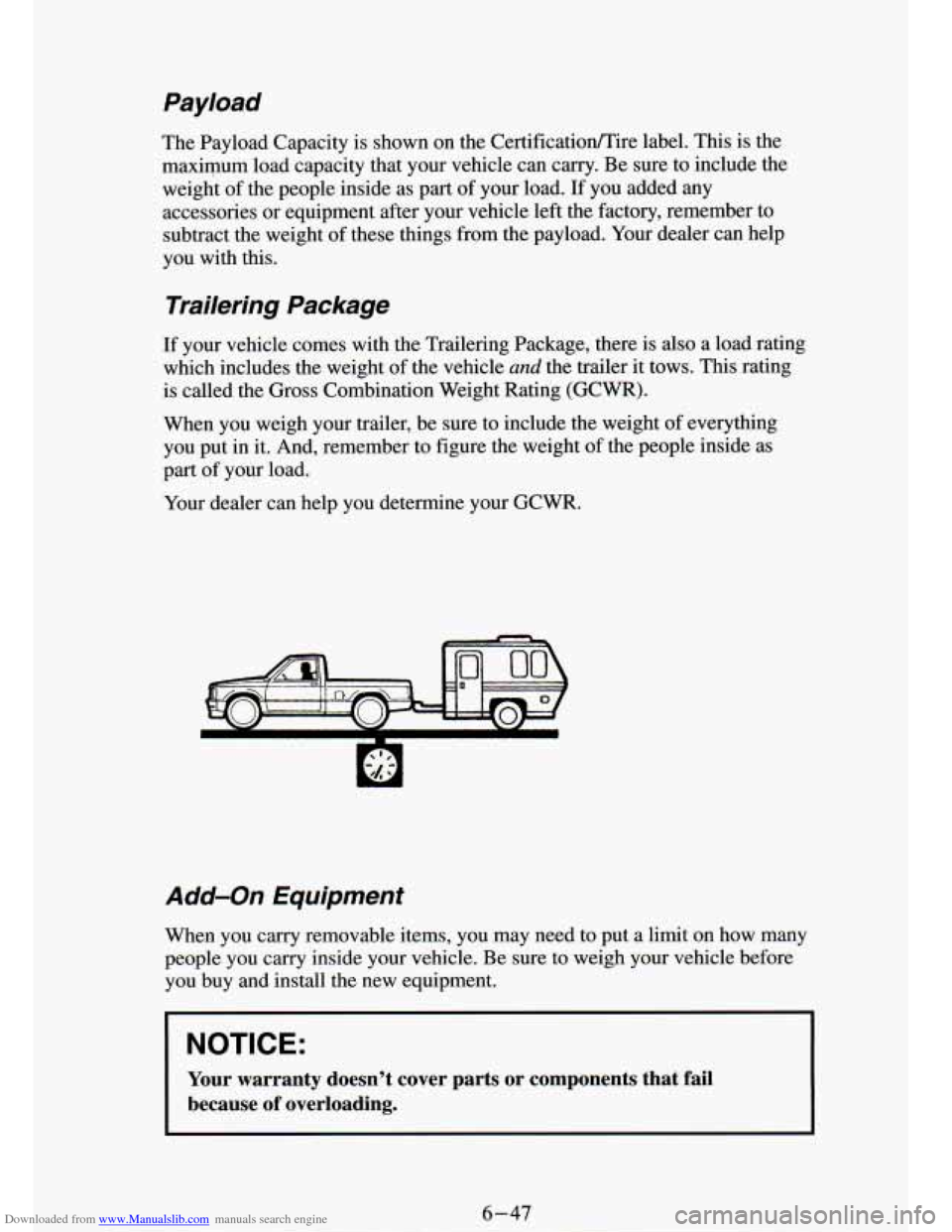
If your vehicle comes with the Trailenng Package, mere is also a load rating
which includes the weight of the vehicle
and the trailer it tows. This rating
is called the Gross Combination Weight Rating (GCWR).
When you weigh your trailer, be sure to include the weight of everything
you put
in it. And, remember to figure the weight of the people inside as
part of your load.
Your dealer can help you determine your
GCWR.
Add-on Equipment
When you carry removable items, you may need to put a limit \
on how many
people you carry inside your vehicle. Be sure to weigh your v\
ehicle before you buy and install the new equipment.
NOTICE:
Your warranty doesn’t cover parrs or components that fail
because of overloading.
Page 268 of 340

Downloaded from www.Manualslib.com manuals search engine You must weigh any accessories, trailer hitches or other equipment you a\
dd
to your vehicle. Then, subtract this extra weight from the CWR\
. This extra weight may shorten the center of gravity zone for your vehicle. Your dealer
can help you with this.
If your slide-in camper and its load weigh less than the CWR, the center of
gravity zone
for your vehicle may be larger.
Your dealer can help you make a good vehicle-camper match. He’ll also
help you determine your CWR.
After you’ve loaded your vehicle and camper, drive to a wei\
gh station and weigh on the front and rear wheels separately. This will tell you the loads on
your axles. The loads on the front and rear axles shouldn’t be more than
either
of the GAWRs. The total of the axle loads should not be more than
the GVWR.
Open your driver’s door and look at the door lock pillar for the
CertificationD‘ire label to find out your GAWR and GVWR.
11 you ve gone over ; Jr weight ratings, move or take out some things until
all the weights fall below the ratings. Of course, you should always tie down
any loose items when you load your vehicle or camper.
When you install and load your slide-in camper, check the manu\
facturer’s instructions.
If you want more information on curb weights, cargo weights, cargo weight
rating and the correct center of gravity zone for your vehicle, your dealer
can help you. Just ask for a copy of “Consumer Information, Truck
-
Camper Loading.”
Trailer Recommendations
You must subtract your hitch loads from the CWR for your vehicle. Weigh
your vehicle with your trailer attached,
so that you won’t go over the
GVWR or the GAWR.
You’ll get the best performance if you spread out the weight of your load
the right way, and if you choose the correct hitch and trailer brakes.
For more information, see “Trailer Towing’’ in the Index.
Pickup Conversion To Chassis Cab
General Motors is aware that some vehicle owners may consider having the
pickup
box removed and a commercial or recreational body installed.
However, we recommend that conversions of this type not be done to this
pickup. Owners should be aware that, as manufactured, there are differences
between a chassis cab and a pickup with the box removed which\
may affect vehicle safety.
For further information, contact the GM Zone Office for your
area. (See the “Warranty and Owner Assistance” booklet fo\
r Zone Office.)
6 --50
Page 289 of 340
Downloaded from www.Manualslib.com manuals search engine Headlights
The headlight wiring is protected by a circuit breaker in the light switch. An
electrical overload will cause the lights to go on and off, or in some cases to
remain
off. If this happens, have your headlight wiring checked right away.
Windshield Wipers
The windshield wiper motor is protected by a circuit breaker and a fuse. If
the motor overheats due to heavy snow, etc., the wiper will stop until .the
motor cools. If the overload is caused by some electrical problem and not
snow, etc., be sure to get it fixed.
Power Windows and Other Power Options
Circuit breakers in the fuse panel protect the power windows and other
power accessories. When the current load is too heavy, the circuit breaker
opens and closes, protecting the circuit until the problem is fixed.
Trailer Wiring Harness
The optional seven-wire trailer wiring harness is protected by an in-line
fuse in the battery feed wire. This fuse
is near the junction block. See
“Trailer Wiring Harness”
in the Features & Controls section.
Page 299 of 340
Downloaded from www.Manualslib.com manuals search engine maintenance receipts. They may be needed to qualify your vehicle for
warranty repairs.
Scheduled Mainfenance Services
This part tells you the maintenance services you should have done and wh\
en
you should schedule them. Your GM dealer knows your vehicle best and
wants you to be happy with it. If you go to your dealer for all your service
needs, you’ll know that GM-trained and supported service peop\
le will
perform the work using genuine GM
parts.
These schedules are for vehicles that:
carry passengers and cargo within the recommended limits. You will
find these limits on your vehicle’s Certification Label. See “Loading
Your Vehicle” in the Index.
are driven on regular road surfaces, and within legal driving limits, as
described in Section
4, Your Driving and the Road.
are driven off-road in the recommended manner. See “Off Road
Driving With Your Four-wheel Drive Vehicle” in the Index.
use the proper fuel. See “Fuel” in the Index.
Selecting me Proper Maintenance Schedule
Your driving conditions and how you use your vehicle will help you
determine which schedule to use. The schedules are found later in this
section.
MAINTENANCE SCHEDULE I
Is any one of these true for your vehicle?
Most trips are less than 4 miles (6 kilometers).
Most trips are less than 10 miles (16 kilc .eters) and outside
The engine is at low speed most of the time (as in stop-and-go traffic,
temperatures
are below freezing.
door-to-door- delivery, or other commercial uses).
0 You operate in dusty areas or off-road frequently.
You tow a trailer.
If any one (or more) of these is true for your driving, follow Schedule. I. The
chart for Schedule
I has plus signs (+).
MAINTENANCE SCHEDULE 11
Follow Schedule I1 ONLY if none of the above conditions are true. The
chart for Schedule
11 has dots (0).
7-3
Page 304 of 340

Downloaded from www.Manualslib.com manuals search engine 6. TRANSMISSION SERVICE:
Automatic Transmission
- Change the transmission fluid and filter
every
15,000 miles (25 000 km) he vehicle is mainly driven under
one or more of these conditions:
0 In heavy city traffic.
0 Where the outside temperature regularly reaches 90°F (32°C) or
0 In hilly or mountainous terrain.
0 Frequent trailer pulling. higher.
Uses such as taxi, police, delivery or other commercial service\
.
If the vehicle is not used mainly under any of these conditions, change
the fluid and filter every
30,000 miles (50 000 km). See “Automatic
Transmission Fluid” in the Index for more information.
Manual Transmission - Transrnission fluid does not require periodic
changing.
specified interval or sooner if clogged.
7. FUEL FILTER REPLACEMENT* - Replace the fuel filter at the
8. SPARK PLUG REPLACEMENT*$ - Replace spark plugs with the
type listed
in Section 6. Spark plugs (AC908) for the 2.2L Engine (VIN
Code 4) should be replaced every 100,000 miles (166 000 kilometers).
Spark plugs (.CR43TSM) for the 4.3L engines
(VIN Codes W and Z)
should be replaced every 30,000 miles (50 000 kilometers). See
‘‘Specification Charts” in the Index.
9. SPARK PLUG WIRE INSPECTION* - Clean wires and inspect
for burns, cracks or other damage. Check the wire boot fit at the
distributor and at the spark plugs. Replace wires as needed.
Adjust timing to underhood label specifications. Inspect the ins\
ide and outside
of the distributor cap and rotor for cracks, carbon tracking and
corrosion. Clean or replace as needed.
10. ENGINE TIMING CHECK AND DISTRIBUTOR CHECK*$ -
*An Emission Control Service
$=The California Air Resources Board has detennined that the fa\
ilure to
perform this maintenance item will not nullify the emission war\
ranty or limit recall liability prior to the completion
of vehicle usefui life. General
Motors, however, urges that all recommended maintenance services \
be
performed at the indicated intervals and the maintenance be rec\
orded.
7-8