Page 243 of 340
Downloaded from www.Manualslib.com manuals search engine Add coolant mix at the recovery tank, but be careful not to spill it.
Radiator Pressure Cap
I NOTICE:
Your radiator cap is a 15 psi (105 kPa) pressure-type cap and
must be tightly installed to prevent coolant loss and possible
engine damage from overheating. Be sure the arrows on the cap \
line up with the overflow tube on the radiator filler neck.
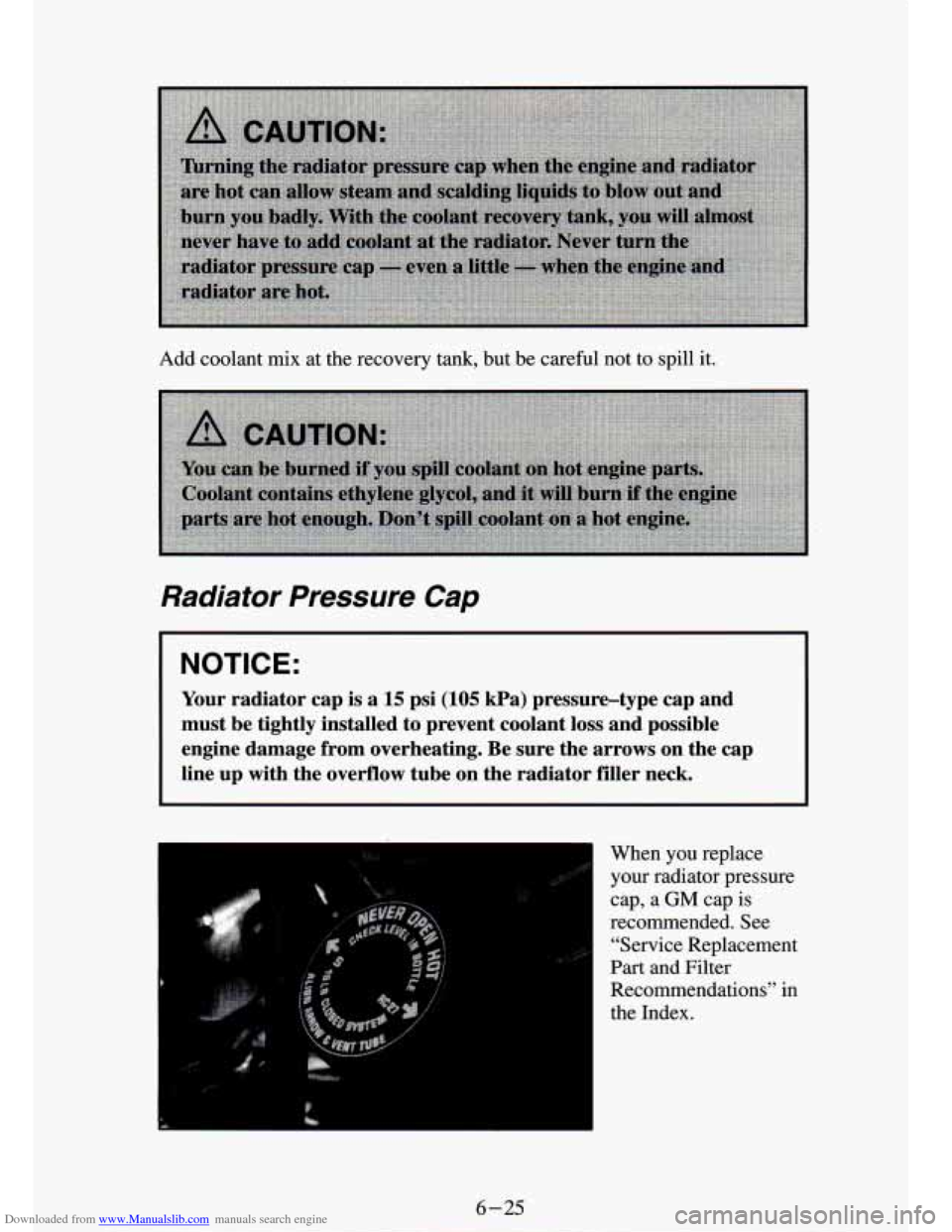
When you replace
your radiator pressure cap, a
GM cap is
recommended. See
“Service Replacement
Part and Filter
Recommendations” in
the Index.
6-25
Page 244 of 340
Downloaded from www.Manualslib.com manuals search engine Thermostat
Engine coolant temperature is controlled by a thermostat in the engine
coolant system. The thermostat stops the
flow of coolant through the
radiator
until the coolant reaches a preset temperature.
When you replace your thermostat, an
AC@ thermostat is recommended.
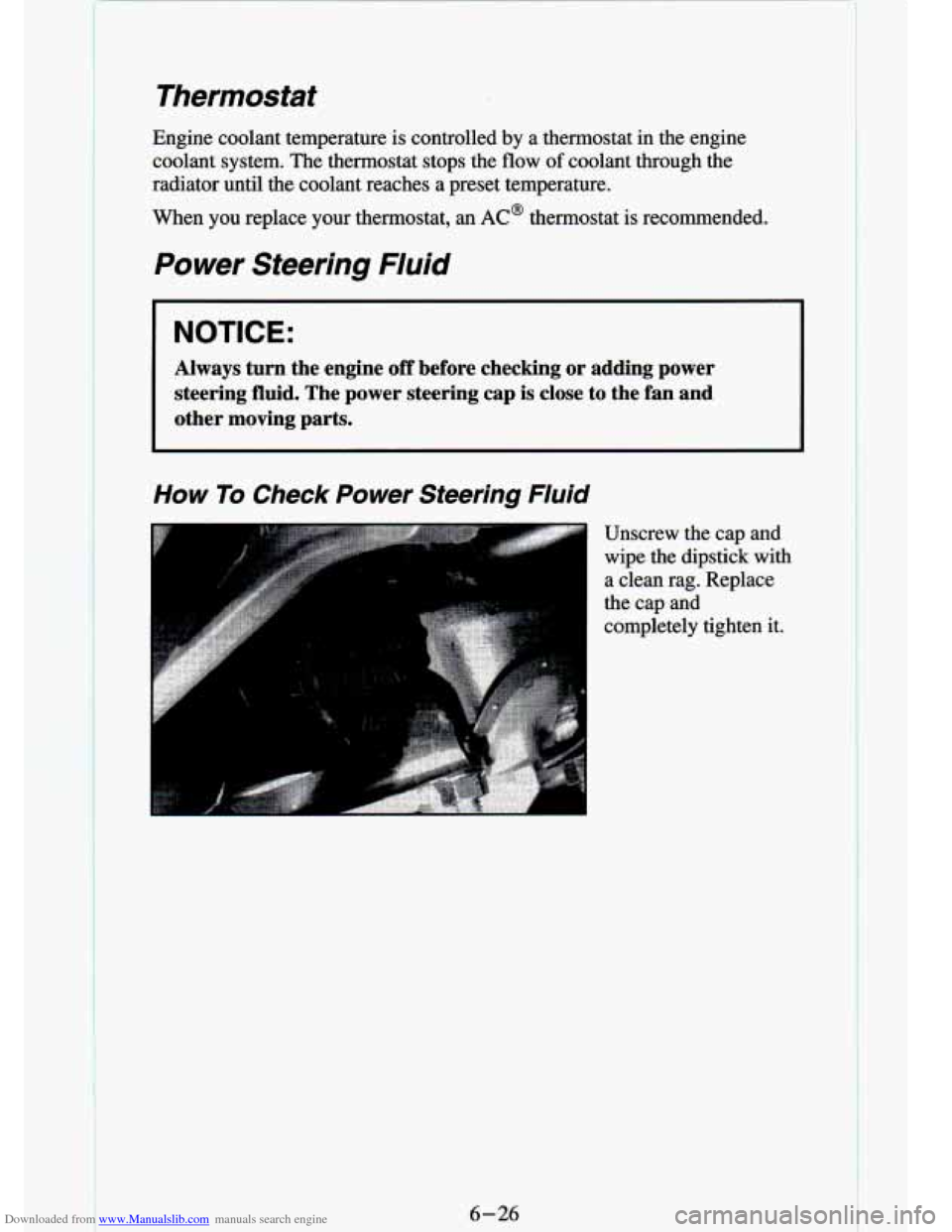
Power Steering Fluid
NOTICE:
Always turn the engine off before checking or adding power
steering fluid. The power steering cap is close
to the fan and
other moving parts.
6-26
Page 246 of 340
Downloaded from www.Manualslib.com manuals search engine Windshield Washer Fluid
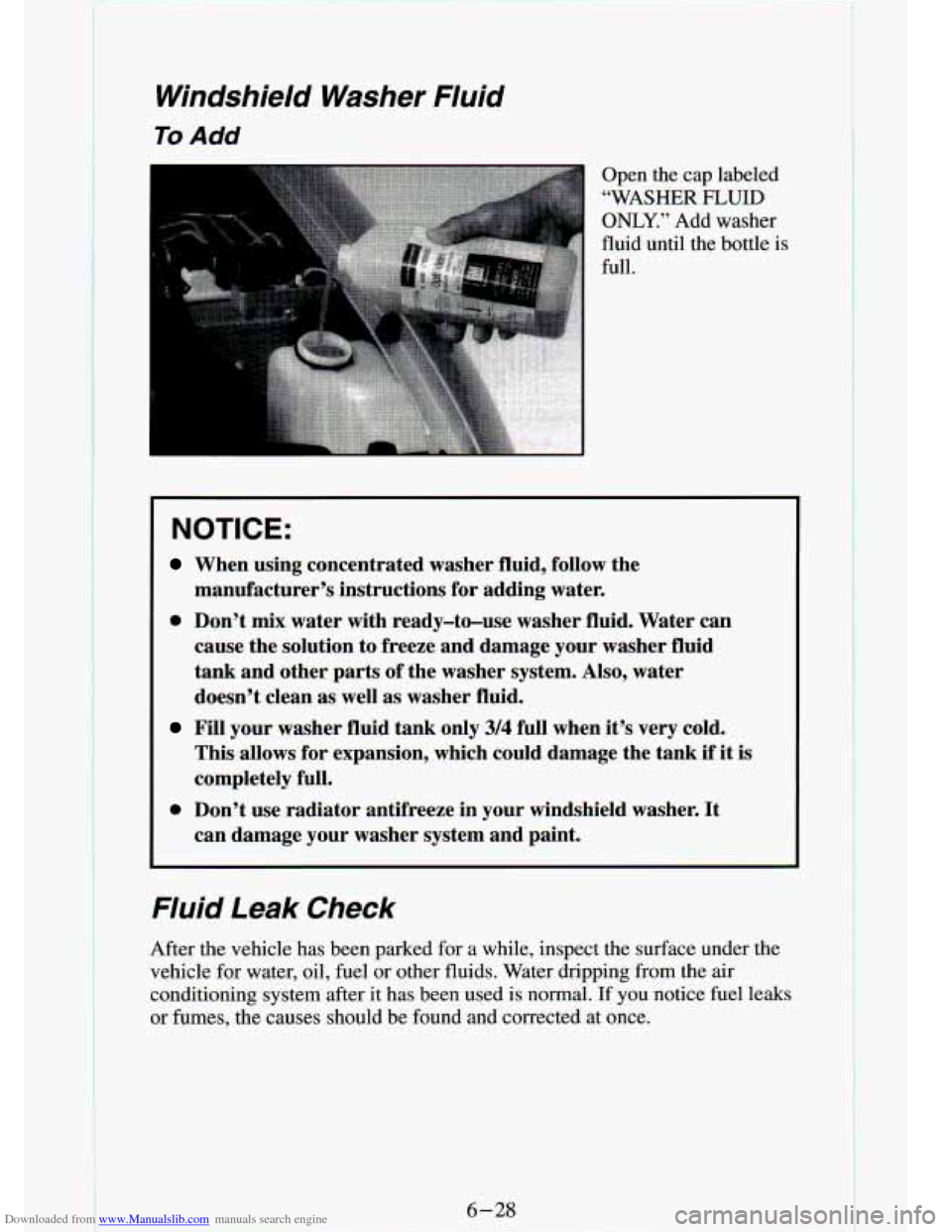
To Add
I Open the cap labeled
“WASHER
FLUID
ONLY.” Add washer
fluid until the bottle
is
full.
NOTICE:
When using concentrated washer fluid, follow the
manufacturer’s instructions for adding water.
0 Don’t mix water with ready-to-use washer fluid. Water can
cause the solution
to freeze and damage your washer fluid
tank and other parts
of the washer system, AIso, water
doesn’t clean as well as washer fluid.
Fill your washer fluid tank only 3/4 full when it’s very cold.
This allows for expansion, which could damage the tank
if it is
completely full.
can damage your washer system and paint.
0 Don’t use radiator antifreeze in your windshield washer. It
Fluid Leak Check
After the vehicle has been parked for a while, inspect the su\
rface under the
vehicle for water, oil, fuel or other fluids. Water dripping from the air
conditioning system after it has been used is normal. If you notice fuel leaks
or fumes, the causes should be found and corrected at once.
6-28
Page 252 of 340
Downloaded from www.Manualslib.com manuals search engine Composite Headlights
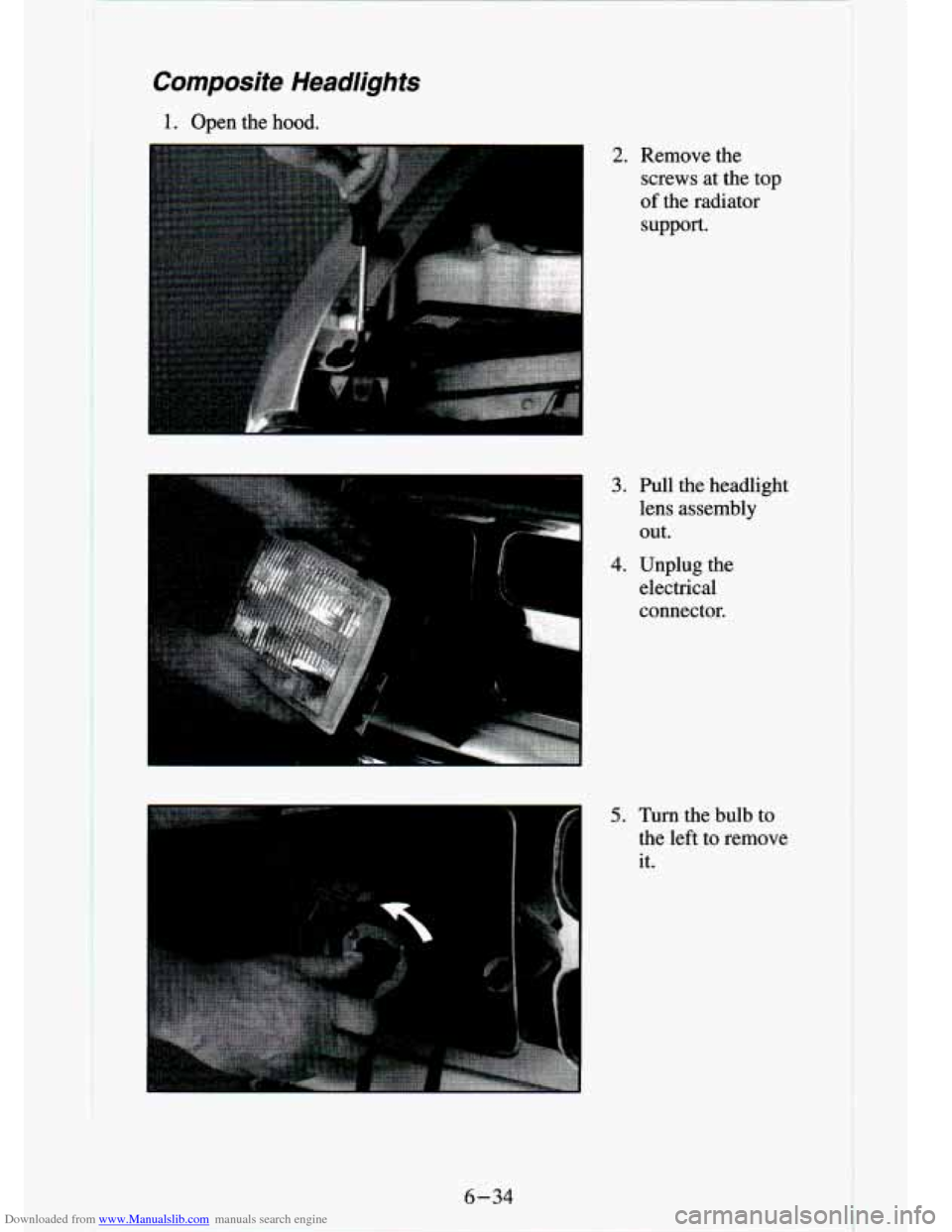
1. Open the hood.
2. Remove the screws at the top
of the radiator
support.
3. Pull the headlight
lens assembly
out.
4. Unplug the
electrical
connector.
1 5. Turn the bulb to
6-34
Page 296 of 340

Downloaded from www.Manualslib.com manuals search engine 4.3L (Z)
PF52
A773C CV789C .CR43TSM
GF48
1
RC36
4.3L (W)
PF52
A1163C cv774c .CR43TSM
GF481
RC36
Service Replacement Part and Filter
Recommendations
Engine (VIN) 2.2L (4)
Oil Filter PF47
Air Cleaner Filter A1163C
PCV Valve cv9ooc
Spark Plugs* AC908
Fuel Filter GF48
1
Radiator Cap RC36
*Use copper-cored resistor type spark plugs.
Air Conditioning Refrigerants
Not all air conditioning refrigerants are the same. If the air conditioning
system
in your vehicle needs refrigerant, be sure the proper refrigerant is
used. If you’re not sure, ask your
GM dealer. For additional information, see
your “Warranty and Owner Assistance Information” booklet.
Air Conditioning Refrigerant Capacity
TYPE SYSTEM QUANTITY*
R-l34a c-60 30 oz. (35 kg)
*All
q1 Les are approximate. ..
NOTICE:
R-134a refrigerant is not compatible with R-12 refrigerant in
an air conditioning system. R-12 in an R-134a system will caus\
e
compressor failure, refrigerant oil sludge,
or poor air
conditioning system performance.
Page 303 of 340
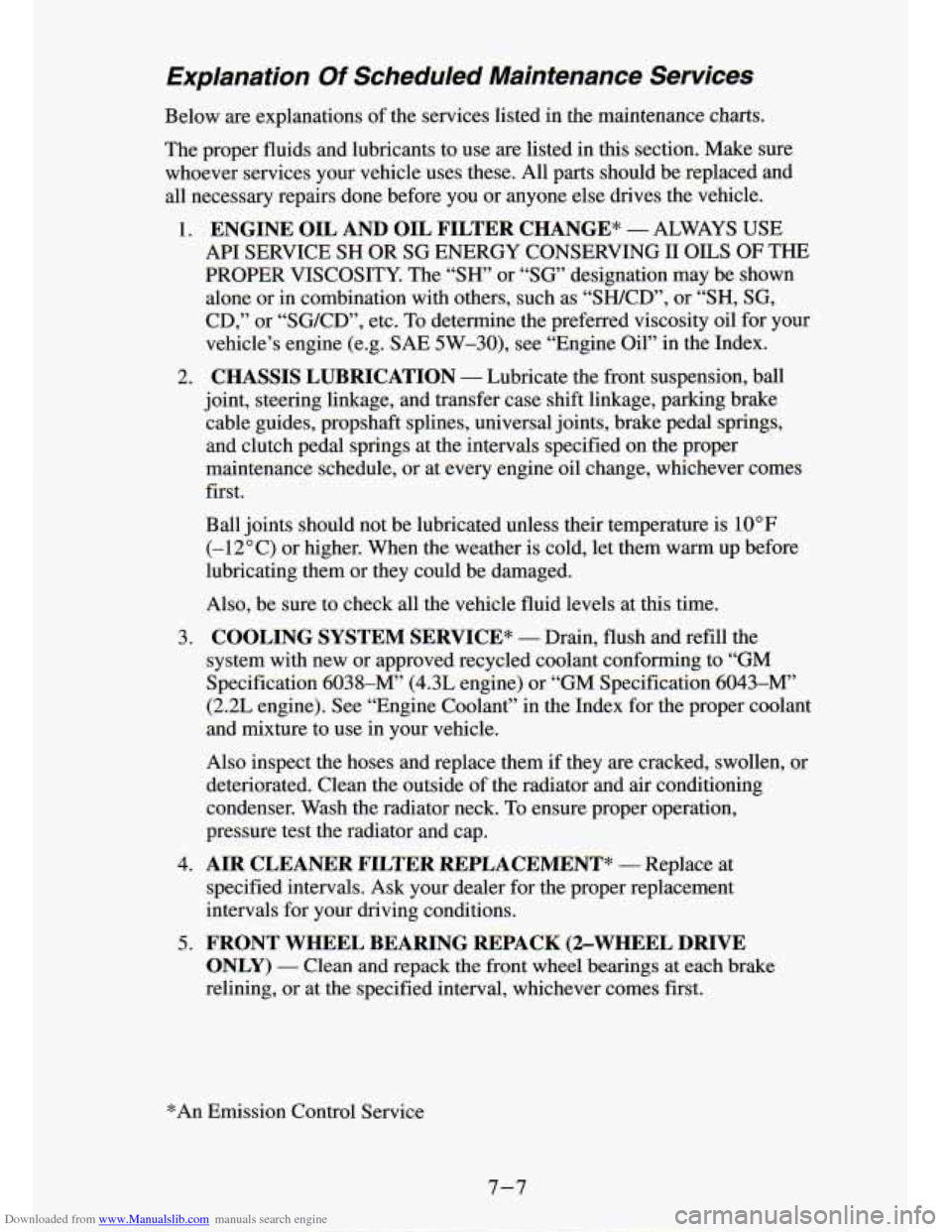
Downloaded from www.Manualslib.com manuals search engine Explanation Of Scheduled Maintenance Services
Below are explanations of the services listed in the maintenance charts.
The proper fluids and lubricants to use are listed
in this section. Make sure
whoever services your vehicle uses these. All parts should be \
replaced and
all necessary repairs done before you or anyone else drives the vehicle.
1. ENGINE OIL AND OIL FILTER CHANGE* - ALWAYS USE
API SERVICE SH OR SG ENERGY CONSERVING I1 OILS
OF THE
PROPER VISCOSITY. The “SH” or
“SG’ designation may be shown
alone or in combination with others, such as “SWCD”, or
“SH, SG,
CD,” or “SGKD”, etc. To determine the preferred viscosity oil for your
vehicle’s engine (e.g. SAE 5W-30), see “Engine
Oil” in the Index.
2. CHASSIS LUBRICATION - Lubricate the front suspension, ball
joint, steering linkage, and transfer case shift linkage, parking brake\
cable guides, propshaft splines, universal joints, brake pedal springs,
and clutch pedal springs at the intervals specified on the proper
maintenance schedule, or at every engine oil change, whichever comes
first
.
Ball joints should not be lubricated unless their temperature is 10°F
(-12°C) or higher. When the weather is cold, let them warm up before
lubricating them or they could be damaged.
Also, be sure
to check all the vehicle fluid levels at this time.
3.
COOLING SYSTEM SERVICE* - Drain, flush and refill the
system with new or approved recycled coolant conforming to “\
GM
Specification 6038-M” (4.3L engine) or “GM Specification 6043-M”
(2.2L engine). See “Engine Coolant” in the Index for the proper coolant
and mixture to use in your vehicle.
Also inspect the hoses and replace them if they are cracked, \
swollen, or
deteriorated. Clean the outside of the radiator and air conditioning
condenser. Wash the radiator neck. To ensure proper operation,
pressure test the radiator and cap.
4. AIR CLEANER FILTER REPLACEMENT* - Replace at
specified intervals. Ask your dealer for the proper replacement
intervals for your driving conditions.
5. FRONT WHEEL BEARING REPACK (%WHEEL DRIVE
ONLY) - Clean and repack the front wheel bearings at each brake
relining, or at the specified interval, whichever comes first.
*An Emission Control Service
7-7
Page 333 of 340
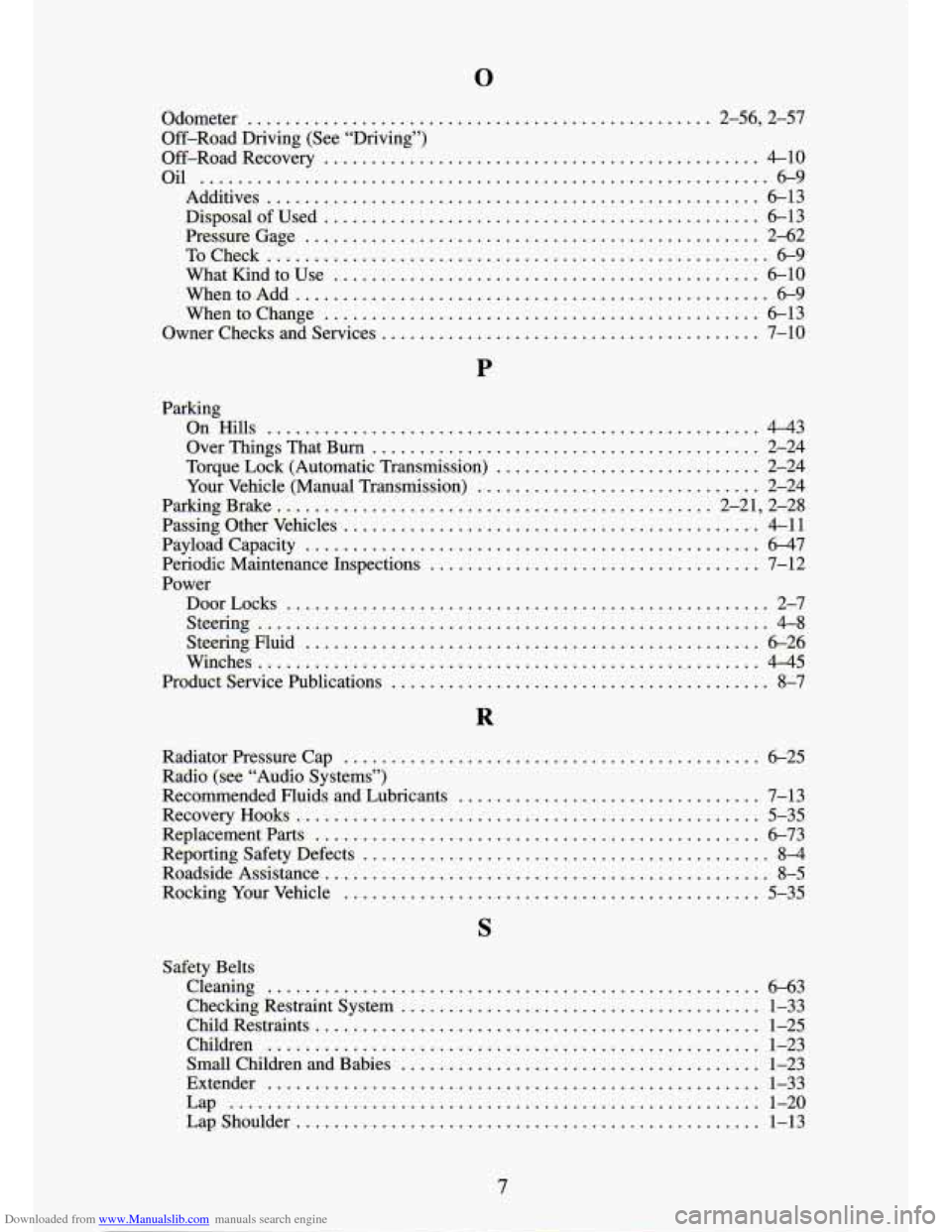
Downloaded from www.Manualslib.com manuals search engine 0
Odometer ................................... ............. 2.56. 2.57
Off-Road Driving (See “Driving”)
Off-RoadRecovery
.............................................. 4-10
Oil
............................................................ 6-9
Additives
.................................................... 6-13
DisposalofUsed
.............................................. 6-13
Pressure Gage
................................................ 2-62
ToCheck
..................................................... 6-9
WhatKindtoUse
............................................. 6-10
WhentoAdd
.................................................. 6-9
Whentochange
.............................................. 6-13
Owner Checks and Services
........................................ 7-10
Parking On Hills
.................................................... 4-43
Over Things That
Burn ......................................... 2-24
Torque Lock (Automatic Transmission)
............................ 2-24
Your Vehicle (Manual Transmission)
.............................. 2-24
ParkingBrake
.............................................. 2.21, 2.28
Passing Other Vehicles
............................................ 4-11
Payload Capacity
................................................ 6-47
Periodic Maintenance Inspections
................................... 7-12
Power DoorLocks
................................................... 2-7
Steering
...................................................... 4-8
SteeringFluid
................................................ 6-26
Winches
..................................................... 4-45
Product Service Publications
........................................ 8-7
R
Radiator Pressure Cap ...... 6-25
Radio (see “Audio Systems”)
Recommended Fluids and Lubricants
................................ 7-13
RecoveryHooks
................................................. 5-35
Replacement Parts
............................................... 6-73
Reporting Safety Defects
........................................... 8-4
Roadside Assistance ............................................... 8-5
Rocking Your Vehicle ............................................ 5-35
Safety Belts
Cleaning
.................................................... 6-63
Checking Restraint System
...................................... 1-33
ChildRestraints
............................................... 1-25
Children
.................................................... 1-23
Small Children and Babies
...................................... 1-23
Extender
.................................................... 1-33
Lap
........................................................ 1-20
Lapshoulder
................................................. 1-13
7