1994 CHEVROLET BLAZER steering wheel
[x] Cancel search: steering wheelPage 194 of 348
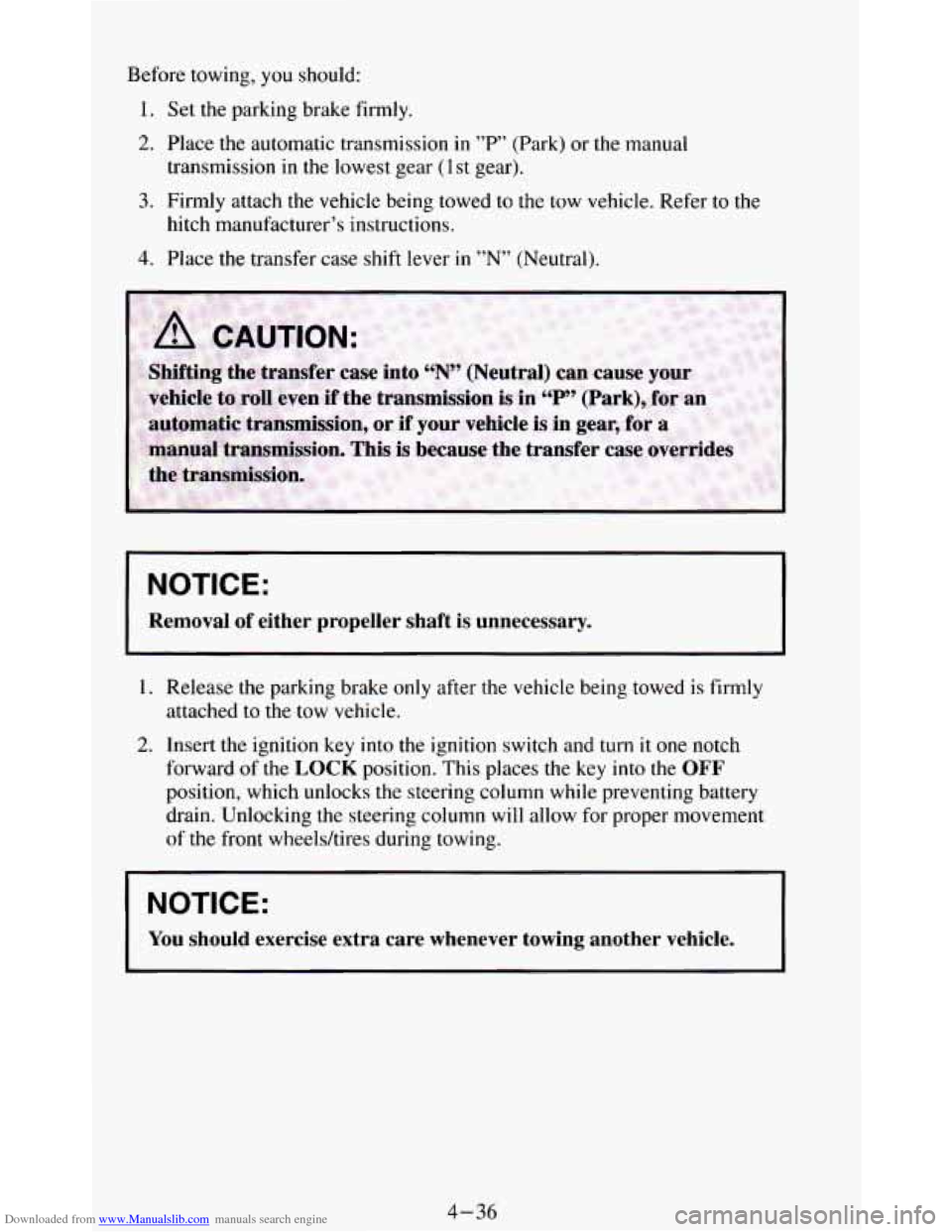
Downloaded from www.Manualslib.com manuals search engine Before towing, you should:
1. Set the parking brake firmly.
2. Place the automatic transmission in "P" (Park) or the manual
3. Firmly attach the vehicle being towed to the tow vehicle. Refer to the
transmission
in the lowest gear (1st gear).
hitch manufacturer's instructions.
4. Place the transfer case shift lever in "N" (Neutral).
NOTICE:
Removal of either propeller shaft is unnecessary.
1. Release the parking brake only after the vehicle being towed is firmly
attached to the tow vehicle.
2. Insert the ignition key into the ignition switch and turn it one notch
forward
of the LOCK position. This places the key into the OFF
position, which unlocks the steering column while preventing battery
drain. Unlocking the steering
column will allow for proper movement
of the front wheeldtires during towing.
NOTICE:
You should exercise extra care whenever towing another vehicle.
4-36
Page 199 of 348
Downloaded from www.Manualslib.com manuals search engine During your trip, check occasionally to be sure that the load is secure, and
that
the lights and any trailer brakes are still working.
Following Disfance
Stay at least twice as far behind the vehicle ahead as you would when
driving your vehicle without a trailer. This can help you avoid situations that
require heavy braking and sudden turns.
Passing
You’ll need more passing distance up ahead when you’re towing a trailer.
And, because you’re a good deal longer, you’ll need
to go much farther
beyond the passed vehicle before you can return to your lane.
Backing Up
Hold the bottom of the steering wheel with one hand. Then, to move the
trailer to the left, just move that hand to the left.
To move the trailer to the
right, move your hand to the right. Always
back up slowly and, if possible,
have someone guide you.
4-41
Page 210 of 348
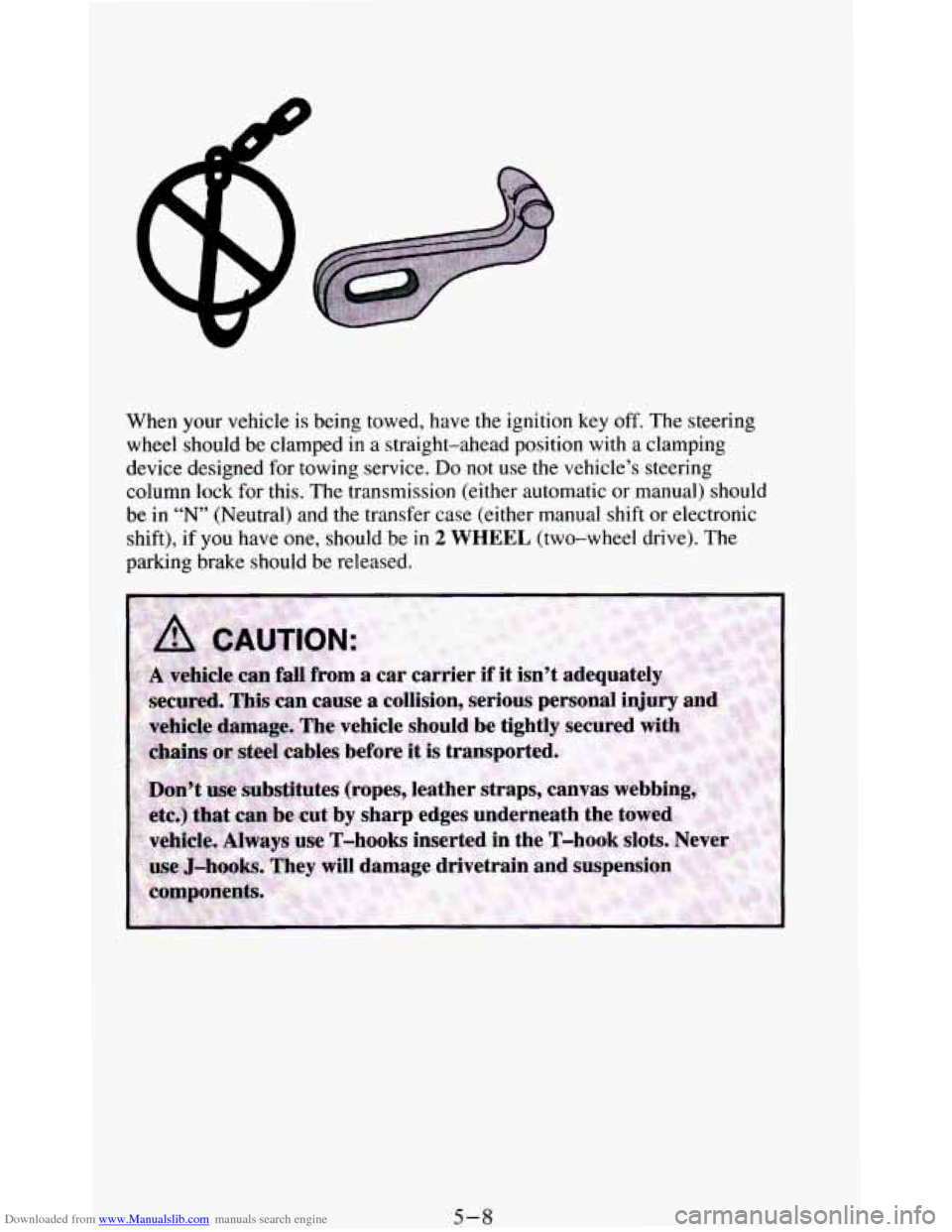
Downloaded from www.Manualslib.com manuals search engine When your vehicle is being towed, have the ignition key off. The steering
wheel should
be clamped in a straight-ahead position with a clamping
device designed for towing service.
Do not use the vehicle’s steering
column lock for this. The transmission (either automatic
or manual) should
be in
“N’ (Neutral) and the transfer case (either manual shift or electronic
shift), if
you have one, should be in 2 WHEEL (two-wheel drive). The
parking brake should be released.
5-8
Page 220 of 348
Downloaded from www.Manualslib.com manuals search engine Engine Fan Noise
This vehicle has a clutched engine cooling fan. When the clutch is engaged,
the fan spins faster to provide more air
to cool the engine. In most every day
driving conditions the clutch is
not engaged. This improves fuel economy
and reduces fan noise. Under heavy vehicle loading, trailer towing and/or
high outside temperatures, the fan speed increases when the clutch engages.
So you may hear an increase in fan noise. This is normal and should not be
mistaken as
the transmission slipping or making extra shifts. It is merely the
cooling system functioning properly. The fan will slow down when
additional cooling
is not required and the clutch disengages.
You may also hear this fan noise when you start the engine. It will go away
as the fan clutch disengages.
If a Tire Goes Flat
It’s unusual for a tire to “blow out” while you’re driving, especially if you
maintain your tires properly. If air goes out of a tire, it’s much more likely
to
leak out slowly. But if you should ever have a “blowout,” here are a few tips
about what to expect and what
to do:
If a front tire fails,
the flat tire will create a drag that pulls the vehicle
toward
that side. Take your foot off the accelerator pedal and grip the
steering wheel firmly. Steer to maintain lane position, then gently brake to a
stop well
out of the traffic lane.
A rear blowout, particularly on a curve, acts much like a skid and may
require the same correction you’d
use in a skid. In any rear blowout, remove
your foot from the accelerator pedal. Get the vehicle under control
by
steering the way you want the vehicle to go. It may be very bumpy and
noisy, but
you can still steer. Gently brake to a stop, well off the road if
possible.
If a tire goes flat, the next section shows how to use your jacking equipment
to change a flat tire safely.
5-18
Page 235 of 348
Downloaded from www.Manualslib.com manuals search engine Rocking your vehicle to get it out:
First, turn your steering wheel left and right. That will clear the area around
your front wheels. Then shift back and forth between “R” (Reverse) and
a
forward gear (or with a manual transmission, between First or Second gear
and Reverse), spinning the wheels
as little as possible. Release the
accelerator pedal while
you shift, and press lightly on the accelerator pedal
when the transmission
is in gear. If that doesn’t get you out after a few tries,
you may need to be towed out. Or,
you can use your recovery hooks, if your
vehicle has them.
If you do need to be towed out, see “Towing Your
Vehicle”
in the Index.
Using the Recovery Hooks
I
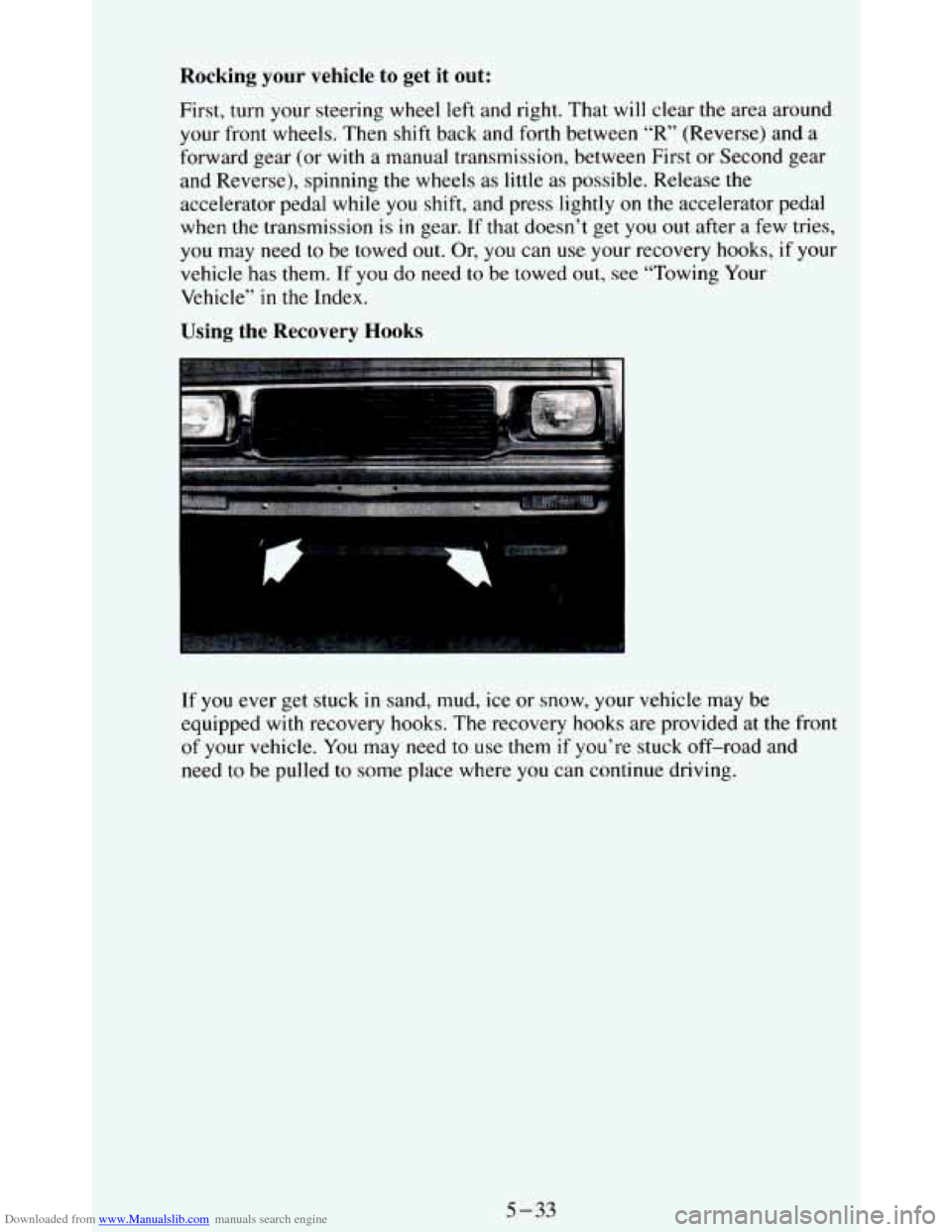
If you ever get stuck in sand, mud, ice or snow, your vehicle may be
equipped with recovery hooks.
The recovery hooks are provided at the front
of your vehicle. You may need to use them if you’re stuck off-road and
need to be pulled to some place where you can continue driving.
5-33
Page 271 of 348
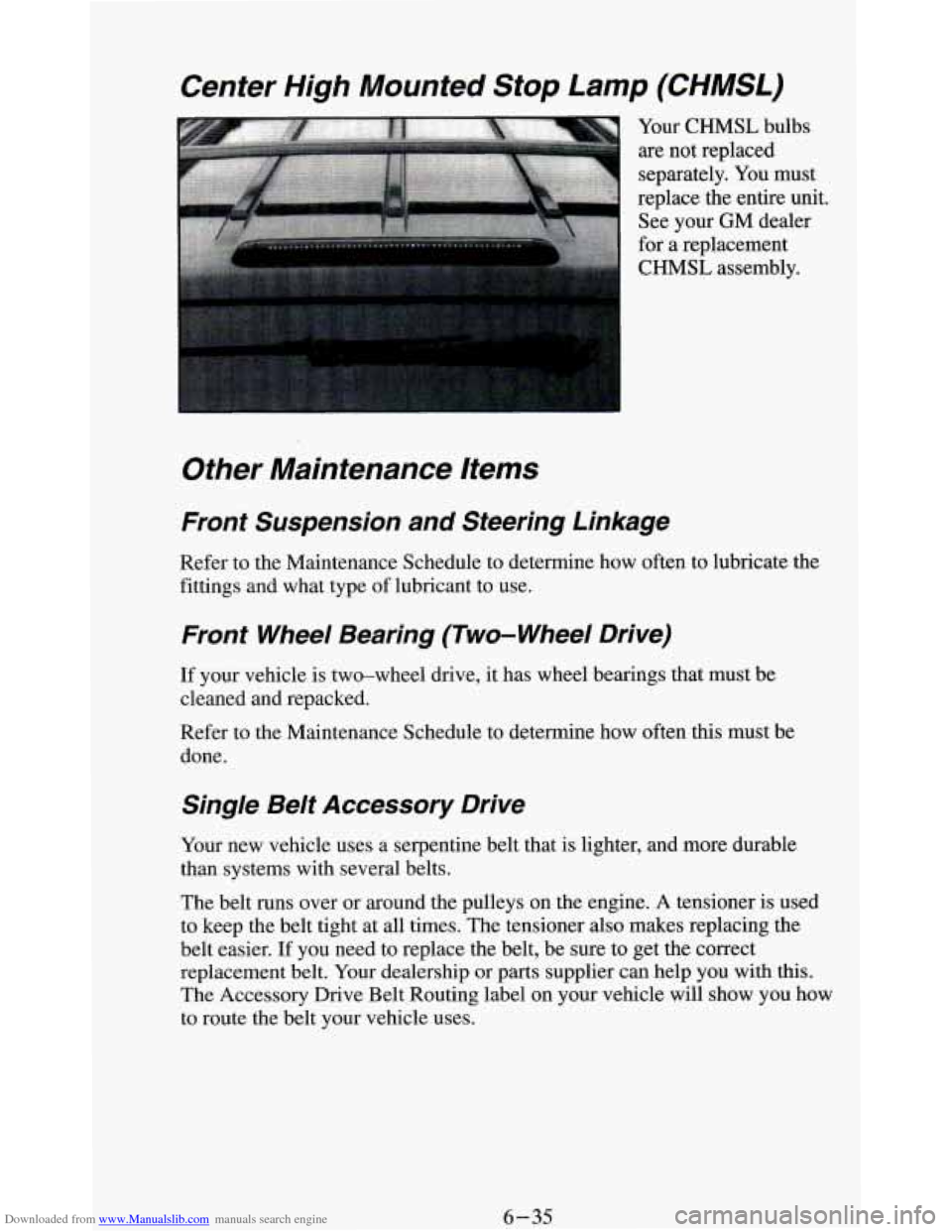
Downloaded from www.Manualslib.com manuals search engine Other Maintenance Items
Front Suspension and Steering Linkage
Refer to the Maintenance Schedule to determine how often to lubricate the
fittings and what type of lubricant to use.
Front Wheel Bearing (Two- Wheel Drive)
If your vehicle is two-wheel drive, it has wheel bearings that must be
cleaned and repacked.
Refer to the Maintenance Schedule to determine how often this must be
done.
Single Belt Accessory Drive
Your new vehicle uses a serpentine belt that is lighter, and more durable
than systems with several belts.
The belt runs over or around the pulleys on the engine. A tensioner is used
to keep the belt tight at all times. 'The tensioner also makes replacing the
belt easier. If you need to replace the belt, be sure to get the correct
replacement belt. Your dealership or parts supplier can help you with this.
The Accessory Drive Belt Routing label on your vehicle will show you how
to route the belt your vehicle uses.
6-35
Page 313 of 348

Downloaded from www.Manualslib.com manuals search engine Explanation Of Scheduled Maintenance Services
Below are explanations of the services listed in the maintenance charts.
The proper fluids and lubricants to use are listed in this section. Make sure
whoever services your vehicle
uses these. All parts should be replaced and
all necessary repairs done before you or anyone else drives the vehicle.
1.
2.
3.
4.
5.
ENGINE OIL AND OIL FILTER CHANGE* - ALWAYS USE
API SERVICE SH OR SG ENERGY CONSERVING I1 OILS OF THE
PROPER VISCOSITY. The “SH” or “SG” designation may be shown
alone or in combination with others, such as “SHKD”, or
“SH, SG,
CD,” or “SG/CD”, etc.
To determine the preferred viscosity oil for your
vehicle’s engine (e.g. SAE
5W-30), see “Engine Oil” in the Index.
CHASSIS LUBRICATION - Lubricate the front suspension, ball
joint, steering linkage, and transfer case shift linkage, parking brake
cable guides, propshaft splines, universal joints, brake pedal springs,
and clutch pedal springs at the intervals specified on the proper
maintenance schedule, or at every engine oil change, whichever comes
first.
Ball joints should
not be lubricated unless their temperature is 10°F
(-12°C) or higher. When the weather is cold, let them warm up before
lubricating them
or they could be damaged.
Also, be sure to check all the vehicle fluid levels at this time.
COOLING SYSTEM SERVICE* - Drain, flush and refill the
system with new or approved recycled coolant conforming to “GM
Specification
603%”’. See “Engine Coolant” in the Index for the
proper coolant and mixture to use in your vehicle.
Also inspect
the hoses and replace them if they are cracked, swollen, or
deteriorated. Clean the outside of the radiator and air conditioning
condenser. Wash the radiator neck. To ensure proper operation,
pressure test the radiator and cap.
AIR CLEANER FILTER REPLACEMENT” - Replace at
specified intervals. Ask your dealer for the proper replacement
intervals for your driving conditions.
FRONT WHEEL BEARING REPACK (2-WHEEL DRIVE
ONLY) - Clean and repack the front wheel bearings at each brake
relining,
or at the specified interval, whichever comes first.
*An Emission Control Service
7-7
Page 318 of 348
Downloaded from www.Manualslib.com manuals search engine Periodic Maintenance Inspections
Listed below are inspections and services which should be performed at
least twice a year (for instance, each spring and fall). You should let your
GM dealer’s service department or other qualified service center do these
jobs. Make sure any necessary repairs are completed at once.
Steering and Suspension Inspection? - Inspect front and rear suspension
and steering system for damaged,
loose or missing parts, signs of wear or
lack of lubrication. Inspect power steering lines and hoses for proper
hook-up, binding, leaks, cracks, chafing, etc. (On vehicles equipped with
manual steering gear, check for seal leakage). Lubricate the steering linkage.
Accelerator Control System - Lubricate all pivot points with engine oil,
except the
TBI throttle shaft. Do not lubricate the cam pulley. Remove all
external deposits from pulley.
Do not oil any accelerator or cruise control
cables. Replace any cables that have high effort or excessive wear.
Exhaust System Inspection - Inspect the complete system. Inspect the
body near the exhaust system. Look for broken, damaged, missing or
out-of-position parts,
as well as open seams, holes, loose connections or
other conditions which could cause a heat buildup in the floor pan or could
let exhaust fumes seep into the passenger compartments. See “Engine
Exhaust” in the Index.
Drive Axle Service - Check readfront axle fluid level and add as needed.
Check constant velocity joints and axle seals for leaking.
Transfer Case (four-wheel drive) Inspection? - Every 12 months or at
oil change intervals, check front axle and transfer case and add lubricant
when necessary. Check vent hose at transfer case for kinks and proper
installation. More frequent lubrication may be required
on off-road use.
?A fluid loss in these systems may indicate a problem. Have them inspected
and repaired at once.
7- 12