1994 CHEVROLET BLAZER ESP
[x] Cancel search: ESPPage 198 of 348
Downloaded from www.Manualslib.com manuals search engine Trailer Brakes
If your trailer weighs more than 1,000 pounds (450 kg) loaded, then it needs
its own brakes
- and they must be adequate. Be sure to read and follow the
instructions for the trailer brakes
so you’ll be able to install, adjust and
maintain them properly.
Your trailer brakes system can tap into vehicle’s hydraulic brake system
except:
Don’t tap into your vehicle’s brake system
if the trailer’s brake system will
use more than 0.02 cubic inch (0.3~~) of fluid from your vehicle’s master
cylinder.
If it does, both braking systems won’t work well. You could even
lose your brakes.
Will the trailer parts take
3,000 psi (20 650 kPa) of pressure? If not, the
trailer brake system must not be used with your vehicle.
If everything checks out this far, then make the brake fluid tap at the
port on
the master cylinder that sends fluid
to the rear brakes. But don’t use copper
tubing for this. If
you do, it will bend and finally break off. Use steel brake
tubing.
Driving with a Trailer
Towing a trailer requires a certain amount of experience. Before setting out
for the open road, you’ll want
to get to know your rig. Acquaint yourself
with the feel of handling and braking with the added weight of the trailer.
And always keep in mind that the vehicle
you are driving is now a good
deal longer and not nearly
so responsive as your vehicle is by itself.
Before you start, check the trailer hitch and platform, safety chains,
electrical connector, lights, tires and mirror adjustment. If the trailer has
electric brakes, start your vehicle and trailer moving and then apply the
trailer brake controller by hand to be sure the brakes are working. This lets
you check your electrical connection at the same time.
4-40
Page 202 of 348
Downloaded from www.Manualslib.com manuals search engine Maintenance When Trailer Towing
Your vehicle will need service more often when you’re pulling a trailer. See
the Maintenance Schedule for more on this. Things that are especially
important in trailer operation are automatic transmission fluid (don’t
overfill), engine oil, axle lubricant, belt, cooling system, and brake
adjustment. Each of these is covered
in this manual, and the Index will help
you find them quickly. If you’re trailering,
it’s a good idea to review these
sections before you start your trip.
Check periodically to see that
all hitch nuts and bolts are tight.
Trailer Light Wiring
See “Trailer Wiring Harness” in the Index.
Power Winches
If you wish to use a power winch on your vehicle, only use it when your
vehicle
is stationary or anchored.
! NOTICE:
~ When operating a power winch on your vehicle always leave the \
l transmission in the neutral position. Do not leave an automatic
transmission in
P (Park) or a manual transmission in gear or the
transmission may be damaged.
Use the regular brakes, set the parking brake or block the wheels to keep
your vehicle from rolling.
4-44
Page 220 of 348
Downloaded from www.Manualslib.com manuals search engine Engine Fan Noise
This vehicle has a clutched engine cooling fan. When the clutch is engaged,
the fan spins faster to provide more air
to cool the engine. In most every day
driving conditions the clutch is
not engaged. This improves fuel economy
and reduces fan noise. Under heavy vehicle loading, trailer towing and/or
high outside temperatures, the fan speed increases when the clutch engages.
So you may hear an increase in fan noise. This is normal and should not be
mistaken as
the transmission slipping or making extra shifts. It is merely the
cooling system functioning properly. The fan will slow down when
additional cooling
is not required and the clutch disengages.
You may also hear this fan noise when you start the engine. It will go away
as the fan clutch disengages.
If a Tire Goes Flat
It’s unusual for a tire to “blow out” while you’re driving, especially if you
maintain your tires properly. If air goes out of a tire, it’s much more likely
to
leak out slowly. But if you should ever have a “blowout,” here are a few tips
about what to expect and what
to do:
If a front tire fails,
the flat tire will create a drag that pulls the vehicle
toward
that side. Take your foot off the accelerator pedal and grip the
steering wheel firmly. Steer to maintain lane position, then gently brake to a
stop well
out of the traffic lane.
A rear blowout, particularly on a curve, acts much like a skid and may
require the same correction you’d
use in a skid. In any rear blowout, remove
your foot from the accelerator pedal. Get the vehicle under control
by
steering the way you want the vehicle to go. It may be very bumpy and
noisy, but
you can still steer. Gently brake to a stop, well off the road if
possible.
If a tire goes flat, the next section shows how to use your jacking equipment
to change a flat tire safely.
5-18
Page 240 of 348
Downloaded from www.Manualslib.com manuals search engine Gasolines for CIeaner Air
Your use of gasoline with deposit control additives will help prevent
deposits from forming in your engine and fuel system. That helps keep your
engine in
tune and your emission control system working properly. It’s good \
for your vehicle, and
you’ll be doing your part for cleaner air.
Many gasolines are now blended with oxygenates. General Motors
recommends that you use gasolines with these blending materials,
such as
MTBE and ethanol. By doing so, you can help clean the air, especially in
those parts
of the country that have high carbon monoxide levels.
In addition, some gasoline suppliers are now producing reformulated
gasolines.
These gasolines are specially designed to reduce vehicle
emissions. General Motors recommends that
you use reformulated gasoline.
By doing
so, you can help clean the air, especially in those parts of the
country that have high ozone levels.
You should
ask your service station operators if their gasolines contain
deposit control additives and oxygenates, and
if they have been
reformulated
to reduce vehicle emissions.
Fuels in Foreign Countries
If you plan on driving in another country outside the U.S. or Canada,
unleaded fuel may be hard
to find. Do not use leaded gasoline. If you use
even one tankful, your emission controls won’t work well or at all. With
continuous
use, spark plugs can get fouled, the exhaust system can corrode,
and your engine oil can deteriorate quickly. Your vehicle’s oxygen sensor
will be damaged. All
of that means costly repairs that wouldn’t be covered
by your warranty.
To check on fuel availability, ask an auto club, or contact a major oil
company that does business in the country where you’ll be driving.
You can also write us at the following address for advice. Just tell
us where
you’re going and give your Vehicle Identification Number (VIN).
General Motors Overseas Distribution Corporation
North American Export Sales
(NAES)
1908 Colonel Sam Drive
Oshawa, Ontario
LlH 8P7
6-4
Page 252 of 348
Downloaded from www.Manualslib.com manuals search engine Wait at least 30 minutes before checking the transmission fluid level if you
have been driving:
0 When outside temperatures are above 90°F (32°C).
At high speed for quite a while.
0 In heavy traffic - especially in hot weather.
While pulling a trailer.
To get the right reading, the fluid should be at normal operating
temperature, which is 180°F
to 200°F (82°C to 93°C).
To check transmission fluid hot: Get the vehicle warmed up by driving
about
15 miles (24 km) when outside temperatures are above 50°F (10°C).
If it’s colder than 50°F (lO”C), drive the vehicle in “D” (3rd Gear) until the
engine temperature gage moves and then remains steady for ten minutes.
Then follow
the hot check procedures.
To check transmissionfluid cold: A cold check is made after the vehicle has
been sitting for eight hours or more
with the engine off and is used only as a
reference. Let the engine run at idle for
five minutes if outside temperatures
are
50°F (10°C) or more. If it’s colder than 50°F (lO”C), you may have to
idle the engine longer. Should the fluid level be low during a cold check,
you must perform a hot check before adding fluid. This will give you a
more accurate reading of
the fluid level.
To check the fluid hot or cold
0 Park your vehicle on a level place.
0 With the parking brake applied, place the shift lever in “P’ (Park).
With your foot on the brake pedal, move the shift lever through each
gear range, pausing for about three seconds
in each range. Then,
position the shift lever in “P” (Park).
Let the engine run at idle for three minutes or more.
6-16
Page 254 of 348
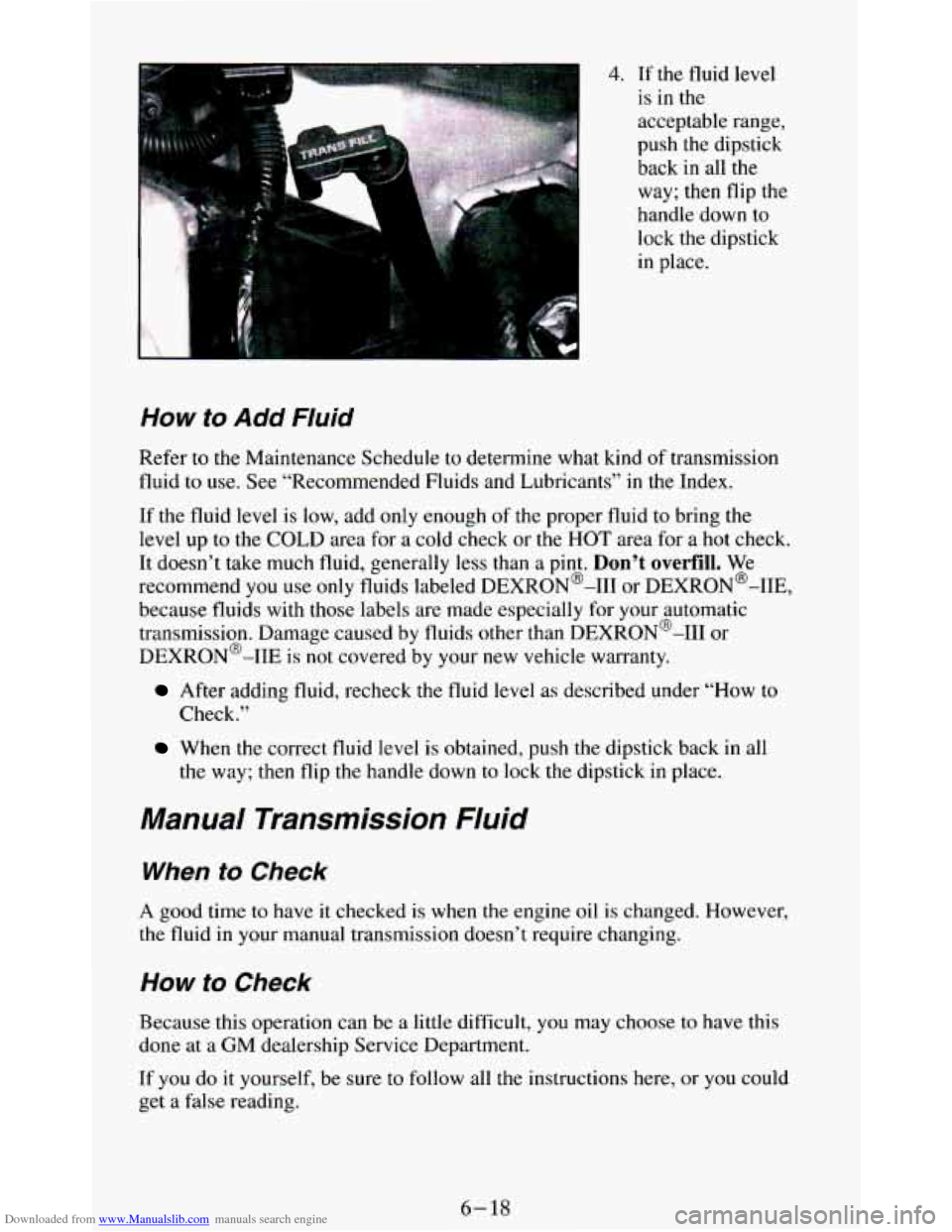
Downloaded from www.Manualslib.com manuals search engine 4. If the fluid level
is in the
acceptable range,
push the dipstick
back in all the
way; then flip
the
handle down to
lock the dipstick
in place.
How to Add Fluid
Refer to the Maintenance Schedule to determine what kind of transmission
fluid to use. See “Recommended Fluids and Lubricants’’
in the Index.
If the fluid level is low, add only enough
of the proper fluid to bring the
level up to the
COLD area for a cold check or the HOT area for a hot check.
It doesn’t take much fluid, generally
less than a pint. Don’t overfill. We
recommend you use only fluids labeled DEXR0N’-I11 or DEXR0N’-IIE,
because fluids with those labels are made especially for your automatic
transmission. Damage caused by fluids other than DEXRON@-I11 or
DEXRON@-IIE
is not covered by your new vehicle warranty.
After adding fluid, recheck the fluid level as described under “How to
Check.”
When the correct fluid level is obtained, push the dipstick back in all
the way; then flip
the handle down to lock the dipstick in place.
Manual Transmission Fluid
When to Check
A good time to have it checked is when the engine oil is changed. However,
the fluid in your manual transmission doesn’t require changing.
How fo Check
Because this operation can be a little difficult, you may choose to have this
done at a
GM dealership Service Department.
If
you do it yourself, be sure to follow all the instructions here, or you could
get a false reading.
6- 18
Page 279 of 348
Downloaded from www.Manualslib.com manuals search engine NOTICE:
Don’t let anyone tell you that underinflation or overinflation is
all right. It’s not. If your tires don’t have enough air
(underinflation)
you can get:
Too much flexing
Too much heat
Tire overloading
Bad wear
Bad handling
Bad fuel economy.
If your tires have too much air (overinflation), you can get:
Unusual wear
Bad handling
Rough ride
Needless damage from road hazards.
When to Check
Check your tires once a month or more.
How to Check
Use a good quality pocket-type gage to check tire pressure. Simply looking
at the tires will not tell you the pressure, especially if you have radial tires
- which may look properly inflated even if they’re underinflated.
If your tires have valve caps, be sure to put them back on. They help prevent
leaks by keeping out dirt and moisture.
6-43
Page 283 of 348
Downloaded from www.Manualslib.com manuals search engine Temperature - A, B, C
The temperature grades are A (the highest), B, and C, representing the tire’s
resistance to the generation
of heat and its ability to dissipate heat when tested
under controlled conditions on a specified indoor laboratory test wheel.
Sustained high temperature can cause
the material of the tire to degenerate
and reduce tire life, and excessive temperature can lead to sudden tire failure.
The grade
C corresponds to a level of performance which all passenger car
tires must meet under the Federal Motor Vehicle Safety Standard\
No. 109.
Grades B and A represent higher levels of performance on the laboratory test
wheel
than the minimum required by law.
Warning: The temperature grade for this tire
is established for a tire that is
properly inflated and not overloaded. Excessive speed, underinflation, or
excessive loading, either separately or
in combination, can cause heat
buildup and possible tire failure.
These grades are molded on the sidewalls
of passenger car tires.
While the tires available as standard or optional equipment on General
Motors vehicles may vary
with respect to these grades, all such tires meet
General Motors performance standards and have been approved for use on
General Motors vehicles. All passenger type
(P Metric) tires must conform
to Federal safety requirements
in addition to these grades.
Wheel Alignment and Tire Balance
The wheels on your vehicle were aligned and balanced carefully at the
factory to give you the longest tire life and best overall performance.
In most cases, you
will not need to have your wheels aligned again.
However,
if you notice unusual tire wear or your vehicle pulling one way or
the other, the alignment may need to be reset. If you notice your vehicle
vibrating when driving on
a smooth road, your wheels may need to be
rebalanced.
Wheel Replacement
Replace any wheel that is bent, cracked or badly rusted. If wheel nuts keep
coming loose, the wheel, wheel bolts, and wheel nuts should be replaced. If
the wheel leaks air, replace
it (except some aluminum wheels, which can
sometimes
be repaired). See your GM dealer if any of these conditions exist.
Your dealer will know the kind of wheel you need.
Each new wheel should have the same load carrying capacity, diameter,
width, offset, and be mounted the same way as the one
it replaces.
6-47