1994 CHEVROLET BLAZER check oil
[x] Cancel search: check oilPage 251 of 348
Downloaded from www.Manualslib.com manuals search engine NOTICE:
If the air cleaner is off, a backfire can cause a damaging engine
fire. And, dirt can easily get into your engine, which will damage
it. Always have the air cleaner in place when you’re driving.
Automatic Transmission Fluid
When to Check and Change
A good time to check your automatic transmission fluid level is when the
engine
oil is changed. Refer to the Maintenance Schedule to determine
when
to change your fluid. See “Scheduled Maintenance Services” in the
Index.
How to Check
Because this operation can be a little difficult, you may choose to have this
done at a
GM dealership Service Department.
If
you do it yourself, be sure to follow all the instructions here, or you could
get
a false reading on the dipstick.
NOTICE:
Too much or too little fluid can damage your transmission. Too
much can mean that some of the fluid could come out and fall on
hot engine parts or exhaust system, starting
a fire. Be sure to get
an accurate reading if you check your transmission fluid.
6-15
Page 254 of 348
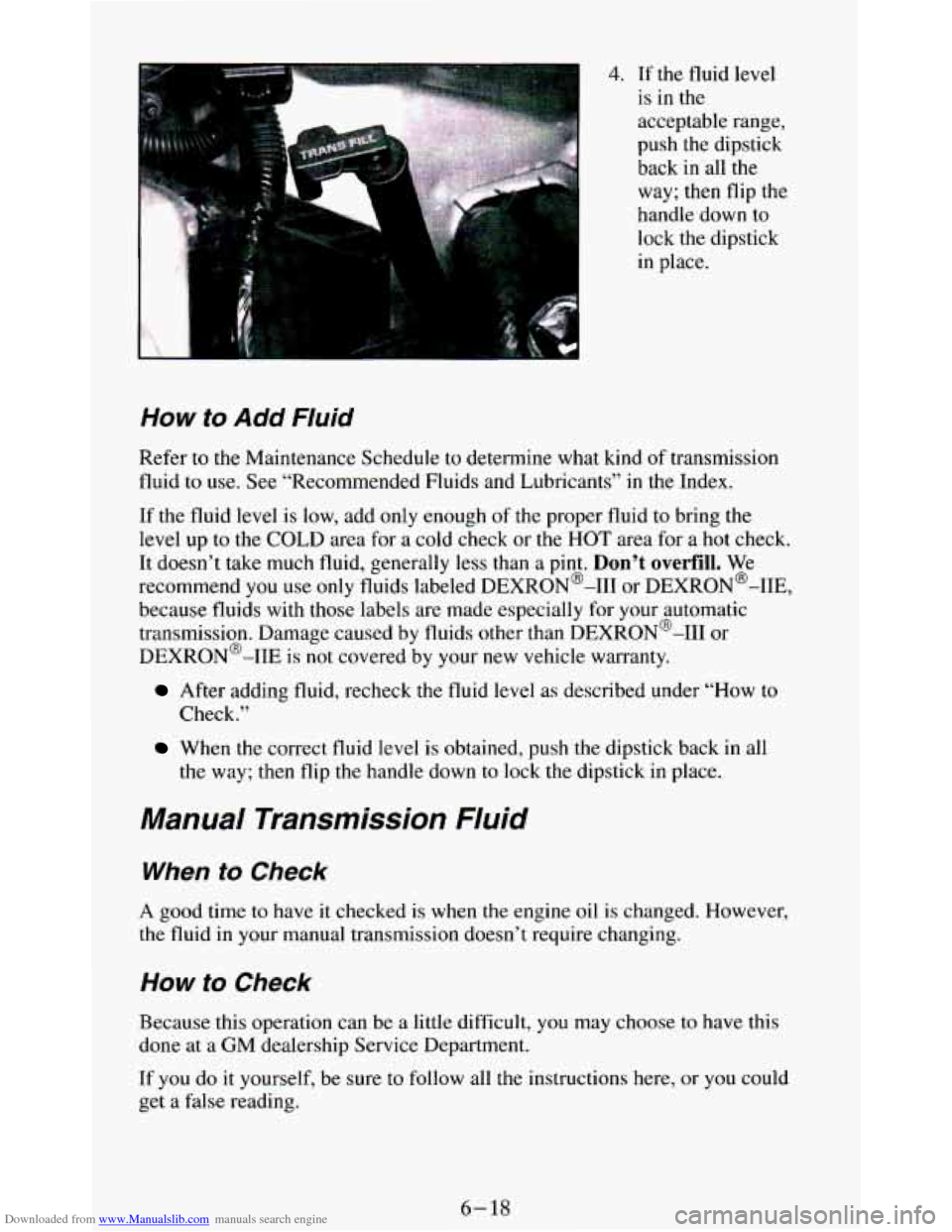
Downloaded from www.Manualslib.com manuals search engine 4. If the fluid level
is in the
acceptable range,
push the dipstick
back in all the
way; then flip
the
handle down to
lock the dipstick
in place.
How to Add Fluid
Refer to the Maintenance Schedule to determine what kind of transmission
fluid to use. See “Recommended Fluids and Lubricants’’
in the Index.
If the fluid level is low, add only enough
of the proper fluid to bring the
level up to the
COLD area for a cold check or the HOT area for a hot check.
It doesn’t take much fluid, generally
less than a pint. Don’t overfill. We
recommend you use only fluids labeled DEXR0N’-I11 or DEXR0N’-IIE,
because fluids with those labels are made especially for your automatic
transmission. Damage caused by fluids other than DEXRON@-I11 or
DEXRON@-IIE
is not covered by your new vehicle warranty.
After adding fluid, recheck the fluid level as described under “How to
Check.”
When the correct fluid level is obtained, push the dipstick back in all
the way; then flip
the handle down to lock the dipstick in place.
Manual Transmission Fluid
When to Check
A good time to have it checked is when the engine oil is changed. However,
the fluid in your manual transmission doesn’t require changing.
How fo Check
Because this operation can be a little difficult, you may choose to have this
done at a
GM dealership Service Department.
If
you do it yourself, be sure to follow all the instructions here, or you could
get a false reading.
6- 18
Page 265 of 348
Downloaded from www.Manualslib.com manuals search engine To Check Brake Fluid
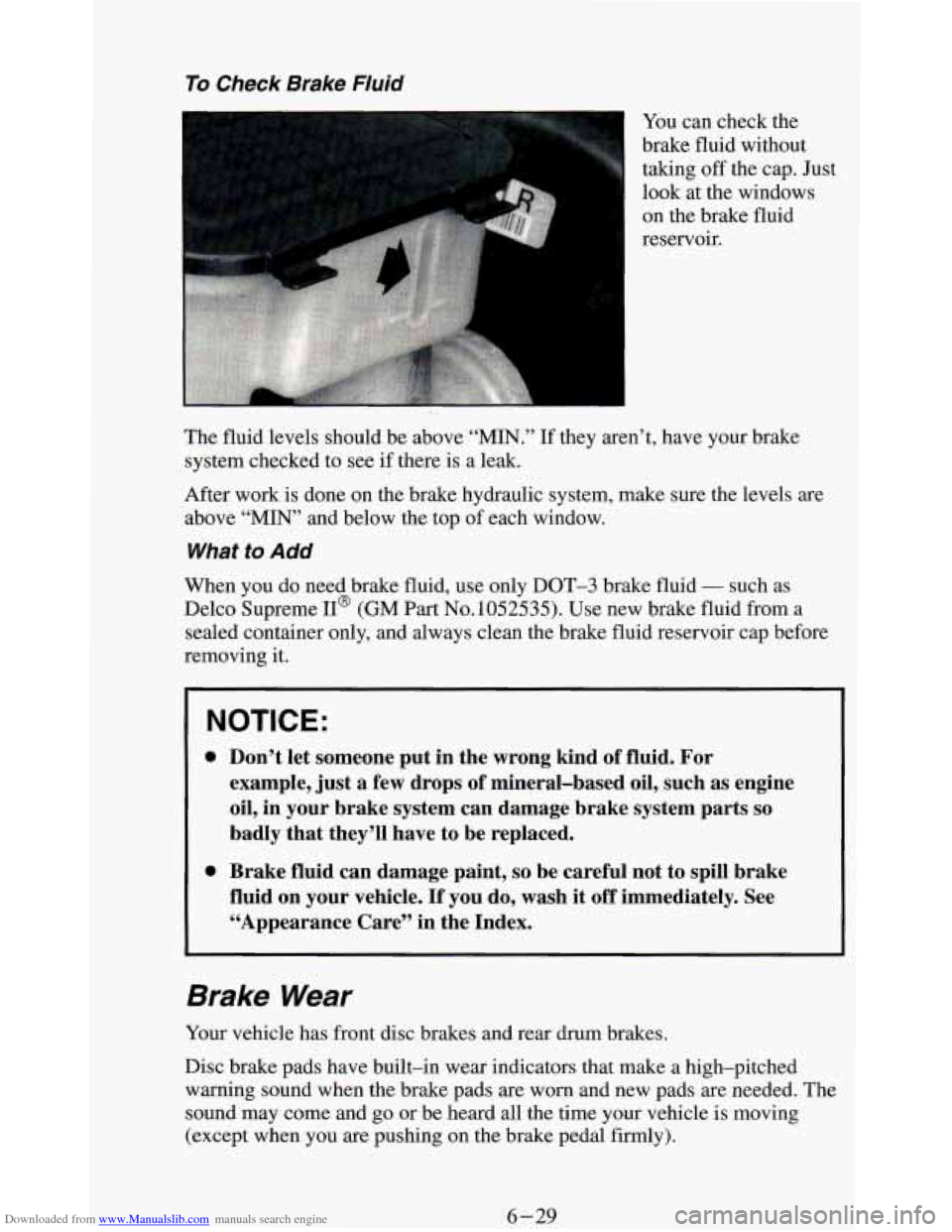
You can check the
brake fluid without
taking off the cap. Just
look at the windows
on the brake fluid
reservoir.
The fluid levels should be above
“MIN.” If they aren’t, have your brake
system checked to see if there
is a leak.
After work is done on the brake hydraulic system, make sure the levels are
above
“MIN” and below the top of each window.
What to Add
When you do need brake fluid, use only DOT-3 brake fluid - such as
Delco Supreme
II@ (GM Part No.1052535). Use new brake fluid from a
sealed container only, and always clean the brake fluid reservoir cap before
removing it.
NOTICE:
0 Don’t let someone put in the wrong kind of fluid. For
example, just a few drops of mineral-based oil, such
as engine
oil, in your brake system can damage brake system parts so
badly that they’ll have to be replaced.
0 Brake fluid can damage paint, so be careful not to spill brake
fluid on your vehicle.
If you do, wash it off immediately. See
“Appearance Care” in the Index.
Brake Wear
Your vehicle has front disc brakes and rear drum brakes.
Disc brake pads have built-in wear indicators that make a high-pitched
warning sound when the brake pads are worn and new pads are needed. The
sound may come and go or be heard all the time your vehicle is moving
(except when you are pushing on the brake pedal firmly).
6-29
Page 267 of 348
Downloaded from www.Manualslib.com manuals search engine you have to have new ones put in - be sure you get new genuine GM
replacement parts. If you don’t, your brakes may no longer work properly.
For example, if someone puts in brake linings that are wrong for your
vehicle, the balance between your front and rear brakes can change, for the
worse. The braking performance you’ve come to expect can change in many
other ways if someone puts in the wrong replacement brake parts.
Fluid Leak Check
After the vehicle has been parked for a while, inspect the surface under the
vehicle for water, oil, fuel or other fluids. Water dripping from
the air
conditioning system after it has been used is normal. If you notice fuel leaks
or fumes, the causes should be found and corrected at once.
Battery
Every new vehicle has a Delco Freedom@ battery. You never have to add
water
to one of these. When it’s time for a new battery, we recommend a
Delco Freedom@ battery. Get one that has the catalog number shown on the
original battery’s label.
Vehicle Storage
If you’re not going to drive your vehicle for 25 days or more, take off the
black, negative
(-) cable from the battery. This will help keep your battery
from running down.
Contact your dealer to learn how to prepare your vehicle for longer storage
periods.
For more information, contact your dealer’s service department, or write:
Adistra Corporation
17 1 Hamilton Street
Plymouth, MI
48 170
In Canada, write:
General Motors of Canada Limited
Customer Services Department
Oshawa, Ontario
L1J 5Z6 Canada
6-31
Page 273 of 348
Downloaded from www.Manualslib.com manuals search engine Propeller Shaft Slip Splines/Universal Joints
Refer to the Maintenance Schedule to determine how often the slip and
universal joints must be lubricated and what type of lubricant to use.
Body
Normal use of your vehicle will cause metal to metal wear at some points on
the cab and body if they are not lubricated.
For exposed surfaces, such as door checks, door lock bolts, lock s\
triker plates,
dovetail bumper wedges, etc., a
thin film of engine oil should be applied.
Where oil holes are provided
in the body or cab, a dripless oil can be used.
The seat adjusters and seat track should be lubricated with chassis grease.
Door weatherstrips and rubber hood bumpers should be wiped clean with a
wet cloth and lightly coated with a rubber lubricant.
Never use too much of any lubricant and be sure to wipe up any extra
lubricant when
you are finished.
Window regulators and controls are inside the doors. They are lubricated
with a long lasting grease.
If lubrication is required your dealer should
perform this service.
Refer to the Maintenance Schedule to determine how often to lubricate
these items and what type of lubricant to use.
Lock Cylinders
To be sure your locks operate properly, they must be lubricated.
Refer to the Maintenance Schedule to determine how often
to lubricate them
and what type of lubricant to
use.
You should not use penetrating oils because they could wash out the factory
installed lubricant and cause
the lock to bind. De-icers which contain
alcohol could also wash away the lubricant,
so be sure to lubricate the lock
after using a de-icer of this type.
Endgate Handle
The endgate handle pivot points on your vehicle should be lubricated to
keep the handle working smoothly.
Refer to the Maintenance Schedule
to determine how often to lubricate them
and what type of lubricant to use.
6-37
Page 312 of 348
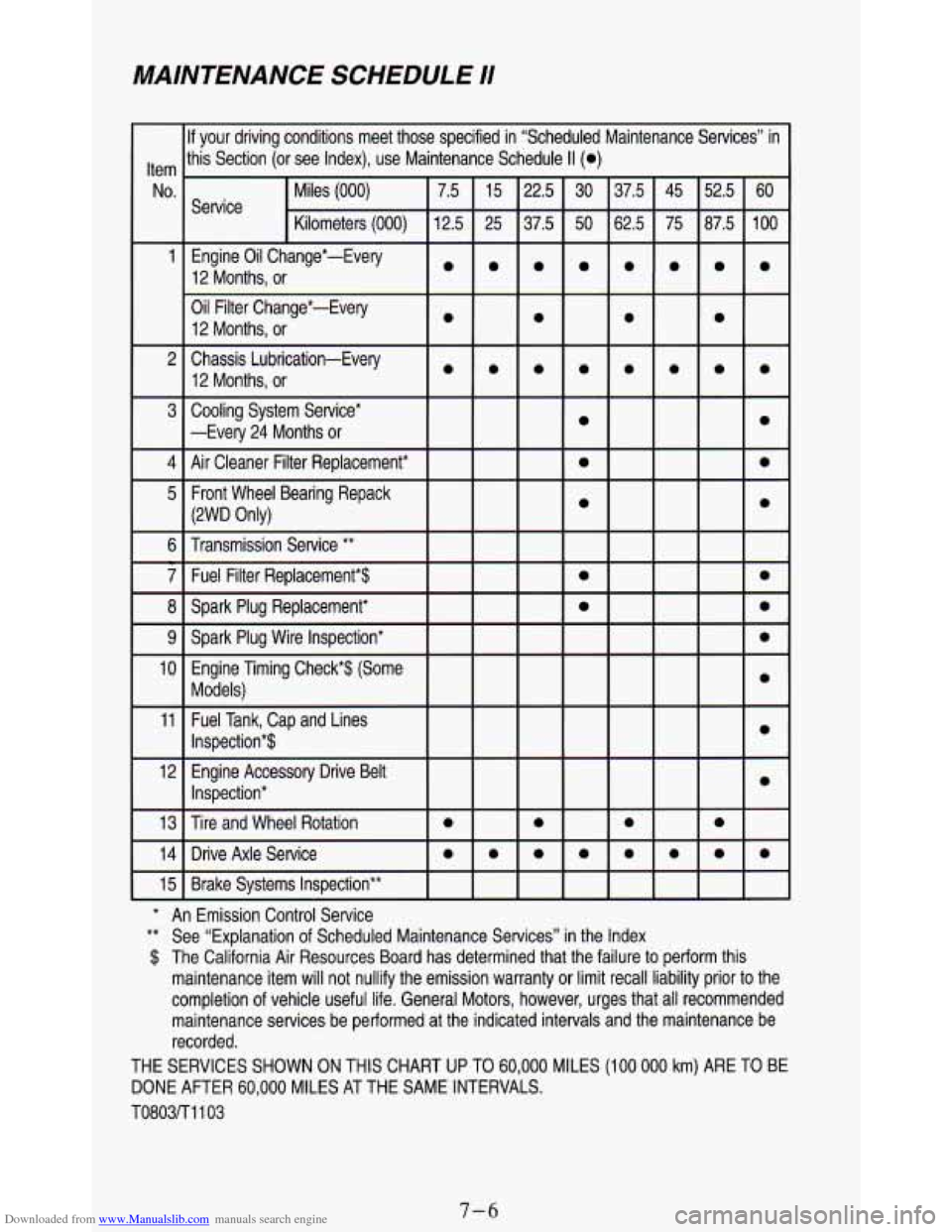
Downloaded from www.Manualslib.com manuals search engine MAINTENANCE SCHEDULE /I
llf your driving conditions meet tho:
Item Ithis
Section (or see Index), use M;
Miles
(000)
Service
Oil Filter Change*-Every 12 Months, or
3 Cooling System Service* -Every 24 Months or
4 Air Cleaner Filter Replacement*
5 Front Wheel Bearing Repack (2WD Only)
6 Transmission Service
**
7 Fuel Filter Replacement*$
8 Spark Plug Replacement*
9 Spark Plug Wire Inspection*
10 Engine Timing Check*$ (Some
11 Fuel Tank, Cap and Lines Models)
Inspection*$
12 Engine Accessory Drive Belt
I Inspection*
13
I Tire and Wheel Rotation
14
I Drive Axle Service
15
I Brake Systems Inspection**
3 specified in “Scheduled Maintc
lntenance Schedule
II (0)
lance Services” in
* An Emission Control service
** See “Explanation of Scheduled Maintenance Services” in the Index
$ The California Air Resources Board has determined that the fail\
ure to perform this
maintenance item will not nullify the emission warranty
or limit recall liability prior to the
completion of vehicle useful life. General Motors, however, urges that all re\
commended
maintenance services be performed at the indicated intervals and\
the maintenance be
recorded.
THE SERVICES SHOWN ON THIS CHART
UP TO 60,000 MILES (100 000 km) ARE TO BE
DONE AFTER
60,000 MILES AT THE SAME INTERVALS.
T0803/Tl103
7-6
Page 313 of 348

Downloaded from www.Manualslib.com manuals search engine Explanation Of Scheduled Maintenance Services
Below are explanations of the services listed in the maintenance charts.
The proper fluids and lubricants to use are listed in this section. Make sure
whoever services your vehicle
uses these. All parts should be replaced and
all necessary repairs done before you or anyone else drives the vehicle.
1.
2.
3.
4.
5.
ENGINE OIL AND OIL FILTER CHANGE* - ALWAYS USE
API SERVICE SH OR SG ENERGY CONSERVING I1 OILS OF THE
PROPER VISCOSITY. The “SH” or “SG” designation may be shown
alone or in combination with others, such as “SHKD”, or
“SH, SG,
CD,” or “SG/CD”, etc.
To determine the preferred viscosity oil for your
vehicle’s engine (e.g. SAE
5W-30), see “Engine Oil” in the Index.
CHASSIS LUBRICATION - Lubricate the front suspension, ball
joint, steering linkage, and transfer case shift linkage, parking brake
cable guides, propshaft splines, universal joints, brake pedal springs,
and clutch pedal springs at the intervals specified on the proper
maintenance schedule, or at every engine oil change, whichever comes
first.
Ball joints should
not be lubricated unless their temperature is 10°F
(-12°C) or higher. When the weather is cold, let them warm up before
lubricating them
or they could be damaged.
Also, be sure to check all the vehicle fluid levels at this time.
COOLING SYSTEM SERVICE* - Drain, flush and refill the
system with new or approved recycled coolant conforming to “GM
Specification
603%”’. See “Engine Coolant” in the Index for the
proper coolant and mixture to use in your vehicle.
Also inspect
the hoses and replace them if they are cracked, swollen, or
deteriorated. Clean the outside of the radiator and air conditioning
condenser. Wash the radiator neck. To ensure proper operation,
pressure test the radiator and cap.
AIR CLEANER FILTER REPLACEMENT” - Replace at
specified intervals. Ask your dealer for the proper replacement
intervals for your driving conditions.
FRONT WHEEL BEARING REPACK (2-WHEEL DRIVE
ONLY) - Clean and repack the front wheel bearings at each brake
relining,
or at the specified interval, whichever comes first.
*An Emission Control Service
7-7
Page 315 of 348
Downloaded from www.Manualslib.com manuals search engine 13. TIRE AND WHEEL ROTATION AND INSPECTION - For
proper wear and maximum tire life, rotate tires at the first
6,000 miles
(10
000 kilometers) for Schedule I or 7,500 miles (12 500 kilometers)
for Schedule I1 and then every 15,000 miles
(25 000 kilometers)
thereafter. Follow the instructions and patterns shown in Section
6.
Check tires for uneven wear or damage. If irregular or premature wear
is apparent, check wheel alignment. Also, check for damaged wheels.
See “Tires” in the Index for more information.
14.
DRIVE AXLE SERVICE - Check readfront axle fluid level and add
as needed. Check constant velocity joints and axle seals for leaking.
Locking Differential - Drain fluid at first oil change and refill.
Check fluid
level and add as needed at subsequent oil changes. In
dusty areas or trailer towing applications, drain fluid at every
15,000 miles (24 135 kilometers) and refill.?
Standard Differential - Check fluid level and add as needed at
every oil change. In dusty areas or trailer towing applications,
drain fluid every
15,000 miles (24 135 kilometers) and refill.?
More frequent lubrication may be required for off-road use.
15. BRAKE SYSTEM INSPECTION - When the engine oil is changed,
inspect the lines and hoses for proper hookup, binding, leaks, cracks,
chafing, etc. Check the parking brake adjustment, and the fluid level in
the master cylinder. A low fluid level can indicate worn disc brake pads
which may need
to be serviced.?
When the wheels are removed for rotation, inspect disc brake pads for
wear and rotors for surface condition. Also inspect drum brake linings
for wear and cracks. Inspect other brake parts, including drums, wheel
cylinders, parking brake, etc. at the same time.
Inspect brakes more often if driving habits or conditions resul\
t in
frequent braking.
.L t A fluid loss in these systems may indicate a problem. Have them inspected
and repaired at once.
7-9