1994 CADILLAC SEVILLE reset
[x] Cancel search: resetPage 159 of 399
Downloaded from www.Manualslib.com manuals search engine CHANGE TRANS FLUID - 47
This message will appear when it is time to replace the transaxle fluid.
See your maintenance booklet for the proper fluid and change intervals.
CHECK BRAKE FLUID - 37
This message is displayed to inform the driver that the brake reservoir fluid
level is low. Check the brake reservoir level and add as needed. Have the
brake system serviced by a Cadillac technician as soon as possible. If the
brake warning light is on, follow the directions in that section.
CHECK COOLANT LEVEL - 04
This message will appear when there is a low level of engine coolant.
Have the cooling system serviced by a Cadillac technician as soon as
possible.
CHECK FUEL GAGE - 39
This message will appear when your fuel supply is less than 4 gallons and
your display
is turned off.
CHECK OIL LEVEL - 36
This message will appear when your engine oil is approximately a quart
low.
If this message is displayed, check the oil and add as needed.
CHECK WASHER FLUID - 25
This message will appear for a few seconds indicating that you need
washer solvent.
CHANGE OIL SOON - 40
This message will appear when your engine oil is less than 10 percent or
the mileage since the last oil change is more than
6750 miles.
CHANGE ENGINE OIL - 82
This means that the life of your engine oil has expired and it should be
changed immediately. See engine oil and filter recommendations
in the
Maintenance Schedule. After an oil change, the Oil
Life Index must be
reset.
See “Oil Life Indicator” in the index on how to reset it.
CRUISE ENGAGED - 43
This message will appear for a few seconds when you select a speed to
cruise at.
146
7
Page 162 of 399
Downloaded from www.Manualslib.com manuals search engine TRACTION ACTIVE - 91
If your vehicle is equipped with Traction Control, this message will be
displayed
if Traction Control is being used to reduce wheel slippage.
TRACTION DISABLED - 88
If your vehicle is equipped with Traction Control, this message will be
displayed if a problem is noted in the Traction Control System. Have your
vehicle serviced as soon as possible.
TRANS FLUID RESET - 48
With the engine not running and the ignition ON, press and hold the
OFF and REAR DEFOG buttons until the TRANS FLUID RESET
message appears in the Information Center (between
5 and 20 seconds).
TURN SIGNAL ON - 20
This message is a reminder, after driving about a mile that you have your
turn signal on.
TRUNK OPEN - 24
This message indicates that your trunk is open when the Ignition is ON.
VERY LOW REFRIGERANT A/C COMPRESSOR OFF - 12
This message means that the Air Conditioning system detects a
refrigerant level that is low enough to cause damage to the A/C
compressor. To avoid damage, the A/C compressor automatically turns
off and the Electronic Climate Control will automatically switch from
“AUTO” to “ECON” and remain there. Have your A/C system serviced if
this message appears.
149
Page 165 of 399
Downloaded from www.Manualslib.com manuals search engine There are two things the system doesn’t do:
It can’t sense heavy dust in the places where you drive. If you drive in
a dusty area, you should change your oil
every 3000 miles (5000 km)
or 3 months (whichever comes first), unless the display says to change
it even sooner than that.
0 It doesn’t check how much oil you have, so you’ll still have to check
for that. To see how, see Index under “Engine Oil.”
When You’ve Changed the Oil
When new oil is put in, you’ll need to reset your system. To do it, display
the “OIL
LIFE INDEX” by pressing the INFORMATION button. Then
press and hold the RESET buttons until the display shows
“100 OIL
LIFE LEFT”
Electronic Level Control
This keeps your car level.
The ignition has to be “ON” for
the level control to work. When you turn
the ignition off, you may hear the level control exhausting.
The system
consists
of an electronic rear position sensor, a small electric air
compressor, and air adjustable shock absorbers mounted on the rear
of
the vehicle.
If the system has a slight leak, the air compressor will run frequently for a
few seconds each time.
For a massive air leak, the air compressor will stay on for approximately
7 minutes. You should see your dealer for service, but you can keep
driving your Cadillac, though.
.,
Page 272 of 399
Downloaded from www.Manualslib.com manuals search engine Engine Oil Additives
Don’t add anything to your oil. Your Cadillac dealer is ready to advise if
you think something should be added.
When to Change Engine Oil
Your Cadillac has an “Oil Life Indicator.” This feature will let you know
when to change your oil
-- usually between 3,000 miles (5 000 km) and
7,500 miles (12 500 km) since your last oil change. Under severe
conditions, the indicator may come on before
3,000 miles (5 000 km).
Never drive your vehicle more than 7,500 miles (12 000 km) or 12 months
without an oil change.
The system won’t detect dust in the oil.
So, if you drive in a dusty area, be
sure to change your oil every
3,000 miles (5 000 km) or sooner if the
“Change Oil Soon” light comes on. Remember to reset the Oil Life
Indicator when the oil has been changed. For more information, see “Oil
Life Indicator” in the Index.
How to Reset the Oil Life Indicator
After the oil has been changed, display the “OIL LIFE LEFT” message
by pressing the INFORMATION button. Then press and hold the
RESET button until the display shows “100”. This resets the
oil life index.
The message will remain off until the next oil change
is needed. The
percentage
of oil life remaining may be checked at, any time by pressing
the INFORMATION button several times until the “OIL LIFE LEFT”
message appears. For more information on the Oil Life Index feature,
see
“Oil Life Index” in the Index.
Engine Coolant Heater (Engine Block Heater)
An engine coolant heater can be a big help if you have to park outside in
very cold weather, 0” F (-18OC) or colder. If your vehicle has this option,
see “Engine Coolant Heater” in the Index.
259
Page 277 of 399
Downloaded from www.Manualslib.com manuals search engine How to Add Fluid
Refer to the Maintenance Schedule to determine what kind of transaxle
fluid to use. See “Recommended Fluids and Lubricants” in the Index.
If the fluid level is low, add only enough of the proper fluid to bring the
level into the cross-hatched area on the dipstick.
1. Pull out the dipstick.
2. Using a long-neck funnel, add enough fluid at the dipstick hole to
bring it to the proper 1evel.It doesn’t take much fluid, generally less
than a pint (OSL).
Don’t overfill. We recommend you use only fluid
labeled DEXR0N’-IIE or DEXRON@-111, because fluids with that
label are made especially for your automatic transaxle. Damage
caused by fluid other than DEXR0N’-IIE or DEXRON@-I11 is not
covered by your new vehicle warranty.
After adding fluid, recheck the fluid level as described under “How to
Check.”
When the correct fluid level is obtained, push the dipstick back in all
How To Reset Transaxle Fluid Change Indicator:
the
way.
Your vehicle is equipped with a transaxle fluid change indicator. A
“CHANGE TRANS FLUID” message will display on the Information
Center when the power train computer determines that the transaxle
fluid needs to be changed or at each
100,000 miles (160,000 km) interval,
whichever occurs first. When this message appears, change the transaxle
fluid and reset the transaxle fluid life indicator as follows:
Turn the key “ON” with the engine stopped.
0 Press and hold the “OFF” and “REAR DEFOG” buttons on the
climate control simultaneously until the “TRANS FLUID RESET”
message appears in the Information Center (between
5 and 20
seconds).
Page 281 of 399
Downloaded from www.Manualslib.com manuals search engine SURGE TANK PRESSURE CAP
1 NOTICE:
Your surge tank cap is a 15 psi (105 kPa) pressure-type cap and
must be tightly installed to prevent coolant loss and possible
engine damage from overheating. Be sure the arrows on the cap \
line up with the overflow tube on the radiator filler neck.
i
When you replace your surge tank pressure cap, an AC@ cap is
recommended.
THERMOSTAT
Engine coolant temperature is controlled by a thermostat in the engine
coolant system. The thermostat stops the
flow of coolant through the
radiator until the coolant reaches a preset temperature.
When you replace your thermostat, an
AC@ thermostat is recommended.
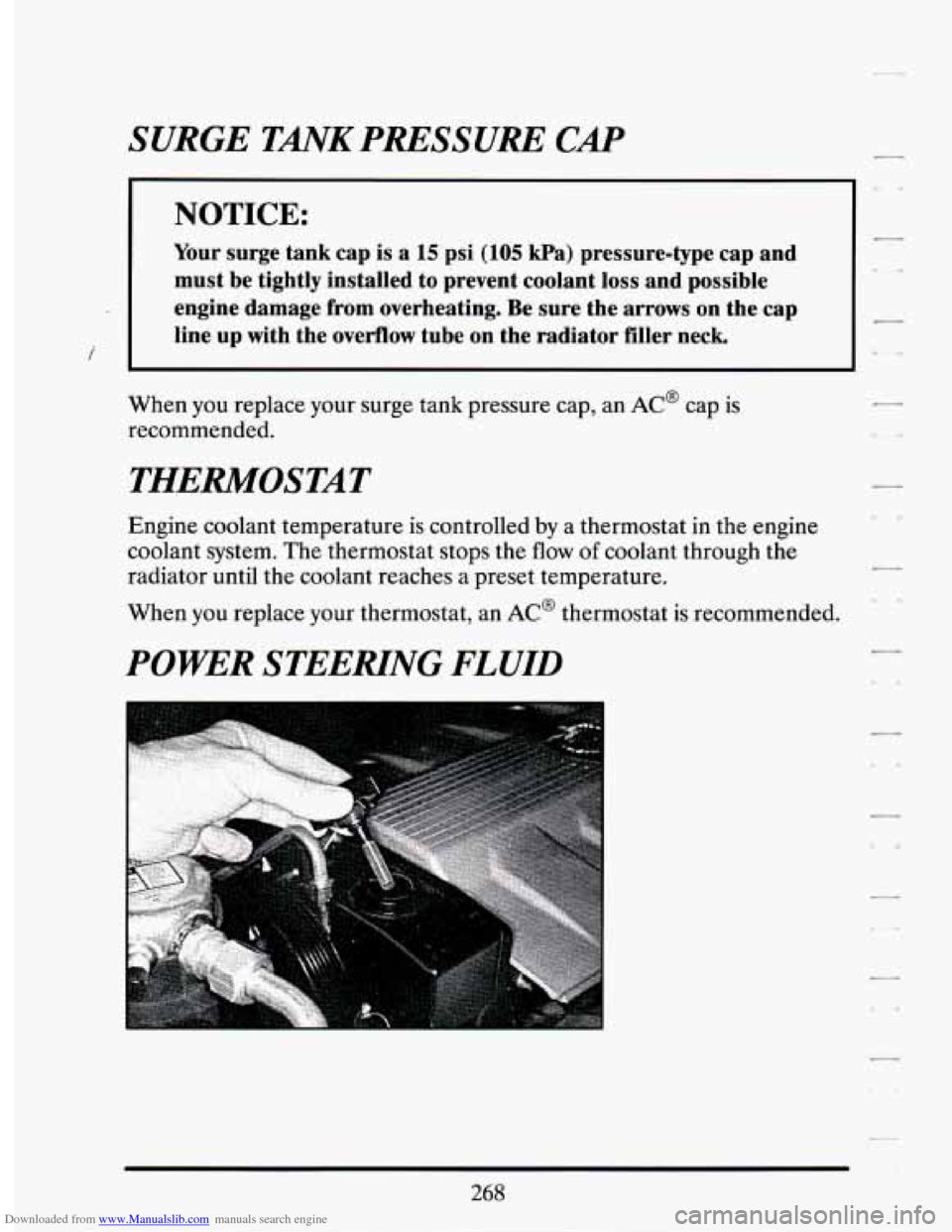
POWER STEERING FLUID
268
Page 309 of 399
Downloaded from www.Manualslib.com manuals search engine While the tires available as standard or optional equipment on General
Motors vehicles may vary with respect to these grades, all such tires meet
General Motors performance standards and have been approved for use
on General Motors vehicles. All passenger
type (P Metric) tires must
conform to Federal safety requirements in addition to these grades.
Wheel Alignment and Tire Balance
The wheels on your vehicle were aligned and balanced carefully at the
factory to give you the longest tire life and best overall performance.
1
In most cases, you will not need to have your wheels aligned again. However,
if you notice unusual tire wear or your vehicle pulling one way or the other,
the alignment may need to be reset. If you notice your vehicle vibrating when
driving on a smooth road, your wheels may need to be rebalanced.
-
Wheel Replacement
Replace any wheel that is bent, cracked or badly corroded. If wheel nuts
keep coming loose, the wheel, wheel bolts, and wheel nuts should be
replaced.
If the wheel leaks air, replace it (except some aluminum wheels,
which can sometimes be repaired). See your Cadillac dealer
if any of
these conditions exist.
Your dealer will know the kind
of wheel you need.
Each new wheel should have the same load carrying capacity, diameter,
width, offset, and be mounted the same way as the one it replaces.
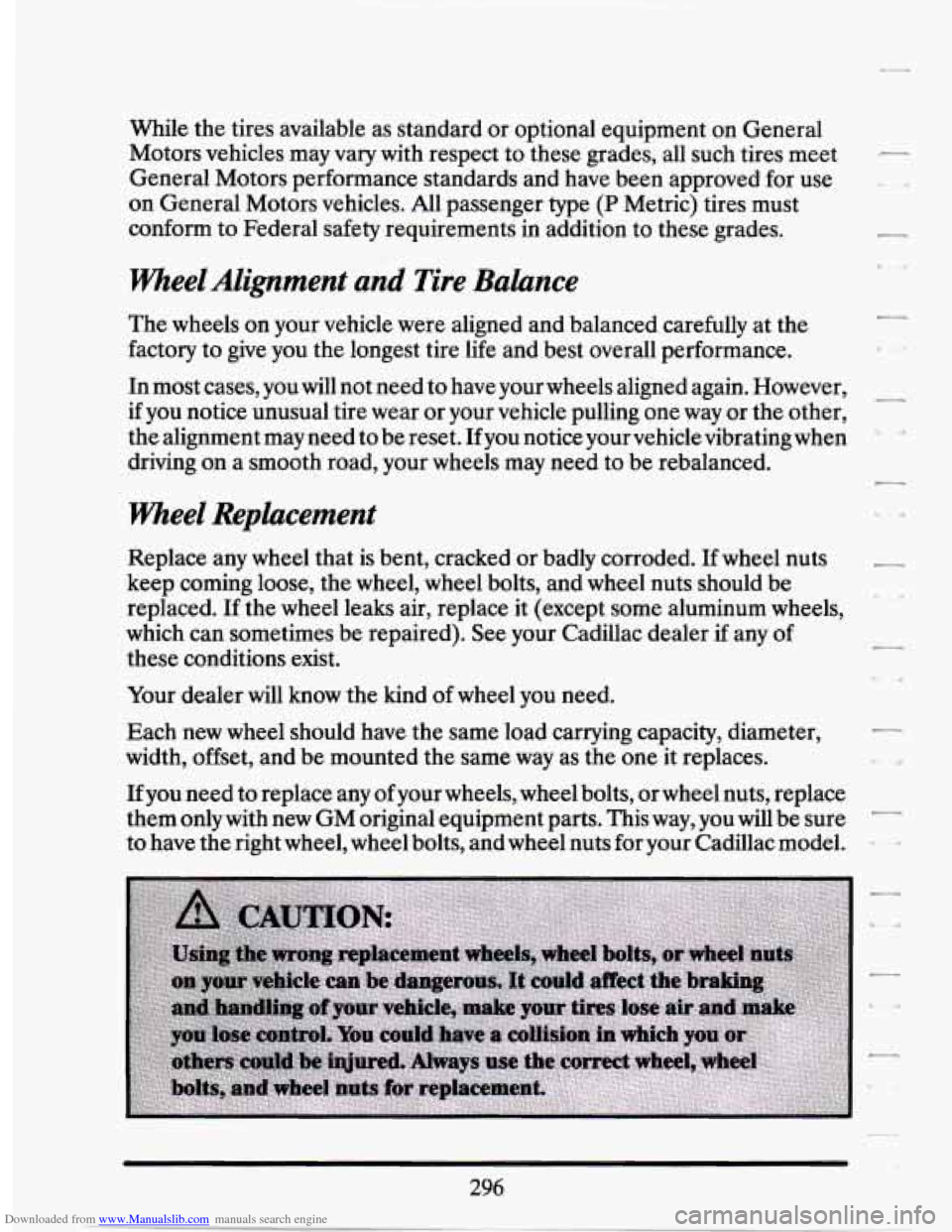
If you need to replace any of your wheels, wheel bolts, or wheel nuts, replace
them only with new GM original equipment parts. This way, you will be sure
-
to have the right wheel, wheel bolts, and wheel nuts for your Cadillac model.
296