1994 CADILLAC SEVILLE climate control
[x] Cancel search: climate controlPage 217 of 399
Downloaded from www.Manualslib.com manuals search engine Ifyou Do Decide To Pull A Trailer
If you do, here are some important points.
0
a
0
0
a
a
a
There are many different laws having to do with trailering. Make sure
your rig will be legal, not only where you live but also where you’ll be
driving.
A good source for this information can be state or provincial
police.
Consider using a sway control.
You can ask a hitch dealer about sway controls.
Don’t tow a trailer at all during the first
500 miles (800 km) your new
vehicle is driven. Your engine, axle or other parts could be damaged.
Then, during the first
500 miles (800 km) that you tow a trailer, don’t
drive over
50 mph (80 km/h) and don’t make starts at full throttle.
This helps your engine and other parts
of your vehicle wear in at the
heavier loads.
When towing a trailer, close all windows and set the Electronic
Climate Control System to “ECON”,
“AUTO”, “DEFOG” or
Defroster to assure that the fan is running.
Three important considerations have to do with weight:
1. Weight of the Fully Loaded nailer
How heavy can a trailer safely be?
It should never weigh more than
1,000 pounds (450 kg) total,
including the load.
It depends
on how you plan to use your rig. For example, speed,
altitude, road grades, outside temperature and how much your
vehicle is used
to pull a trailer are all important. And, it can also
depend
on any special equipment that you have on your vehicle.
You can
ask your dealer for information or advice, or you can write
us at Cadillac.
In Canada, write to General Motors
of Canada Limited, Customer
Assistance Center,
1908 Colonel Sam Drive, Oshawa, Ontario L1H
8P7.
--
L -e
c-
-4
204
Page 277 of 399
Downloaded from www.Manualslib.com manuals search engine How to Add Fluid
Refer to the Maintenance Schedule to determine what kind of transaxle
fluid to use. See “Recommended Fluids and Lubricants” in the Index.
If the fluid level is low, add only enough of the proper fluid to bring the
level into the cross-hatched area on the dipstick.
1. Pull out the dipstick.
2. Using a long-neck funnel, add enough fluid at the dipstick hole to
bring it to the proper 1evel.It doesn’t take much fluid, generally less
than a pint (OSL).
Don’t overfill. We recommend you use only fluid
labeled DEXR0N’-IIE or DEXRON@-111, because fluids with that
label are made especially for your automatic transaxle. Damage
caused by fluid other than DEXR0N’-IIE or DEXRON@-I11 is not
covered by your new vehicle warranty.
After adding fluid, recheck the fluid level as described under “How to
Check.”
When the correct fluid level is obtained, push the dipstick back in all
How To Reset Transaxle Fluid Change Indicator:
the
way.
Your vehicle is equipped with a transaxle fluid change indicator. A
“CHANGE TRANS FLUID” message will display on the Information
Center when the power train computer determines that the transaxle
fluid needs to be changed or at each
100,000 miles (160,000 km) interval,
whichever occurs first. When this message appears, change the transaxle
fluid and reset the transaxle fluid life indicator as follows:
Turn the key “ON” with the engine stopped.
0 Press and hold the “OFF” and “REAR DEFOG” buttons on the
climate control simultaneously until the “TRANS FLUID RESET”
message appears in the Information Center (between
5 and 20
seconds).
Page 289 of 399
Downloaded from www.Manualslib.com manuals search engine Vehicle Storage
If you’re not going to drive your vehicle for 25 days or more, take off the
black, negative
(-) cable from the battery. This will help keep your battery
from running down.
Contact your dealer to learn how to prepare your vehicle for longer
storage periods.
Battery Power Loss
If you lose battery power or the battery is disconnected, your car’s
computer must be programmed. It takes just over
20 minutes to do it. If
you want to do it yourself, here’s how:
0
0
0
0
0
0
a
Apply the parking brake.
Make sure the front wheels are straight.
Turn off the Electronic Climate Control.
Start the engine in
“P” (Park) and let it idle for 15 minutes. Then:
Put your foot on the brake pedal, shift the transaxle to
@ and let it
idle for
3 minutes or more. Do not accelerate the engine. Then:
With the car in
@ (Drive), turn the Electronic Climate Control to
“Auto” and let the engine idle for
3 minutes or more.
Turn your engine off.
Now your computer is programmed.
276
Page 308 of 399
Downloaded from www.Manualslib.com manuals search engine Treadwear
The treadwear grade is a comparative rating based on the wear rate of
the tire when tested under controlled conditions on a specified
- government test course. For example, a tire graded 150 would wear one
and a half
(1 1/2) times as well on the government course as a tire graded
100. The relative performance of tires depends upon the actual
conditions
of their use, however, and may depart significantly from the
norm due to variations in driving habits, service practices and differences
in road characteristics and climate.
-
__
Traction - A, B, C
The traction grades, from highest to lowest are: A, B, and C. They
represent the tire’s ability to stop on wet pavement as measured under
controlled conditions on specified government test surfaces
of asphalt
and concrete.
A tire marked C may have poor traction performance.
Warning: The traction grade assigned to this tire is based on braking
(straight-ahead) traction tests and does not include cornering (turning)
traction.
Temperature -A, B, C
The temperature grades are A (the highest), B, and C, representing the
when tested under controlled conditions on a specified indoor laboratory
test wheel. Sustained high temperature can cause the material of the tire
to degenerate and reduce tire life, and excessive temperature can lead to
sudden tire failure. The grade.C corresponds to a level
of performance
which all passenger car tires must meet under the Federal Motor Vehicle
Safety Standard
No. 109. Grades B and A represent higher levels of
performance on the laboratory test wheel than the minimum required by
law.
-. - tire’s resistance to the generation of heat and its ability to dissipate heat
_- -
Warning: The temperature grade for this tire is established for a tire that
is properly inflated and not overloaded. Excessive speed, underinflation,
or excessive loading, either separately or
in combination, can cause heat
buildup and possible tire failure.
These grades
are molded on the sidewalls of passenger car tires.
~
295
Page 326 of 399
Downloaded from www.Manualslib.com manuals search engine 60A I
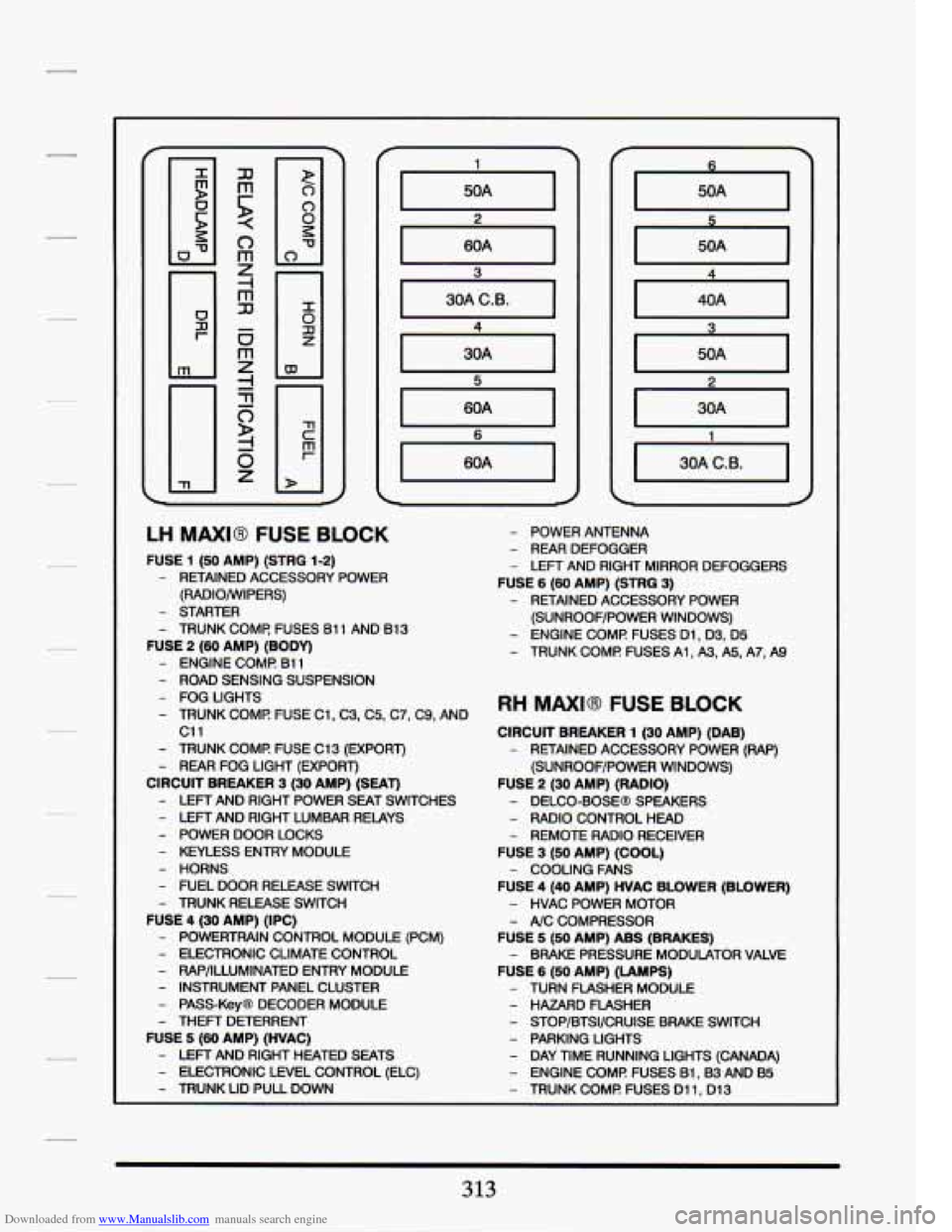
LH MAXI8 FUSE BLOCK
FUSE 1 (50 AMP) (STRG 1-2)
- RETAINED ACCESSORY POWER
(RADIO/WIPERS)
- STARTER
- TRUNK COMF! FUSES 61 1 AND 81 3
FUSE 2 (60 AMP) (BODY)
- ENGINE COMI? B11
- ROAD SENSING SUSPENSION
- FOG LIGHTS
- TRUNK COMI? FUSE C1, C3, C5, C7, C9, AND
c11
- TRUNK COME FUSE C13 (EXPORT)
- REAR FOG LIGHT (EXPORT)
CIRCUIT BREAKER 3 (30 AMP) (SEAT)
- LEFT AND RIGHT POWER SEAT SWITCHES
- LEFT AND RIGHT LUMBAR RELAYS
- POWER DOOR LOCKS
- KEYLESS ENTRY MODULE
- HORNS
- FUEL DOOR RELEASE SWITCH
- TRUNK RELEASE SWITCH
FUSE 4 (30 AMP) (IPC)
- POWERTRAIN CONTROL MODULE (PCM)
- ELECTRONIC CLIMATE CONTROL
- W/ILLUMINATED ENTRY MODULE
- INSTRUMENT PANEL CLUSTER
- PASS-Key@ DECODER MODULE
- THEFT DETERRENT
FUSE 5 (60 AMP) (HVAC)
- LEFT AND RIGHT HEATED SEATS
- ELECTRONIC LEVEL CONTROL (ELC)
- TRUNK LID PULL DOWN
- POWER ANTENNA
- REAR DEFOGGER
- LEFT AND RIGHT MIRROR DEFOGGERS
FUSE 6 (60 AMP) (STRQ 3)
- RETAINED ACCESSORY POWER
(SUNROOF/POWER WINDOWS)
- ENGINE COMI? FUSES Dl, 03, D5
- TRUNK COMI? FUSES A1 , A3, A5, A7, A9
RH MAXI@ FUSE BLOCK
CIRCUIT BREAKER 1 (30 AMP) (DAB)
- RETAINED ACCESSORY POWER (RAP)
(SUNROOF/POWER WINDOWS)
FUSE 2 (30 AMP) (RADIO)
- DELCO-BOSEB SPEAKERS
- RADIO CONTROL HEAD
- REMOTE RADIO RECEIVER
FUSE 3 (50 AMP) (COOL)
FUSE
4 (40 AMP) HVAC BLOWER (BLOWER)
- COOLING FANS
- HVAC POWER MOTOR
- A/C COMPRESSOR
FUSE 5 (So AMP) ABS (BRAKES)
FUSE
6 (So AMP) (LAMPS)
- BRAKE PRESSURE MODULATOR VALVE
- TURN FLASHER MODULE
- HAZARD FLASHER
- STOP/BTSI/CRUISE BRAKE SWITCH
- PARKING LIGHTS
- DAY TIME RUNNING LIGHTS (CANADA)
- ENGINE COMI? FUSES Bl,B3 AND B5
- TRUNK COMI? FUSES Dl 1, Dl3
313
Page 384 of 399
Downloaded from www.Manualslib.com manuals search engine .
.
.
.
.
.
.
.
.
.
.
Capacities. Fluid ................................... 327
Carbon Monoxide In Exhaust ......................... 99
Cassette Tape Player. Care Of Your ................... 166
Cassette Tape Systems .............................. 166
Cautions. Safety ...................................... 1
CB Radio. Adding A ............................ 224. 310
Cellular Telephone. Adding A .................... 224. 310
Center Console ..................................... 76
Central Door Unlocking System ....................... 70
Change The Oil. When To ........................... 259
Changing A Flat Tire ............................... 232
Chassis Lubrication ...................... See Maint . Book
Checking The Brake Fluid
................................. 273
The Engine Oil Level ............................ 254
The Power Steering Fluid ......................... 268
The Transaxle Fluid .............................. 261
Things Under The Hood .......................... 251
Your Restraint Systems ............................ 63
Your Safety Belt Systems ........................... 63
Checks. Service Station ................... See Maint . Book
Chemical Paint Spotting ............................. 306
Child Restraint. Securing ............................. 50
Child Restraints ..................................... 48
Children And Safety Belts ............................ 45
Chains. Tire ....................................... 297
Charge. Battery. No Warning Light .................... 137
Cigarette Lighter ...................................
Circuit Breakers ...................................
City Driving .......................................
Cleaner. Air .......................................
Cleaning
AluminumWheels
...............................
Fabric ..........................................
Glass ..........................................
Vinyl or Leather .................................
SafetyBelts .....................................
The Inside Of Your Cadillac .......................
The Outside Of Your Cadillac .....................
The Power Antenna ..............................
The Underbody Of Your Car ......................
The Windshield and Wiper Blades ..................
Weatherstrips ...................................
Clock. Setting The ..................................
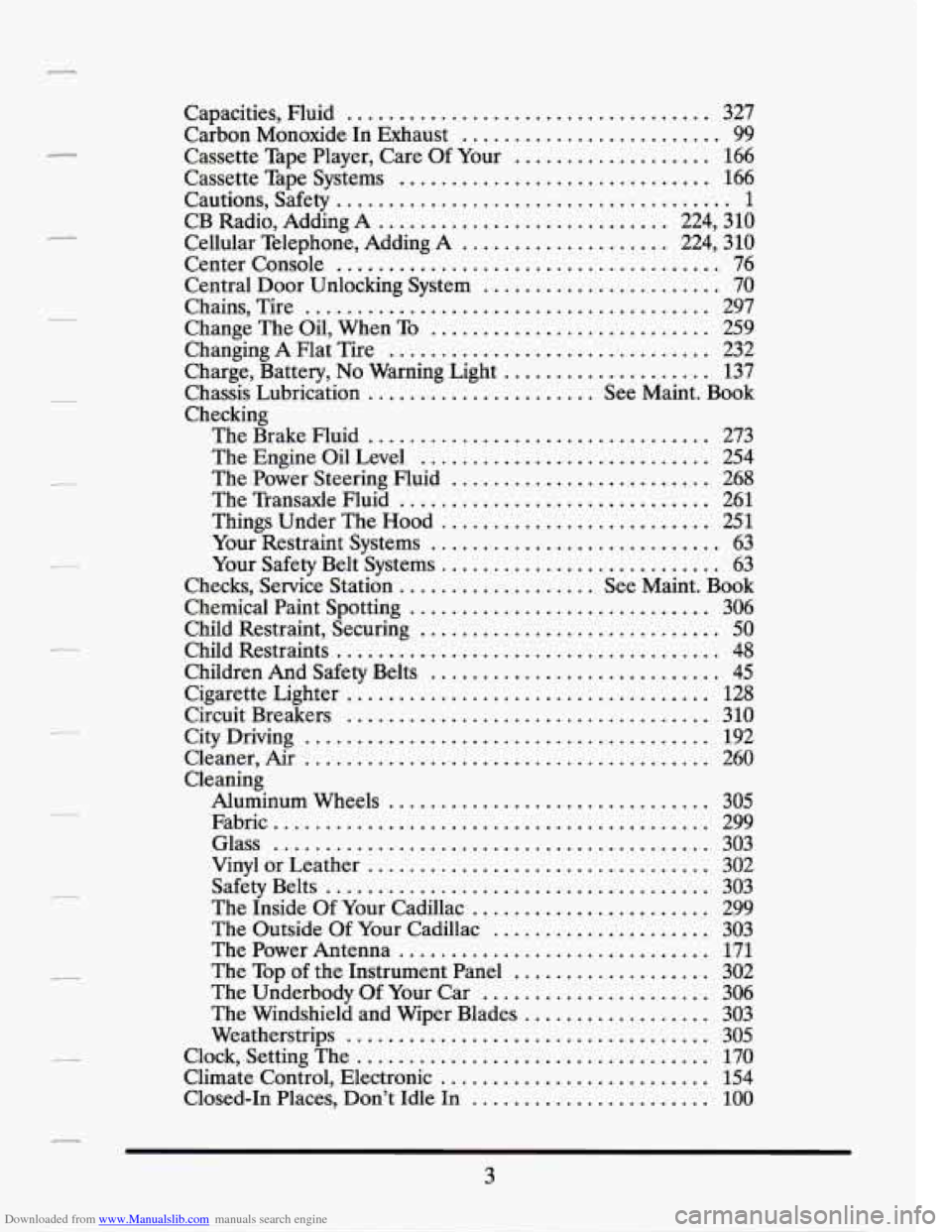
Climate Control. Electronic ..........................
Closed-In Places. Don’t Idle In .......................
The Top of the Instrument Panel ...................
128
310 192
260
305
299
303
302
303 299
303
171
302
306
303
305
170
154
100
.
3
Page 386 of 399
Downloaded from www.Manualslib.com manuals search engine .
.
.
.
.
.
.
.
AtNight ....................................... 188
Defensive ...................................... 173
Hill and Mountain ............................... 196
In Cities ........................................ 192
On Snow Or Ice ................................. 199
In The Rain ..................................... 190
In Winter ....................................... 198
On A Long Trip ................................. 194
On The Freeway ................................. 193
On Curves ...................................... 182
Through Deep Standing Water ...................... 87
Winter ......................................... 198
Drunken Driving ................................... 174
E
Economy. Fuel ..................................... 246
Electric Outside Mirror Control ...................... 123
Electrical Equipment. Adding .................... 224. 310
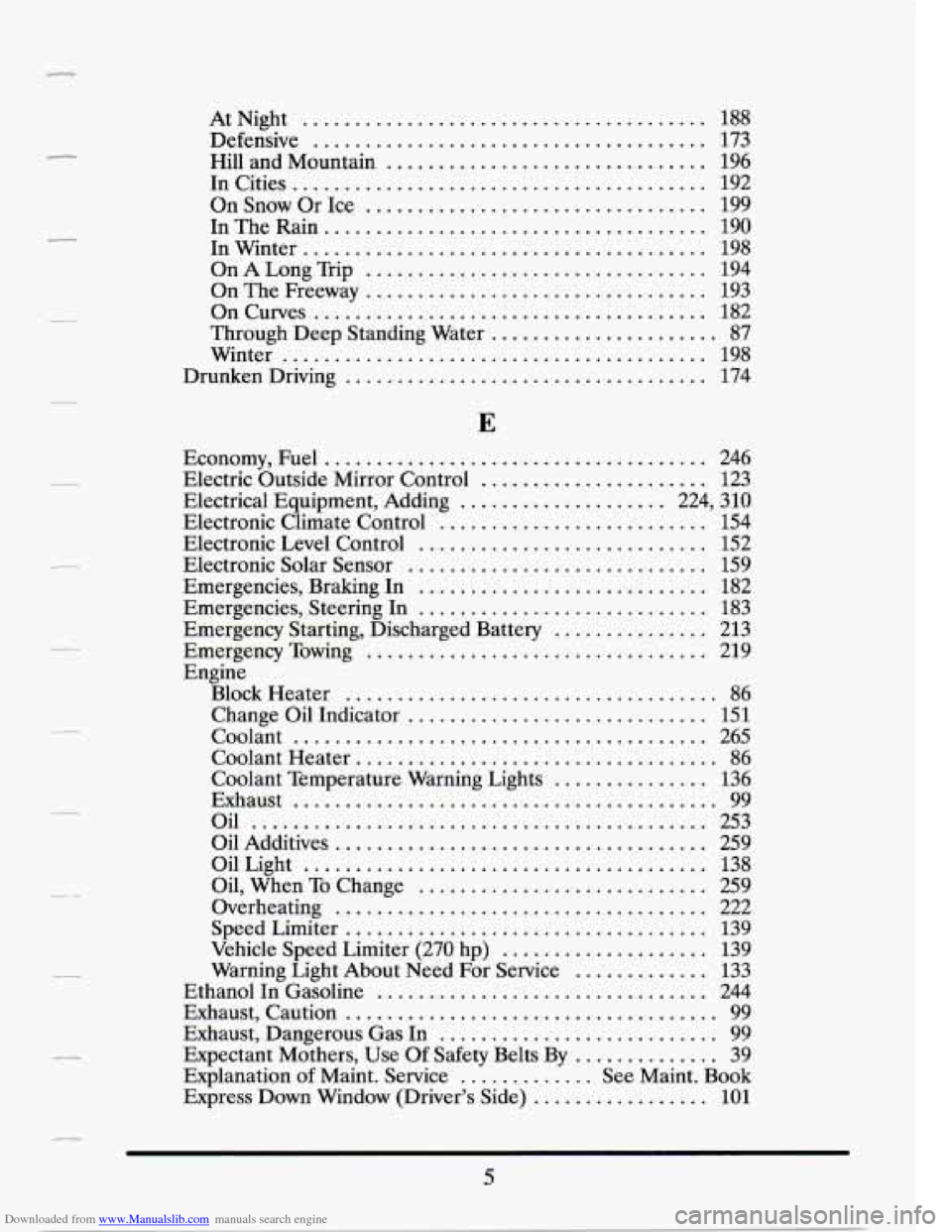
Electronic Climate Control .......................... 154
Electronic Level Control ............................ 152
Electronic Solar Sensor ............................. 159
Emergencies. Braking In ............................ 182
Emergencies. Steering In ............................ 183
Emergency Starting. Discharged Battery ............... 213
EmergencyTowing ................................. 219
Engine
Block Heater .................................... 86
Change Oil Indicator ............................. 151
Coolant ........................................ 265
Coolant Heater ................................... 86
Coolant Temperature Warning Lights ............... 136
Exhaust ......................................... 99
Oil ............................................ 253
Oil Additives .................................... 259
Oil Light ....................................... 138
Oil. When To Change ............................ 259
Overheating .................................... 222
Speed Limiter ................................... 139
Vehicle Speed Limiter (270 hp) .................... 139
Warning Light About Need For Service ............. 133
Ethanol In Gasoline ................................ 244
Exhaust. Caution .................................... 99
Exhaust. Dangerous Gas In ........................... 99
Expectant Mothers. Use Of Safety Belts By .............. 39
Explanation of Maint . Service ............. See Maint . Book
Express Down Window (Driver’s Side) ................. 101
.