1994 CADILLAC ELDORADO belt
[x] Cancel search: beltPage 179 of 398
Downloaded from www.Manualslib.com manuals search engine To Set the Minutes:
F 0 Press SET, and within 5 seconds, 1
Press and hold SCAN. When the clock gets& the correGt minute, Set j
Your clock is set.
go*
I I I
f
Care of Your Cassege .Tape Phyer
-2 , . . . -111.: ,, :
--,= ,: . . , .. . .,,&V?i'.,.r: m.. ... . - ., - c: ,I >$ -72 .. I . ,. .
A tape
player that is qot cl6aiied.r&gctlarly can cause reduad sound
quality, ruined cassettes,
or a..dam&$ed mechanism. Cassette tapes should .
be stored in their cases away ficmici&aninants, direct sunlight, and . '
failure of the tape player. I
,I
L extreme heat. If they aren?, they :may not operate properly or cause
- Your tape player should be cleaned regularly each month or after every
50 hours of use. If you notice a reduction in sound quality, try a known
good cassette to see
if the tape or the tape player is at fault. If this other
Cleaning may be done with a scrubbing action, non-abrasive cleaningi.
~
cassette. This system uses a cleaning cassette with pads which scrub the
tape head 'as the hubs of the cleaner cassette turn. It is-normal for. the
ensure thorough cleaning.
A scrubbing action cleaning cassette is
available through your Cadillac dealership.
-, cassette has no improvement in sound quality, clean the tape player.
.I
(, cartridge to eject while cleaning. Insert the cassette at least 3 times to
r
You may also choose a non-scrubbing action, wet-type cleaner which uses
a cassette with a fabric belt to clean the tape head. This
type of cleaning
cassette
will not eject. It -may not clean as thoroughly as the scrubbing
type cleaner.
Cassettes are subject to wear and the sound quality may degrade over
time. Always make sure that the cassette tape is in good condition before
you have your tape player serviced.
Care of Your Compact Discs
Handle discs carefully. Store them in their original cases or other
protective cases and away from direct sunlight and dust.
If the surface of
a disc
is soiled, dampen a clean, soft cloth in a mild, neutral detergent
solution and clean it, wiping from the center to the edge.
167
Page 182 of 398
Downloaded from www.Manualslib.com manuals search engine I
YOUR DRIVING AND THE ROAD
II
Here you’ll find information about driving on different kinds of roads and
in varying weather conditions. We’ve also included many other useful tips
on driving.
DEFENSIVE DRIVTNG
The best advice anyone can give about driving is: Drive defensively.
Please start with a very important safety device in your Cadillac: Buckle
up. (See “Safety Belts” in the Index.)
Defensive driving really means “be ready for anything.” On city streets,
rural roads, or freeways, it means “always expect the unexpected.”
Assume that pedestrians or other drivers are going to be careless and
make mistakes. Anticipate what they might do. Be ready for the\
ir
mistakes.
170
Page 193 of 398
Downloaded from www.Manualslib.com manuals search engine ‘I
r td
r
r
!
-
I- t>
Try to adjust your speed so you can ‘‘d&xCY through.thecurve. Maintain a
reasonable,. steady speed, Wait to .accelerate until you are out of the
curve,
and then accelerate-gently into the straightaway.
.. .:r 5.
Steering in Emergencies
There are times when steering canbe more effective.than braking. For
example, you. come over a hill and, find a truck stopped
in your lane, .or a
car suddenly pulls. out from nowhere, ox a child darts out €rm betwe
you. You can avoid these pxoblems
by braking.
-- if you can stop in time. But sometimes you can’t; there isn’t
room. That’s the time for evasive action
-- steering around the problem.
Your Cadillac can perform verywell
in. emergencies like these. First apply
your brakes. It
is better to remove as much speed as you can from a,
possible collision. Then steer around the problem, to the left orright
depending on the space available.
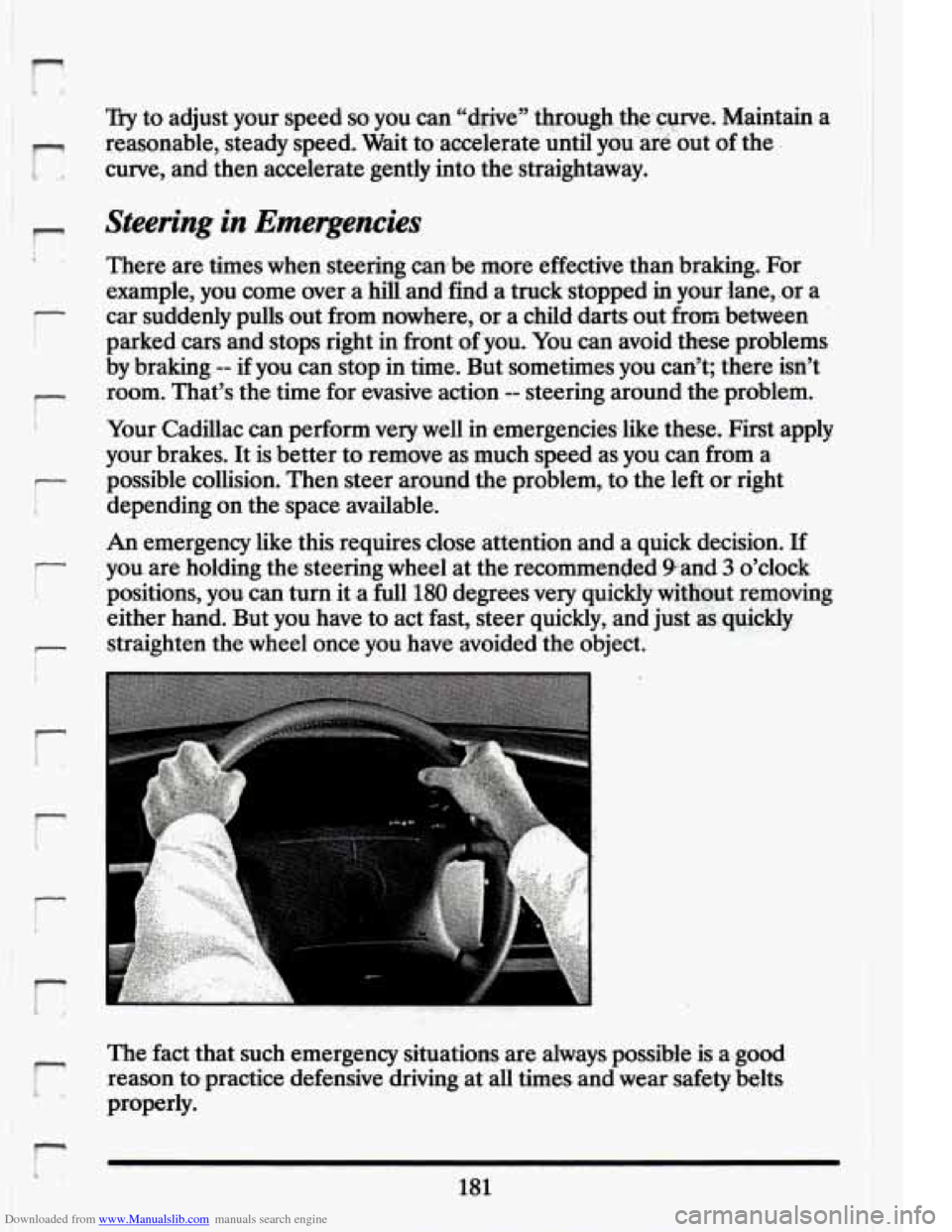
An emergency like this requires close attention and a quick decision. If
you. are holding the steering wheel’ at the recommended Pand-3’o’clock
positions, you can turn
it a full 180 degrees very quickly without removing
either hand. But you have to act fast, steer quickly, and just aslquickly
straighten the wheel once
you have avoided-:the object.
The fact that such emergency situations are always possible
is a.good
reason to practice defensive driving at all times. and wear safety belts
properly.
r c
181.
Page 219 of 398
Downloaded from www.Manualslib.com manuals search engine r
F, 4. Stop and have someone pick up .and store the chocks.
Engine Cooling When Tru.ilering
r
I ? Your cooling system may temporarily overheat during severe operating
conditions such as;
Climbing grades steeper than 4% at ambient temperatures above
90” Fahrenheit (32O Celsius) with a loaded vehicle and trailer.
Stopping after high-speed driving.
I
r Idling for long periods in stop and go traffic. I
If ,“ENGINE HOT A/C COMPRESSOR OFF” message appears on. the
Driver Information Center, do.not be alarmed.
This is. a normal function
continue to drive’your vehicle.
the -Driver Information Center, pull
,off to the side of the road as, soon as
it is safe to do
so. When the vehicle is at a complete stop, shift the
transaxle selector to
P (Park) and allow the engine to idle.:Do not turn off
three minutes the system should cool sufficiently to allow A/C operation
to resume. At that time resume driving at a reduced speed. Return to
normal driving after
10 minutes if the “ENGINE COOLANT HOT
- designed. to reduce the load on the.engine and cooling system. You can
- If “ENGINE COOLANT HOT IDLE ENGINE” message.appears on
c
I the engine or increase engine speed.above a normalidle. Wit-hin two or
b- IDLE ENGINE” message is not displayed.
Maintenance When Trailer Towing
i L.
Your vehicle will need service more often when you’re pulling a trailer.
See the Maintenance Schedule for more on this. Things that are
(don’t overfill), engine oil,
axle lubricant, belts, cooling system, and brake
adjustment. Each
of these is covered in this manual, and the Index will
these sections before you start your trip.
i especially important in trailer operation are, automatic transaxle fluid
7 help you find them quickly. If you’re trailering, it’s a good idea to review
I
‘F
Check periodically to see that all hitch nuts and bolts are tight.
r 207
Page 306 of 398
Downloaded from www.Manualslib.com manuals search engine The tire has a bump, bulge or split.
The tire has a puncture, cut, or other damage that can’t be repaired
well because
of the size or location of the damage.
Buying New Tires
To find out what kind and size of tires you need, look at the Tire-Loading
Information label.
The tires installed on your vehicle when it was new had a Tire
Performance Criteria Specification (TPC Spec) number on each tire’s
sidewall. When you get new tires, get ones with that same
TPC Spec
number. That way, your vehicle
will continue to have tires that are
designed to give proper endurance, handling, speed rating, traction, ride
and other things during normal service
on your vehicle. If your tireshave
an all-season tread design, the TPC number will be followed by a
“MS”
(for mud and snow).
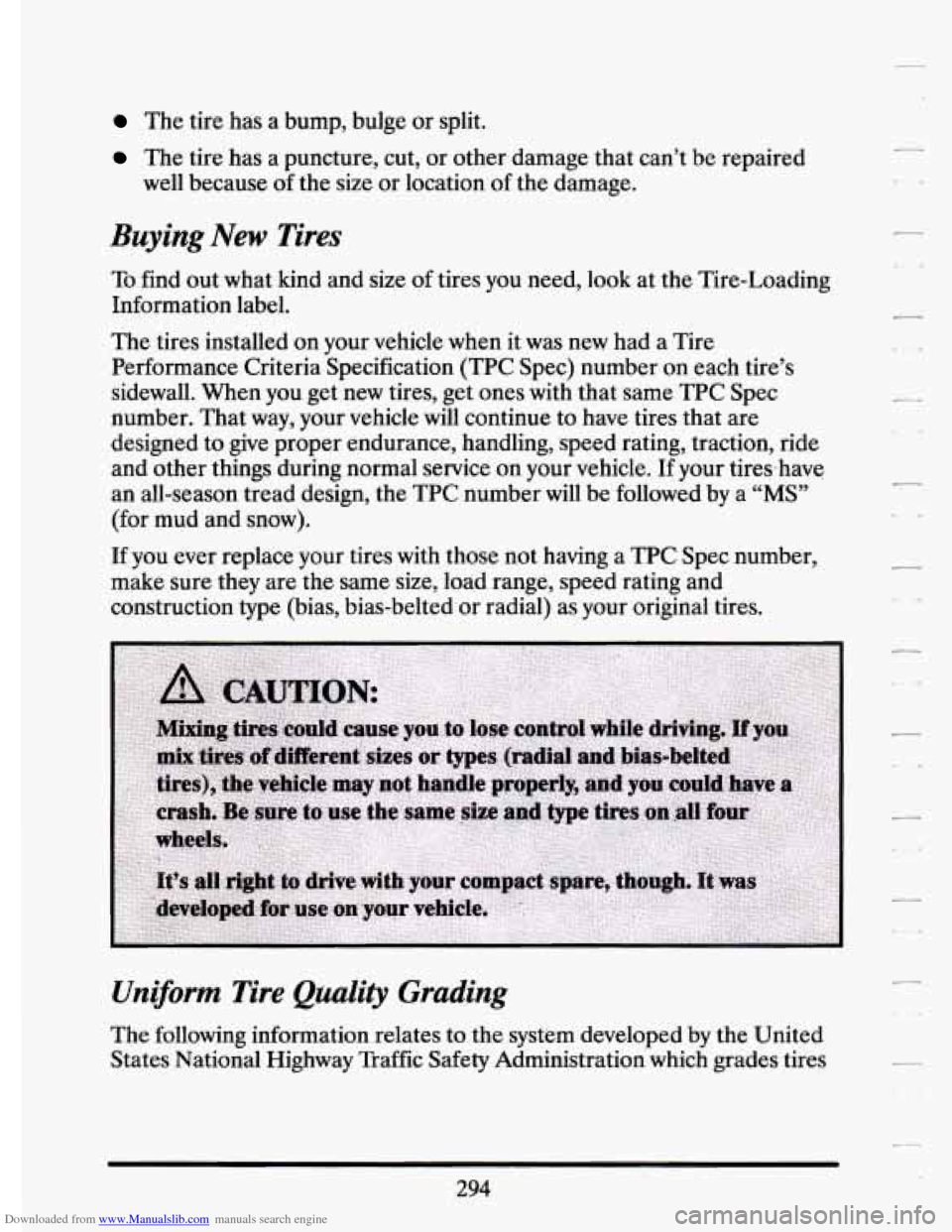
If you ever replace your tires with those not having a TPC Spec number,
make sure they are the same size, load range, speed rating and
construction type (bias, bias-belted or radial) as your original tires.
Uniform Tire Quality Grading
The following information relates to the system developed by the United
States National Highway Traffic Safety Administration which grades tires
294
Page 315 of 398
Downloaded from www.Manualslib.com manuals search engine r
P
r
r
r
PI
r
n
0 Never use- oils, varnishes,. solvent-based or abrasive cle.aners, furniture,
0 Soiled leather should be cleaned immediately. If dirt is allowed to
polish-or
shoe polish on leather.
work into finish, it can harm the leather.
Ckaning Speaker Covers
Vacuum ar0und.a speaker cover gently, so that the-speaker won’t be
damaged. If something gets on one of them, follow .the steps earlier under
“Using.Solvent-Type. Cleaner on.Fabric.” Use. aslittle solvent as you can.
Cleaning the Top of the Instrument Panel
Use only mild soap and. water. to .clean the top surfaces of the instrument
panel. Sprays containing silicones or waxes may cause annoying
reflections in-the windshield and even make it difficult to see through the
windshield under certain conditions.
Care of Wood Panels
Use a clean cloth moistened in warm soapy water (use mild di\
sh washing
soap). Dry the wood.immediately with a clean cloth.
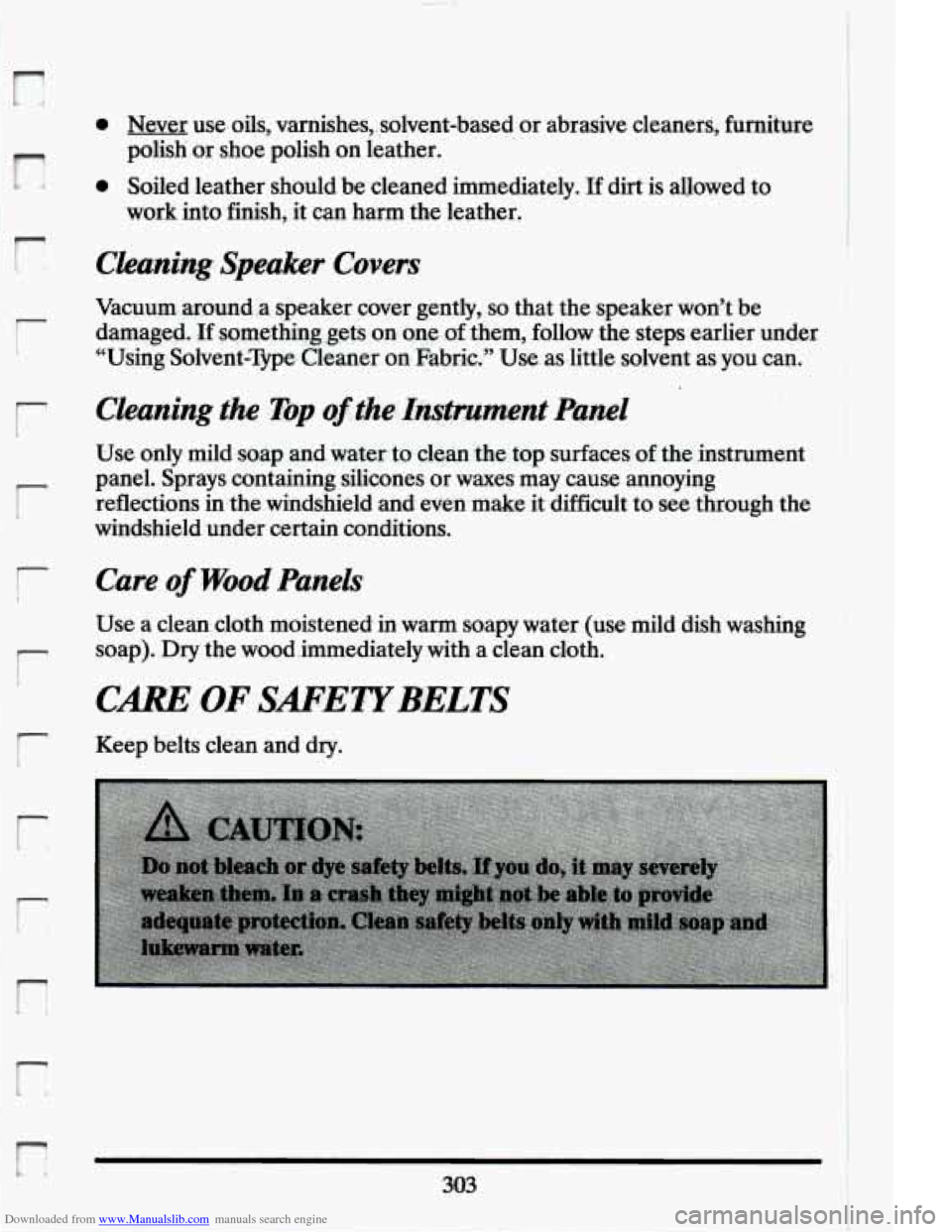
Keep belts clean and
dry.
303
Page 321 of 398
Downloaded from www.Manualslib.com manuals search engine r
I r
r
r
r i
r
P I
I
r
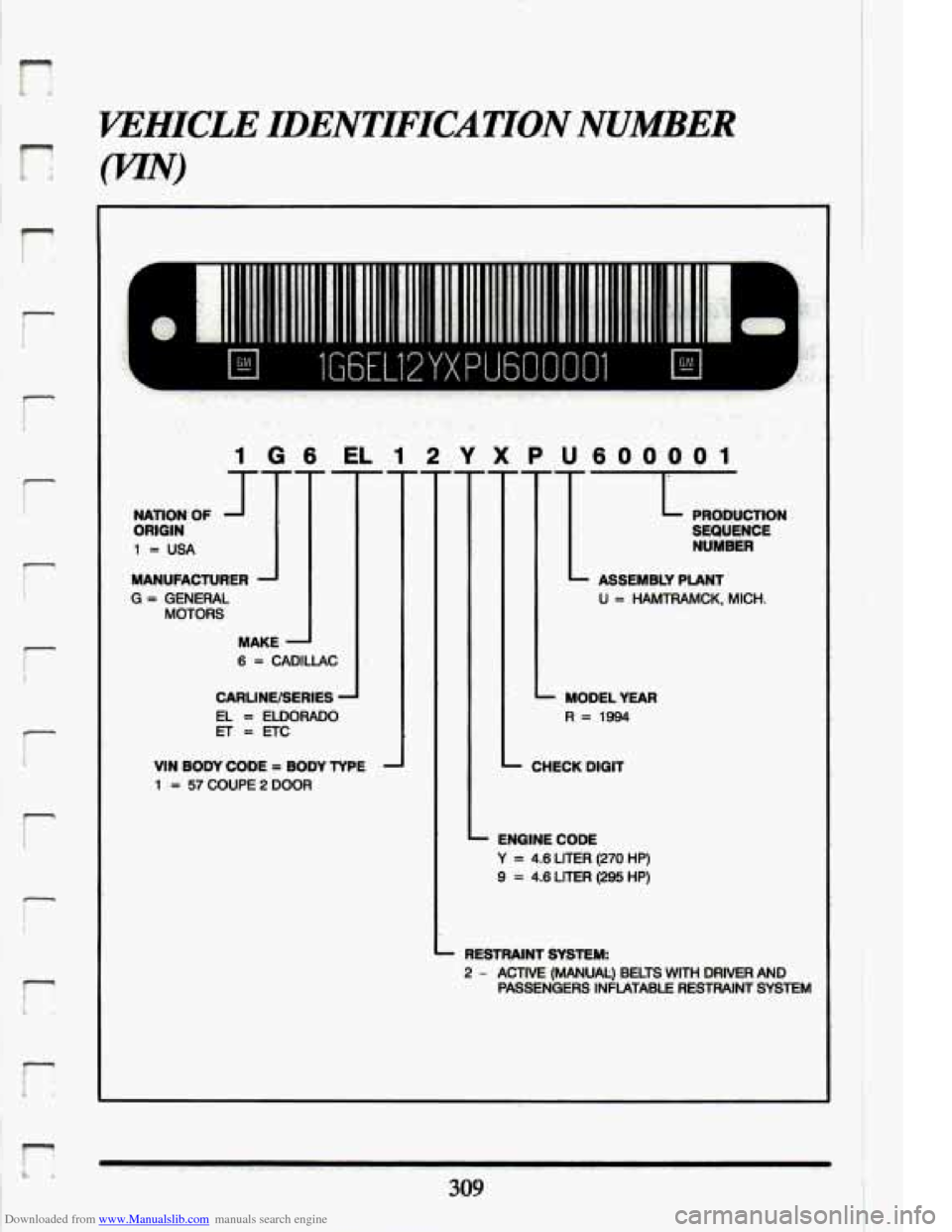
WHICLE IDENTIFICATION NUMBER
WN)
El lG6EL12YXPU600001 HA . . .. - __ ,. --
I G 6 EL 12 Y X P U600001
NATIONOF ORIGIN *T
1 = USA I
MANUFACTURER
G = GENERAL MOTORS
MAKE - 6 = CADILIAC 1
CARLINE/SERIES
EL = ELDORADO
ET = ETC
VIN BODY CODE = BODY TYPE
1 = 57 COUPE 2 DOOR
I-
PRODUCTION
SEQUENCE NUMBER
ASSEMBLY PLANT
U = HAMTRAMCK, MICM.
- MODELYEAR
R= 1994
- CHECK DlGlT
- ENGINE CODE
Y = 4.6 LITER (270 HP)
9 = 4.6 LITER (295 HP)
- RESTRAINT SYSTEM:
2 - ACTIVE (MANUAL) BELTS WITH DRIVER AND
PASSENGERS INFLATABLE RESTRAINT SYSTEM
Page 328 of 398

Downloaded from www.Manualslib.com manuals search engine
REAR FOG FOG LP CNSL FAN CIGAR BODY
2 BODY 1 READ LP
LPRKLP
R PRKLP RAD (BAT) ANTBRKPLD ELC R HTD SEAT L HTD SEAT
~
TRUNK COMPARTMENT FUSE BLOCK
- RAP/IUMINATED ENTRY MODULE CRANK (10 AMP)
- DIAGNOSTIC/ENERGY RESERVE
- TRANSAXLE RANGE SWITCH (NSSS) MODULE (DERM) ION 1 (10 AMP .,
- FUEL
LEV& SENSOR - ELECTROCHROMIC MIRROR - RAP/ILWMINATED ENTRY MODULE - THEFT DETERRENT MODULE - KEYLESS ENTRY MODULE - TURN FLASHER RELAY-~F" TRUNK cc MICRO RELAY CENTER )MF!
MODI
JLE
- PASS-Key@ DECODER MODULE - THEFT DETERRENT RELAY
"D" (TRUNK COME
- THEFT DETERRENT MODULE
- HEATER AND NC PROGRAMMER HVAC/DABIE (10 AMP)
- RAP/ILLUMINATED ENTRY MODULE RELAY CENTER) REAR FOG (10 AMP)
FOG
LP (10 AMP)
CNSL FAN (1OAMP)
~~ ~~~
- REAR FOG LIGHT RELAY A (EXPORT)
- FOG LIGHT RELAYS A AND F
- REAR BLOWER MOTOR - REAR BLOWER RELAY .MODULE
CIGAR (20 AMP) - LTAND
RT REAR CIGARETTE LIGHTERS (SNILLE ONLY) - FRONT CIGARETTE LIGHTER - CHIME MODULE
- POWER MdOR SWITCH BODY 2 (10 AMP
- RAPRELAY - LOCK-OUT INHIBIT RELAY "B" (TRUNK COMF! 1 MICRO
- PANEL LIGHTS INHIBIT RELAY "F" (TRUNK COMF! 3 MICRO
- COURTESY LIGHTS RELAY "C" (TRUNK COMF! 2 MICRO
- RAP RELAY "E" (TRUNK COMF! 2 MICRO RELAY CENTER) - KEYLESS ENTRY MODULE - TRUNKLAMP - SEAT BELT RETRACTOR SOLENOIDS (ELDORADO ONLY) RELAY CENTER)
RELAY CENTER) (EXPORT)
RELAY CENTER)
- FRONT Dook LOCK swmm BODY 1 (10 AMP
- GLOVE BOX LAMP - LT AND RT FOOTWELL COURTESY LAMPS - HEADLIGHT SWITCH
- LTAN- ___ L PRK LP (10 AMP - LT REAR TAIdToPnURN LAMPS - LT FRONT PARWURN LAMPS - FRONT AND REAR I .EFT SIDE MARKER LAMPS - RADIO CONTRC - HEADLlGl - INSTRUML ... . . R PRK LP (10 AMP - RT TAlusToP !URN LAMPS - AT FRONT AND REAR SIDE MARKER LAMPS - RT FRONT PARK AND TURN LAMPS
- RAE RAD (BA
ANT/TRl
- TRU - POWER7
~VlVl~ WM. : PLATE LAMPS
;% (10 AMP)
c PLD (20 AMP) NK LID PULL DOWN MOTOR WTENNA
{NIC LEVEL CONTROL (ELC)
% SEAT
316