1994 CADILLAC ELDORADO ECU
[x] Cancel search: ECUPage 92 of 398
Downloaded from www.Manualslib.com manuals search engine When you park your Cadillac and open the driver’s door, you’ll hear a
chime reminding you to remove your key from the ignition and take it
with you. Always
do this. Your steering wheel will be locked, and so will
your ignition and transaxle. And remember to lock the doors.
Parking at Night
Park in a lighted spot, close all windows and lock your vehic\
le. Remember
to keep your valuables out
of sight. Put them in a storage area, or take
them with you.
Parking Lots
If you park in a lot where someone will be watching your vehicle, it’s best
to lock it up and take your keys. But what
if you have to leave your
ignition key? What
if you have to leave something valuable in your
vehicle?
a Put your valuables in a storage area, like your trunk or glove box.
Lock the glove box.
0 Lock all the doors except the driver’s.
Then take the door key with you.
THEFT DETERRENT (OPTION)
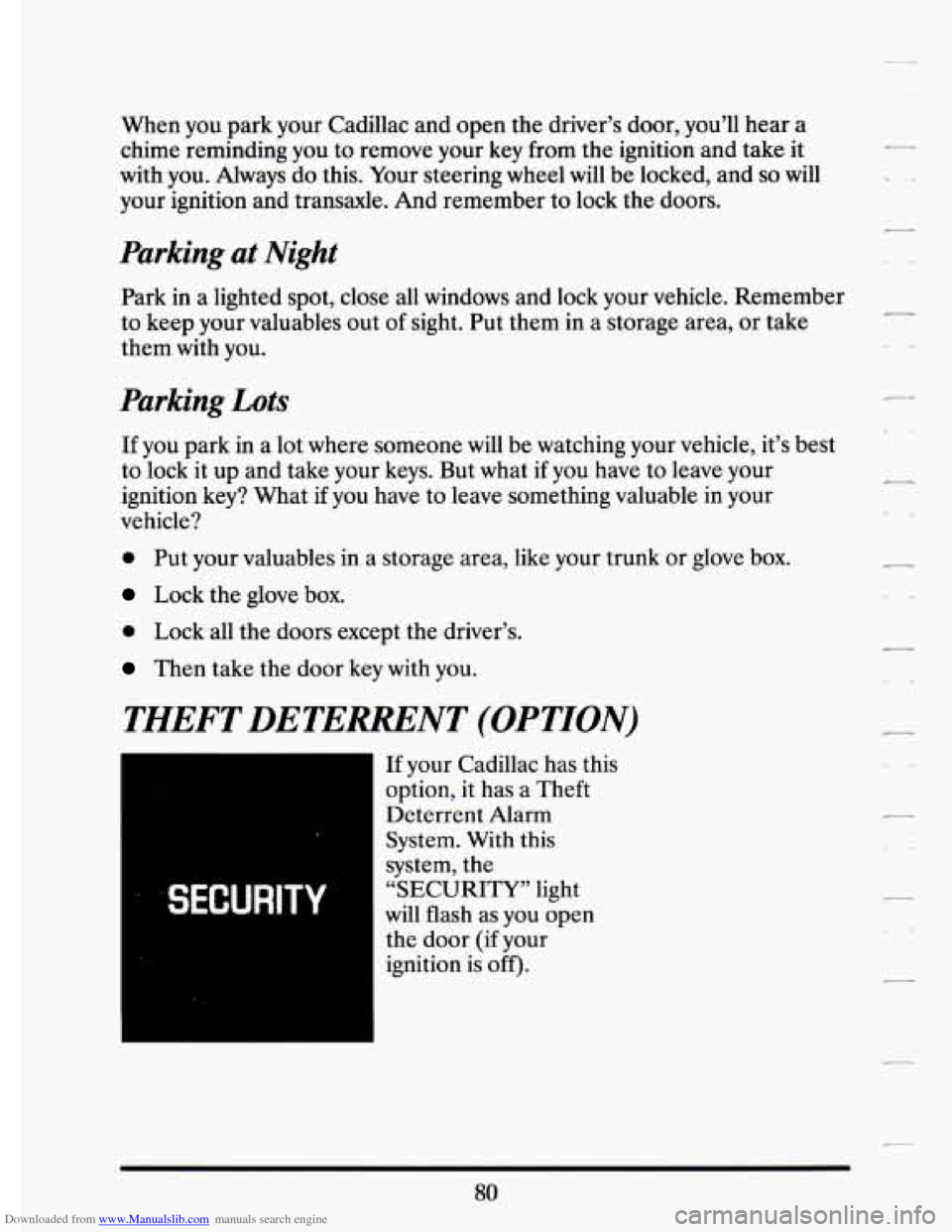
I ,SECURITY
If your Cadillac has this
option, it has a Theft
Deterrent Alarm
System. With
this
system, the
“SECURITY” light
will flash as you open
the door
(if your
80
Page 93 of 398
Downloaded from www.Manualslib.com manuals search engine hl
c7
r
This light reminds you to arm the theft deterrent system. Here’s how to
do it:
1. Open the door.
2. Lock the door with the power aoor lock switch or Keyless Entry
System. The “SECURITY” light should come on and stay on.
3. Close all doors. The “SECURITY” light should go off.
If a door or the trunk is opened without the key or Keyless Entry System,
the alarm will go
off. It will also go off if the’trunk lock is damaged. Your
vehicle’s lights will flash and thehorn will sound for
3 minutes, then will
- go off to save battery power. 1. I
1 Remember, the theft deterrent system wht arm if you lock the doors
with a key or manual door lock. It arms only if you use a power door lock
switch or Keyless Entry System.
Here’s how to avoid setting
off the alarm by accident:
r
r t
P
r
r
r
If you dop’t want to arm the theft deterrent system, the vehicle should
be locked with the door key after the doors are closed.
Always unlock a door with a key, or use the Keyless Entry System.
If you set off the alarm by accident, unlock any door with your key. You
Unlocking
a door any other way will set off the alarm.
can also turn
off the alarm by using the Keyless Entry Syste
it. The alarm won’t stop if you try to unlock a door any
How to Test The Alarm
Roll down your window and lock your vehicle using the power door
lock or the Keyless Entry System.
Reach in and unlock the door using the manual lock, and open the
If the alarm does not sound when it should, check to see if the horn
works. The horn fuse may
be blown. To replace the fuse, see “Fuses and
Circuit Breakers” in the Index.
To reduce the possibility of theft, always
arm the theft deterrent system
when leaving your vehicle. door.
The horn will sound and your headlights
will flash.
81
Page 94 of 398
Downloaded from www.Manualslib.com manuals search engine PASS-KEY@II
Your vehicle is equipped with the PASS-Key@II (Personalized
Automotive Security System) theft deterrent system. PASS-Key@II
is a
passive theft deterrent system.
This means you don’t have to do anything
different to arm or disarm the system. It works when you insert or remove
the
key from the ignition. PASS-Key@II uses a resistor pellet in the
ignition key that matches a decoder in your vehicle.
When the PASS-Key@II system senses that someone is using the wrong
key, it shuts down the vehicle’s starter and
fuel systems. For about three
minutes, the starter won’t work and fuel won’t go to the engine.
If
someone tries to start your vehicle again or uses another key during this
time, the vehicle will not start. This discourages someone from randomly
trying different keys with different resistor pellets
in an attempt to make a
match.
The ignition key must be clean and dry before it’s inserted in the ignition
or the engine may not start. If
the engine does not start and the
SECURITY light comes on, the key may be dirty or wet. Turn the
ignition off.
-
c .*
Clean and dry the key. If the starter still won’t work, and the key appears -
to be clean and dry, wait about three minutes and try the other ignition
key. At this time, you may also want to check the fuses (see “Fuses and
Circuit Breakers”
in the Index). If the starter won’t work with the other
key, your
vehicle needs seivice. If your vehicle does start, the first ignition
key may be faulty. See your Cadillac dealer or a locksmith who can
service the PASS-Key@II.
If you accidentally use a
key that has a damagea or missing resistor pellet,
the starter won’t work But you don’t have to wait three minutes before
trying one of the other ignition keys.
CI
-
-
See your Cadillac dealer or a locksmith who can service the PASS-Key@II
to have a new key made.
If you’re ever driving and you get the “PASS-KEY MALFUNCTION”
message you
will be able to restart your engine if you turn it off. Your
PASS-Key% system, however, is not working properly and must be
serviced by your Cadillac dealer. Your vehicle is not protected by the
PASS-Key@II system.
82
Page 157 of 398

Downloaded from www.Manualslib.com manuals search engine n
r
Ir
r
b”
n I t-
compressor,.is ,automatically $Urned.o€L =tlaat.;hap.pgns, air
conditioned air is not delivered.
If the coolant temperature returns to
normal, you must select “AUTO”, “DEFOG” or Defrost to return to a
normal A/C compressor operation.
FUEL LEVEL VERY LOW - 11
This message serves as a warning that the fuel level in your tank is
critically low. It means you should stop for fuel immediately. I
CHECK WASHER FLUID - 25
This message shows that the washer fluid reservoir is nearly empty.
SERVICE A/C SYSTEM A/C COMPRESSOR OFT - 14 I
This message appears when the electronic sensors that control the A/C
and heating system are no longer working. You may notice a drop in
heating and
A/C efficiency when this message appears. Have your
Climate Control system serviced
if this message appears.
STARTING DISABLED DUE TO THEFT SYSTEM REMOVE
IGNITION KEY - 33
This message will a ear when the Personalized Automotive Security
System (PASS Key
gp 11) senses that an improper ignition key is being used
to try to start the vehicle. Check the ignition key for damage.
If it is
damaged, it may need to be replaced.
If you see no damage, clean the Ii
pellet contacts with a soft cloth or napkin. Remove the ignition key and
wait for the Driver Information Center to display “WAIT
3 MINUTES”.
The Instrument Panel Cluster
will then run a timer and change the
messages to “WAIT
2 MINUTES ”, “WMT 1 MINUTE”, and then
“START CAR”. When the “START
CAR” message is displayed, try again
to start the engine.
SERVICE NOW - REFER TO OWNERS MANUAL - 02
This message appears if you have a problem with the Powertrain Control
Module
(PCM). To correct this problem have your vehicle serviced at
your Cadillac dealership.
SERVICE RIDE CONTROL - 84
This message is displayed to indicate that the Suspension System is not
operating properly. To correct this problem have your vehicle serviced at
your Cadillac dealership at your earliest convenience.
145.
Page 158 of 398
Downloaded from www.Manualslib.com manuals search engine STOP ENGINE ENGINE 0-TED - 42
This message will appear when your engine has overheated. Stop and
turn your engine off immediately to avoid severe engine damage. See
“Engine Overheating”
in the Index.
SERVICE VEHICLE SOON - 03
This message will appear if there is a problem with your Emission
Control System. If the “SERVICE ENGINE SOON” light on the
instrument panel and this message appears and then turns
off, it is an
indication that a temporary problem has cleared itself. Have your vehicle
checked at your earliest convenience.
STOP ENGINE LOW OIL PRESSURE - 35
If this message appears while the engine is running, stop the engine and
do not operate it until the cause of low oil pressure is corrected. Severe
damage to the engine can result.
SERVICE AIR BAG SYSTEM - 83
If this message appears, there is a problem with your Supplemental
Inflatable Restraint (Air Bag) system. Let only a qualified technician
work
on your vehicle. See your Cadillac dealer for service at once.
THEFT SYSTEM PROBLEM/CAR MAY NOT RESTART - 34
This message means there is a problem in the Personalized Automotive
Security System (PASS Key@ 11). PASS Key@ I1
will prevent the vehicle
from restarting
if it is turned off, so you should take the vehicle to a
proper service center before turning the engine
off. Never leave an
unattended vehicle with the engine running. Once you are where you can
get service, turn the engine off and then try to restart it. If
the vehicle
does not restart, the PASS Key@ I1 system will need servicing.
TRACTION ACTIVE - 91
If your vehicle is equipped with Traction Control, this message will be
displayed if Traction Control is being used to reduce wheel slippage.
TRACTION DISABLED - 88
If your vehicle is equipped with Traction Control, this message will be
displayed
if a problem is noted in the Traction Control System. Have your
vehicle serviced as soon as possible.
146
Page 193 of 398
Downloaded from www.Manualslib.com manuals search engine ‘I
r td
r
r
!
-
I- t>
Try to adjust your speed so you can ‘‘d&xCY through.thecurve. Maintain a
reasonable,. steady speed, Wait to .accelerate until you are out of the
curve,
and then accelerate-gently into the straightaway.
.. .:r 5.
Steering in Emergencies
There are times when steering canbe more effective.than braking. For
example, you. come over a hill and, find a truck stopped
in your lane, .or a
car suddenly pulls. out from nowhere, ox a child darts out €rm betwe
you. You can avoid these pxoblems
by braking.
-- if you can stop in time. But sometimes you can’t; there isn’t
room. That’s the time for evasive action
-- steering around the problem.
Your Cadillac can perform verywell
in. emergencies like these. First apply
your brakes. It
is better to remove as much speed as you can from a,
possible collision. Then steer around the problem, to the left orright
depending on the space available.
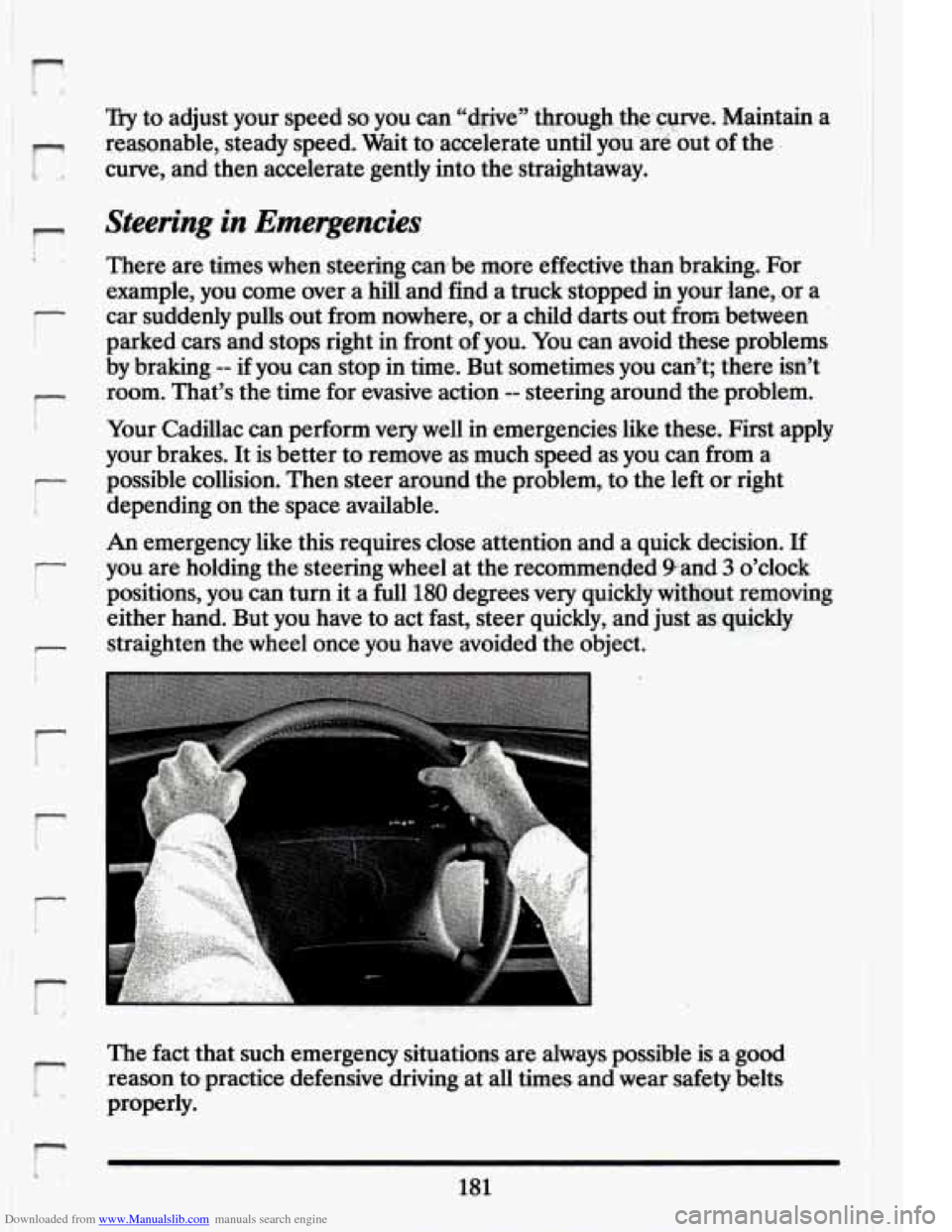
An emergency like this requires close attention and a quick decision. If
you. are holding the steering wheel’ at the recommended Pand-3’o’clock
positions, you can turn
it a full 180 degrees very quickly without removing
either hand. But you have to act fast, steer quickly, and just aslquickly
straighten the wheel once
you have avoided-:the object.
The fact that such emergency situations are always possible
is a.good
reason to practice defensive driving at all times. and wear safety belts
properly.
r c
181.
Page 209 of 398
Downloaded from www.Manualslib.com manuals search engine r
r_
r-
r-
r
r
.
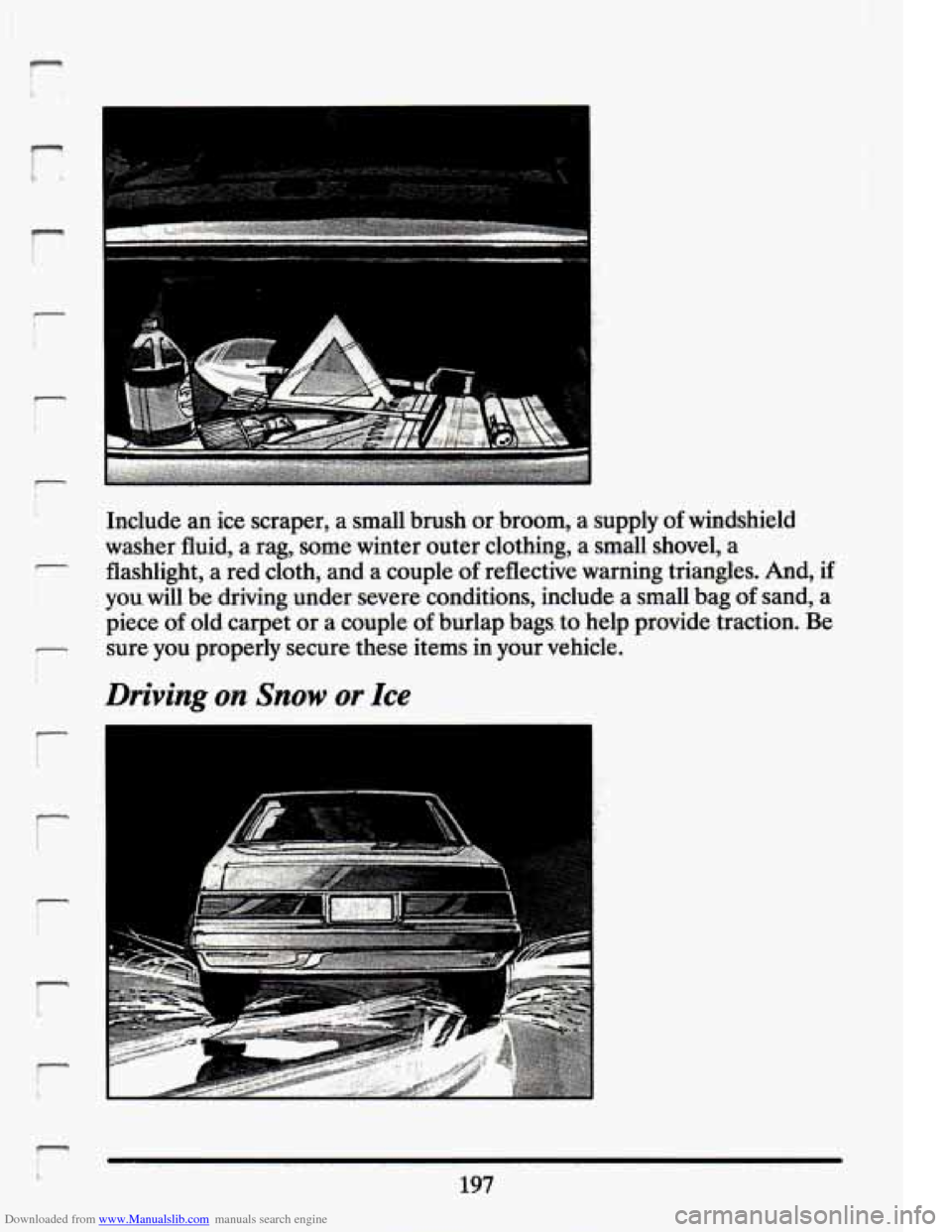
Include an ice scraper, a small brush or-broom, a supply of windshield
washer fluid,
a rag, some winter outer clothing, a small shovel, a
flashlight, a red cloth, and
a couple of reflective warning triangles. And, if
you will be driving under severe conditions, include a small bag of sand, a
piece
of old carpet or a couple of burlap bags, to help provide traction. Be
sure you properly secure these items in your vehicle..
Driving on Snow or Ice
r
Page 216 of 398
Downloaded from www.Manualslib.com manuals search engine NOTICE:
The bumpers on your vehicle are not intended for hitches. Do
not attach rental hitches or other bumper-type hitches to them.\
-
Safety Chains
You should always attach chains between your vehicle and your trailer.
Cross the safety chains under the tongue of the trailer
so that the tongue
will not drop to the road
if it becomes separated from the hitch. Follow
the manufacturer’s recommendation for attaching safety chains. Alwa\
ys
leave
just enough slack so you can turn with your rig. And, never allow
safety chains to drag on
the ground.
Trailer Brakes
Be sure to read and follow the instructions for the trailer brakes so you’ll -
be able to install, adjust and maintain them properly. L:
Driving with a Trailer
Towing a trailer requires a certain amount of experience. Before setting
out for the open road, you’ll want to get to know your rig. Acquaint
yourself with the feel of handling and braking with the added weight of
the trailer. And always keep in mind that the vehicle you are driving is
now a good deal longer and not nearly
so responsive as your vehicle is by
itself.
Before you start, check the trailer hitch and platform, safety chains,
electrical connector, lights, tires and mirror adjustment. If the trailer has
electric brakes, start your vehicle and trailer moving and then apply the
trailer brake controller by hand to be sure the brakes are working. This
lets you check your electrical connection at the same time.
During your trip, check occasionally to be sure that the load is secure,
and that the lights and any trailer brakes are still working.
204