Page 14 of 308
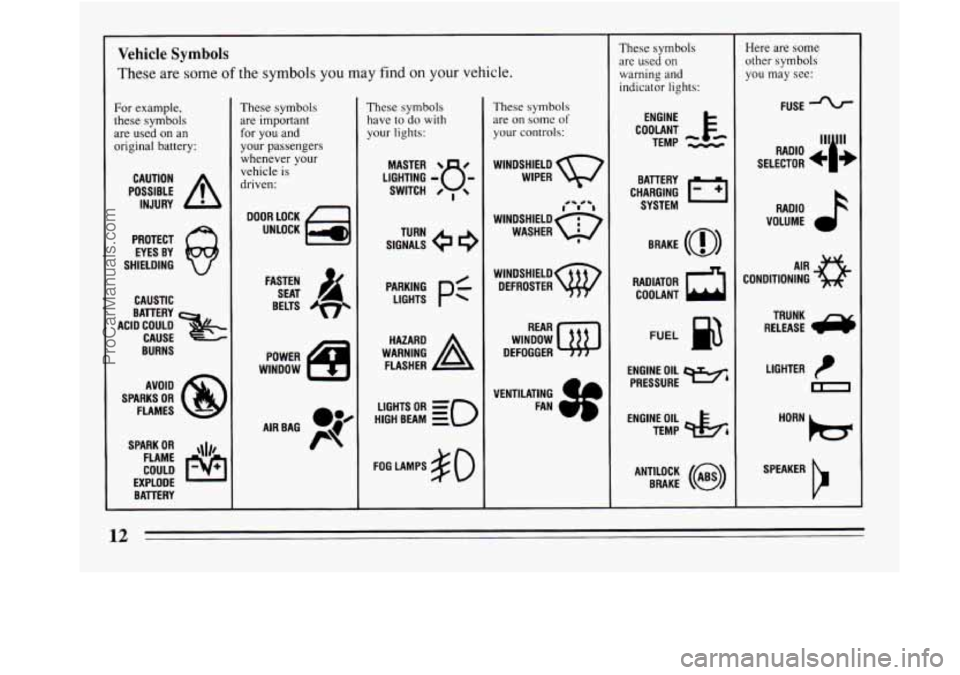
Vehicle Symbols
These are some of the symbols you may find on your vehicle.
For example,
these symbols
are used on an
original battery:
POSSIBLE A
CAUTION
INJURY
PROTECT EYES BY
SHIELDING
CAUSTIC
BURNS AVOID
SPARKS
OR
FLAMES
SPARK OR
,\I/,
FLAME
COULD
EXPLODE
BATTERY
These symbols
are important
for you and
your passengers
whenever your
vehicle is
driven:
DOOR LOCK
UNLOCK
FASTEN SEAT
4
BELTS
POWER
WINDOW
These symbols have
to do with
your lights:
SIGNALS e
TURN
WARNING
A
HAZARD
FLASHER
These symbols are on some
of
your controls:
WINDSHIELD WIPER Q7
WINDOW
DEFOGGER
VENTILATING FAN
HIGH BEAM
=
FOG LAMPS # 0
These symbols
are used
on
warning and
indicator lights:
CHARGING I-1
BATTERY
SYSTEM
RADIATOR COOLANT
FUEL
ENGINE OIL
PRESSURE
Wb
TEMP OIL &
ANTILOCK (a)
BRAKE
Here are some
other symbols
you may see:
FUSE
RADIO
>
VOLUME
CONDITIONING
AIR a
LIGHTER
m
SPEAKER
b
12
ProCarManuals.com
Page 123 of 308
Part 3 Comfort Controls and Audio Systems
In this part you’ll find out how to operate the comfort control systems and audio systems offered with your Buick . Be
sure to read about the particular system supplied with your vehicle .
Part 3 includes:
Comfort Control System ............................................................ 122
Heater
and Defroster ........................................................... 124
AirConditione
l- ............................................................... 123
Rear Window Defogger
........................................................ 125
Ventil~tio1.1 ................................................................... 124
AudioSystems
.................................................................... 125
Understanding Radio Reception
.................................................. 126
Setting the Clock
........................................................... 128.132
RadioControls
............................................................ 127. 131
Tape Player Controls ........................................................ 128. 132
CD Player Controls ............................................................ 129
Care 01’ Cassette Tape Player and Tapes ............................................ 125
Care
of Compact Discs ......................................................... 136
Antenna Care
...................................................... ........ 136
ProCarManuals.com
Page 125 of 308
Temperature Control conditioner’s compressor will have to do, which should
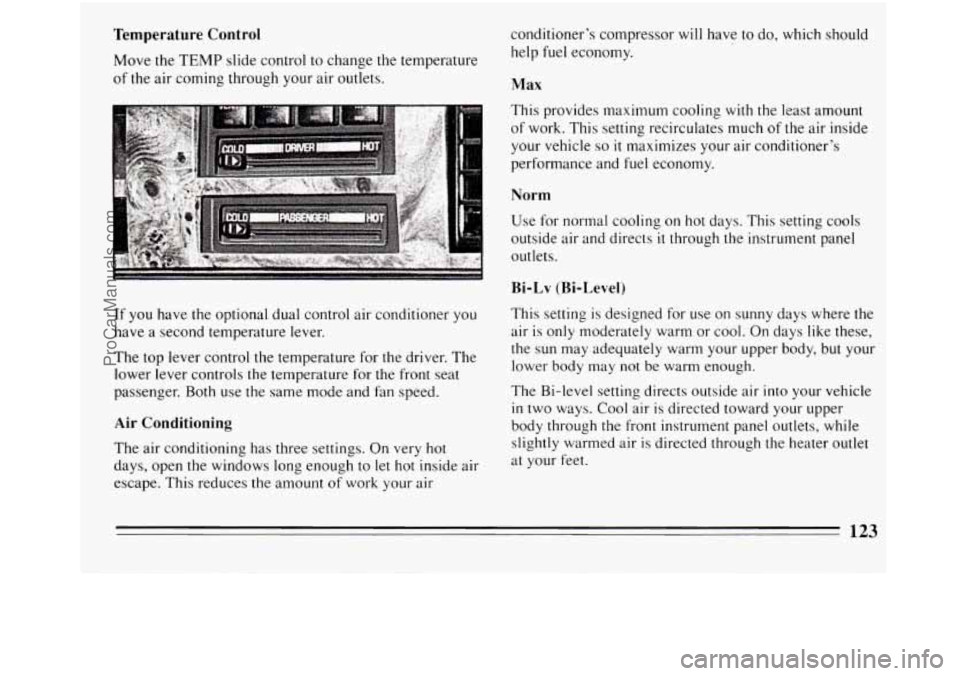
Move the TEMP slide control to change the temperature
of the air coming through your air outlets. Max
help fuel economy.
If you have the optional dual control air conditioner you
have a second temperature lever.
The top lever control the temperature for the driver. The
lower lever controls the temperature for the front seat
passenger. Both use the same mode and fan speed.
Air Conditioning
The air conditioning has three settings. On very hot
days, open
the windows long enough to let hot inside air
escape. This reduces the amount of work your
air
This provides maximum cooling with the least amount
of work. This setting recirculates much of the air inside
your vehicle
so it maximizes your air conditioner’s
performance and fuel economy.
Norm
Use for normal cooling on hot days. This setting cools
outside air and directs
it through the instrument panel
outlets.
Bi-Lv (Bi-Level)
This setting is designed for use on sunny days where the
air is only moderately warm or cool.
On days like these,
the sun may adequately warm your upper body, but your
lower body may not be warm enough.
The Bi-level setting directs outside air into your vehicle
in two ways. Cool air is directed toward your upper
body through the front instrument panel outlets, while
slightly warmed air is directed through the heater outlet
at your feet.
123
ProCarManuals.com
Page 126 of 308
The air conditioner compressor operates in all Air
Conditioning positions, and the Defrost position when
the outside temperature is above
40°F (4.5"C).
Ventilation
For mild outside temperatures, when little heating or
cooling is needed, press the
VENT button. Air will flow
through the instrument panel outlets. Use the air outlets
to turn on, adjust and turn off the air flow. Adjust the
TEMP lever to control the temperature.
Heating
When outside temperatures are cold, press the button
marked HTR and slide the
TEMP lever toward HOT to
send heated air through the floor outlets.
Defog
When your windshield is foggy, press the DEFOG
button to direct most of the air flow toward the
windshield. When it's
50°F (IOOC) or warmer, the
system will provide cooled air.
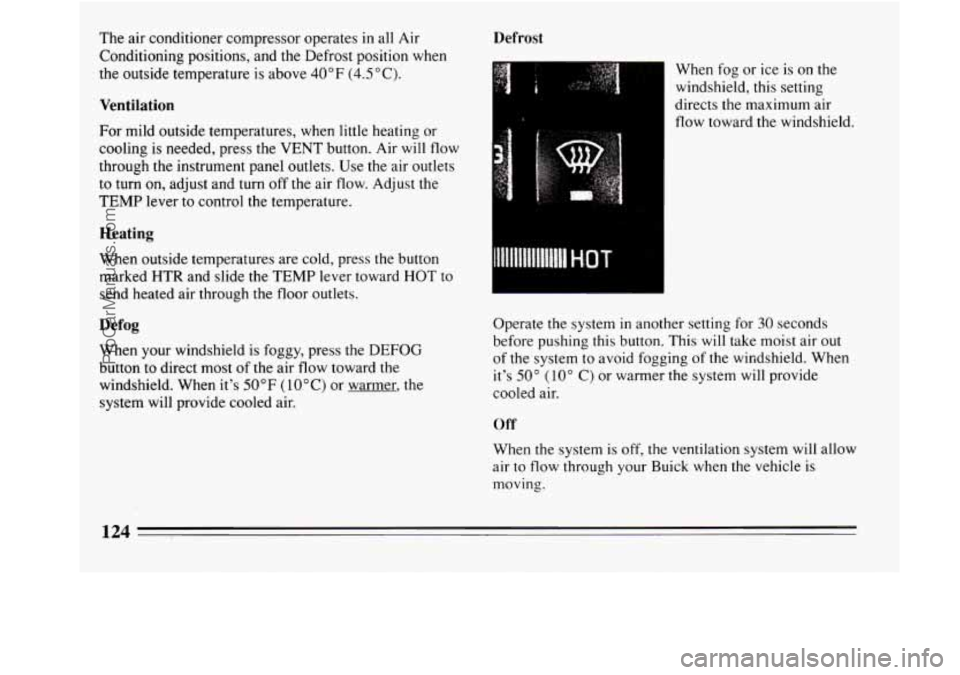
Defrost
. When fog or ice is on the
windshield, this setting
directs the maximum air
flow toward the windshield.
Operate the system
in another setting for 30 seconds
before pushing this button. This
will take moist air out
of the system to avoid fogging
of the windshield. When
it's 50" (10" C) or warmer the system will provide
cooled air.
Off
When the system is off, the ventilation system will allow
air to flow through your Buick when the vehicle is
moving.
124
ProCarManuals.com
Page 190 of 308
If you get the overheat warning with no sign of steam,
try this for a minute or
so:
1. Turn off your air conditioner.
2. Turn on your heater to full hot at the highest fan
speed and open the window as necessary.
3. Try to keep your engine under load (in a drive gear
where the engine runs slower).
If
you no longer have the overheat warning, you can drive.
Just to be safe, drive slower for about
ten minutes. If the
warning doesn’t come back on,
you can drive normally.
If the warning continues, pull over, stop, and park your
vehicle right away.
If there’s still no sign of steam, you can idle the engine
for two or three minutes while you’re parked, to see if the
warning stops. But then, if you still have the warning,
TURN OFF THE ENGINE AND GET EVERYONE
OUT OF THE VEHICLE until it cools down.
You may decide not
to lift the hood but to get service
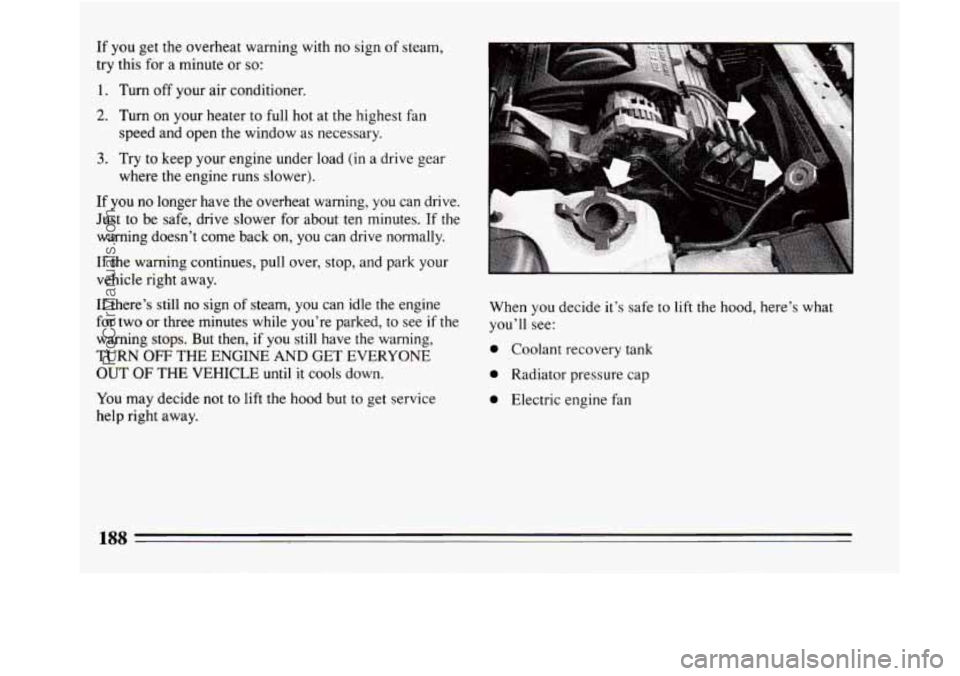
help right away. When you
decide it’s safe to lift
the hood, here’s what
you’ll see:
0 Coolant recovery tank
0 Radiator pressure cap
0 Electric engine fan
ProCarManuals.com
Page 244 of 308
Wheel Replacement
Replace any wheel that is bent, cracked or badly rusted.
If wheel nuts keep coming loose, the wheel, wheel bolts,
and wheel nuts should be replaced. If the wheel leaks
air, replace
it (except some aluminum wheels, which can
sometimes be repaired). See your Buick dealer
if any of
these conditions exist.
Your dealer will know the kind of wheel you need.
Each new wheel should have the same load carrying
capacity, diameter, width, offset, and be mounted the
same way as the one it replaces.
If you need to replace any of your wheels, wheel bolts,
or wheel nuts, replace them only with new
GM original
equipment parts. This way, you will be sure
to have the
right wheel, wheel bolts, and wheel nuts for your Buick
model. NOTICE:
The wrong wheel can also cause problems with
bearing life, brake cooling,
speedometer/odometer calibration, headlight
aim, bumper height, vehicle ground clearance,
and tire or tire chain clearance to the body and
chassis.
242
ProCarManuals.com
Page 253 of 308
Fiberglass Springs
NOTICE:
Don’t use corrosive or acidic cleaning agents,
engine degreasers, aluminum cleaning agents or
other harsh solvents to clean fiberglass springs;
they’ll damage the springs.
Chemical Paint Spotting
Some weather and atmospheric conditions can create a
chemical fallout. Airborne pollutants can fall upon and
attack painted surfaces on your vehicle. This damage
can take two forms: blotchy, ringlet-shaped
discolorations, and small irregular dark spots etched into
the paint surface.
Although no defect
in the paint job causes this, Buick
will repair,
at no charge to the owner, the surfaces of
new vehicles damaged by this fallout condition within
12 months or 12,000 miles (20 000 km) of purchase,
whichever comes first.
251
ProCarManuals.com
Page 258 of 308
30
30
30
20
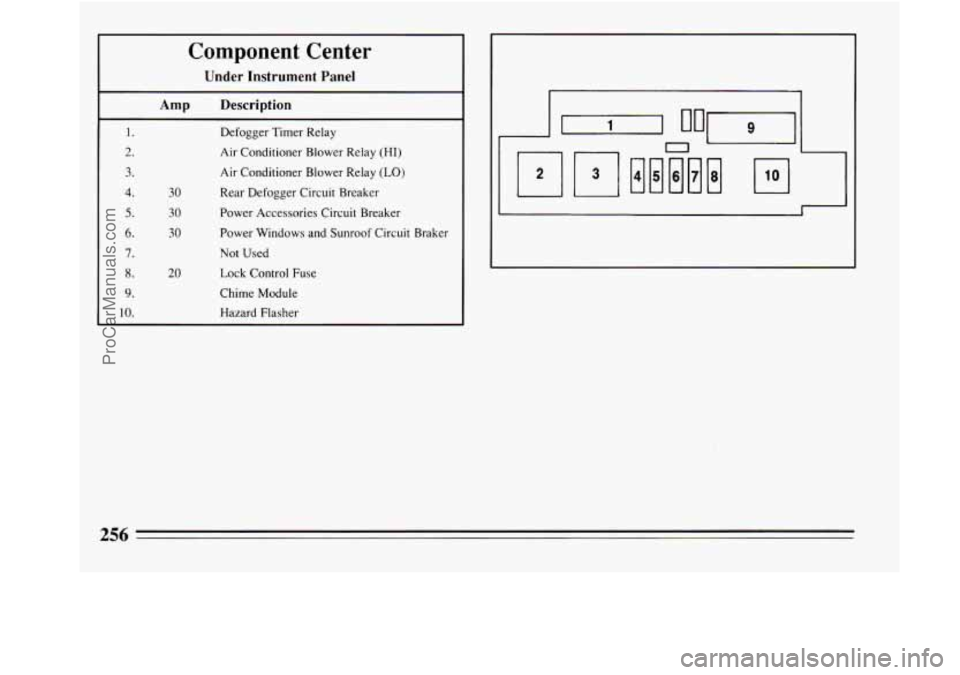
Component Center
Under Instrument Panel
Amp Description
1. Defogger Timer Relay
2. Air Conditioner Blower Relay (HI)
3. Air Conditioner Blower Relay (LO)
4. Rear Defogger Circuit Breaker
5. Power Accessories Circuit Breaker
6. Power Windows and Sunroof Circuit Braker
7. Not Used
8. Lock Control Fuse
9. Chime Module
10. Hazard Flasher
.r
I I
256
ProCarManuals.com