Page 203 of 308
~ NOTICE:
Raising your
vehicle with the jack improperly
positioned
will damage the vehicle or may allow
the vehicle to fall off the jack. Be sure to
fit the
jack lift head into the proper location before
raising your vehicle.
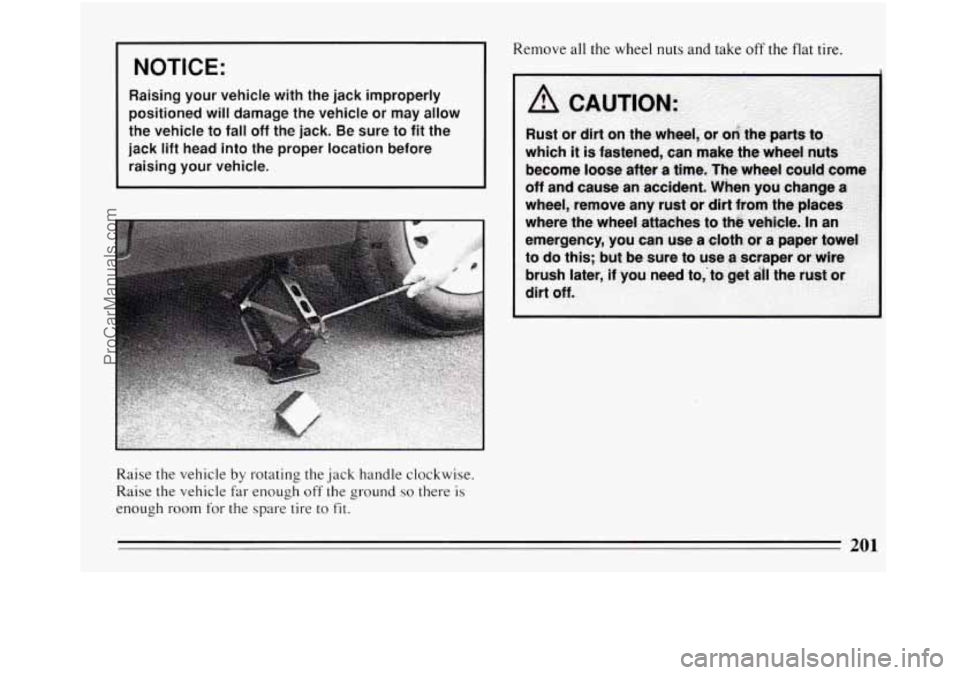
Raise the vehicle by rotating the jack handle clockwise.
Raise the vehicle far enough
off the ground so there is
enough room for the spare tire to fit.
Remove all the wheel nuts and take off the flat tire.
201
ProCarManuals.com
Page 205 of 308
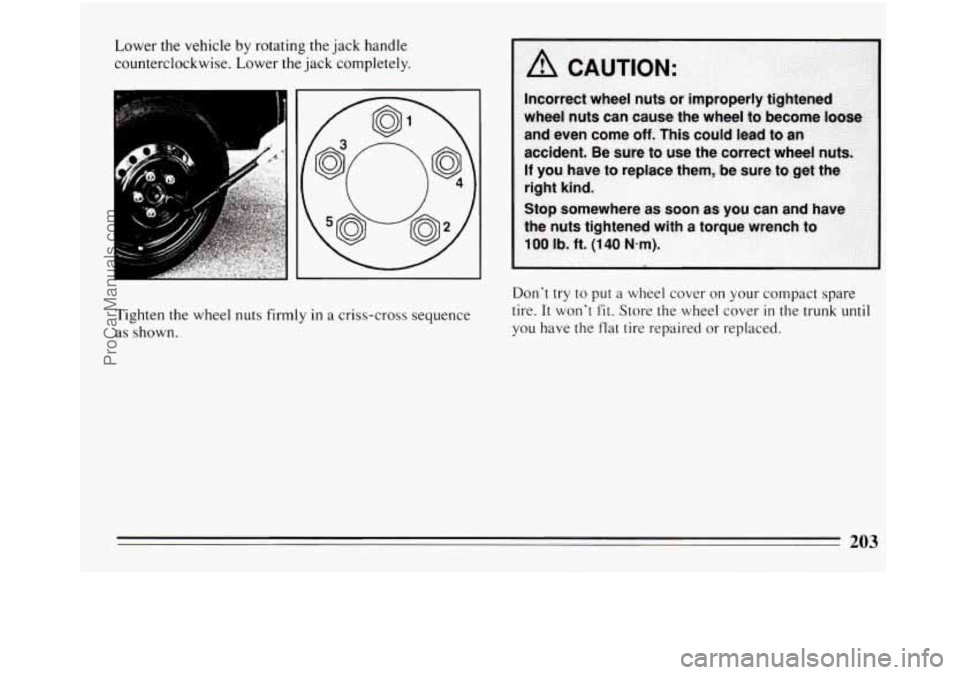
Lower the vehicle by rotating the jack handle
counterclockwise. Lower the jack completely.
Tighten the wheel nuts firmly
in a criss-cross sequence
as shown. Don’t
try to put a wheel
cover on your compact spare
tire. It won’t
fit. Store the wheel cover in the trunk until
you have the flat tire repaired or replaced.
203
ProCarManuals.com
Page 207 of 308
I NOTICE:
Compact Spare Tire
Although the compact spare was fully inflated when
your vehicle was new,
it can lose air after a time. Check
the inflation pressure regularly. It should be
60 psi (420
kPa). After installing the compact spare on your vehicle,
you should stop as soon as possible and make sure your
spare tire is correctly inflated. The compact spare
is
made to perform well at posted speed limits for
distances
up to 3,000 miles (5 000 km). The compact
spare is made to
go up to 3,000 miles (5 000 km), so you
can finish your trip and have
your full-size tire repaired
or replaced where you want. Of course, it’s best to
replace your spare with a full-size tire
as soon as you
can. Your spare will last longer and be
in good shape in
case you need it again.
Don’t take your compact spare through an
automatic car wash with guide rails. The
compact spare can get caught on the rails. That
can damage the tire and wheel, and maybe other
parts
of your vehicle.
Don’t use your compact spare on some other vehicle.
And don’t mix your compact spare or wheel with other
wheels or tires. They won’t fit. Keep your spare and its
wheel together.
NOTICE:
Tire chains won’t fit your compact spare. Using
them will damage your vehicle and destroy the
chains too. Don’t use tire chains on your
compact spare.
205
ProCarManuals.com
Page 236 of 308
4. Pull the bulb straight out to remove it from its
socket. The new bulb
must be aligned properly, then
push
it in the socket. Reinstall the socket, taillight,
and rear
trunk trim.
Loading Your Vehicle
TIRE-LOADING INFORMATION
OCCUPANTS VEHICLE CAP. WT.
FRT. CTR.
RR. TOTAL LBS. KG
MAX. LOADING & GVWR SAME AS VEHICLE
CAPACITY WEIGHT XXX COLD TIRE
TIRE
SIZE SPEED PRESSURE
RTG
PSI/KPa
FRT.
RR.
SPA.
IF TIRES ARE HOT, ADD 4PS1/28KPa
SEE OWNER'S MANUAL FOR ADDITIONAL
, INFORMATION IlJ@#@i
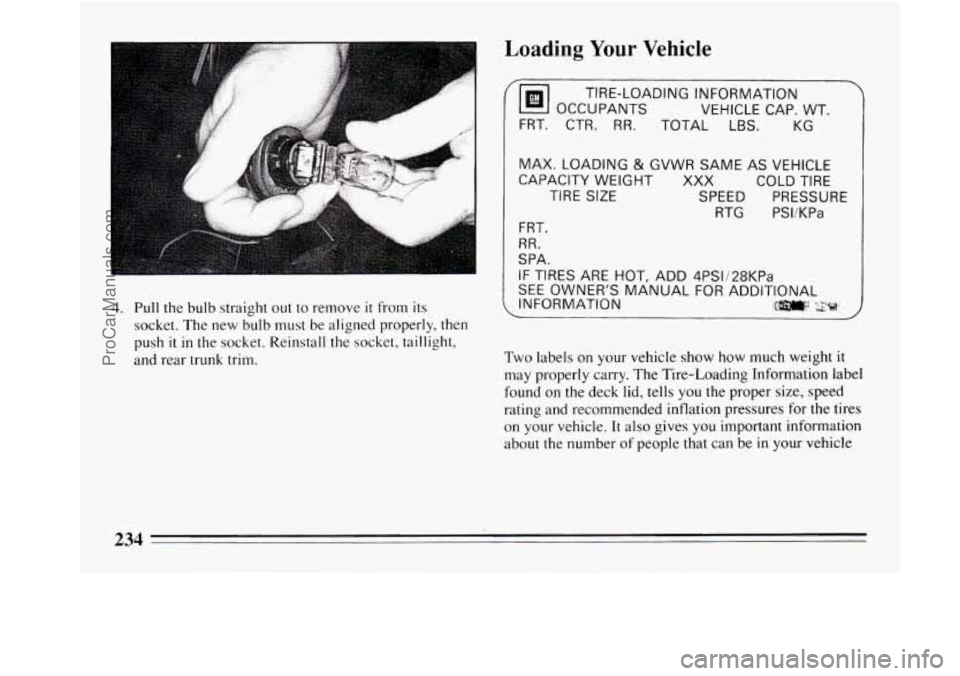
Two labels on your vehicle show how much weight it
may properly carry. The Tire-Loading Information label
found on the deck lid, tells you the proper size, speed
rating and recommended inflation pressures for the tires
on your vehicle. It also gives you important information
about the number of people that can be in your vehicle
234
ProCarManuals.com
Page 239 of 308
Inflation - Tire Pressure
The Tire-Loading Information label which is on the deck lid
shows the correct inflation pressures for your tires, when
they’re cold. “Cold” means your vehicle has been sitting for
at least three hours or driven no more than a mile.
NOTICE:
Don’t let anyone tell you that underinflation or
overinflation is all right. It’s not. If your tires don’t
have enough air (underinflation) you can get:
0 Too much flexing
Too much heat
Tire overloading
Bad wear
0 Bad handling
Bad fuel economy.
If your tires have too much air (overinflation),
you can get:
Unusual wear
0 Bad handling
0 Rough ride
Needless damage from road hazards.
When to Check
Check your tires once a month or more.
Don’t forget your compact spare tire. It should be at
60
psi (420 kPa).
How to Check
Use a good quality pocket-type gage to check tire
pressure. Simply looking at the tires will not tell
you the
pressure, especially
if you have radial tires -- which
may look properly inflated even
if they’re underinflated.
If your tires have valve caps, be sure to put them back
on. They help prevent leaks by keeping out dirt and
moisture.
237
ProCarManuals.com
Page 240 of 308
Tire Inspection and Rotation
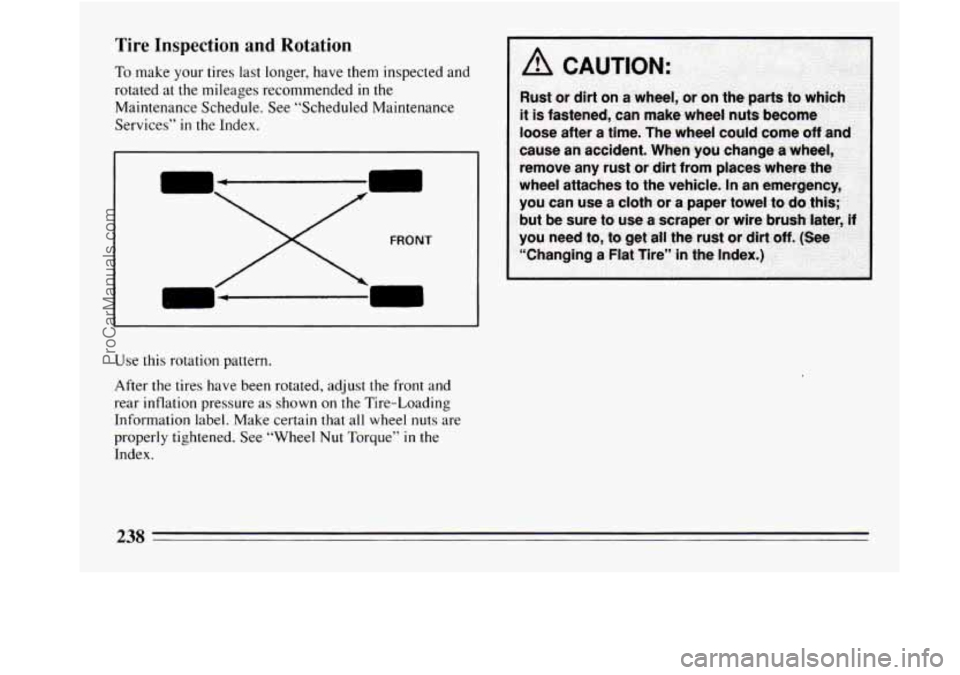
To make your tires last longer, have them inspected and
rotated at the mileages recommended
in the
Maintenance Schedule. See “Scheduled Maintenance
Services”
in the Index.
FRONT
Use this rotation pattern.
After the tires have been rotated, adjust the front and
rear inflation pressure as shown
on the Tire-Loading
Information label. Make certain that all wheel nuts are
properly tightened. See “Wheel Nut Torque”
in the
Index.
238
ProCarManuals.com
Page 243 of 308
Temperature - A, B, C
The temperature grades are A (the highest), B, and C,
representing the tire’s resistance to the generation of
heat and its ability
to dissipate heat when tested under
controlled conditions on a specified indoor laboratory
test wheel. Sustained high temperature can cause the
material of the tire
to degenerate and reduce tire life, and
excessive temperature can lead to sudden tire failure.
The grade
C corresponds to a level of performance
which all passenger car tires must meet under the
Federal Motor Vehicle Safety Standard
No. 109. Grades
B and A represent higher levels of performance on the
laboratory test
wheel than the minimum required by law.
Warning: The temperature grade for this tire is
established for a tire that is properly inflated and not
overloaded. Excessive speed, underinflation, or
excessive loading, either separately or
in combination,
can cause heat buildup and possible tire failure.
These grades are molded on
the sidewalls of passenger
car tires. While the tires
available as standard or optional
equipment
on General Motors vehicles may vary with
respect to these grades, all such tires meet General
Motors performance standards and have been approved
for use on General Motors vehicles. All passenger type
(P Metric) tires must conform to Federal safety
requirements
in addition to these grades.
Wheel Alignment and Tire Balance
The wheels on your vehicle were aligned and balanced
carefully at the factory to give you the longest tire life
and best overall performance.
In most cases, you will not need to have your wheels
aligned again. However,
if you notice unusual tire wear
or your vehicle pulling one way or the other, the
alignment may need to be reset. If you notice your
vehicle vibrating when driving on a smooth road, your
wheels may need to be rebalanced.
241
ProCarManuals.com
Page 267 of 308
Your Vehicle and the Environment
Proper vehicle maintenance not only helps to keep your
vehicle
in good working condition, but also helps the
environment. All recommended maintenance procedures
are important. Improper vehicle maintenance or the
removal
of important components can sigHificantly
affect the quality
of the air we breathe. Improper fluid
levels or
even the wrong tire inflation can increase the
level of emissions from your vehicle.
To help protect
our environment, and
to help keep your vehicle in good
condition, please maintain your vehicle properly.
How This Part is Organized
The remainder of this part is divided into five sections:
“Section
A: Scheduled Maintenance Services” shows
what to have done and how often. Some of these
services can be complex,
so unless you are technically
qualified and have
the necessary equipment, you should
let your dealer’s service department or another qualified
service center do these jobs. If you
are skilled enough to do some work on your
vehicle,
you will probably want to get the service
information
GM publishes. You will find a list of
publications and how to get them in this manual. See
“Service Publications”
in the Index.
“Section B: Owner Checks and Services” tells you what
should be checked whenever you stop for fuel.
It also
explains what you can easily do to help keep your
vehicle
in good condition.
“Section C: Periodic Maintenance Inspections” explains important inspections that your Buick dealer’s service
department or another qualified service center should perform.
265
ProCarManuals.com