Page 197 of 324
Part 5 Problems on the Road
Here you’ll find what to do about some problems that can occur on the road .
Part 5 includes:
Hazard Warning Flashers .................................................. ....
Other Wa-ning Devices ........................................ ...............
“Jump”Starting ...................................................................
TowingYourBuick ................................................................
Engineoverheating ................................................................
IfaTireGoesFlat .................................................................
ChangingaFlatTire ................................................................
Compact Spare Tire .................................................................
If You’re Stuck in Sand, Mud, Ice or Snow ..............................................
196
197
198
203
207
214
215
224
225
195
ProCarManuals.com
Page 205 of 324
Towing Your Park Avenue
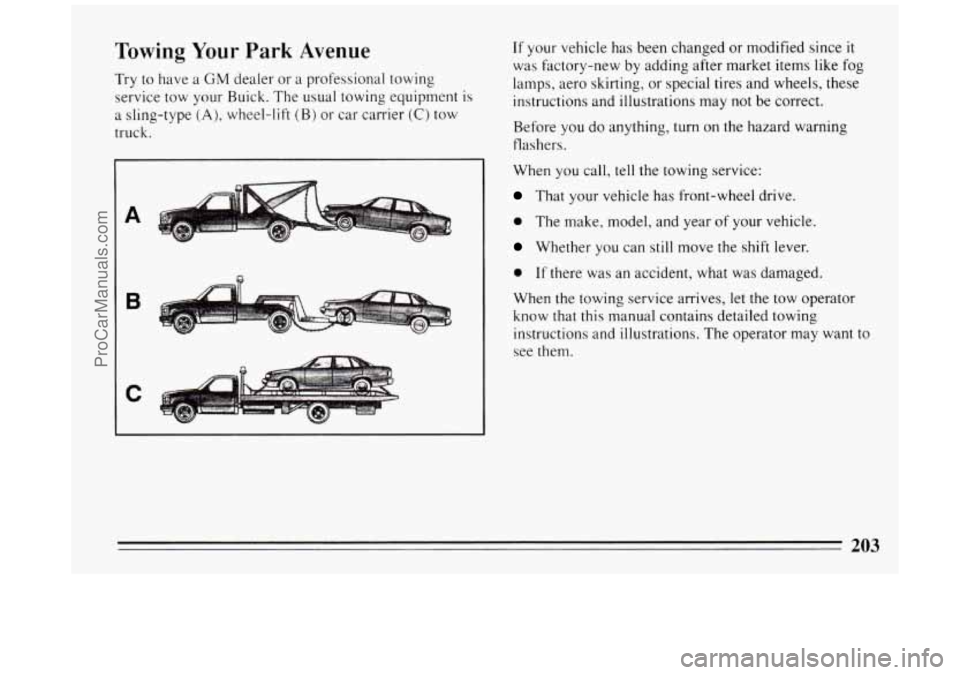
Try to have a GM dealer or a professional towing
service tow your Buick. The usual towing equipment is
a sling-type
(A), wheel-lift (B) or car carrier (C) tow
truck.
B
C
If your vehicle has been changed or modified since it
was factory-new by adding after market items like fog
lamps, aero skirting, or special tires and wheels, these
instructions and illustrations may not be correct.
Before you do anything, turn on the hazard warning
flashers.
When you call, tell the towing service:
That your vehicle has front-wheel drive.
0 The make, model, and year of your vehicle.
Whether you can still move the shift lever.
0 If there was an accident, what was damaged.
When the towing service arrives, let the tow operator
know that this manual contains detailed towing
instructions and illustrations. The operator may want to
see them.
203
ProCarManuals.com
Page 206 of 324
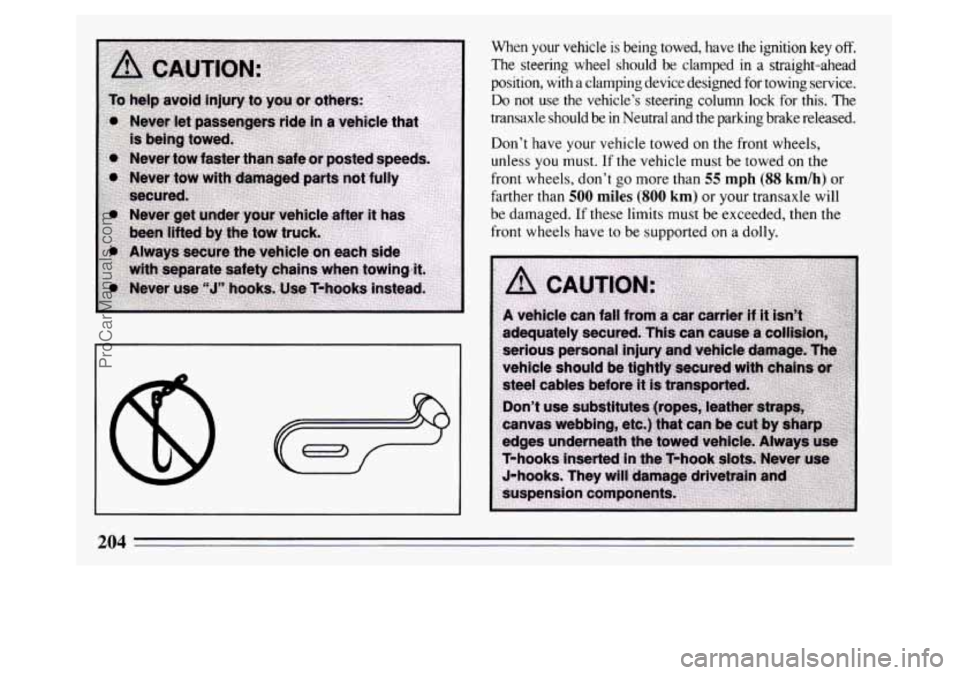
When your vehicle is being towed, have the ignition key off.
The steering wheel should be clamped in a straight-ahead
position, with
a clamping device designed for towing service.
Do not use the vehicle’s steering column lock for this. The
transaxle should be
in Neutral and the parking brake released.
Don’t have your vehicle towed on the front wheels,
unless you must.
If the vehicle must be towed on the
front wheels, don’t go more than
55 mph (88 km/h) or
farther than
500 miles (800 km) or your transaxle will
be damaged. If these limits must be exceeded, then the
front wheels have
to be supported on a dolly.
ProCarManuals.com
Page 207 of 324
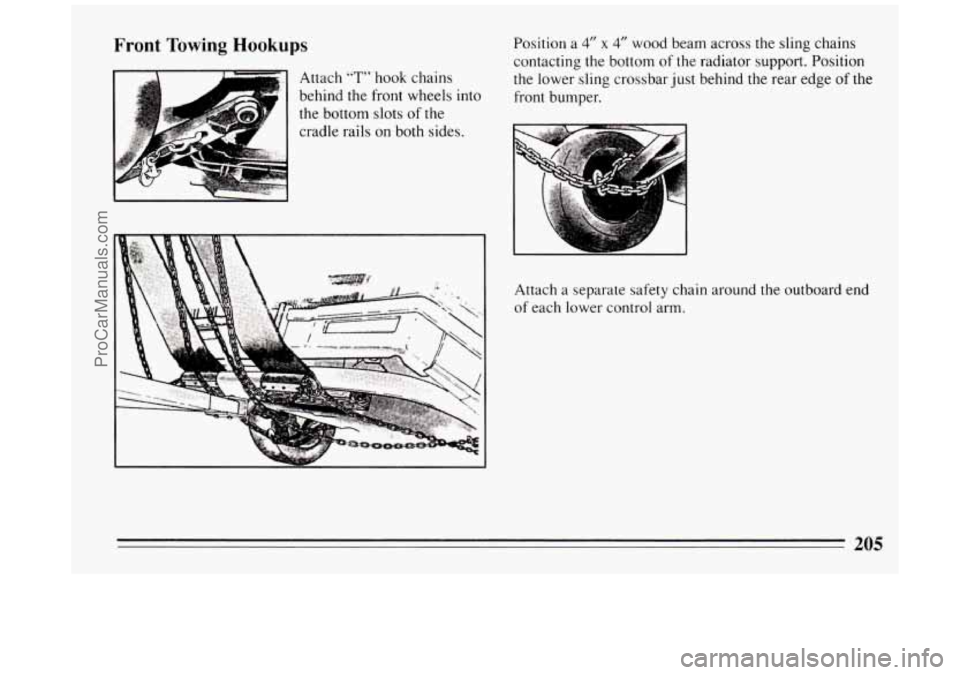
Front Towing Hookups
Attach “T” hook chains
behind the front wheels into
the bottom slots
of the
cradle
rails on both sides. Position
a
4” x 4” wood beam across the sling chains
contacting the bottom of the radiator
support. Position
the lower sling crossbar just behind the rear edge of the
front bumper.
Attach a separate safety chain around
the outboard end
of each lower control arm.
205
ProCarManuals.com
Page 208 of 324
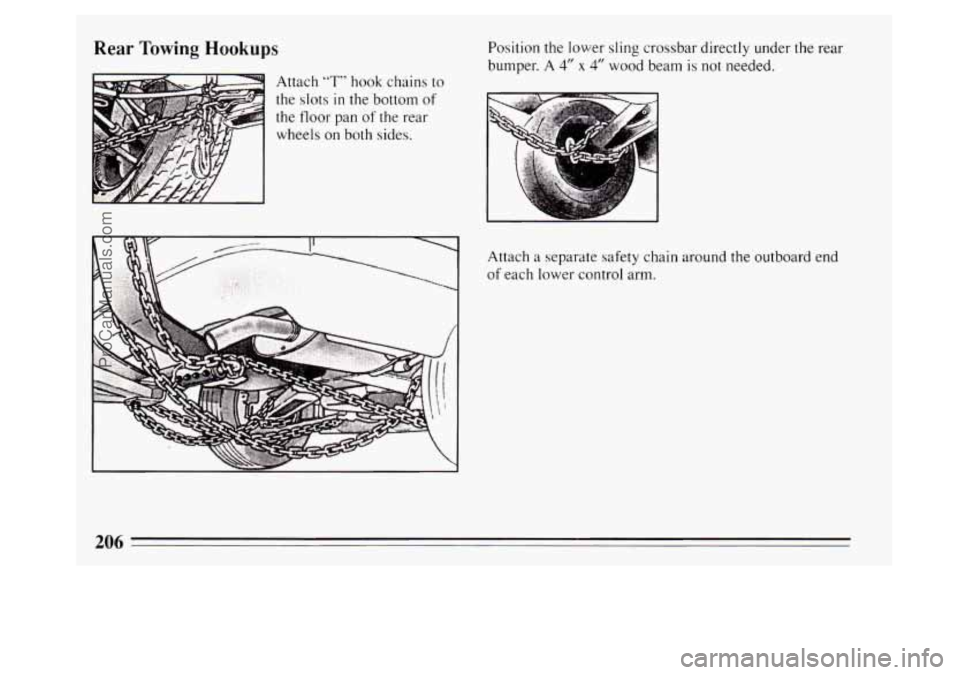
Rear Towing Hookups
Attach “T” hook chains to
the slots in the bottom of
the floor pan
of the rear
wheels
on both sides. Position the
lower sling crossbar directly under the rear
bumper. A
4” x 4” wood beam is not needed.
Attach
a separate safety chain around the outboard end
of each lower control arm.
206
ProCarManuals.com
Page 209 of 324
Engine Overheating
You will find a warning light about a hot engine on your
Buick instrument panel and if you have the optional
gage cluster, a coolant temperature gage. You will also
find a low coolant warning light.
If Steam Is Coming From Your Engine
NOTICE:
If your engine catches fire because you keep
driving with no coolant, your vehicle can be
badly damaged. The costly repairs would not be
covered by your warranty.
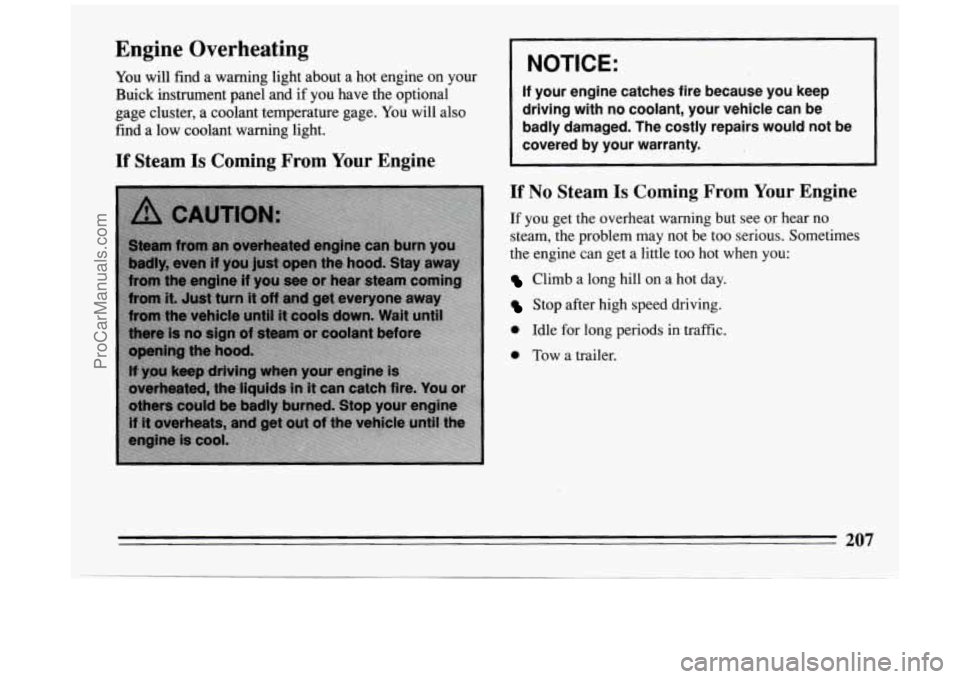
If NO Steam Is Coming From Your Engine
If you get the overheat warning but see or hear no
steam, the problem may not be too serious. Sometimes
the engine can get a little too hot when you:
Climb a long hill on a hot day.
Stop after high speed driving.
0 Idle for long periods in traffic.
0 Tow a trailer.
207
ProCarManuals.com
Page 216 of 324
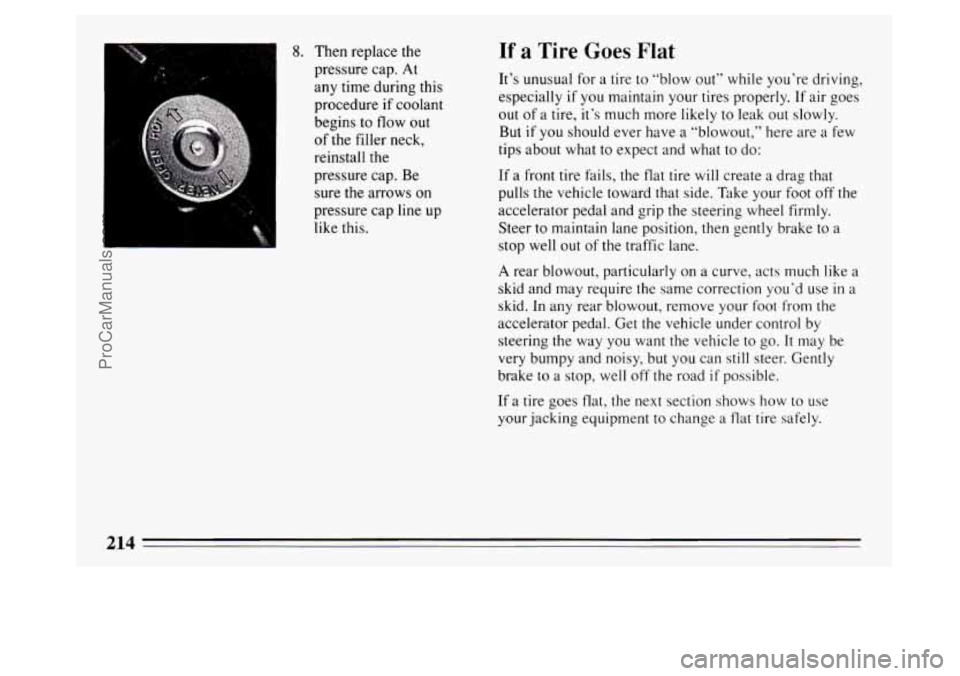
8. Then replace the
pressure cap. At
any time during this
procedure
if coolant
begins to
flow out
of the filler neck,
reinstall the
pressure cap. Be
sure the arrows on
pressure cap line up
like this.
If a Tire Goes Flat
It’s unusual for a tire to “blow out” while you’re driving,
especially
if you maintain your tires properly. If air goes
out of
a tire, it’s much more likely to leak out slowly.
But
if you should ever have a “blowout,” here are a few
tips about what to expect and what to do:
If a front tire fails, the flat tire will create
a drag that
pulls the vehicle toward that side. Take your foot
off the
accelerator pedal and grip the steering wheel firmly.
Steer to maintain lane position, then gently brake to a
stop well out of the traffic lane.
A rear blowout, particularly on a curve, acts much like a
skid and may require the same correction you’d use in a
skid. In any rear blowout, remove your foot from the
accelerator pedal. Get the vehicle under control by
steering the way you want the vehicle to
go. It may be
very bumpy and noisy, but you can still steer. Gently
brake to a stop, well
off the road if possible.
If a tire goes flat, the next section shows how to use
your jacking equipment to change
a flat tire safely.
214
ProCarManuals.com
Page 224 of 324
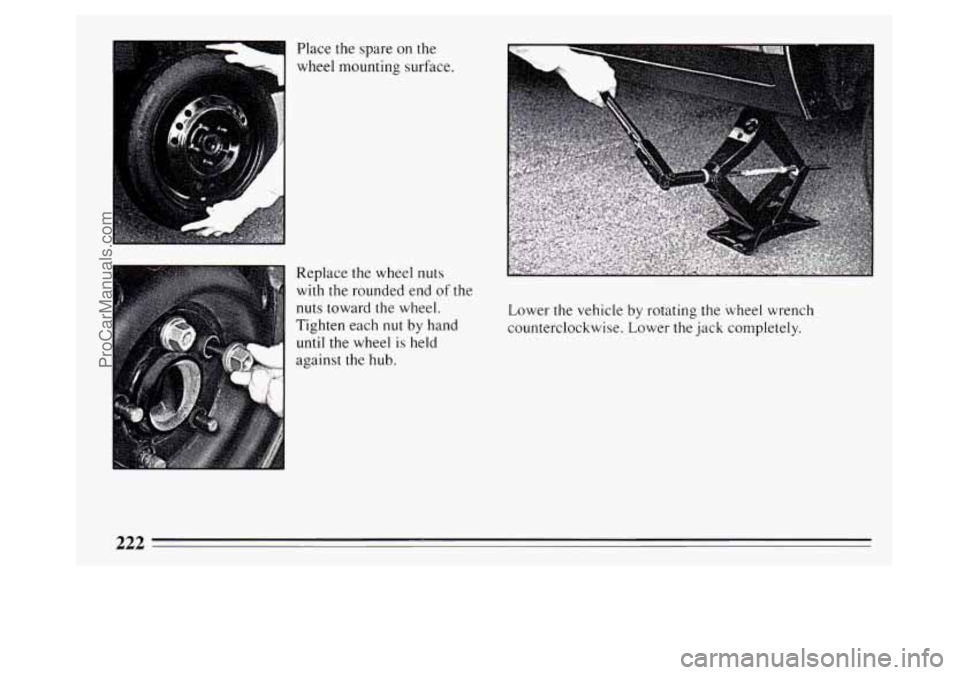
Place the spare on the
wheel mounting surface.
Replace the wheel nuts
with the rounded end
of the
nuts toward the wheel.
Tighten each
nut by hand
until the wheel is held
against the hub. Lower
the vehicle by rotating the wheel wrench
counterclockwise. Lower the jack completely.
222
ProCarManuals.com